Table of Contents
TL;DR,
- The Africa Stablecoin Summit 2025 revealed that stablecoins represent 43% of Africa’s crypto trading volume, with over $300 billion in annual transactions flowing through African markets.
- Momentum is shifting from pilots to policy—licensing, AML/CFT, and interoperable rails like PAPSS are central to unlocking faster, cheaper cross‑border payments.
- Debate intensifies over global vs. local stablecoins: USDT/USDC hedge inflation while CNGN, CKES, and ZAR drive utility; Nigeria’s ISA 2025 emerges as a regulatory blueprint.
Stablecoins have become Africa’s new buzzword. Exchanges, startups, firms, and businesses are rushing to incorporate global and local stablecoins to simply be part of the movement. At the Africa Stablecoins Summit 2025, over 300 financial leaders, central bankers, and blockchain innovators converged in Johannesburg.
Each unified under a single banner, “Harnessing Stablecoins for Africa’s Economic Resilience.” The data (43% of Africa’s crypto trading volume is stablecoins) backs the movements, and the conference had unique insights.
Global blockchain leaders like Binance, Tether, VISA, and Telcoin; delegates from alongside delegates from the United Nations, the International Monetary Fund (IMF), and the Pan-African Payment and Settlement System (PAPSS); central bank officials and regulators from Kenya, Ghana, Nigeria, Uganda, Zambia, and South Africa; and local startups like Kotani Pay and BlockRadar each had a stake.
The Numbers Tell a Story of Rapid Transformation
Initially we all thought crypto would be the go-to medium; however, it was stablecoins that ended up taking the larger share. Stablecoins in Africa represent a fundamental shift and a realized dream of hedging against inflation, accessing better markets, and offering better and cheaper transaction costs.
Nigeria, the continent’s largest stablecoin market, recorded nearly USD 22 billion in transactions between July 2023 and June 2024. To put that in perspective, the Center for Global Development noted that international stablecoin flows represented about 6.7% of GDP in Africa and the Middle East in 2024. With over USD 300 billion in stablecoin transactions estimated to flow through African markets annually, dismissing this as a passing trend would be shortsighted.
At the Africa Stablecoin Summit 2024, central bank officials, international organizations, private sectors, blockchain titans, and local facilitators all met under this single truth: stablecoins are transforming Africa’s financial sector. As Africa stablecoin adoption accelerates, the conversation is shifting from experimentation to policy, compliance, and interoperability.
How Stablecoins Solve Currency Volatility
At first the entire conversation of stablecoins focused primarily on “How stablecoins solve currency volatility.” USDT, USDC, and PYUSD are a game changer for local firms, freelancers, and startups, offering a hedge against natively dramatic swings in value.
The “Stablecoins at Work” panel showcased practical deployment scenarios across fintech, trade finance, and small-to-medium enterprise operations.
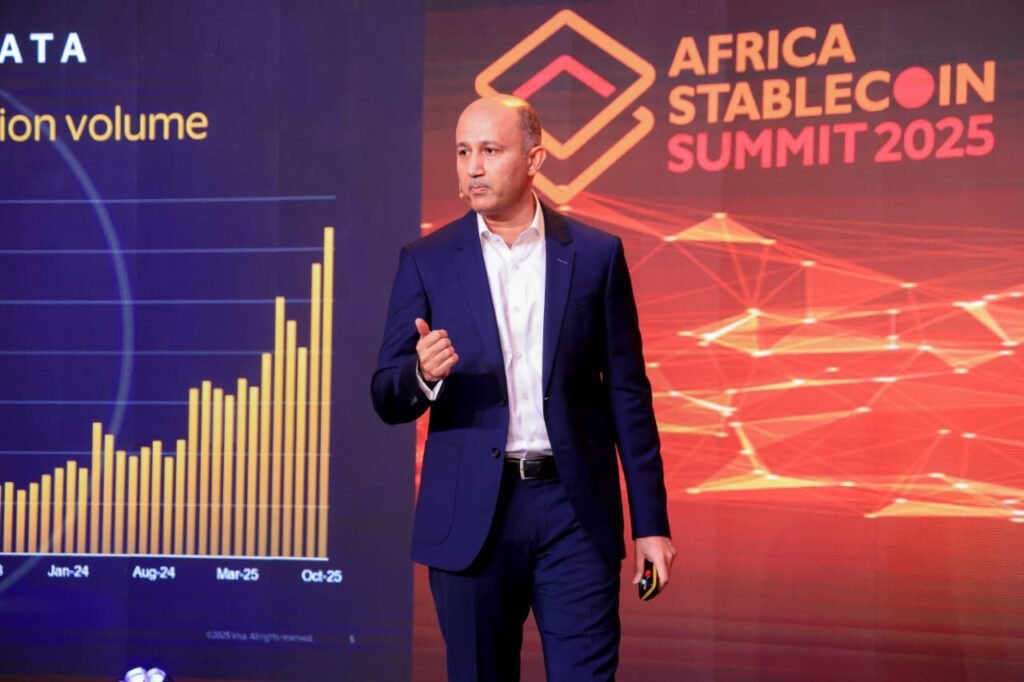
Shahebaz Khan (Senior Vice President, Head of Commercial and Money Movement Solutions, VISA CEMEA). [Photo: AFS]
“As money itself evolves, we’re extending that same trusted infrastructure to the next frontier: stablecoins. By pairing stablecoins with Visa’s world-class technology stack, we see tremendous potential to modernize global money movement—making payments faster, more accessible, and more secure for everyone.”
Even mobile money is transforming, with many local operators taking a chance at stablecoin. At the talk, Telcoin CEO Paul Neuner captured the telecom vantage.
The promise of stablecoin and what that could really mean to telecom—it is a message that we’ve been preaching for a long time, which is the internet of money, where there’s just stablecoin floating and directly transacting from consumer to merchant.
Given Africa’s increased mobile penetration and reliance on mobile money, the next step is to provide a cheaper alternative to 7% transaction fees.
What would a pan‑African stablecoin regulatory framework require?
The next step to adopting stablecoins in Africa is regulation, the fear of most firms, and the mountain of most regulators. Cryptocurrency is one thing, but forging a pan-African stablecoin regulatory framework is a complex undertaking requiring drawing a line between traditional law and blockchain law.
The summits of The Regulators’ Roundtable focused on a continent‑wide approach to licensing, supervision, and AML/CFT. Nigeria currently holds a head start with its ISA 2025 law, which generally formulates Africa’s first stablecoin oversight. The law mandates registration, auditing, and anti-money laundering compliance while simultaneously establishing a regulatory sandbox to encourage innovation.

Larry Cooke (Africa Head of Legal, Binance).
The ISA is an ideal stablecoin regulatory framework since it strives to strike the perfect balance between innovation and security. However, while global-backed stablecoins are one aspect, the question comes into local stablecoins. Currently, CNGN, CKES, and ZAR stablecoins have gained traction within the year. The case here is more about utility than value retention, but would existing regulations govern distribution fairly?
The Interoperability Imperative Connecting Africa’s Digital Wallets
A critical Town Hall Session titled “Charting the Road to Scale—From Fragmentation to Pan-African Rails” addressed perhaps the most persistent challenge: moving beyond fragmented national payment systems toward continent-wide interoperable infrastructure. Currently, cross-border transactions within Africa often route through foreign intermediaries, adding costs and delays that make intra-African trade unnecessarily expensive.
The Pan-African Payment and Settlement System (PAPSS) and its African Currency Marketplace, launched in June 2025 on the Bantu blockchain network, exemplify efforts to enable real-time settlements in African currencies without foreign intermediaries. When combined with how stablecoins solve currency volatility by providing neutral settlement assets, these systems could dramatically reduce transaction costs for remittances and trade.
Larry Cooke, Africa Head of Legal at Binance, stated
“Stablecoins are more than a technological innovation—they are a pathway to inclusive, cross-border financial systems that can empower businesses and individuals across Africa. At Binance, we are committed to fostering responsible innovation, collaborating with regulators, and investing in solutions that enable Africans to participate fully in the digital economy.”
The Africa Stablecoin Summit 2025
When focusing on stablecoins in Africa, there is a debate on utility, regulations, and payment rails. The summit concluded by identifying these key factors while featuring some of Africa’s stablecoin powerhouses like Kotani Pay.
While USDT and USDC are the powerhouses of hedging against inflation, local stablecoins should also become a concern. The over-reliance on global stablecoins tips the financial scale to one side (or rather one superpower), causing issues in terms of value for local fiat. Can Africa focus more on local utility than value, or will we succumb to the circular nature of the monetary system as usual?