
Table of Contents
TL;DR,
- MTN MoMo generated $91.64 million (₦131.62 billion) in nine months, but 63% came from airtime lending, highlighting a need to diversify its core mobile money services.
- While telcos are losing the mobile money race to nimbler fintechs like OPay and PalmPay, MTN is recalibrating its strategy by focusing on quality users and ecosystem growth.
- The majority of MTN’s impressive $91.64 million fintech revenue comes from its Xtratime airtime lending service, a dependency the company is now trying to move beyond.
MTN Nigeria’s fintech arm, MTN MoMo, recently broke expectations by announcing a total of $91.64 million (₦131.62 billion) in fintech revenue in the first three quarters of 2025. Nigeria’s mobile money market continues to grow, with fintech solutions opting for stablecoin rails and mobile money systems to streamline payments. According to the report, its airtime lending solution (Xtratime) accounted for most of the contribution.
While its breach is impressive, MTN momo only serves 2.9 million active wallets, reflecting a mere 3.2% of Africa’s 89.64 million subscribers. However, its sudden rise to fame gives OPay and PalmPay a worthy competitor, especially given that both dominate 70% of Nigeria’s mobile money market.
MTN MoMo Posts Stellar $92 Million Revenue by Betting on Quality Over Scale
Africa’s tech industry is vastly growing, with mobile penetration fueling most education and fintech platforms. As such, mobile subscribers turned to mobile money as an extension of interconnecting Africa’s diaspora with financial services.
MTN Nigeria made headlines by acquiring $91.64 million within the first nine months, all thanks to Xtratime. The platform is the company’s airtime lending service that allows subscribers to borrow airtime when they run out of credit. For most Nigerians, it’s a lifeline, especially with the internet powering its informal and youth demographic.
FOLLOW UP: Nigeria Crypto Tax 2026 Guide: Calculate and Report Your Gains
Its core fintech revenue (MTN MoMo) generated $4.73 million (₦6.8 billion), a 142.86% YoY rise. Karl Toriola, CEO of MTN Nigeria, acknowledged the growth, stating:
“We still see substantial opportunities for growth and diversification. With disciplined execution, we are accelerating advanced services, expanding our ecosystem, and deepening customer engagement. Our fintech strategy is focused on unlocking significant long-term value and advancing financial inclusion, and on the quality of our wallets and customers that we acquire. We are focused on building a scalable, sustainable fintech platform that delivers attractive returns and supports our broader growth ambitions.”
The Race Nobody Expected Telcos to Lose
Nigeria is Africa’s fintech pioneer, with mobile money trailing behind its blockchain and stablecoin adoption. During Q1 2025, transactions reached $14.42 billion (₦20.71 trillion), according to the Nigeria Inter-Bank Settlement System (NIBSS). Ironically, you’d expect telcos similar to Safaricom’s Mpesa to dominate; however, for Nigeria, fintech startups are its financial backbone.
CHECK OUT: United Front: SEC, CBN, and EFCC Form Alliance to Crush Crypto Scams
For instance, OPay reported 10 million daily active users and 100 million daily transactions in 2024. PalmPay processes 15 million transactions daily. Meanwhile, telco-backed payment service banks—including MTN MoMo, Airtel’s SmartCash, 9mobile’s 9PSB, Globacom’s Money Master, and Hope PSB from Unified Payments—have struggled to achieve similar scale despite larger subscriber bases.
The reality is that fintech offers superior infrastructure and, better yet, cheaper transaction fees and a broader scope. Most, if not all, local Nigerian startups are rapidly upgrading their systems to offer stablecoin transactions and digital assets. Normal mobile money markets often have a 6 to 8% transaction cost. For instance, Kenya’s Mpesa has a 7% transaction fee for sending $3.87 (500 KES). On the contrary, using platforms like Swypt or even Tando can cost between 0.1% and 3% maximum. In Africa is a no-brainer for most businesses and individuals.
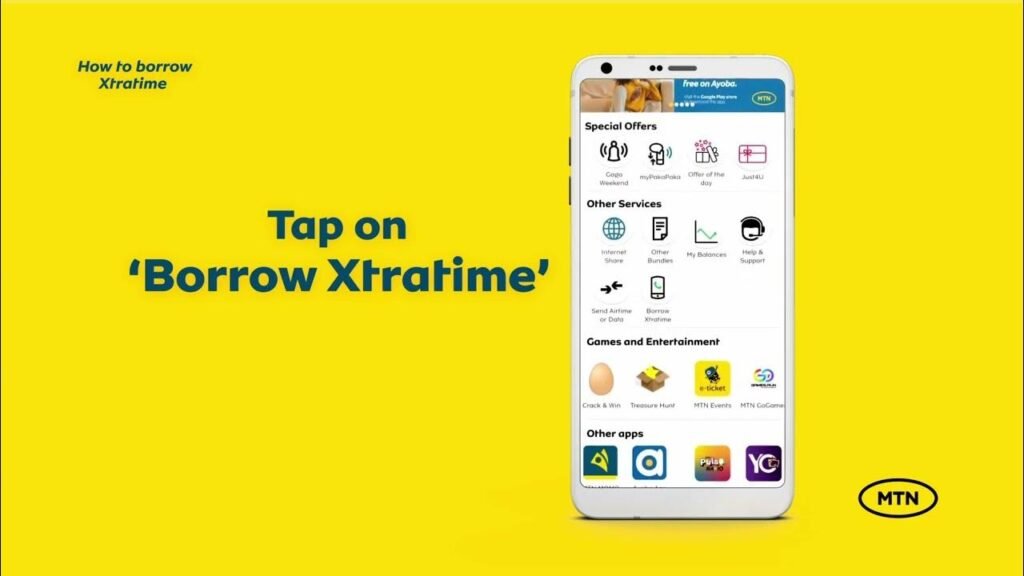
MTN XtraTime
is a service in Nigeria that allows eligible prepaid customers to borrow airtime or data on credit when they run out, and pay it back on their next recharge.[Photo: Mtn]
MTN’s Response A Deliberate Focus on Wallet Quality and Deposits
Fortunately, MTN has quickly sought after a solution. The company’s MTN fintech strategy centers around advancing services and high-value customers rather than chasing user numbers at any cost.
This explains why active MTN MoMo wallets actually declined before their recent modest recovery. The active wallet base contracted from higher levels in previous years to focus on quality users—those who transact frequently and maintain balances.
As per the company’s data in September 2025, wallets had grown 1.6% to 2.9 million, while customer deposits jumped an impressive 146.43% year-on-year to ₦6.9 billion ($4.80 million).
Furthermore, the company focused on restructuring its distribution network. Its active agent network grew by 73.6% and merchant network by 42.6% between December 2024 and September 2025. MTN calls it a “deliberate focus on optimizing distribution quality and building a more sustainable fintech ecosystem for long-term growth.”
Phrase Lubega, CEO of MoMo PSB, stated: “
We see continuous usage of customers coming to make payments through those value chains, and that has helped drive the momentum that we expect. As we onboard or deliver additional advanced services, more high-value customers actually come in to engage and interact with those services, thereby driving the additional momentum and increasing the flow that we are seeing.”
This new approach also reflects alignment with CBN under its Payment Service Bank license. MoMo PSB can accept deposits and process payments but cannot lend directly. This ties to Xtratime’s outsized role and backing, as well as the platform’s reliance on partnerships. MTN MoMO processed over $2.1 billion in international remittances in H1 2025 and has over 283 million accounts across 16 countries, with $1.1 trillion processed annually.
These milestones are coupled with its 900+ partner API ecosystem, which pushes its telco payment services into a new frontier.