Table of Contents
TL;DR,
- VR education in Kenya advances as Brookhouse School invests $25,000 in 40 VR headsets for immersive learning.
- This VR education pilot in Kenya uses a hybrid model, supplementing traditional teaching with immersive metaverse experiences.
- While promising, this premium-school pilot highlights Kenya’s digital divide. Questions remain about long-term learning outcomes, teacher training costs, and whether such technology can scale beyond elite institutions.
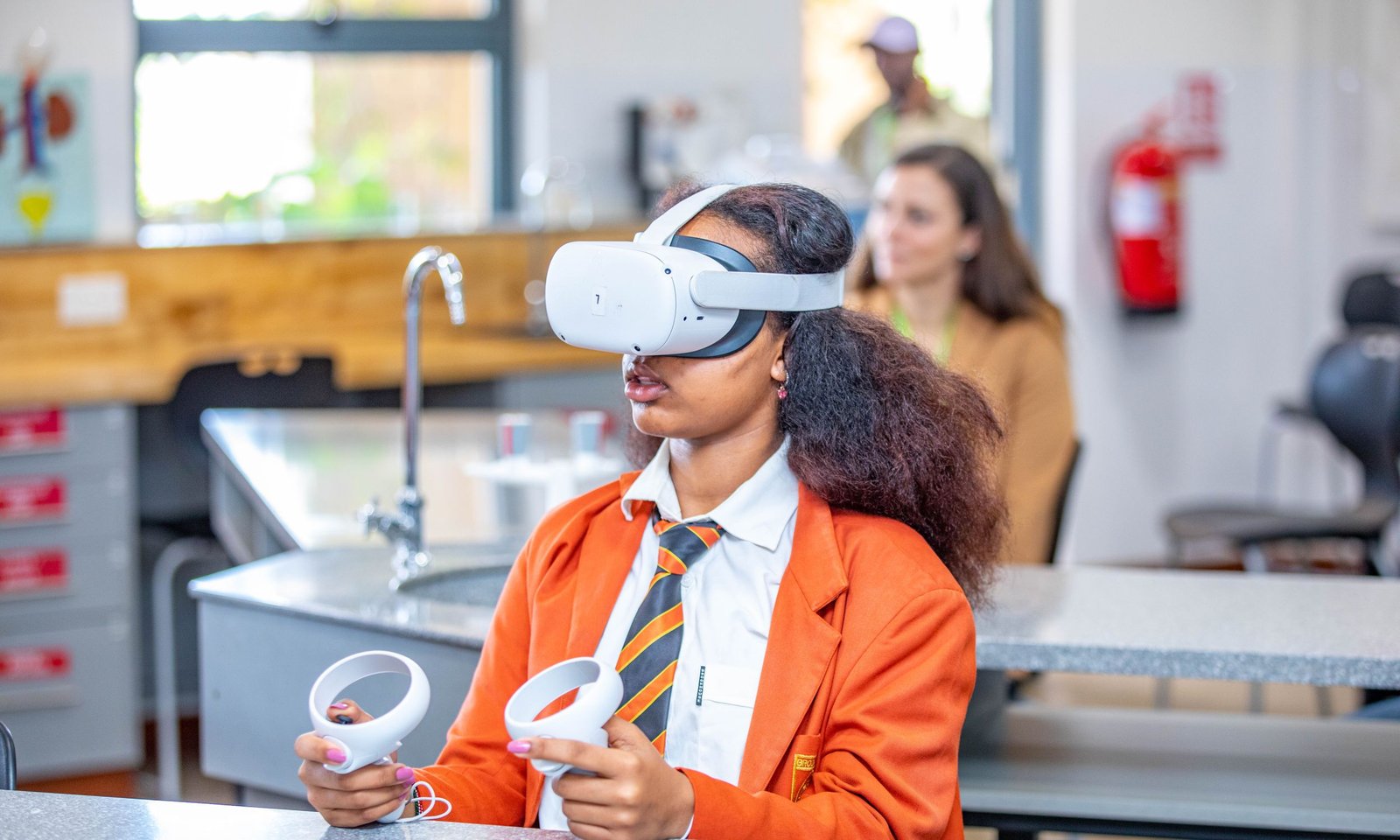
VR education in Kenya takes another step from being theoretical to practical. Recently, Brookhouse School’s Runda campus in Nairobi became one of Kenya’s first premium schools to integrate virtual reality into its curriculum. During its public launch, the school showcased VR classrooms and a biology lesson that took place “inside” a functioning heart.
The school integrated virtual reality sessions for students aged 12 and above as part of Inspired Education Group’s global pilot. The program focuses on structured, curriculum-linked experiences rather than novelty demos, and the best part is there are no additional school fees.
What the Brookhouse VR Program Involves
Brookhouse Runda’s metaverse-based learning program targets students in Years 7 through 13 (ages 12 and older). The school invested in approximately 40 Oculus Quest 2 headsets at $618.48 each (KES 80,000 ), representing a total hardware investment of approximately $24,739.20 (KES 3.2 million), excluding software installation costs.
The program is part of a broader pilot program by the Inspired Education Group, Brookhouse’s parent organization, which operates 13 educational institutes across Africa. The program partners with VictoryXR, a provider specializing in educational VR content, offering a library of over 250 bespoke learning experiences.
The planned sessions were an add-on to teacher-led instruction. Inspired’s flagship online school (King’s InterHigh) uses a comparable model—at least one metaverse class per week and roughly 5% of the taught curriculum.
Brookhouse’s deployment is part of a network now using over 2,000 Meta Quest devices, with 13 Inspired institutes across Africa adopting the tools.
Moses Lutta, Head of School at Brookhouse Runda, explained:
“It is the realization that education is evolving very fast and that the integration of VR and the metaverse in education is something that we cannot run away from.”

Inspired Education Group is a leading global network of over 125 premium private schools across 30 countries, educating more than 95,000 students worldwide.
How the VR Classrooms Work Day to Day
The implementation follows what educators describe as a “hybrid learning model.” Virtual reality in education at Brookhouse supplements rather than replaces traditional teaching. Students participate in VR sessions as experiential add-ons, then reconvene in physical classrooms to discuss and embed learning points.
The program is designed to cover various lessons, including
- Science: Nuclear experiments, volcano exploration, human anatomy.
- History and culture: World War scenarios, Anne Frank’s museum.
- Geography and marine science: Ocean dives and global landmarks like the Pantheon and pyramids.
- Space: Explorations that put learners “on mission.”
“The conventional teaching and learning method has always been chalk and talk. But now we are trying to immerse the students into an environment whereby they can begin to interact with the real world just by a press of a button.“
The basis of metaverse-based learning is to provide a more practical look at various subjects. The majority of African schools often rely on textbook information, and currently the world is moving at such a fast pace that some lessons can be considered archaic.
As Lutta notes,
“Some subjects, for example, World War, are very abstract, but VR enables learners to actually be in that situation. In instances where the poisonous gases are being released, the students are actually there inhaling the gases, and that makes them resonate more.”
Eric Mulindi, Head of School at Brookhouse’s Karen campus, adds,
“Through the amalgamation of VR and the Metaverse, we’re creating dynamic, interactive ecosystems where subjects come alive, inviting students to explore, question, and understand in ways previously unimaginable.”
VictoryXR is a key technology partner that provides the immersive educational content and platforms which Inspired Education uses to deliver virtual reality (VR) and mixed reality (MR) learning experiences in its schools.
Pedagogy behind metaverse-based learning
The program is framed in experiential and social-constructivist terms, where students “live” concepts and then reflect, discuss, and apply them. Independent research generally supports this direction:
- A 2022 meta-analysis in K–6 found immersive VR produced moderate-to-large learning gains over traditional methods.
- A 2024 review comparing VR with videoconferencing reported a notably larger effect size for VR, especially in natural sciences.
- Internal assessments from the Inspired pilot and a Meta case study report improved recall (85% improvement claimed) and teacher-observed confidence gains. These are institution-led evaluations, not independent trials, and should be read with caution.
A journalist at Brookhouse’s launch described the heart simulation as “visceral,” reinforcing why even skeptical observers see pedagogical value when VR is closely tied to the lesson objective.
Infrastructure, Costs, and accessibility
Any assessment of Brookhouse School virtual reality learning must acknowledge the practicality of the program. Running VR education in Kenya is one thing, but maintaining it can be another story altogether.
The Metaverse-based learning at Runda required 40 Quest 2 headsets at roughly KSh 80,000 each (about KSh 3.2 million in hardware, excluding software setup). Brookhouse reports no fee increase. In Kenya, less than 10% of pupils have access to digital learning materials, and only 18% have internet access for learning.
The program did stretch to its sister Inspired school in South Africa. As per the data, 344 Quest 3 headsets were distributed at a 1:20 device-to-student ratio. Graham Bennetts, an executive head, describes using “the technology in short, sharp doses to keep it safe for the students.”
Nationally, access to devices and connectivity remains limited, and this premium-school model does not by itself “democratize” availability. A separate donation-driven VR project at Mcedo Beijing School (Mathare) underscores the funding gap.
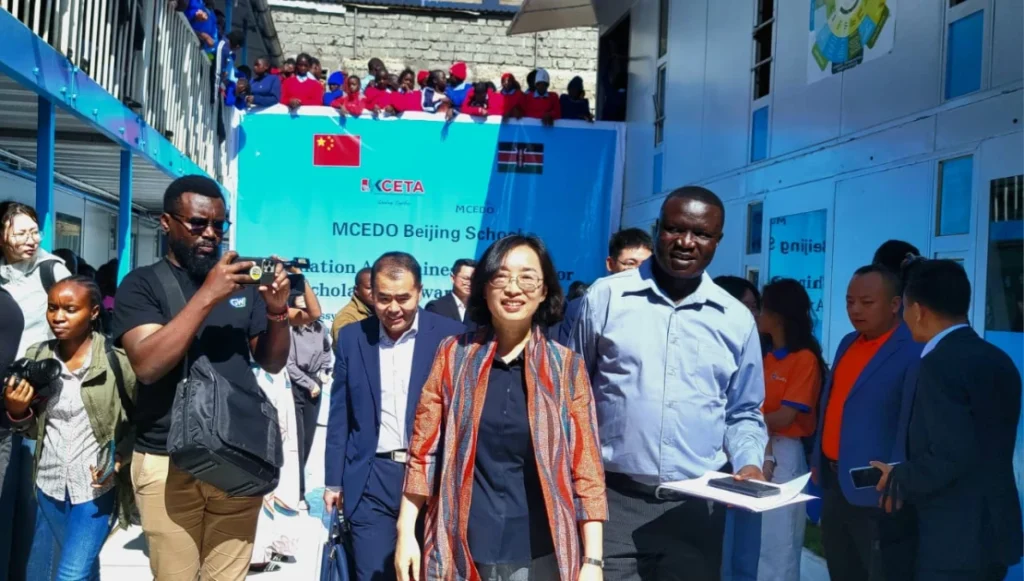
VR project at Mcedo Beijing School (Mathare)
Regulatory and Safety Considerations
Regulation is also another consideration when applying VR education in Kenya. The Data Protection Act (2019) in the region says that you need to get clear permission from a parent before you can process a child’s personal information. VR headsets can gather private usage information, so it’s important to get permission and follow data-handling rules. Kenya has fined schools for not handling minors’ data properly, which shows how risky it is to not follow the rules.
The 2019 National ICT Policy and the Digital Economy Blueprint also support educational technology, but they don’t make any rules about VR. TVET programs are looking into using VR and AR for training workers, which shows that the public sector is becoming more interested.
Research indicates approximately 37% of students in some VR studies reported mild nausea, and eye strain remains a consideration.
The Brookhouse School’s virtual reality learning is the first step to introducing metaverse learning. There is no data on any integration of on-chain analytics; however, it’s a start.
Educational Impact at Brookhouse: What We Know (and Don’t)
What we know
- Strong engagement: Teacher observations and student feedback in Nairobi point to high engagement, particularly in abstract or hazardous-to-replicate topics.
- Structured integration: VR is used as an “add-on,” not a replacement for teaching, aligning with best practice.
Open questions
- Outcomes in the long run: No peer-reviewed studies specific to Brookhouse have yet compared VR and non-VR cohorts.
- Equity: It is uncertain how this model may expand beyond elite educational institutions.
- Teacher development: The costs of required training time and ongoing support have not been made public.
Brookhouse’s Role in VR Education in Kenya
The VR education in Kenya gives students a chance to use experiential learning technologies without having to pay extra. Parents should ask how often sessions are held, what safety measures are in place, and how VR content fits in with the curriculum.
Brookhouse’s experience offers preliminary findings for institutions contemplating VR classrooms. We need to consider how much money we need to spend on hardware, how many content partnerships we need to make, how much training teachers need, and how to position VR as a supplement to, not a replacement for, instruction.
This premium-school pilot shows that virtual reality in education is possible, but it also demonstrates how hard it is to get to. To roll out more widely, the digital divide would need to be fixed, and rules would need to be made for using immersive technology in schools.
Brookhouse Runda’s VR classrooms show how teacher-led experiences that are well-planned can make hard-to-understand subjects easier to understand while still being safe and appropriate for kids. Inspired’s global infrastructure, content library, and new ways of learning in the metaverse are all good for the school. However, there are still important questions about long-term results and fair access. For now, the early feedback is favorable, but there is still no independently verified long-term outcome data.