Table of Contents
TL;DR,
- The AR vs VR debate relies on data: VR training cut Walmart’s session times by 96%, while Boeing used AR to reduce wiring error rates to nearly zero, proving each tech has distinct ROI strengths.
- Augmented Reality enhances the real world for retail and surgery, while Virtual Reality offers total immersion for safe training simulations. Mixed Reality devices like the Quest 3 are now blending both capabilities into single headsets.
- Choosing the right tech depends on your goal: prioritize VR for high-stakes skill acquisition and gaming, but select AR for live workflow guidance. Hardware costs and battery life remain key constraints for broad adoption.
Mark Zuckerberg’s recent declaration that Meta’s Quest 3 is “the better product, period” in comparison to Apple’s $3,499 Vision Pro garnered significant attention in the tech world. The debate over AR vs. VR falls mainly on various key differences, such as technology, experience, practicability, and use cases.
The answer to this particular question lies in matching the right technology to the right problem.
What these terms really mean (and why it matters)
Before diving into the whole AR vs. VR thing, let’s break down what they are for some context:
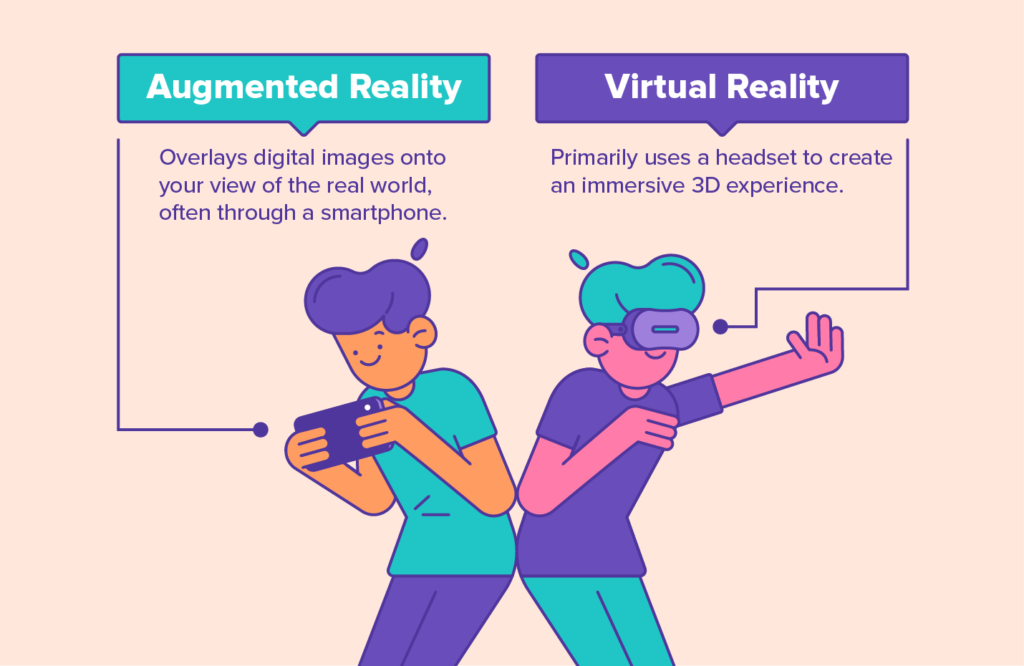
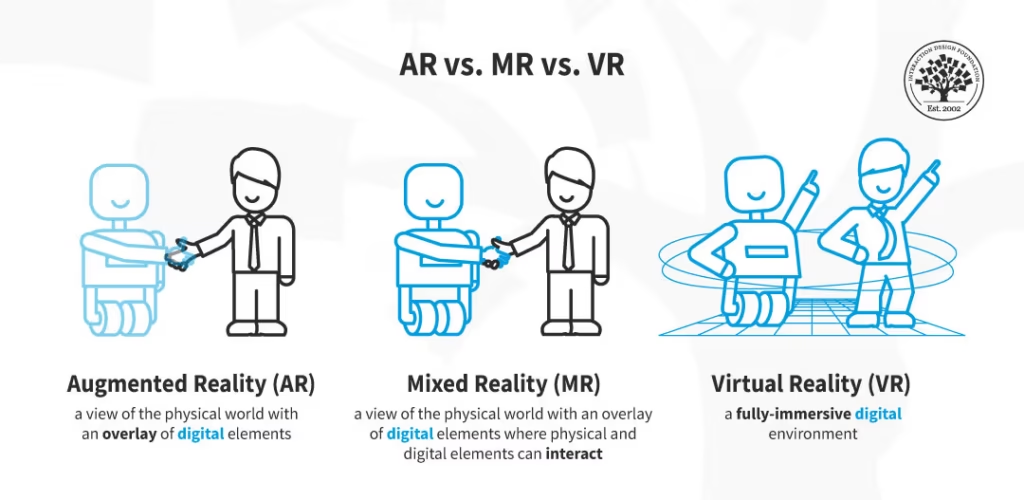
Virtual Reality (VR) creates a fully immersive digital environment that completely blocks out the physical world. Put on a VR headset like the Meta Quest 3 or PlayStation VR, and your visual and auditory fields are replaced entirely by computer-generated content. Instead of being in your living room, you find yourself on a spaceship, in a surgical theater, or courtside at a basketball game.
Augmented Reality (AR) takes an alternative approach. It overlays digital content onto the real world using devices like smartphones or AR glasses. When IKEA’s app lets you see how a couch looks in your actual living room, or when a surgeon sees a 3D spine model superimposed on a patient during surgery, that’s AR enhancing reality rather than replacing it.
Mixed Reality (MR) further blurs these boundaries. Microsoft defines it as “blending the physical world with the digital world” in a way that allows both to interact in real-time. Unlike simple AR overlays, MR is spatially aware. Typically, a virtual object can be hidden behind your real coffee table, or you can walk around a holographic engine to examine it from different angles.
The newest term, spatial computing, popularized by Apple for its Vision Pro, describes the broader framework enabling machines to understand and interact with three-dimensional space. This concept focuses more on the underlying technologies, such as AI, computer vision, and advanced sensors..
AR vs VR vs Mr; What each tech is best at (with real-world evidence)
In the context of technology, the theoretical aspects are less important than their practical applications. Here’s a breakdown of each sector and the technologies that have dominated them..
AR’s Sweet Spot: Enhancing Work in the Physical World
Augmented reality applications shine best when workers need digital information while remaining grounded in actual reality.
Retail and commerce are two of the first industries that come to mind. According to Deloitte, they found that 61% of shoppers prefer stores using AR, and 71% would shop more often with AR apps. IKEA’s Kreativ app fully exploits this preference, letting customers visualize furniture at true scale (IKEA reports 98% scaling accuracy) and even “delete” existing furniture to plan layouts. Sephora’s virtual try-on helps customers test products hygienically and decide faster.
Augmented reality applications also play a unique role in healthcare, particularly in surgery. Augmedics’ xvision overlays a 3D spine model for “X-ray vision,” with 98.9% accuracy for screw placement. Mayo Clinic applies similar tech, reporting how surgical plans changed by 24% after 3D immersive planning.
The in-depth experience of augmented reality use cases has also improved manufacturing services. Boeing reduced wiring production time by 25% and cut error rates to nearly zero using AR headsets to guide technicians through complex wire harness assembly. Lockheed Martin saw even better results with AR, cutting the time needed to interpret spacecraft assembly instructions by 95% and boosting productivity by over 40%.
VR’s Domain: Immersive Training and Complete Presence
VR’s complete immersion clearly outperforms AR, shifting the debate between VR and AR in its favor. The education and training sector mainly uses its ability to provide a safe environment for practicing high-stakes procedures repeatedly without any consequences.
Osso VR-trained surgeons showed a 230% improvement in overall surgical performance and completed procedures 25% faster than traditional training. Walmart compressed technology training (Strivr) from 8 hours to just 15 minutes—a 96% reduction—while increasing knowledge retention by 10-15%.
A PwC study found VR learners were 275% more confident in acting on what they learned compared to classroom learners, and they were four times more focused than their e-learning peers.
Aviation, military, and other high-risk simulations heavily utilize this technology. When Embry-Riddle Aeronautical University used VR flight training, students reached their first solo flight over 30% faster.
Mixed Reality: The Convergence Play
Mixed reality represents the industry’s bet that future devices won’t choose between AR and VR—they’ll do both. Mixed reality devices like Meta Quest 3 ($499) and Apple Vision Pro ($3,499) exemplify this trend. Both are fundamentally VR headsets with high-quality passthrough cameras enabling AR experiences. The Quest 3 switches seamlessly between modes, providing immersive computing experiences. The Vision Pro’s passthrough is so sharp that reviewers noted it feels “almost like you’re not wearing a headset.”
Mortenson Construction used this very theory to create a digital twin of an Illinois data center, enabling client collaboration that resolved over 600 issues before they could derail the project. This blending of virtual planning with real-world context shows why mixed reality devices are gaining traction in manufacturing, construction, and collaborative design.
Strengths and limits at a glance
If you’re weighing the differences between augmented‑reality use cases and VR, think in terms of the core trade‑off: staying in the real world vs. full immersion.
AR strengths
- Works on billions of smartphones/tablets; rapid deployment.
- AR enhances real workflows hands-free (schematics, IoT data overlays) with proven ROI in manufacturing.
- Less friction for use in public and on-site.
What AR can’t do right now:
- Because of hardware limitations, you have to choose between lightweight glasses with few features or headsets that are too heavy to wear all day.
- Environmental dependencies make it hard for AR tracking to work in low light or places without clear visual features.
- Concerns about privacy are still a big reason why people don’t want to use glasses with cameras.
- Current AR glasses have a narrower field of view than what people can see naturally.
VR strengths
- VR offers unparalleled immersion and presence in games, therapy, soft skill training, and entertainment.
- There is a lot of evidence that training works (focus, confidence, and retention).
VR’s persistent challenges:
- 40 to 70 percent of users experience motion sickness to some degree. This is because the visual motion and physical stillness don’t match up.
- Even with lighter headsets like the Quest 3 (515 g), you can feel the weight and discomfort after 20 minutes.
- Being physically cut off from your surroundings makes it difficult to socialize and limits how useful shared spaces can be.
- The battery life of both the Quest 3 and the Vision Pro lasts about 2 to 2.5 hours.
- Prices range from $499 for regular devices to $3,499 for high-end ones.
Ultimately, even when focusing specifically on Africa, these devices are either technologically inaccessible or the existing infrastructure cannot support them.
Where Africa lies in the AR vs. VR debate
Adoption is early but promising. Examples include BlackRhino VR (Kenya) with a no‑code AR platform, VRapeutic (Egypt) for therapeutic VR, Mix Reality (South Africa) for education/tourism, and learning platforms like Gidi Mobile (Nigeria).
Constraints—device cost, bandwidth, and local content—push teams toward smartphone AR for telemedicine, virtual labs, agriculture training, and cultural heritage. Partnerships and mobile‑first design are key to delivering immersive computing experiences sustainably.
How to use this information (quick decision guide)
- If you need shoppers or stakeholders to see products in their space: prioritize AR.
- If mistakes are costly or dangerous (flight, surgery, defense, heavy industry): VR for simulation; AR/MR for live, heads‑up guidance.
- If you’re a gamer or fitness user: Quest 3 is the pragmatic pick today.
- If you’re a Mac‑centric pro needing virtual screens and Apple workflows: Vision Pro—budget permitting.
- Environment and privacy: Augmented reality (AR) in public spaces has social and recording implications, so it is important to plan appropriate policies and signage.
- Comfort and health: test for motion sensitivity; target 90–120 Hz and low latency; include breaks.
- Content and ecosystem: verify the apps you need exist now (don’t buy on promises).
The real question isn’t whether differences between AR overlay technology and VR immersive environments will persist—it’s whether a single device will seamlessly span the entire spectrum. Both Meta and Apple are betting yes, framing it as “mixed reality” and “spatial computing,” respectively.
There’s no universal winner in AR vs VR. VR creates unmatched immersive computing experiences for training, gaming, and high-stakes simulations. AR improves workflows in the real world in manufacturing, field service, and retail. Mixed reality devices are flexible because they can work in both modes. Overall, it’s about having the right tool for the job and, more and more, having one device that can switch between modes as your needs change.