











South Africa did not create a new crypto law. Instead, it pulled digital assets into the same legal machinery that already governed financial advisors, intermediaries, and tax reporting.
That single decision, especially the licensing of crypto providers by the Financial Sector Conduct Authority (FSCA), soon made South African crypto regulation a blueprint for most of Africa’s regulators.
This article unpacks how the FSCA licensing regime emerged, how it actually works in practice, and why it has become a workable blueprint for integrating crypto into formal finance rather than banning or ignoring it.
TL;DR,
- South African crypto regulation licensed 300 providers by retrofitting existing financial laws—no new legislation required. The market grew from $26B to $35B (35% YoY) while exiting FATF’s Grey List.
- South Africa transformed crypto chaos into a $35B supervised sector by classifying digital assets as “financial products” under existing FAIS regulations, creating a blueprint now studied across Africa.
- The FSCA licensed 300 crypto providers in under 3 years using adapted financial laws. Result: 6M users, institutional surge, FATF compliance—and a replicable model for African regulators.
South African Crypto Regulation: The Legal Turning Point (2014–2022)
South Africa is Africa’s second-largest cryptocurrency market, processing an estimated $35 billion in annual on-chain value between July 2024 and June 2025.
That’s a 35% increase from the prior year’s $26 billion. The market serves approximately 5.8 to 6 million users (roughly 10% of the population), according to data from the South African Revenue Service (SARS) and analytics firm Chainalysis.
However, its pro-regulatory streak didn’t start out all rosy.
It started in 2014 when the National Treasury, the South African Reserve Bank (SARB), FSCA’s predecessor, SARS, and the Financial Intelligence Centre (FIC) issued a joint warning over the risks of crypto.
Their main concern was over its volatility, lack of legal protection, and no recourse when intermediaries failed. Crypto was treated as an “intangible asset,” not currency, to avoid breaking the outdated Currency and Exchange Act of 1933.
However, unlike its peers, its regulatory body came around on 6 April 2018, when SARS formally confirmed that crypto gains and losses must be declared for tax. This effectively treated digital assets as an intangible asset subject to normal income tax or capital gains tax rules, not as legal tender.

A “wait and see” posture, however, left a vacuum. Massive frauds such as Mirror Trading International (2020) and Africrypt (2021) showed that nonintervention carried real consumer and reputational costs.
The change came through the Intergovernmental Fintech Working Group (IFWG), which in 2019–2021 proposed a strategy of “regulatory integration.” This brought the South African crypto regulation inside existing financial laws instead of building a new statute from scratch.
The decisive step was 19 October 2022, when the FSCA issued General Notice 1350, declaring crypto assets to be “financial products” under the FAIS Act. Two points were crucial:
Crypto assets were now squarely within the FSCA’s conduct and licensing perimeter.
The notice explicitly did not recognize crypto as legal tender, allowing SARB to keep its monetary policy boundaries intact.
So how does South Africa regulate cryptocurrency in practice?
The core design choice is to regulate intermediaries, not the code.
[inline_related_posts title=”Related” title_align=”left” style=”grid” number=”1″ align=”none” ids=”” by=”categories” orderby=”rand” order=”DESC” hide_thumb=”no” thumb_right=”no” views=”no” date=”no” grid_columns=”1″ post_type=”” tax=””]
Under FAIS, crypto exchanges, brokers, wallet providers, and advisors receive the same treatment as other financial service providers. That means:
They must be licensed as Crypto Asset Service Providers (CASPs).
They must meet “Fit and Proper” requirements, which include solvency, governance, segregation of client assets, compliance officers, and clear business models.
Their conduct can be challenged via the FAIS Ombud, giving consumers a complaints and redress mechanism previously unavailable in crypto.

The South African crypto regulation has a multiagency structure:
FSCA—licensing, supervision, and conduct regulation of CASPs.
SARS—tax administration and, from 2026, implementation of the OECD Crypto‑Asset Reporting Framework (CARF).
SARB – financial stability and the evolving cross‑border framework.
FIC – Anti-Money Laundering (AML) compliance and the “Travel Rule.”
National Treasury & IFWG – overall policy coordination and risk mapping.
The FSCA crypto license as the system’s anchor
The FSCA opened its licensing window on 1 June 2023, giving existing providers until 30 November 2023 to apply. The pipeline shows both rapid scaling and deliberate market pruning.
By December 2025, the FSCA had received 512 applications for CASP licenses. Around 300 had been approved, with 14 formally declined. Unfortunately, the regulations placed a strict rule that did set the bar, culling most who didn’t meet the criteria. About a quarter, 121 applicants, withdrew after engaging with the regulator.

Those withdrawals amount to a “soft purge.” Firms that could not meet FAIS‑level requirements for segregated funds, solvency, or governance effectively exited the regulated perimeter.
South African crypto regulation has created a distinct three-tier market:
Tier 1 – Full-Service Crypto-Native Platforms: Luno serves over 6.3 million South African users, adding 530,000 in the year to October 2025. VALR surpassed 1 million users by July 2025 and acquired an Over-the-Counter Derivatives Provider license, enabling regulated crypto derivatives trading.
Tier 2 – Traditional Financial Integrators: The entry of Momentum Consult and Efficient Private Clients signals crypto’s absorption into mainstream wealth management and institutional portfolios—a key indicator of regulatory legitimacy.
Tier 3 – Niche Specialists: Firms like Jaltech offer crypto investment baskets and specialized products.
This institutional character distinguishes South Africa from Nigeria, where, despite ranking #6 globally in the 2025 Chainalysis Crypto Adoption Index (versus South Africa’s #30), the market remains retail- and peer-to-peer-dominant.
Licensing, FATF, and Tax Transparency: Closing the Gaps
International pressure also drove South Africa’s approach.
FATF greylisting and the Travel Rule
Tightening controls over virtual assets became a priority after the country’s placement on the FATF Grey List in February 2023. Regulating CASPs and enforcing Anti-Money Laundering (AML) compliance were key action items.
The FIC’s Directive 9, issued 13 December 2024 and effective 30 April 2025, implemented the Travel Rule for crypto.
For transactions above ZAR 25,000 ($1500), the originating CASP must transmit sender and beneficiary identity data to the next CASP.
This demands significant technical investment, creating a compliance moat that smaller, informal operators struggle to cross but giving banks more confidence to service licensed CASPs.
Some international reports still state that South Africa has “not implemented” the Travel Rule. The country’s removal from the Grey List in October 2025 was attributed, in part, to the rapid implementation of a rigorous Anti-Money Laundering (AML) compliance regime for CASPs.
CARF and the end of crypto tax opacity
The next step is tax transparency. After public consultation in September 2025, National Treasury codified CARF and a revised Common Reporting Standard on 28 November 2025, with both scheduled to take effect on 1 March 2026.
[inline_related_posts title=”Related” title_align=”left” style=”grid” number=”1″ align=”none” ids=”” by=”categories” orderby=”rand” order=”DESC” hide_thumb=”no” thumb_right=”no” views=”no” date=”no” grid_columns=”1″ post_type=”” tax=””]
Under CARFs, CASPs operating in South Africa must collect tax residence self-certifications from users and report identity details plus aggregate transactional data. This includes gross amounts, fair market value, and units for each “Relevant Crypto-Asset.”
NFTs are explicitly within scope; central bank digital currencies and some e‑money are not.
According to Jashwin Baijoo, Head of Strategic Engagement & Compliance at Tax Consulting SA:
“These changes represent a significant advancement in compliance with international tax standards and the eradication of crypto-tax evasion… CARF and CRS are mandatory—not optional or advisory… Taxpayers should no longer rely on the assumption that crypto gains are outside SARS’s reach.”
KPMG noted:
“This is a significant step in normalizing crypto transparency alongside mainstream financial accounts… SARS will likely receive structured cross-border crypto data from 2026/27.”
Non-compliance can trigger suspended customer relationships, penalties, and mandatory service termination if certifications are not received within 90 days.
SARS does not publicly reveal tax revenue specific to cryptocurrency as a disaggregated line item. While industry estimates suggest 500,000 South Africans declare crypto gains, actual revenue collected remains opaque.
CARF implementation from March 2026 should improve both compliance and measurement through automatic data exchange.
Consumer Protection and Active Supervision
Classifying crypto as a FAIS “financial product” also opened the door to mainstream consumer protection.
In 2024/25, the FAIS Ombud received 77 formal crypto-related complaints. Precedent‑setting cases have already held advisors liable for steering unsuitable clients (e.g., pensioners) into high‑risk crypto assets or into unregulated offshore platforms that later collapsed.
South Africa’s crypto users skew young (83% aged 18–44) and middle-income. 77% earn under R450,000 annually ($25,000). 52% use crypto for purchases, not just speculation, with 40% transacting over R10,000 monthly.
This profile, educated and digitally literate but not high-net-worth, makes consumer protection frameworks particularly important, as users remain vulnerable to unsuitable advice or platform failures.
On the supervisory side, by late 2025 the FSCA had:
Launched 81 investigations into suspected unlicensed crypto businesses, closing 25 when entities shut down operations.
Conducted 10 onsite inspections of licensed CASPs in early 2025, with more scheduled into 2026.
Across all sectors in 2024/25, finalized 633 investigations, levied significant penalties, and debarred over 100 individuals – an indication that crypto is being policed within a mature enforcement culture, not as a side‑project.
Unfinished Business: Exchange Controls and Legal Friction
Not everything fits neatly into the integrated model.
[inline_related_posts title=”Related” title_align=”left” style=”grid” number=”1″ align=”none” ids=”” by=”tags” orderby=”rand” order=”DESC” hide_thumb=”no” thumb_right=”no” views=”no” date=”no” grid_columns=”1″ post_type=”” tax=””]
In May 2025, the Gauteng High Court, in Standard Bank of South Africa v South African Reserve Bank, found that crypto assets do not fall within the 1961 Exchange Control Regulations’ definitions of “currency,” “goods,” or “securities.”
That ruling, if it ultimately stands, would undermine SARB’s current practice of treating crypto as “capital” for exchange‑control purposes.
SARB and the Minister of Finance have appealed, which suspends the judgement’s effect for now. However, the case highlights a structural tension: legacy FX laws, never intended for digital assets, coexist with modern, integrated South African crypto regulation. Any African regulator looking to copy the model should audit its own ageing legislation for similar clashes.
Why This Model Is Shaping Policy Beyond South Africa
South African crypto regulation emerged within a broader regional boom. Sub-Saharan Africa processed $205 billion in on-chain value between July 2024 and June 2025, representing 52% year-over-year growth.
The third-fastest growing crypto region globally. The region shows a strong retail character, with over 8% of transferred value under $10,000, compared to 6% globally.
Within this landscape, South Africa occupies a unique position: second-largest by volume, but first in regulatory formalization. Compared with other crypto-friendly countries in Africa, South Africa’s distinction is not permissiveness but coherence.
Its model retrofits crypto into existing conduct and tax frameworks, rather than declaring it a new legal category. Existing market structure is increasingly institutional and diversified, in contrast to the heavily retail, peer‑to‑peer‑dominated patterns seen elsewhere.
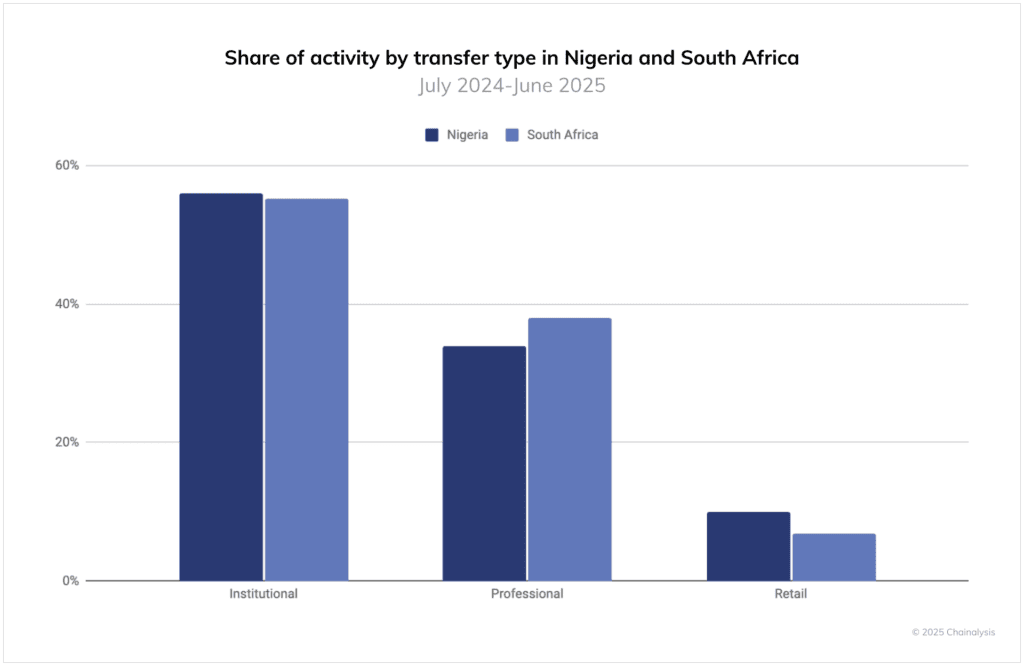
Additionally, the framework helped the country address FATF concerns and align with CARF, making it easier for banks and global partners to engage.
Nigeria has opted for new primary legislation (Investment and Securities Act 2025) with high capital thresholds. Its market processes $92 billion annually versus South Africa’s $35 billion and ranks #6 globally (SA: #30).
However, Nigeria’s market is 89% Bitcoin-dominant and retail/P2P-focused, driven by currency instability. South Africa’s model is slower to replicate but offers greater institutional depth and asset diversification (74% Bitcoin, significant stablecoin and altcoin activity), providing a more sustainable foundation for financial integration.
By contrast, South African crypto regulation, starts with classification under existing laws, then licensing CASPs, then layering FATF and CARF requirements, is more modular and replicable.
A Blueprint Built on Pragmatism, Not Hype
South African crypto regulation is different. It categorizes crypto as a financial product under existing law, converting a regulatory vacuum into a supervised sector with over 300 licensed providers in under three years.
The exit from the FATF Grey List in October 2025 and the implementation of CARF on 1 March 2026 position the country as a mature anchor among crypto-friendly countries in Africa.
The model’s core lesson is that regulatory legitimacy, not prohibition or neglect, is the most effective path to harnessing digital assets while mitigating risks.
African policymakers evaluating similar frameworks find South Africa’s “regulatory integration” playbook to be both replicable and efficient, providing a sustainable path forward without the need to reinvent legislation.
Related Reading:
Discover more from Web3Africa
Subscribe to get the latest posts sent to your email.

You must be logged in to post a comment.