











Table of Contents
If you’ve ever sent money back home to family in Sub-Saharan Africa, you’ve probably winced at the fees. In 2024, the region pulled in a staggering $56 billion in remittances, according to the World Bank.
But sending that cash where it needs to go still costs a lot. By the third quarter of 2025, sending just $200 into the region averaged 8.46% in fees. Let that sink in. That’s nearly three times higher than the UN’s 3% target, and it’s well above the global average of 6.36%.
Now, here’s the thing. This isn’t just a policy failure. It’s a massive, structural market gap. And over the last year and a half, stablecoins have started rushing in to fill it. Major money transfer operators have launched stablecoin products.
African fintechs are securing institutional licenses to build on-ramps. And on-chain transaction volumes are now rivaling those old-school formal remittance flows. The real question is how fast the infrastructure will mature and who will end up controlling all that juicy liquidity.
The infrastructure shift is already happening.
Take Western Union. In May 2026, they rolled out “Stable by WU” across more than 40 countries. They built it on Solana with their own USDPT stablecoin and are pushing it through over 500,000 agent locations. Their CEO, Devin McGranahan, called stablecoins “the next evolution” of remittances, talking up speed and efficiency at a Money20/20 conference back in October 2025.
MoneyGram, meanwhile, took a different route. They built their stablecoin ramps on Stellar, supporting USDC. It’s now live across 180-plus countries and 350,000 retail partners. What’s cool here is that they’re letting third-party apps tap into their global agent network to cash in and cash out USDC. Basically, they’re turning their physical footprint into liquidity infrastructure for decentralized apps.
Then there’s Yellow Card, Africa’s biggest stablecoin exchange, which operates in over 35 markets. In November 2025, they snagged a third-party payment provider license in South Africa, with Standard Bank backing them. Then in May 2026, they teamed up with Mastercard across Ghana, Kenya, Nigeria, South Africa, and the UAE to weave USDC and USDT directly into Mastercard’s cross-border network.
RELATED: Why Nigeria and South Africa Dominate Global Stablecoin Utility
Just to be clear, these aren’t tiny pilot projects. This is a full-blown strategic repositioning of the entire remittance industry around stablecoin rails.
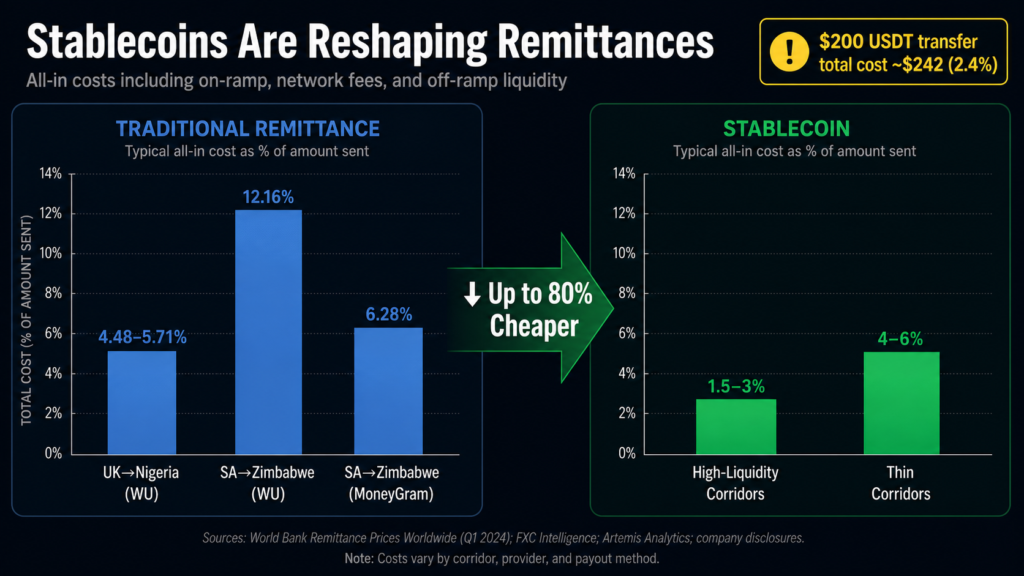
The World Bank’s Q3 2025 data shows huge variation depending on the corridor. Sending $200 from the UK to Nigeria via Western Union cost between 4.48% and 5.71%. The South Africa to Zimbabwe corridor showed significant variation, with costs ranging from 6.28% (using FNB via MoneyGram) to 12.16% (using ABSA via Western Union).
Industry experts estimate that in high-liquidity corridors, like the UK to Nigeria, stablecoin remittances now run between 1.5% and 3% all-in. But you have to watch the “all-in” part. That’s the kicker. A $200 USDT transfer might sound like a good deal, but when you factor in on-ramp spreads, network fees, and off-ramp liquidity costs, your total bill could end up around $242. That’s a 2.4% total cost, according to compliance docs from stablecoin service providers.
In thinner corridors, like South Africa to Zimbabwe or China to Nigeria, costs can creep up to 4% to 6% because the order books are thinner and regulatory friction bites harder. The advantage is still there, but it narrows.
RELATED: EA Capital’s FSCA Approval Sets New African Crypto Standards
The big, unanswered question is liquidity. Right now, public data on order-book depth for pairs like USDT/NGN or USDT/KES is scarce. Exchanges just don’t publish spread metrics for different ticket sizes (like $200 vs. $20,000), so it’s tough to know how well this crypto infrastructure performs when things get really busy.
On-Chain Volume Reveals Where Adoption Is Taking Hold
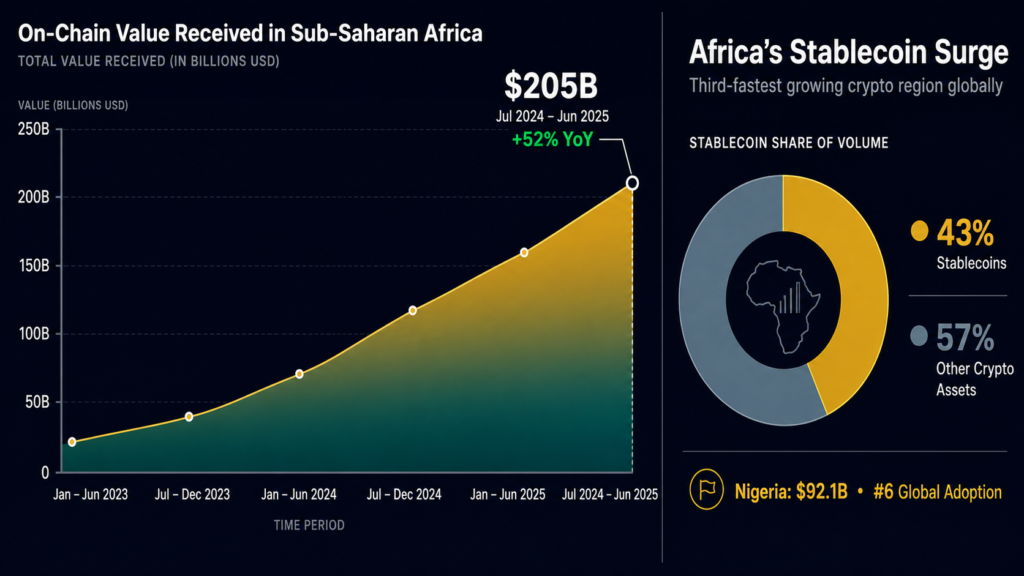
Chainalysis found that Sub-Saharan Africa received over $205 billion in on-chain value between July 2024 and June 2025. That’s a 52% year-over-year jump, making it the third-fastest-growing region globally. Stablecoins alone made up 43% of that volume.
Nigeria? They snagged $92.1 billion of that on-chain value and ranked 6th on Chainalysis’s 2025 Global Crypto Adoption Index (they slipped from 2nd in 2024, but they’re still massive). Activity peaked at about $25 billion in March 2025, driven largely by naira devaluation and capital controls pushing people into crypto.
Moyo Sodipo, COO of Nigerian exchange Busha, pointed out that about 85% of Nigeria’s crypto transfers during that period were under $1 million. That’s a dead giveaway that we’re looking at retail and SME cross-border payments, not just wild speculation. Chainalysis also flagged multi-million-dollar stablecoin transfers tied to trade between Africa, the Middle East, and Asia, proving this infrastructure is already handling commercial settlements, not just pocket change.
The Hard Part Is Moving Between Currencies
The blockchain transfer itself is the easy part. Sending USDT on Tron costs about a penny and settles in under 30 seconds. The real friction happens at the fiat level. That is, turning local cash into stablecoins (on-ramp) and turning stablecoins back into local cash or mobile money (off-ramp).
Yellow Card is tackling this with a B2B Payment API that lets businesses accept stablecoins and dish out local fiat or mobile money. They support USDT and USDC across several blockchains, directly plugged into local banks.
Kotani Pay takes another angle by connecting mobile money accounts (including M-PESA) straight to stablecoin wallets, enabling USDT TRC-20 payouts to mobile money users. A UNICEF Venture Fund pilot found that average off-ramp times were around 19 minutes. But it varied wildly, from under a minute to over two hours, depending on whether a liquidity provider was immediately available.
In July 2026, Visa, M-PESA, and Onafriq announced a pilot in the DRC where stablecoins work as invisible settlement infrastructure. You send and receive local currency, while the stablecoin layer hums quietly underneath. This might actually be the most scalable model. Mobile money providers keep their customer relationships, and stablecoin platforms just handle the backend settlement.
Compliance Is Becoming the Real Competitive Advantage
The FATF Travel Rule, enforced in over 70 jurisdictions as of June 2026, is a beast. VASPs have to collect sender and receiver info, screen against sanctions lists, and keep records for five years. The EU’s Transfer of Funds Regulation went even harder, dropping the reporting threshold to zero euros in 2026.
Over in the US, the GENIUS Act (signed July 2025) set the first federal stablecoin rules, demanding 100% reserves, monthly audits, and strict AML/KYC. This sets the baseline for any African fintech handling USDC if they want to play ball with US finance.
FATF’s March 2026 Targeted Report threw some shade too, noting that 84% of illicit virtual asset volume involved stablecoins, mostly in secondary peer-to-peer markets rather than regulated exchanges. That stat has regulators breathing down everyone’s necks.
African countries are all moving at their own speed. Nigeria’s SEC authorized a naira-backed stablecoin in early 2025 after the Central Bank finally lifted its crypto banking ban. Kenya passed a VASP Act in October 2025, splitting oversight between the Central Bank and the Capital Markets Authority. South Africa gave the Yellow Card that TPPP license, essentially saying stablecoin infrastructure is welcome under existing payment laws. Mauritius, the early bird with its VAITOS Act in 2021, dropped stablecoin-specific guidance in 2025.
This fragmented regulatory landscape is a headache for any fintech trying to scale across multiple countries. You can’t just copy-paste a compliance system from Nigeria to Kenya to South Africa. You need modular infrastructure that bends to each jurisdiction’s specific rules while keeping core operations intact.
For payment companies and remittance startups, stablecoin infrastructure has shifted from “nice to have” to “must have.” The cost advantage is real, but it’s not automatic. It hinges entirely on liquidity depth, smart regulatory positioning, and how well you stitch the tech together. My advice? Partner with licensed on/off-ramp providers like Yellow Card or leverage MoneyGram’s Stellar ramps rather than trying to build the whole thing from scratch. It saves time and keeps the regulators off your back.
Restrictive policies don’t kill demand. They just push it into peer-to-peer markets where you have zero visibility and zero consumer protection. The jurisdictions that lay out clear, proportionate rules will attract licensed infrastructure and, eventually, the tax revenue that comes with it.
The $56 billion Sub-Saharan Africa remittance market is fundamentally transforming. Stablecoins aren’t some parallel, underground system anymore. They’re weaving directly into mainstream payment infrastructure through heavy partnerships between money transfer giants, mobile money providers, card networks, and regulated fintechs.
The cost savings are measurable, but they depend on corridor-specific liquidity and solid compliance architecture. The companies building the on-ramps, off-ramps, compliance APIs, and settlement layers today are quietly positioning themselves as the essential utilities of Africa’s next-generation financial system.
Discover more from Web3Africa
Subscribe to get the latest posts sent to your email.

You must be logged in to post a comment.