



Table of Contents
At scale, asset tokenization has already proven the mechanics of fractional ownership, programmable compliance, and borderless settlement. Blockchain infrastructure has shown that physical and financial assets can be represented digitally, traded more efficiently, and accessed by a much broader pool of investors than traditional financial markets have historically allowed.
The larger question, however, is whether these innovations are genuinely democratizing investment in Africa or simply making sophisticated financial products easier to access for people who were already connected to the formal financial system. More importantly, can tokenized assets close Africa’s wealth gap, or will they primarily become another tool for preserving wealth among the continent’s growing middle class?
The Barriers That Make the Promise Compelling
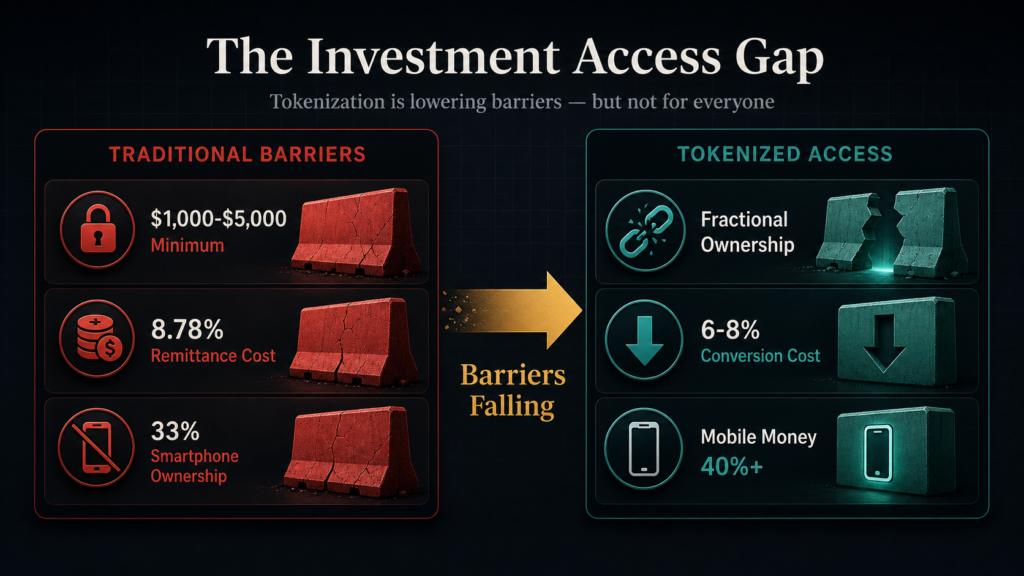
Minimum investment thresholds for international mutual funds typically start at $1,000 to $5,000, placing them beyond reach for savers accumulating wealth in small increments.
Many citizens lack the documentation required to open foreign brokerage accounts, while capital controls often restrict how much local currency they can legally convert into dollars.
Domestic capital markets frequently offer limited alternatives. In many African countries, equity exchanges list fewer than 50 companies, concentrating risk in a handful of dominant firms. Real estate, meanwhile, demands substantial upfront capital and often locks investors into illiquid positions for years.
The result has been heavy reliance on informal savings structures, including Kenya’s chamas, where roughly 300,000 groups collectively manage around KES 300 billion, alongside rotating savings and credit associations that provide social collateral but little protection against inflation.
Currency depreciation transforms these limitations from simple inconveniences into long-term wealth destruction. Nigeria’s inflation peaked above 33 percent before aggressive monetary tightening slowed price growth, while the African Development Bank projects continent-wide inflation averaging 13.7 percent in 2025 and 10.3 percent in 2026. For households holding savings in local currency, even double-digit deposit rates frequently produce negative real returns.
RELATED: Kenya Becomes Hideout for Fugitive Binance Executive Nadeem Arjarwalla
This is where asset tokenization is beginning to reshape the investment landscape. By converting real-world assets into digital, divisible investments, it reduces historical barriers that prevented ordinary Africans from participating in global financial markets. Through fractional ownership, investors no longer need thousands of dollars to gain exposure to high-quality assets. Instead, they can purchase small portions of government securities, real estate, private credit, or other investment products using relatively modest amounts of capital.
While this development represents meaningful progress toward democratizing investment in Africa, accessibility alone does not guarantee inclusion. Lower investment minimums solve only one part of a much larger challenge involving digital access, regulatory certainty, financial literacy, and affordable on-ramps into global markets.
The effectiveness of real-world assets as a tool for wealth creation will ultimately depend on whether these broader structural barriers can also be addressed.
What Fractional Ownership Actually Changes
Asset tokenization converts ownership rights in real-world assets into digital tokens that can be divided, transferred, and settled on blockchain networks. This means a $10,000 commercial property investment can be split into 10,000 tokens worth $1 each, while a $100,000 U.S. Treasury bill can be fractionalized so investors gain exposure with as little as $100.
The technology converts assets previously reserved for institutional investors or high-net-worth individuals into investments accessible to ordinary savers through fractional ownership.
The technology performs three functions that previously required extensive manual infrastructure. Smart contracts automate dividend distributions, coupon payments, and compliance checks, including verifying that investors satisfy regulatory requirements before transactions are completed.
Settlement occurs in minutes rather than the several days required by traditional securities markets, allowing fintech platforms to integrate investment products directly into their applications instead of building full-scale asset management businesses.
RELATED: Forget crypto wallets. The Real Blockchain Revolution Is Happening in the Backend
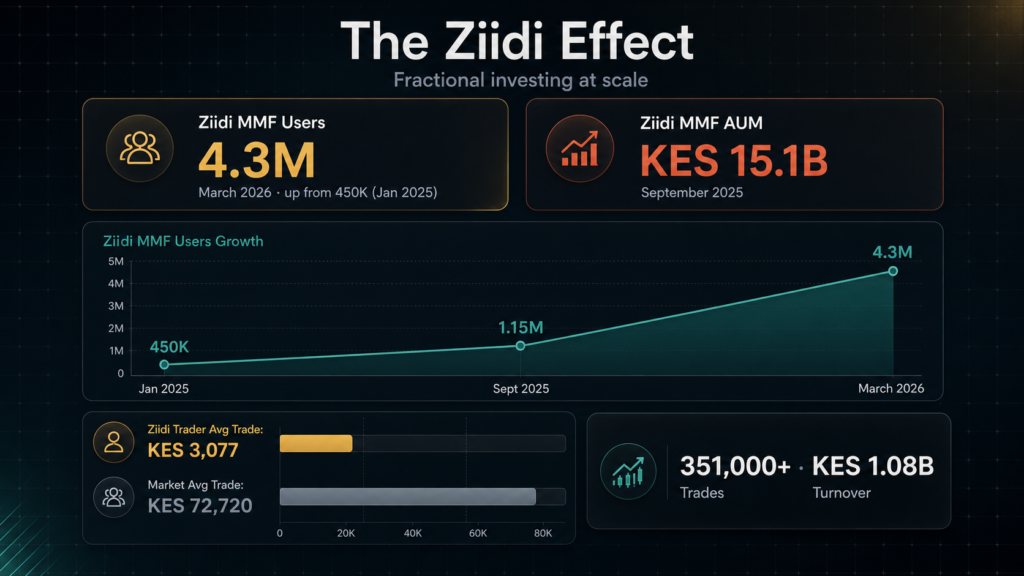
Kenya’s Safaricom demonstrated the commercial potential of this model through Ziidi Money Market Fund, launched within M-PESA in January 2025. The service attracted 450,000 customers and KES 2.85 billion in assets under management during its first month.
More than one million users had deposited KES 6 billion, growing to 1.15 million users with KES 15.1 billion by late 2025. When Ziidi Trader launched in February 2026, the platform processed more than 351,000 fractional equity trades worth KES 1.08 billion within its early months.
Although Ziidi does not rely entirely on blockchain-based tokenization, it illustrates the broader principle behind asset tokenization. Investment products became accessible because they were embedded inside trusted financial infrastructure that millions of users already understood.
Customers invested without opening brokerage accounts, managing crypto wallets, paying gas fees, or learning blockchain terminology. The technology remained largely invisible while the investment experience became dramatically simpler.
The model also demonstrates how technology can contribute to democratizing investment in Africa when combined with trusted payment infrastructure, strong regulatory oversight, and products designed around everyday users rather than blockchain enthusiasts.
Yet Ziidi’s success depended heavily on M-PESA’s 34 million existing customers, Safaricom’s long-established reputation, and regulatory approval from Kenya’s Capital Markets Authority. Replicating those conditions across fragmented African markets remains considerably more difficult.
The Access Divide Becomes Visible
Despite the promise of real-world assets, significant structural barriers remain. According to the World Bank’s 2025 Global Findex, only 20 percent of adults within the poorest 40 percent of Sub-Saharan Africa own smartphones.
Most tokenized investment platforms require smartphones for wallet management, identity verification, and transaction authorization, effectively excluding many of the people these innovations aim to serve.
Know-your-customer requirements create a second layer of exclusion. Following several high-profile fintech failures, regulators strengthened identity verification standards across much of Africa. Many investment platforms now require biometric identification, proof of address, and additional documentation that millions of citizens, particularly in rural communities, still lack.
A third obstacle appears through currency conversion costs. Although blockchain settlement fees remain relatively low, converting local currency into stablecoins and then into tokenized investments can cost between six and eight percent once on-ramp and off-ramp spreads are included.
The World Bank reported average remittance costs into Sub-Saharan Africa of 8.78 percent during the first quarter of 2025, reducing much of the return investors might otherwise earn from dollar-denominated assets.
As a result, today’s users of Real World Assets largely consist of urban professionals, freelancers, diaspora-connected savers, digitally literate entrepreneurs, and middle-class investors seeking protection against inflation. In practice, asset tokenization is currently expanding investment access within the continent’s already-connected population rather than across society as a whole.
RELATED: Why Crypto Virtual Cards Fail African Freelancers
Mobile money demonstrates both the opportunity and the limitation. Around 40 percent of adults in Sub-Saharan Africa now own mobile money accounts, with many relying on these platforms for payments and savings.
Mobile money successfully democratized financial transactions, but it has been far less successful at democratizing investment in Africa or creating broad-based wealth accumulation. Tokenized investing may face a similar trajectory unless structural barriers continue to fall.
Currency Denomination Overwhelms Asset Class
When local currencies lose 40 percent of their value in a year, an investment yielding four percent in U.S. dollars often outperforms one yielding 15 percent in local currency. For many African investors, real-world assets represent more than access to diversified portfolios, they offer protection against domestic currency depreciation.
This explains why demand for asset tokenization increasingly centers on dollar-denominated securities such as U.S. Treasury bills. Investors are not simply chasing higher returns; they are seeking stable stores of value capable of preserving purchasing power.
From the perspective of individual households, this strategy is entirely rational. From a macroeconomic perspective, however, widespread adoption contributes to what the International Monetary Fund describes as “digital dollarization.” If savings increasingly migrate into foreign-denominated real-world assets, domestic currencies lose demand while local capital markets lose investment capital.
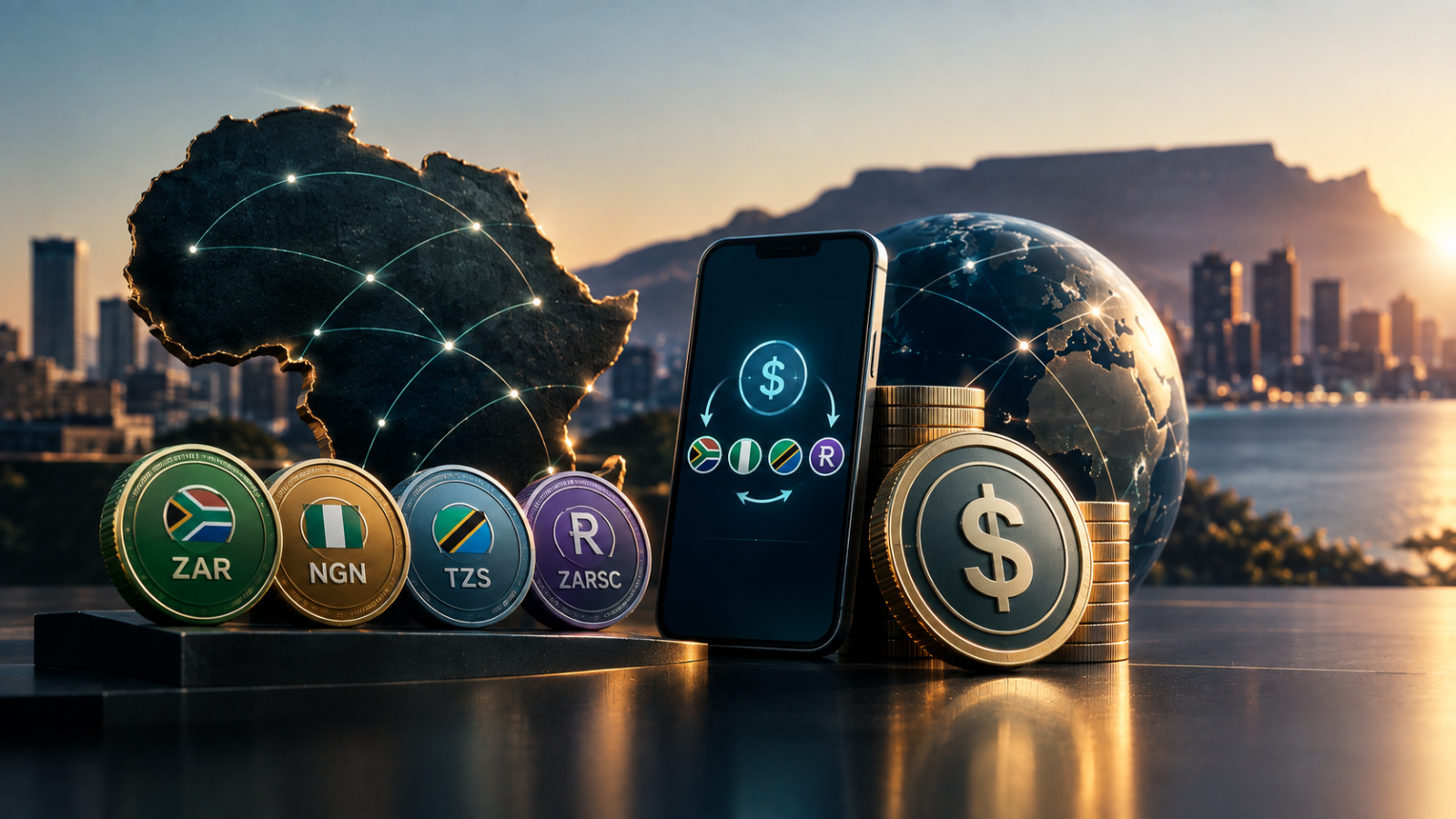
Nigeria illustrates this tension. Although the country introduced cNGN as Africa’s first regulated naira-backed stablecoin, user adoption remained limited despite regulatory support. Many investors simply preferred dollar-linked assets over tokenized versions of a depreciating domestic currency.
The technology therefore provides individuals with an effective hedge against inflation while simultaneously raising important questions about long-term capital formation within African economies.
Asset Risk Changes Form but Persists
While asset tokenization improves accessibility, it does not eliminate investment risk. A tokenized commercial property remains exposed to vacancies, maintenance costs, and property market downturns.
Tokenized private credit continues to carry borrower default risk, while tokenized Treasury bills remain dependent on the financial strength of their issuing governments. The blockchain changes the method of ownership and settlement—not the underlying economics of the real-world asset itself.
This distinction is particularly important for new investors attracted by fractional ownership. Buying a $100 share of a multimillion-dollar office building may feel safer than purchasing an entire property, but investors still inherit the same economic risks associated with the underlying asset. Diversification through smaller investment sizes should not be confused with lower investment risk.
Custody introduces another layer of complexity. Every token ultimately represents a legal claim over an underlying asset held by a custodian. If that custodian fails or legal protections prove inadequate, token holders may lose access to their investments regardless of blockchain transparency. Likewise, non-custodial platforms shift responsibility to users, creating new cybersecurity risks that many first-time investors may underestimate.
RELATED: De-Dollarization Dreams Meet African Reality: Inside the BRICS Payment System
African regulators have made substantial progress in building legal frameworks for digital assets. Nigeria’s Investment and Securities Act 2025, Kenya’s Virtual Asset Service Provider Act, and South Africa’s licensing regime collectively represent a significant maturation of digital asset regulation.
These laws establish disclosure requirements, licensing obligations, consumer protections, and stricter oversight for platforms offering real-world assets through asset tokenization.
However, regulation largely remains national while tokenized markets are inherently global. An investor in Nigeria may purchase tokenized property located in Dubai through a Kenyan platform operated by a company incorporated elsewhere.
When disputes arise, determining jurisdiction becomes considerably more complex. Existing legal systems have yet to establish harmonized cross-border enforcement mechanisms capable of protecting investors across multiple jurisdictions.
Five Markets, Not One Continent
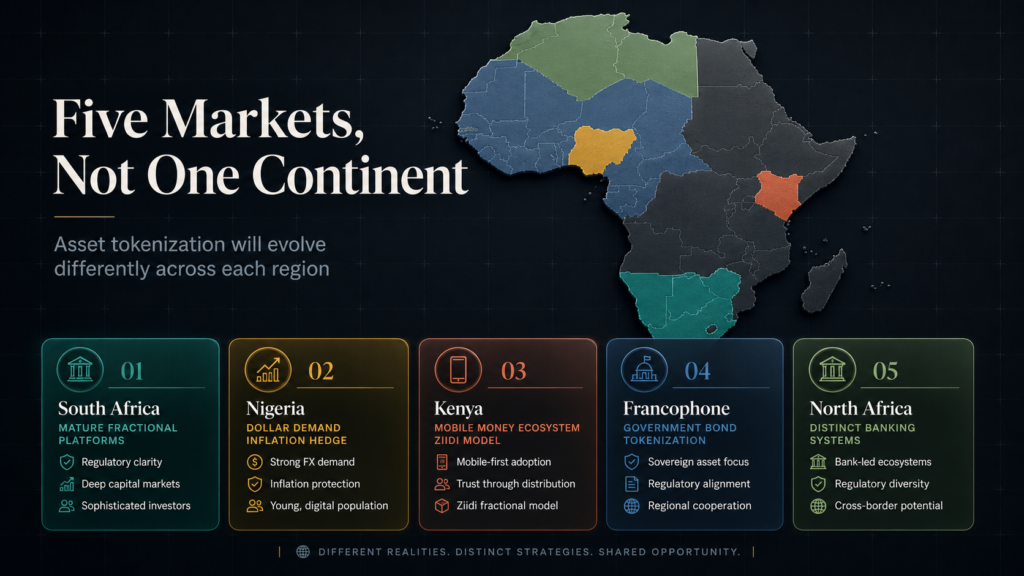
Africa is not a single investment market. South Africa’s mature financial sector differs fundamentally from Nigeria’s inflation-driven demand for dollar assets, Kenya’s mobile money ecosystem, Francophone Africa’s CFA-franc stability, and North Africa’s distinct banking systems. Consequently, asset tokenization will evolve differently across each region.
South Africa already possesses sophisticated fractional investing platforms. Nigeria’s strongest demand centers on currency preservation. Kenya benefits from trusted digital payment infrastructure, while Francophone markets increasingly focus on government bond tokenization. These differences suggest there will be multiple pathways toward democratizing investment in Africa, rather than one continent-wide model built around a single technology.
RELATED: Zimbabwe Government Launches Comprehensive Study for Digital Asset Regulation
While real-world assets may not eliminate Africa’s wealth gap, asset tokenization is fundamentally transforming the participation of individuals in investment markets. Through fractional ownership, barriers that once excluded millions of potential investors are steadily falling, allowing smaller savers to access opportunities that previously belonged almost exclusively to institutions and wealthy individuals.
Whether this initiative ultimately succeeds in democratizing investment in Africa depends on far more than blockchain infrastructure. Affordable internet access, smartphone adoption, lower currency conversion costs, stronger consumer protection, interoperable regulation, and improved financial literacy will ultimately determine who benefits from these innovations.
So, can tokenized assets close Africa’s wealth gap? Not on their own. Today, they function primarily as powerful wealth-preservation tools for Africa’s connected middle class. Over time, however, if the surrounding financial ecosystem becomes more inclusive, real-world assets and asset tokenization could evolve from preserving wealth for a few into expanding wealth-building opportunities for millions across the continent.
Discover more from Web3Africa
Subscribe to get the latest posts sent to your email.

You must be logged in to post a comment.