













Pave Bank, a Singapore-headquartered digital commercial bank, closed a $39 million Series A funding round led by Accel and Tether Investments. While the announcement drew much attention, what’s most peculiar is the bank’s unusual proposition: a fully licensed institution offering programmable money.
The partnership intends to create a platform that allows institutional clients to automate complex treasury and payment logic using code across both fiat and digital assets.
Yet beneath the funding headlines lies a critical discrepancy. While some narratives portray Pave Bank as a tool for promoting financial inclusion in Africa, the evidence presents a different perspective. The digital bank is a blockchain-based banking system that is aimed at global tech companies, crypto exchanges, and businesses looking into stablecoins, not regular people in Africa.
This article examines what Pave Bank actually is, how its programmable money model works, and who it truly serves.
Key Takeaways
- Pave Bank raised $39M to build programmable money infrastructure for institutions, not African retail customers. Despite narratives, the digital bank targets crypto exchanges and global tech companies with its PaveNet platform.
- Singapore-based Pave Bank operates under Georgian license, offering multi-asset programmable banking to institutional clients. Its 2024 financials show $500K in customer accounts and a $380K net loss.
- Pave Bank’s PaveNet merges fiat and stablecoins under programmable rails, but serves B2B clients—not the African financial inclusion story some media suggest.
What Is Pave’s Digital Bank? A Timeline and Licensing Journey
The National Bank of Georgia (NBG) gave the digital bank Full Reserve Banking License #305. This was done through a phased authorization process that started in December 2023.
The banks started off in 2023, when JSC Pave Georgia incorporated under Georgian law on March 14. A few months later, in December, the bank gained a $5.2 million seed round and received its initial Digital Commercial Banking License from the NBG.
However, it was only on February 5, 2024, that the digital bank officially operated under the name “Pave Bank Georgia.” Following this solidifying moment, the Pave bank focused on streamlining its licensing and its backing with:
- July 12, 2024: NBG granted the right to operate in “real mode” (live client operations).
- February 11, 2025: Advanced to Stage 3 of the NBG’s 13-month licensing process.
- October 23, 2025: Announced a $39 million Series A, bringing total funding to approximately $44.2 million.
- December 2025: Fully operational with offices in Singapore (HQ), Georgia (operations), and London, serving institutional clients.
Georgia’s progressive regulatory stance, which included a 0% corporate income tax and a crypto-friendly NBG framework, basically “paved” a unique licensing environment for the bank as compared to more restrictive jurisdictions.
Inside PaveNet: How Programmable Money Works
Programmable money, as defined by Pave Bank, is “codified counterparty risk,” embedding transaction conditions (e.g., “release payment only upon delivery verification”) directly into the payment rail, replacing intermediaries like escrow agents or letters of credit.

The bank built PaveNet, a proprietary, always-on, ledger-agnostic multi-asset network compatible with EVM (Ethereum Virtual Machine) standards.
Its main features are
- Multi-asset accounts let you hold and manage fiat money (USD, EUR), stablecoins (USDT, USDC), and tokenized real-world assets all in one place.
- Code Upload: Clients can upload their own code to automate treasury tasks, like automatically turning revenue into assets that earn interest.
- Full Reserve Model: Pave Bank keeps all of its clients’ money in cash or cash equivalents at the central bank. It doesn’t lend out deposits, which gets rid of the risk of fractional reserve, a feature that is meant to appeal to crypto-native clients who are worried about traditional banks going bankrupt.
- Institutional OTC Trading and Custody: The platform has an OTC trading desk and digital asset custody that is safe for institutions.
According to CEO Salim Dhanani, a former World Bank staff member and fintech entrepreneur;
“Programmable money allows businesses to build in the necessary protection, so they can avoid the often convoluted traditional solutions such as letters of credit and escrow accounts.“
The model mainly focuses on businesses operating across fiat and crypto rails. These niches often include exchanges managing multi-currency liquidity, fintechs needing programmable settlement logic, and corporates exploring stablecoin treasury automation.
Who’s Behind Pave Bank?
The $39 million Series A round, led by Accel and Tether Investments, included participation from Quona Capital, Wintermute, and others. Earlier reports cited 468 Capital as a lead investor in the seed round; however, this still remains hearsay.
Pave Bank’s founding team brings deep banking and fintech experience:
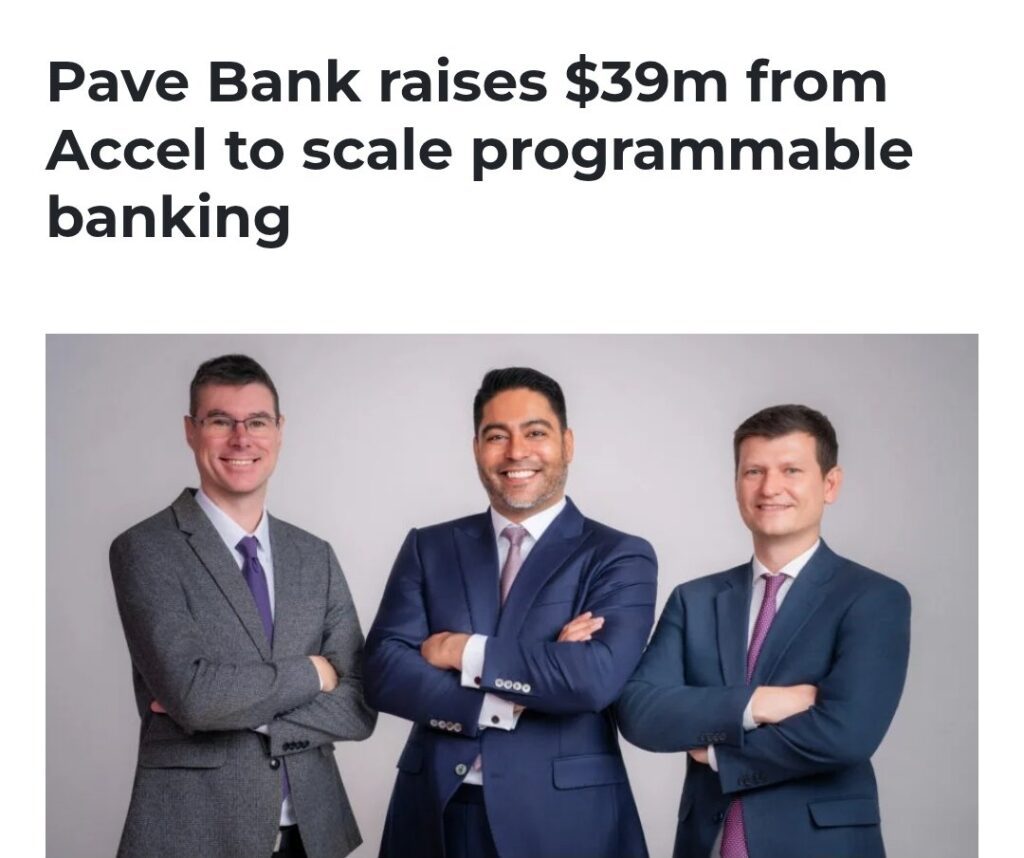
- Salim Dhanani (CEO): Ex-World Bank, former COO of BigPay.
- Simon Vans-Colina: Veteran of Starling Bank and Monzo.
- Dmitry Bocharov: Previously at Ferratum Group.
The National Bank of Georgia noted in its licensing statements:
“The NBG facilitates the entry of new technology players and helps spark competition in the financial sector.”
The Real Market Focus: Institutional Clients, Not African Retail
The notion of programmable money does provide a compelling narrative, and one that, if applied in Africa, can boost its adoption. Digital banking for financial inclusion has become a cornerstone narrative in Africa. Thus, the notion of blockchain-based banking could thrive in a region where M-Pesa, Airtel Money, MTN Momo, and Vodafone Cash thrive.
However, despite narratives in some media outlets, no company statement, operational documentation, or audited filing positions the digital bank as an African retail play. Instead, Pave Bank describes its target market as global “technology-driven companies,” crypto exchanges, and corporates exploring stablecoins.
[inline_related_posts title=”Related” title_align=”left” style=”list” number=”2″ align=”none” ids=”” by=”categories” orderby=”date” order=”DESC” hide_thumb=”no” thumb_right=”no” views=”no” date=”no” grid_columns=”1″ post_type=”” tax=””]
Why the confusion? Africa does exhibit high stablecoin usage. For example, in early 2025, Tether (USDT) volumes in Sub-Saharan Africa were over $25 billion, and the average cost of sending money across borders using SWIFT was 7.4%–8.3%. In theory, these market conditions are advantageous for using programmable money.
But Pave Bank’s business model is B2B infrastructure, not a mobile-first retail neobank like Kuda or TymeBank. Instead, it competes with API-driven banking platforms and unregulated crypto-only solutions. These are for businesses that need programmable rails, not for people who want to use blockchain-based banking.
Pave Bank doesn’t teach policymakers much about digital banking for financial inclusion. The value of this is that it shows how blockchain-based banking can bring together real and digital assets under full regulatory control. This model is better for wholesale and institutional banking than for last-mile consumer access.
Financial Performance and Operational Reality (2024 Data)
Audited financial statements for the year ending December 31, 2024, provide grounding context:
- Customer Accounts: GEL 1,324,000 ($500,000 USD).
- Interest Income: GEL 489,000.
- Commission Income: GEL 44,000.
- Net Loss: GEL 1,008,000 ($380,000 USD).
- General and Administrative Expenses: GEL 2,014,00, a 12× increase from 2023, reflecting operational scaling.
The 2024 statements include a going-concern note, but management says they have enough resources for the next 12 months after Series A.
These numbers show a bank that is still in the growth stage and building its client base, not one that is fully grown and has a variety of income sources. Institutional clients looking at Pave Bank should compare its regulatory credentials and technical innovation to its early-stage financials and changing licensing status.
The Pros and Cons for Institutional Clients
How Pave Bank uses programmable money for cross-border business payments introduces both opportunity and complexity.
Some of its direct benefits include:
- Reduced intermediary fees and settlement times for multi-currency transactions.
- Automated compliance and conditional payment logic are embedded directly in rails.
- The full-reserve model eliminates the counterparty insolvency risk common to fractional-reserve banks.
However, that’s where some lines must be drawn. For instance, regulatory fragmentation is a major hurdle the digital bank has to overcome. Currently, the bank is still in its phased licensing and reported net losses in 2024.
Furthermore, getting conservative corporate treasurers to use new “code-first” banking rails on a large scale is still unproven.
A Global Bank with Rails That Could Help Local Inclusion
Stablecoin integration, or programmable treasury automation, gives fintechs, exchanges, and businesses a regulated alternative to unregulated cryptorails. However, it is important to assess the operational maturity and regulatory coverage of this growing institution in your area.
As Dhanani said in the announcement of funding in October 2025:
“We have built a multi-asset bank that merges the stability of traditional finance with the speed of digital assets… This is about redefining how money moves safely, transparently, and automatically.“
Programmable money is still a new concept, and its platform, PaveNet, merges fiat, stablecoins, and tokenized assets under one programmable interface.
For African fintechs and policymakers, the opportunity lies in selectively using this kind of infrastructure to cut cross‑border costs, automate risk management, and build safer dollar access on top of existing mobile money and banking systems.
FAQ Section:
1. What is programmable money in simple terms?
Programmable money embeds conditions directly into payment rails, allowing automated execution based on predefined rules (e.g., “release funds only when goods are delivered”). It eliminates intermediaries like escrow agents.
2. Is Pave Bank available to individual customers in Africa?
No. Pave Bank targets institutional clients like crypto exchanges, fintechs, and global tech companies. It is not a retail neobank for African consumers.
3. How does Pave Bank’s full-reserve model work?
Pave Bank holds 100% of customer deposits in cash or equivalents at the central bank. It does not lend out deposits, eliminating fractional reserve risk.
4. What is PaveNet and how is it different from traditional banking platforms?
PaveNet is Pave Bank’s proprietary network that lets clients manage fiat, stablecoins, and tokenized assets in one interface, with programmable logic for automated treasury operations.
5. Can African fintechs benefit from Pave Bank’s infrastructure?
Indirectly, yes. African fintechs could use Pave Bank’s B2B rails to reduce cross-border costs and automate dollar liquidity management, but they would need institutional-level integration capabilities.
Discover more from Web3Africa
Subscribe to get the latest posts sent to your email.
You must be logged in to post a comment.