











Table of Contents
Nigeria’s foreign exchange crisis between 2022 and 2025 offers the clearest illustration of why legacy “banked” status fails as a proxy for economic inclusion.
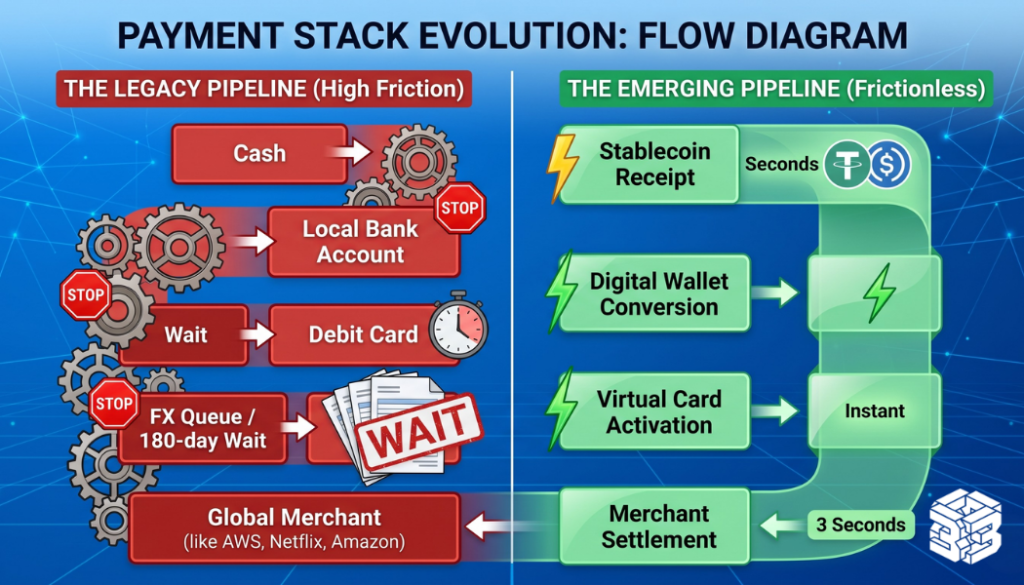
At the peak of the dollar shortage in 2022, Nigerian banks slashed international card spending limits to $20 per month. The central bank’s official FX allocation system was historically governed by the “Form M” import documentation process that could take 180 days or more for approvals. This created bottlenecks that cascaded into the retail banking sector. Even businesses with verified export earnings faced weeks-long queues for foreign currency access, delaying payments to suppliers, cloud service providers, and SaaS vendors.
By mid-2025, conditions had partially improved, with emphasis on the “partially.” GTBank restored a $1,000 quarterly limit, and First Bank permitted $500 monthly; however, there is a distinct difference between “resumed” and “functional.” Run a modest Google Ads campaign, subscribe to three professional tools, and pay for an online course. The quarter is over, and the cardholder is locked out of the international economy until the next cycle.
Digital wallets linked to virtual card infrastructure enable a faster settlement speed. A freelance developer in Abuja receives payment in USDT to a non-custodial wallet. Within seconds, she converts a portion to fund a dollar-denominated virtual Visa card issued by an African fintech. That card is live instantly.
She subscribes to an AWS instance, pays for a Figma license, and tops up her Linear project management account. Three transactions together take less time than a single phone call to a bank’s customer service line and, crucially, involve zero interaction with the central bank’s FX allocation process.
RELATED: USDC Overtakes Tether to Claim the Crown in Global Transfer Volume
This is the difference between capital efficiency as a policy aspiration and capital efficiency as a lived user experience. One system requires cross-border reconciliation delays, correspondent banking approvals, and regulatory checkpoints. The other system offers 3-second settlement and programmable liquidity.
Virtual Cards Are Now Core Financial Infrastructure
It would be easy to dismiss virtual cards as a temporary workaround, a hack for users stuck in restrictive currency regimes.
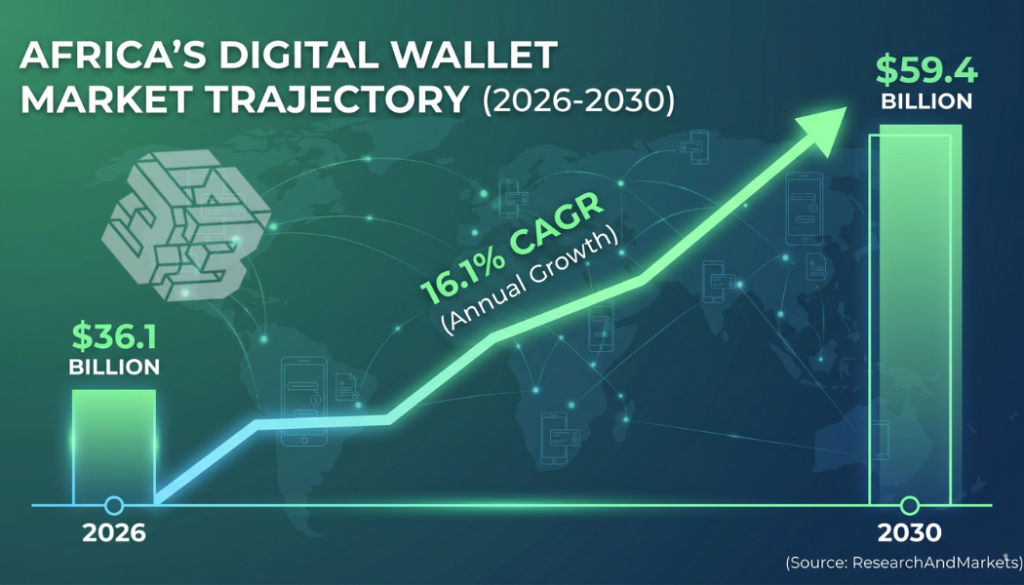
Africa’s prepaid card and digital wallet market reached $36.1 billion in 2026 and is forecast to grow at 16.1% annually to $59.4 billion by 2030, according to ResearchAndMarkets. Virtual cards are now the fastest-growing segment of commercial card issuance globally, and in Africa, they have formalized into a distinct product layer.
Mastercard and MTN MoMo Uganda launched the “Virtual Card by MoMo” in February 2025, explicitly designed to let mobile money users pay for anything online. Now, users can fund online expenses directly from a MoMo wallet balance, whether that means paying for Coursera, running social media ads, streaming Spotify, or shopping on Amazon, all without a traditional bank account.
Visa partnered with Onafriq (formerly MFS Africa) to enable over 200 million mobile wallets to generate instant Visa virtual cards linked to mobile money balances for remittances and e-commerce. Safaricom’s M-Pesa GlobalPay virtual Visa card allows Kenyan users to spend across Visa’s global network via app or USSD. Orange Money, with over 100 million users across 17 African countries, partnered with Visa in late 2025 to bring virtual card credentials to its mobile money base.
Essentially they are core infrastructure partnerships by Tier-1 networks and the continent’s largest mobile money operators. Mobile money provides the local funding and cash-in/cash-out rails, while virtual cards provide the global merchant acceptance layer.
“Mobile money isn’t replacing cards. Through initiatives like Visa’s Fintech Fast Track, mobile money providers can now issue virtual and physical cards, unlocking more ways for consumers to spend and for merchants to accept digital payments.”
The stablecoin wallets integrated into platforms like NoOnes extend this model further. Users hold dollar-denominated value in USDT or USDC, convert as needed into local mobile money for everyday expenses, and activate a virtual Visa card when they need to pay a merchant in the global loop. The old stack was cash, bank account, debit card, and merchant. The emerging stack is stablecoin, digital wallet, virtual card, and merchant.
Why Transaction Speed Drives More Growth Than Pure Volume
The World Bank and development institutions have long tracked “access to finance” as an input metric. What matters more, and what policymakers are only beginning to measure, is the velocity of financial access.
Basically, how quickly can an African entrepreneur convert an idea into revenue, a creator convert content into subscription income, or a software developer convert code into cross-border client payment?
A 2025 GSMA study found that by the end of 2023, the total GDP of countries with mobile money services was over $720 billion higher than it would have been without them. That’s a 1.7% GDP increase attributable directly to mobile money infrastructure.
Now let’s extend that logic. If mobile money alone, operating primarily within the local loop, can generate a 1.7% GDP uplift, what happens when African creators, agencies, consultants, and SaaS entrepreneurs gain frictionless access to the $14 trillion Visa merchant network, all without waiting on central bank FX allocation approvals or arbitrary quarterly spending caps. Additionally it goes without the correspondent banking delays that make cross-border reconciliation a multi-week ordeal.
The answer is a step-change in the velocity of African trade. A Nairobi-based design agency can accept Stripe payments in USDC, hold balances in a stablecoin wallet, pay its global SaaS stack via virtual card, and settle freelancer invoices via M-Pesa. All within a single business day, all without touching a traditional bank’s foreign currency desk.
For multinational corporations operating across African markets, the implications are equally profound. Connecting ERP systems with African payment methods has often been complicated and frustrating, requiring manual tracking of foreign exchange allocations, managing multiple currency accounts, and banking workflows that are prone to mistakes.
Digital wallet APIs and stablecoin settlement rails provide programmable treasury operations, real-time visibility, automated reconciliation, and capital efficiency that legacy banking infrastructure cannot match.
Visa, Mastercard, major mobile money operators, and a generation of African fintech platforms are already building this infrastructure reality.
Why Global Connectivity Beats the Traditional Banked Metric
The legacy definition of financial inclusion in Africa served its purpose by measuring the percentage of adults with a bank account during an era when the primary challenge was bringing unbanked populations into formal finance. That era is over.
The new standard must be global economic connectivity, the ability to receive value from anywhere, store it securely, and deploy it across both local and international merchant networks without regulatory friction, without FX queue delays, and without arbitrary spending caps.
A university student in Accra who holds a mobile money account and a virtual card funded by freelance income in USDT is more financially included, by any meaningful economic measure, than a salaried banker in the same city whose debit card is capped at $1,000 per quarter for international spending.
Policymakers and development institutions must adapt their frameworks accordingly. Financial inclusion is no longer a binary state of “banked” or “unbanked.” It is a spectrum of economic capability, and the most capable participants in 2026 are those who can move seamlessly between local digital wallets, global card networks, and programmable stablecoin wallets, regardless of whether they have ever set foot in a bank branch.
The infrastructure is converging. The user behaviors are evolving. The question is whether our regulatory definitions, development metrics, and policy frameworks will catch up before the gap between “banked” and “connected” becomes the next frontier of financial exclusion.
The end of the ‘banked’ metric is not the end of inclusion but the beginning of a more honest accounting of what inclusion actually requires in a globally connected digital economy.
Discover more from Web3Africa
Subscribe to get the latest posts sent to your email.
You must be logged in to post a comment.