









When Cristiano Ronaldo and Binance launched exclusive NFT collections in late 2022, it was a unique step merging global sports stardom and blockchain technology. However, sixteen months later, the football “goat” found himself caught in a string of Binance lawsuits alleging he promoted unregistered securities.
Sizemore et al. v. Cristiano Ronaldo (Case No. 1:23‑cv‑24481‑BB) case sites the intersection of NFTs, aggressive exchange marketing, and growing scrutiny of every celebrity crypto endorsement.
TL:DR,
- Cristiano Ronaldo faces a class action lawsuit alleging he promoted unregistered Binance securities through NFT campaigns, raising questions about celebrity crypto endorsement liability and SEC disclosure requirements.
- The footballer’s 2022 NFT partnership with Binance led to legal trouble when searches spiked 500% and users claimed they were misled into investing in unlawful securities offerings.
- Judge Roy Altman allowed the lawsuit to proceed in May 2024, signaling courts will scrutinize whether celebrities perform due diligence before promoting crypto platforms.
Overview of the Cristiano Ronaldo–Binance NFT Partnership
Binance announced an “exclusive, multi‑year partnership” with Cristiano Ronaldo on 15 November 2022. Just three days later, on 18 November 2022, the first CR7 NFT collection went live on the Binance NFT marketplace.
The first collection features seven animated statues depicting iconic moments from Ronaldo’s career across four rarity tiers:
- Super Super Rare (SSR): 5 NFTs, starting at 10,000 BUSD (auction)
- Super Rare (SR): 40 NFTs, starting at 1,700 BUSD (auction)
- Rare (R): 600 NFTs at 77 BUSD
- Normal (N): 6,000 NFTs at 77 BUSD
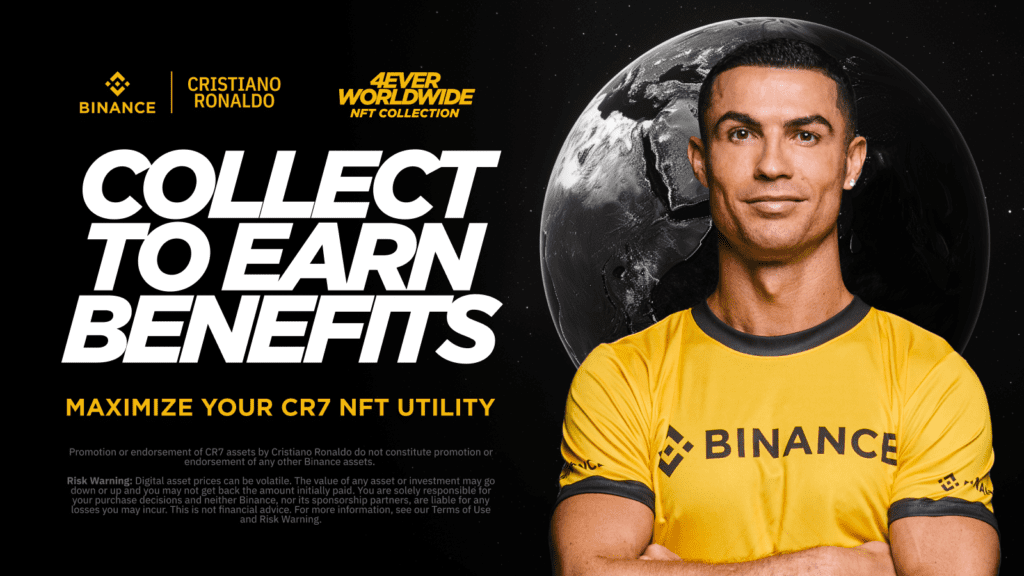
Their success actually led to another scheduled drop for 2023, culminating in a fourth drop, “Forever Worldwide: The Road to Saudi Arabia,” launched on 29 May 2024.
That collection featured another seven NFTs tied to various milestones in Ronaldo’s career (from Madeira and Lisbon to Madrid, Turin, Saudi Arabia, and Portugal) and used a “Collect to Earn” system rewarding users who accumulated more CR7 NFTs.
Their marketing strategy was genius, offering perks varying by rarity, like
- A personal message from Cristiano Ronaldo
- Autographed CR7 x Binance merchandise
- Guaranteed access to future CR7 drops
- Complimentary CR7 Mystery Boxes and entry into giveaways
Binance also offered “Cristiano Ronaldo Mystery Boxes” to up to 1.5 million new users who registered with the referral code “RONALDO” and passed KYC checks. These boxes could contain limited‑edition Ronaldo NFTs, directly tying user acquisition to the campaign.
Cristiano Ronaldo framed the partnership as fan‑focused, saying it was important to “create something memorable and unique” that “rewards fans for all the years of support.”

When the SEC stepped in, Cristiano found himself in a class action lawsuit.
Plaintiff Michael Sizemore, Mikey Vongdara, and Gordon Lewis allege that Cristiano Ronaldo
“illegally engaged in the mass solicitation of unregistered securities on behalf of embattled crypto exchange Binance.“
The new Binance lawsuit centered on three main claims.
- Mass solicitation of unregistered securities
The complaint says Ronaldo’s reach and popularity made him uniquely effective in “mass solicitation” for Binance, a platform the complaint characterizes as having “facilitated billions of dollars of unregulated cryptocurrency transactions,” including hundreds of millions involving users subject to U.S. sanctions. - Measurable marketing impact
According to the filing, searches for Binance rose by up to 500% in the week after the first CR7 NFTs launched—evidence, plaintiffs say, that the campaign “was incredibly successful” in driving traffic and new users. - Kickbacks and undisclosed compensation
that “given Ronaldo’s investment experience and resources, he should have been aware of the potential risks associated with Binance’s practices.” They cite SEC disclosure requirements that obligate celebrities to reveal payments received for promoting cryptocurrencies. Something Ronaldo failed to do.
The class action seeks damages and legal fees for U.S. users who say they were induced, through Ronaldo’s promotions, to use Binance and invest in products they now argue were unlawful securities offerings. During the entire endorsement, Binance had well over 100 million global customers and approximately 1.47 million U.S. users with access to its digital asset services.
Ronaldo’s defense and motion to dismiss
Ronaldo’s legal team moved to dismiss the case, arguing that the complaint “fails to properly allege” that the Portuguese soccer star violated any laws or specifically targeted Florida residents.
Additionally, the plaintiffs “did not state a claim for relief against Ronaldo specifically” and failed to demonstrate injuries “traceable to any conduct or statements of Ronaldo.”
Finally, Ronaldo’s defense cited how the plaintiffs merely copied claims from a separate Binance lawsuit the exchange was involved in but tailored the accusation to Ronaldo. Their focus was protecting the celebrity endorser and ensuring that the exchange should face the class action lawsuit, not their client.
On May 4, 2024, Judge Roy Altman denied Ronaldo’s motion to dismiss “without prejudice,” allowing the Binance lawsuit to proceed while pausing proceedings pending an arbitration decision. That means the case remains alive, and that courts are willing to scrutinize whether celebrities performed adequate due diligence before promoting crypto platforms.
How Binance lawsuits slipped into its celebrity endorser
Binance has had several run-ins with regulators, and somehow we can’t say this particular case is an isolated legal attack. During the period Ronaldo promoted the platform, Binance was operating what prosecutors would later characterize as a “sham crypto platform that has allowed fraud and violation of federal money laundering laws.”
[inline_related_posts title=”Related” title_align=”left” style=”grid” number=”2″ align=”none” ids=”” by=”categories” orderby=”rand” order=”DESC” hide_thumb=”no” thumb_right=”no” views=”no” date=”no” grid_columns=”1″ post_type=”” tax=””]
Within the same month as the Ronaldo lawsuit, Binance CEO Changpeng Zhao (CZ) pleaded guilty to willfully violating federal anti-money laundering laws. This led to $4.3 billion in penalties and forfeitures, plus a personal $50 million fine for CZ, who stepped down as CEO and faces a potential prison sentence of up to 18 months.
Court documents reveal that various enforcement actions have frozen U.S. dollar withdrawals from certain Binance-related platforms at times.
Furthermore, the SEC has pursued a separate enforcement case alleging unregistered securities sales and other violations.
SEC disclosure requirements and NFT promotion liability in focus
While the lawsuit is civil, not criminal, it is grounded in U.S. securities law concepts that now surround every celebrity crypto endorsement.
For instance, the SEC has repeatedly warned that celebrities must clearly disclose “the nature, source, and amount” of any compensation they receive for promoting crypto assets. Cristiano Ronaldo failed to account for this aspect, which gives plaintiffs a significant legal advantage. This also related back to the SEC’s 2022 settlement with Kim Kardashian for promoting crypto without disclosure (resulting in a $1.26 million penalty).
The question over whether NFTs are securities is still highly debated. While the case didn’t focus on the classification of NFTs, it did argue that NFT campaigns are a gateway to push fans into Binance’s other products that are more obviously at issue in existing SEC cases. Still, any court analysis here could influence future views on NFT promotion liability.
A Test Case for the Influencer Economy
The Cristiano Ronaldo Binance lawsuit is not just a simple case of one deal going wrong. Influencers and celebrities have become a go-to marketing option for many industries, including the crypto economy. The case is a high-stakes test of how U.S. securities law applies to the influencer-driven marketing that dominates cryptocurrency adoption.
There are gaps in celebrity crypto endorsement regulation, with current rules poorly suited to complex, multi-product platforms where the line between legitimate promotion and securities solicitation blurs. No one is above the law, least of all cryptocurrency, an entirely new financial system with the potential to outpace any prior system but still has plenty of ambiguity.
Whatever the final ruling, this case is already reshaping how lawyers, marketers, and talent agents think about celebrity crypto endorsement deals, especially those built around NFTs and exchange referrals. For fans, it’s a reminder that even when a promotion looks like pure fandom, financial and legal risks may be close behind.
Discover more from Web3Africa
Subscribe to get the latest posts sent to your email.

You must be logged in to post a comment.