












Table of Contents
A striking data point from NoOnes’ internal research exposes a crack in the Western narrative about stablecoin adoption in Africa. While USDT usage on the platform surged from roughly 35% to 60% of all trades over two years, crypto virtual card uptake remained completely flat over the same period.
The divergence is a window into how Africans actually use crypto, and it contradicts almost every assumption fintech operators make about emerging-market users.
Capital Preservation Trumps Global Spending
Local users aren’t treating stablecoin use cases the way Silicon Valley pitch decks imagine. They’re not building “global spending freedom.” They’re running a two-step survival strategy: receive or buy USDT as a hedge against local currency devaluation, then cash out USDT to mobile money the moment they need to pay a bill, send money home, or buy airtime.
Nigeria’s naira lost more than 70% against the dollar between 2023 and 2025. Kenya’s shilling, Ghana’s cedi, and most regional currencies followed similar arcs. Against that backdrop, holding USDT is more capital preservation.
But spending that USDT via a NoOnes virtual card means walking into a fee labyrinth and friction tunnel that makes little sense when M-Pesa, MTN Mobile Money, and local P2P rails offer instant, trusted liquidity.
Why Virtual Cards Lose to MoMo Every Time
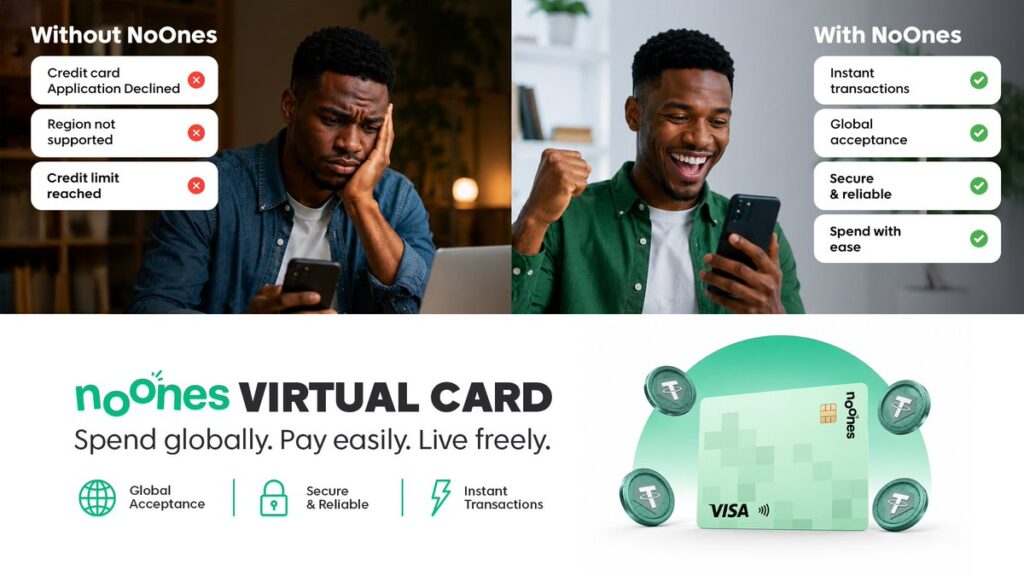
Consider the cost stack for an African freelancer paid $100 in USDT who wants to spend it via NoOne’s virtual Visa USD card:
- Undisclosed USDT-to-USD conversion spread at card load (industry norm: 1–2%)
- 3% + $0.50 cross-border fee on every non-US transaction
- $500 cumulative deposit cap without Level 3 address verification
- US billing address workaround (a shared Miami address in help docs) that triggers fraud flags at Stripe, PayPal, and Shopify merchants
- Auto-deactivation after three failed transactions, with a $1 termination fee
Contrast that with the MoMo path: trade USDT peer-to-peer on NoOnes, receive local currency in your mobile wallet in under 10 minutes, and pay any merchant or person in your economy instantly, with fees you understand.
The GSMA reports that $1.4 trillion flowed through mobile money in sub-Saharan Africa in 2025. Virtual cards are trying to compete with the most liquid, most trusted digital rail on the continent.
The Illusion of Mass Market E-Commerce
Virtual cards solve a real problem for a narrow user segment: SaaS subscriptions, cloud hosting, Facebook Ads, and Upwork payouts. Freelancers and digital entrepreneurs who bill internationally need dollar-denominated cards.
RELATED: Why Nigeria and South Africa Dominate Global Stablecoin Utility
But they are not the mass market. The majority of stablecoin adoption in Africa is driven by informal traders, remittance recipients, and savers trying to escape inflation, none of whom need to pay a Californian software company.
No one’s own data confirms these findings. If card usage stayed flat while stablecoin trading doubled, it means users found the dollar-holding feature valuable but the dollar-spending feature irrelevant.
For crypto operators, stop designing for imagined global citizens. Design for local liquidity preferences. The most successful stablecoin product in Africa will closely integrate with mobile money APIs rather than relying on Visa’s merchant network.
For policy analysts: African crypto adoption is about monetary escape. The real competition is actually inflation.
For global card programs expanding to Africa: unless you solve KYC friction, fee transparency, and cross-border decline rates, you’re building for the 5%, not the 50%.
The paradox isn’t that Africans love stablecoins but hate cards. It’s that the West keeps confusing survival tools with spending toys.
Discover more from Web3Africa
Subscribe to get the latest posts sent to your email.

You must be logged in to post a comment.