








Table of Contents
The crypto market has recently been in turmoil, with the latest being a forced short liquidation wiping out $648.3 million in bearish positions within 24 hours. The end result propelled Bitcoin briefly above $85,000 for the first time since January.
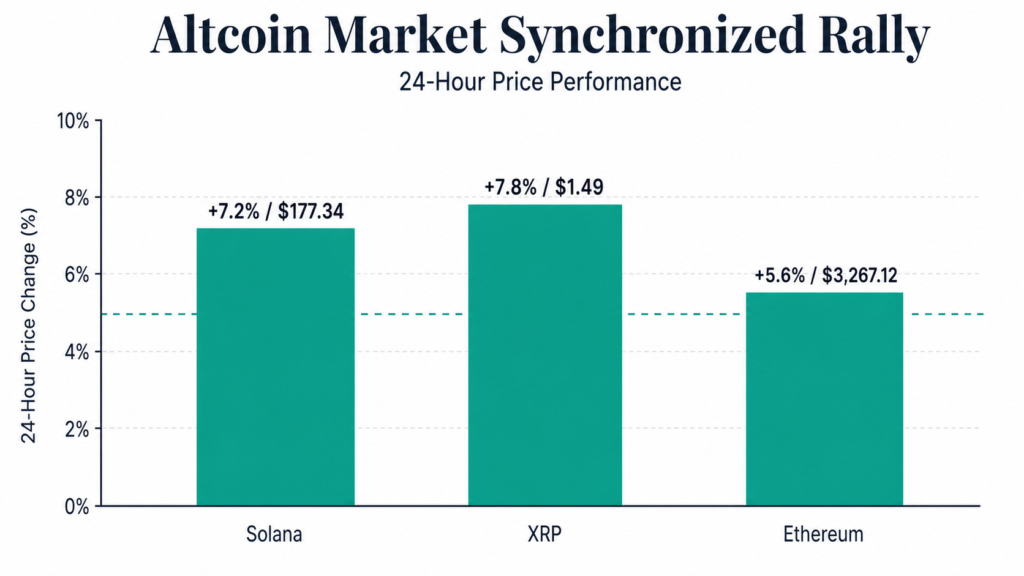
This might be good news for some traders, but it also led to a synchronized outperformance of high-throughput settlement rails like Solana (+7.2% to $115.75), XRP (+7.8% to $1.49), and Ether (+5.6% to $2,717).
Even as short positions collapsed, total open interest rose to $156 billion, indicating that institutional traders were reloading risk rather than exiting. When enterprise blockchain payment infrastructure relies on variable-priced native tokens for settlement, these sudden expansions in market capitalization directly alter treasury requirements.
The Working-Capital Math Behind Cross-Border Settlement
To understand the P&L impact of Layer-1 volatility on African fintechs, the analysis must shift from token prices to working capital math.
Our focus will mainly be on the working capital math rather than the token prices. Think of it as a practical application.
Consider a standard $50,000 B2B cross-border transaction. Legacy SWIFT or correspondent banking rails incur direct costs of 1.5% to 3.5%, alongside a 1% to 3% FX spread. But the true institutional burden is the working capital cost. In sub-Saharan Africa, the cost of capital typically ranges between 18% and 22%, so locking funds in a three-day settlement window costs treasuries roughly $70 to $150 in trapped float per transfer.
CHECK OUT: Beyond the Dollar: How Flatcoins Aim to Fix Stablecoins’ Biggest Flaw
A business processing 20 such settlements monthly saves upward of $14,790 annually in pure working capital costs by migrating to instant Layer-1 finality.
However, a 7% surge in L1 asset prices in a single day sends ripples throughout the market. The immediate assumption is that higher token prices equals increased prices and profits. The data suggests otherwise.
Even at September 21 peak prices, the median network fee on Solana was just 5,000 lamports (roughly $0.00058), while the XRP Ledger (XRPL) minimum base fee stood at 10 drops ($0.000015). On Ethereum, the daily average gas price sat near 0.6966 gwei, keeping a standard 21k-gas transfer under $0.05.
The primary cost during sudden market expansion is the execution layer. On variable-fee chains, sudden volatility forces automated priority bidding. Furthermore, failed transactions become a hidden tax.
During the 04:00 UTC network peak on September 21, independent block analysis showed Solana recording an 11.2% transaction failure rate. Payment processors must factor retry costs and priority tips into their automated routing logic, as failed executions still consume compute fees.
Altcoin Liquidity, Off-Ramps, and the Local Stablecoin Fix
To absorb this volatility without passing costs to end-users, African fintechs increasingly rely on stablecoin integration backed by maturing Layer-1 liquidity pools.
Currently Africa’s fintech and markets are heavily leaning toward stablecoins, and international blockchain entities are supporting this new narrative.
Over the course of 2026, XRP liquidity climbed 79% year-over-year, while RLUSD balances on the XRPL jumped 642% to $539 million.
This deep on-chain liquidity narrows execution spreads for enterprise tickets.
“A Nigerian trader could convert a naira-pegged stablecoin, like the cNGN, directly into a South African rand stablecoin. The transaction settles entirely on the blockchain, providing a transparent end-to-end audit trail,” noted Moyo Sodipo, co-founder & COO of Busha.
Yet, regional order books present a separate reality. While global BTC/USDT pairs remain highly liquid during surges, regional African fiat pairs focus on our current reality. During the liquidity event, slippage on institutional tickets exceeding $10,000 widened by 1% to 3% on local SOL/NGN and XRP/ZAR fiat books.
Unfortunately, the market operates under different rules, leading to distinct challenges. For the most part, our true latency comes from the fiat off-ramp. This issue is one of the primary drivers behind local stablecoins like ZARU and CNGN. They provide the last step in accessing cryptocurrency for everyday use.
RELATED: Inside the Great Deleveraging and the 2026 Bitcoin price crash
Fortunately, the growth and use of digital currency has enabled many local jurisdictions to upgrade their legal framework. For instance, South Africa’s FSCA has already licensed over 300 crypto asset service providers, and Nigeria’s SEC maintains a consolidated rulebook for digital assets that allows licensed virtual asset service providers to leverage Solana and the XRPL for B2B efficiency.
The recent capital rotation shows that modern African clearing networks no longer face constraints from blockchain throughput or base gas fees. Instead, the competitive advantage now belongs to platforms that can successfully manage regional order book slippage, algorithmically route around failed Layer-1 transactions, and secure resilient fiat off-ramps that do not freeze during market volatility.
Discover more from Web3Africa
Subscribe to get the latest posts sent to your email.