





Table of Contents
When the International Monetary Fund’s First Deputy Managing Director stood before an audience at the University of Cape Town, he delivered a warning that cut against the prevailing narrative in African blockchain circles.
Local stablecoins, often promoted as solutions to digital dollarization, may inadvertently accelerate the phenomenon.
This statement raises a lot of policy questions and can even reframe the whole approach. Currently, proponents and creators of local stablecoins argue that putting domestic currencies on-chain provides a way to preserve monetary sovereignty. Think of it as the best of both worlds since it also captures the perks and gains of blockchain-based payments.
Regulators in Kenya, South Africa, and Nigeria have listened, while Ghana, Tanzania, Uganda, and Zimbabwe are actively listening. But Katz’s speech is not based on pure observation. In fact, the IMF and Bank for International Settlements data backs his statements.
So, do local tokens actually reduce dollar demand, or do they simply provide faster rails for converting into dollars?
The Dollar Dominance No One Disputes
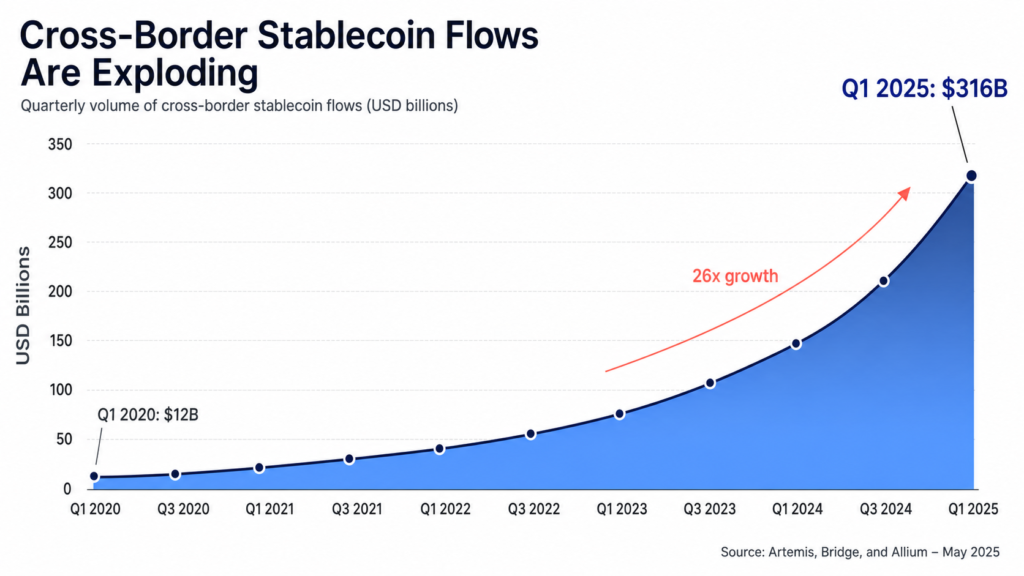
Currently, 99.4% of fiat-backed stablecoins are dollar-pegged, with the combined market reaching approximately $316 billion.
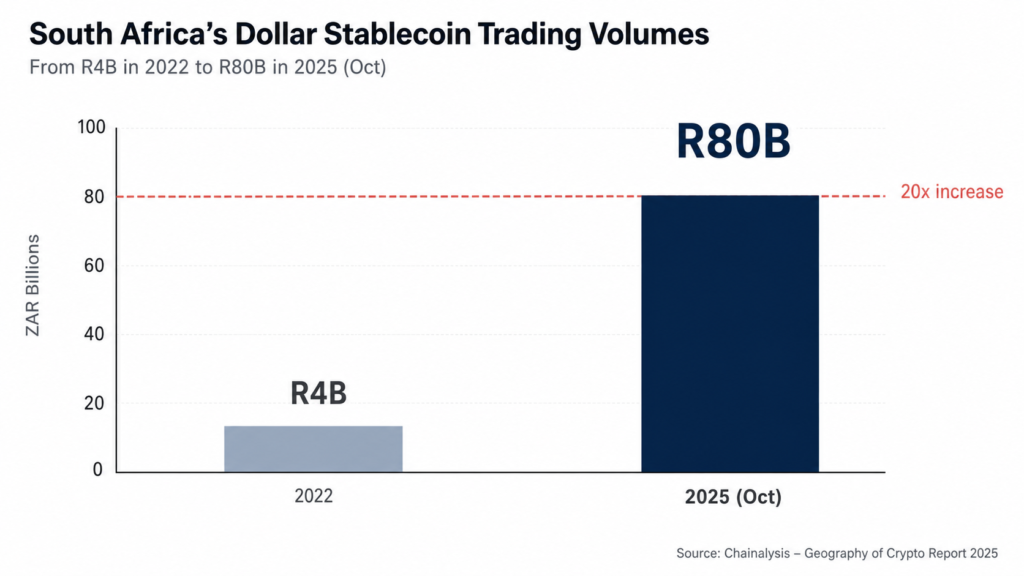
This situation isn’t that much different when we take a look at our market. In South Africa, the South African Reserve Bank revealed that dollar stablecoin trading on domestic platforms rose from under R4 billion in 2022 to roughly R80 billion in the first ten months of 2025.
The IMF’s Global Financial Stability Report estimated gross cross-border flows in the two largest dollar stablecoins rose from $12 billion in the first quarter of 2020 to $316 billion in the first quarter of 2025. A substantial share of these flows went to Africa, where inflation, currency depreciation, and capital controls occur annually rather than being classified as economic crises.
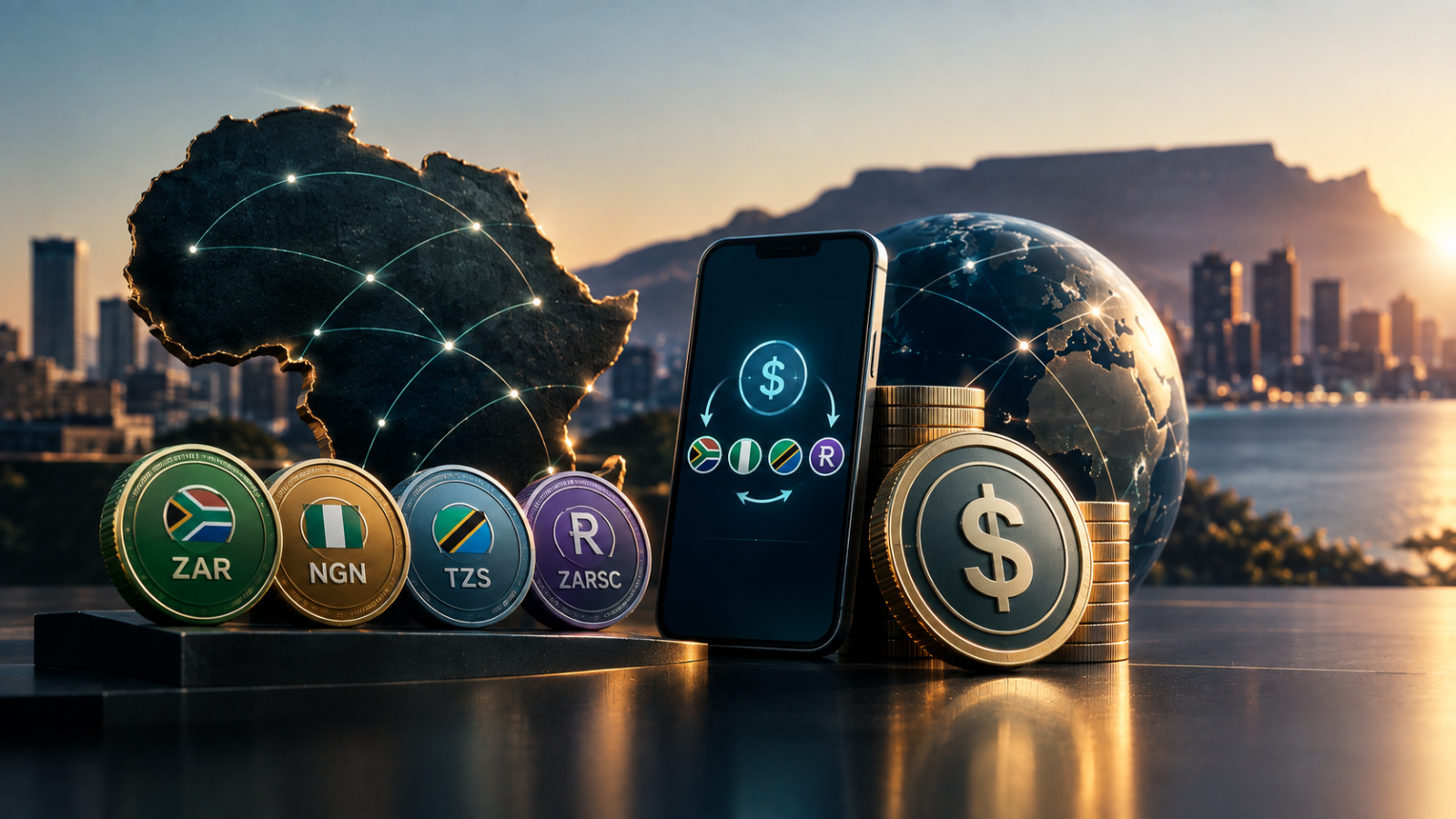
However, local stablecoins also have important functions to fulfill. We will focus on four local stablecoins: South Africa’s ZAR and ZARSC, Nigeria’s NGN, and Tanzania’s TZS. Each one has managed to survive and even thrive despite its value difference when compared to their peers.
Related: ZARU Is a Policy Experiment Wearing a Commercial Product’s Clothes
ZARP reported approximately R74.6 million in circulation, backed by R92.8 million in reserves held with Old Mutual Wealth and attested by independent auditors. Nigeria’s cNGN crossed ₦3.75 billion in reported supply, while Tanzania’s nTZS reached roughly 9.66 million tokens following its April mainnet launch and subsequent entry into the Bank of Tanzania’s regulatory sandbox.
Regulators See Local Stablecoins as a Visibility Tool
For central banks watching deposit bases migrate to offshore-issued dollar tokens, local stablecoins offer something dollar tokens do not: domestic regulatory visibility.
Local stablecoins offer domestic regulatory visibility, a factor many central banks consider. Take Tanzania’s approach into account. The Bank of Tanzania approved the nTZS sandbox pilot in April 2026 with strict conditions.
To ensure its success, it must have no yield distribution without separate written approval, transaction caps of TZS 1 million per transaction and TZS 60 million per month, a maximum of 100 initial users, and all customer-facing interfaces denominated exclusively in shillings. In addition, reserves must remain fully backed 1:1 by shilling-denominated assets, and the token does not constitute legal tender.
Kenya’s Virtual Asset Service Providers Regulations, gazetted in July 2026, impose KSh 300 million minimum capital requirements for stablecoin issuers and assign the Central Bank of Kenya lead authority over issuance and payments. Nigeria’s Securities and Exchange Commission admitted cNGN issuer WrappedCBDC Ltd. into its Regulatory Incubation program in August 2024, months before the Investment and Securities Act 2025 formalized digital assets as securities.
In each case, the regulatory overseer had to ensure that the reserves were held domestically or with verified custodians and restrict or prohibit passive yield that would compete directly with bank deposits.
Related: African Stablecoins Cannot Scale Without Europe’s Regulatory Trust
South Africa’s Financial Sector Conduct Authority has licensed Supercoin, the issuer of ZARsc, which holds rand reserves in segregated accounts at Absa and uses Fireblocks for custody and Chainalysis for anti-money-laundering screening.
These frameworks give regulators tools the IMF explicitly recommended in its June 2026 report on Nigeria:
“Better data on naira-stablecoin conversions rather than trying to suppress stablecoin use outright.”
Local Tokens Often Become Dollar On-Ramps
Katz’s main warning was about the underlying blockchain infrastructure. When local currency and dollar stablecoins run on the same networks, users can convert between them directly through decentralized exchanges, liquidity pools, or peer-to-peer transactions, bypassing banks and licensed foreign-exchange dealers.
The data actually proves his concern.
HyperFX, an on-chain foreign-exchange protocol built by Nigerian startup Polytope Labs and launched in July 2026, allows businesses to deposit cNGN and receive USDC or USDT through atomic smart-contract settlement.
Between June and mid-September 2026, the protocol settled $3.83 million across more than 1,300 orders. Nigerian payments infrastructure provider Noblocks moved over ₦573 million in cNGN across 45 large orders during the same period, transactions averaging ₦12.7 million, well above retail scale.
Related: Nigeria’s cNGN Stablecoin Launch: Charting a New Digital Currency Path Beyond the eNaira
Many businesses will opt to convert the local stablecoin for USDC on-chain and settle a cross-border invoice in dollars. Frankly, it’s easier, has less paperwork, and introduces you to a market that most banks often delay.
The local stablecoin provides the on-ramp. The dollar stablecoin provides the settlement currency.
David Machuche, founder of NedaPay and architect of nTZS, stated that much of the early demand came from payment service providers, market makers, and businesses managing cross-border liquidity, not consumers.
For a payment company holding idle balances in multiple African currencies, a local stablecoin can turn trapped capital into a programmable on-chain asset that connects to global dollar liquidity within seconds.
This is useful, a bit too useful, and it’s exactly what the IMF warned about.
Stablecoins “do not challenge the international monetary hierarchy. They reinforce it.”
Inflows across 130 economies: more than 70% of cumulative net inflows arrived from non-dollar currencies. This indicates that stablecoins function less as payment rails and more as on-ramps to digital dollars.
Stablecoin regulation can ensure reserves are audited, redemptions honored, and issuers licensed. It cannot, on its own, create demand to hold a local token when users want dollar exposure.
Most African regulators often question whether tightly supervised local stablecoins can serve domestic and intra-African payment corridors effectively enough to reduce reliance on offshore dollar tokens. On the other end, no matter how well regulated, local stablecoins become merely the first leg in a dollarization journey the law cannot prevent.
Nigeria’s eNaira, launched in 2021 as a central bank digital currency, encountered tepid adoption despite official backing. Local stablecoins, issued by private entities under regulatory oversight, may avoid the distrust that hampered the eNaira. However, given inflation and currency depreciation when compared to the benefits, users gravitate toward dollar stablecoins for superior liquidity, global network effects, and seamless cross-border acceptance.
Monetary sovereignty in the stablecoin era may depend less on whether central banks permit local tokens and more on whether they can design incentives that make holding and transacting in local tokens economically rational beyond regulatory compliance.
Until then, the current trajectory is a bit too focused on dollar-pegged stablecoins.
Discover more from Web3Africa
Subscribe to get the latest posts sent to your email.