












Table of Contents
In less than five years, Nigeria’s central bank has moved from banning banks from touching crypto to designing a full stablecoin licensing regime at the heart of its Payments System Vision 2028 (PSV 2028).
On one side, dollar‑pegged stablecoins have become essential infrastructure for Nigerian households, freelancers, importers, and startups. On the other hand, the same rails are accelerating digital dollarization. The shift of savings and transactions from the naira to dollar-linked tokens occurs beyond the direct reach of the Central Bank of Nigeria (CBN).
For African macroeconomists, institutional investors, policymakers, and infrastructure builders, this development is now one of the defining tests of the impact of stablecoins on the Nigerian economy. Can the CBN harness stablecoins to cut remittance costs and ease FX bottlenecks without hollowing out its currency?
All regulatory descriptions and data here reflect public information available up to mid‑2026. Nothing in this article is financial or legal advice.
The Great Policy Reversal From the 2021 Crypto Ban to PSV 2028
The starting point is February 2021. Concerned about money laundering, consumer risks, and speculative excess, the CBN ordered banks and other financial institutions to close any accounts linked to crypto trading.
The ban effectively had severe consequences:
- It severed the formal link between Nigerian bank deposits and crypto platforms.
- This pushed activity into informal, peer-to-peer (P2P) channels, where messaging apps and offshore exchanges coordinated trades.
- It left the CBN with minimal visibility into the rapidly growing on-chain flows.
Later that same year, the CBN launched the eNaira, Nigeria’s central bank digital currency (CBDC). In theory, the eNaira would provide a state‑backed alternative to private crypto, but things took a different direction.
- IMF assessments found that only about 0.5% of Nigerians ever adopted the eNaira.
- Approximately 98.5% of eNaira wallets remained inactive.
- By 2024–2025, public reports indicated the eNaira app had been removed from major app stores, and the USSD code stopped working reliably.
- As of early 2025, eNaira in circulation, at around ₦18.3 billion, amounted to well under 1% of the currency in circulation.
The CBDC failed to address the core economic problem, the rapid Naira depreciation and high inflation. Nigerians did not need a new digital form of a weakening currency. They needed an accessible way to protect their purchasing power and move value across borders.
By December 2023, the CBN quietly reversed the banking ban, allowing regulated institutions to interact with crypto again under stricter risk management rules.
In March 2025, it launched a supervisory pilot for virtual asset service providers (VASPs) that included firms like Flutterwave, Paystack, Koin Koin, and the naira‑backed stablecoin issuer cNGN. In October 2025, Governor Olayemi Cardoso announced a 15‑member task force to design a national stablecoin framework.
PSV 2028, released in mid‑2026, is the culmination of that policy arc. The document mentions stablecoins more than 60 times and sketches a full architecture for regulated fiat‑backed tokens, reserve rules, and on‑chain supervision.
RELATED: The New Battle for Control Over Stablecoin Reserves
The anatomy of Nigeria’s stablecoin boom
Grassroots Utility as a Savings and Payments Rail Beyond Speculation
Nigeria is one of the largest crypto markets globally by transaction volume. Between July 2024 and June 2025, the country received roughly $92.1 billion in crypto‑asset value, according to Chainalysis. IMF work on Nigeria’s crypto sector notes that:
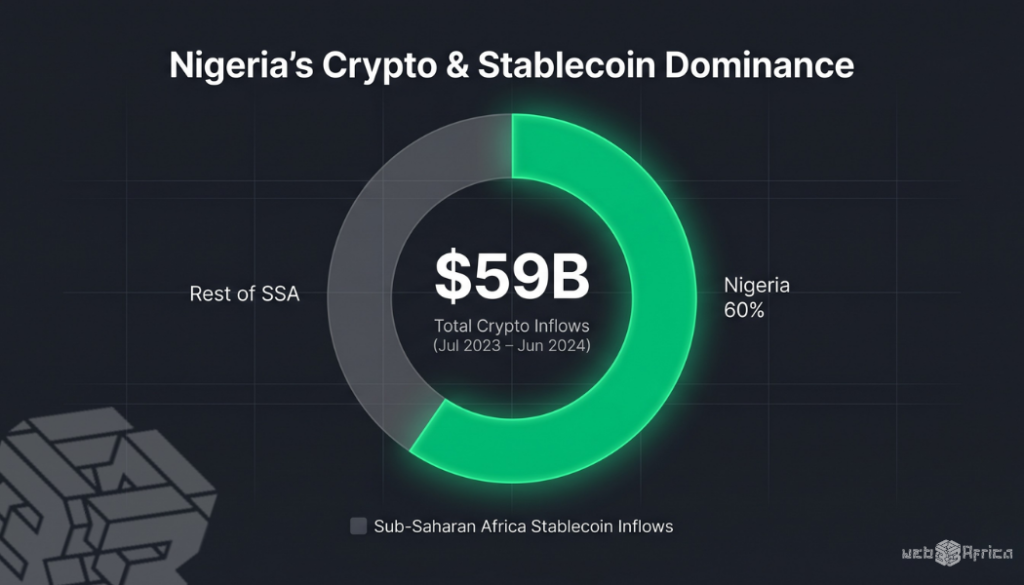
- Stablecoins now account for over 65% of Nigeria’s crypto inflows.
- Nigeria accounts for about 60% of all stablecoin inflows into Sub‑Saharan Africa.
- Tether’s USDT and Circle’s USDC dominate activity.
This goes beyond simple day trading:
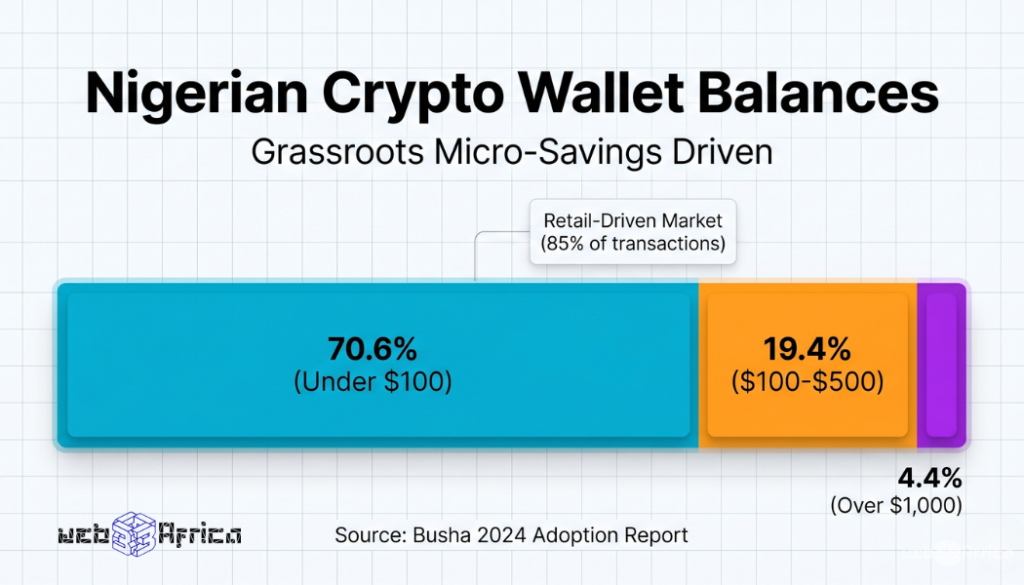
- Recent adoption research suggests about 26 million Nigerians now own or use digital assets.
- Only around 14% are active traders, while the vast majority use crypto, especially stablecoins, for savings, remittances, and everyday payments.
That reality sits at the core of why Nigerians are saving in USDT and other stablecoins.
How Naira Depreciation Acted as the Macro Driver Fueling the Flight to USDT
Using CBN and market data:
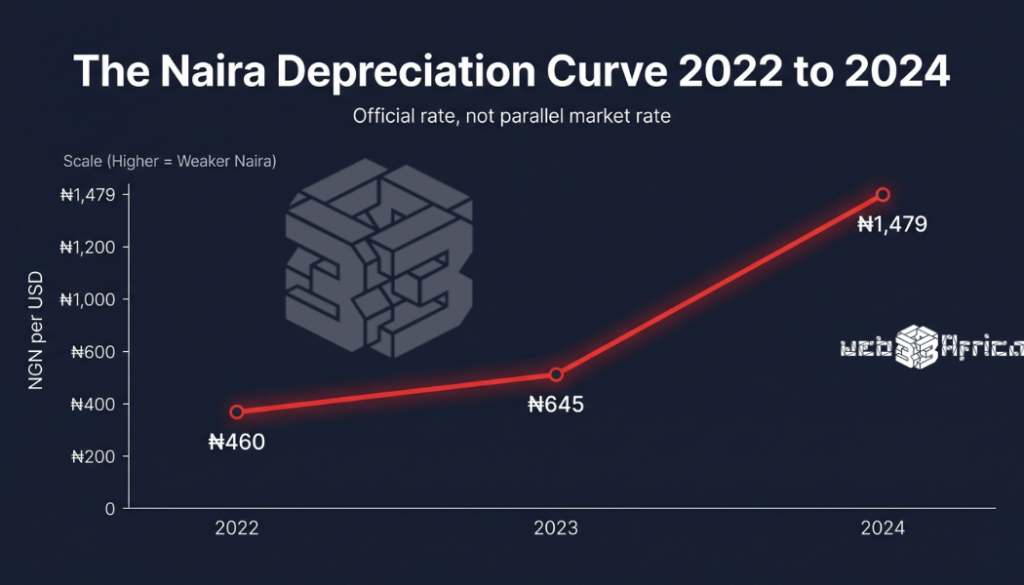
- In 2022, the naira traded at roughly ₦460 per USD on official markets.
- By the end of 2023, it had slid to about ₦645 per USD, roughly a 51% annual loss on some measures.
- 2024 was way worse, with the naira depreciated by around 129% over the year, closing near ₦1,479 per USD.
In just two years, the currency lost well over 80% of its value against the dollar. Inflation eroded local purchasing power, and salary increases and bank deposit rates lagged behind.
This scenario creates a simple calculus for a middle-income Nigerian professional receiving payment in naira:
- Keep savings in naira and watch real value melt.
- Or convert spare cash into dollar‑pegged tokens like USDT and USDC, even if that means dealing with P2P markets and FX spreads.
From a macro perspective, this is rational currency substitution in response to Naira depreciation.
RELATED: Senate Warns Unclear Crypto Stance Crushing Naira Against Global Currencies
Real World Utility Across Remittances, Freelance, Payroll and Trade Settlement
Stablecoins now intermediate a broad range of real‑economy flows:
- Household remittances: Nigeria receives about $21 billion in remittances annually. Sending $200 through traditional channels to Sub‑Saharan Africa costs an average of 8.78% in fees, according to the World Bank. By contrast, blockchain‑based stablecoin transfers often cost a few cents plus FX costs on the on‑/off‑ramps.
- Freelancers and remote workers: Nigerian software developers, designers, and writers serving global clients increasingly request payment in USDT or USDC. Converting from dollar stablecoins to naira locally can be faster and cheaper than navigating correspondent banking frictions.
- Businesses and importers: SMEs use stablecoins as working capital and for cross‑border settlement, particularly when suppliers insist on “dollar or dollar‑equivalent” terms.
Functionally, stablecoins have become an unofficial dollar payment and savings rail operating in parallel with the banking system.
P2P rates as a shadow inflation gauge
Because much of this activity runs through offshore exchanges’ P2P desks, the USDT/NGN rate in those markets has become a de facto sentiment barometer. When confidence in policy weakens or FX supply tightens, the P2P rate typically moves first, often diverging from the official rate.
For many Nigerians, Kenyans, and South Africans, this P2P dollar‑stablecoin rate is a more credible, real‑time signal of naira health than any official index. It basically serves as a “shadow central bank” indicator of expected inflation and devaluation.
That is precisely why the stablecoin boom worries both the CBN and the IMF.
The Mechanics of Displacement and How Digital Dollarization Actually Works
The IMF stablecoin report for Nigeria and its 2025 departmental paper on digital payments in Sub‑Saharan Africa introduced the term “digital dollarization” to describe what is happening in markets like Nigeria.
At a mechanical level, three things matter.
Currency substitution and deposit displacement
When a Nigerian converts naira into USDT:
- They transfer naira (often via P2P) to someone in Nigeria who holds or can access dollar stablecoins.
- That counterparty sends them USDT on‑chain, which is ultimately backed by dollars or Treasuries held by a foreign issuer.
- The recipient may then hold USDT as savings, use it for payments, or cash out later.
Over time, this behavior:
- Reduces demand for naira deposits in local banks.
- Increases demand for offshore dollar assets (the reserves backing stablecoins).
- It encourages businesses to use dollars or their digital equivalents for pricing and bookkeeping.
Standard Chartered has estimated that, at a global scale, dollar stablecoins could eventually displace up to $1 trillion in deposits from emerging market banking systems.
For a country like Nigeria, where banks intermediate credit and the CBN relies on that system for monetary transmission, such a scenario is a recipe for economic disaster.
Seigniorage and fiscal space
Seigniorage is the profit a government earns from issuing currency. In essence, seigniorage is the difference between the cost of creating money and the value of the assets it acquires in return.
RELATED: Governor Kganyago delivers a stark warning on the future of South African money
IMF research suggests African countries derive seigniorage income worth around 1.0 to1.5% of GDP annually. As residents shift their store of value away from domestic money into dollar stablecoins, part of that income stream effectively migrates:
- To the issuers of those stablecoins, who invest reserves in interest‑bearing dollar assets like US Treasuries.
- Indirectly, to the US government, which now benefits from additional demand for its debt.
For Nigeria, already fiscally constrained, erosion of seigniorage further reduces budgetary room for maneuver.
Weaker monetary policy transmission and faster capital flight
Finally, once a significant share of savings and payments is denominated in private dollar tokens:
- CBN interest rate decisions have less impact on real economic decisions.
- On-chain markets can bypass domestic liquidity conditions.
- Capital can exit more easily, meaning Nigerians can move wealth into USDT and then into offshore exchanges without touching the formal banking system.
The IMF warns that, in this configuration, widespread use of USD stablecoins can “amplify capital flow volatility, deepen currency substitution (dollarization), and weaken the effectiveness of monetary policy.”
The question PSV 2028 tries to answer is, can you tame these dynamics by regulating the rails without destroying their usefulness?
Inside the CBN PSV 2028 Blueprint to Absorb the Stablecoin Boom
PSV 2028 does more than simply “allow stablecoins.” It sketches an entire architecture aimed at capturing their utility while re‑anchoring them to Nigeria’s monetary framework.
Classifying and licensing stablecoins
The CBN proposes a classification framework that distinguishes the following:
- Fiat‑backed stablecoins
Fully collateralized by naira or foreign currency reserves, intended for payments, remittances, trade facilitation, and tokenized deposits. These are the focus of PSV 2028. - Asset‑backed stablecoins
These stablecoins are backed by commodities or securities, which carry greater price and valuation risk. These would sit under stricter transparency and valuation rules.
RELATED: The New Rules for Stablecoin-Based Trade Settlement in Nigeria
For fiat‑backed instruments used in Nigeria, the CBN wants:
- Explicit licensing of issuers.
- 100% reserve backing in “high‑quality liquid assets” (cash, T‑bills, short‑term sovereign paper).
- Daily reserve reconciliation and real‑time attestations.
- Monthly audits and legally enforceable redemption obligations.
- Robust AML/CFT compliance and Travel Rule adherence.
The CBN is seeking legislative amendments so that fully fiat‑collateralized stablecoins are treated as monetary instruments, not securities. That would place them squarely under central bank oversight, even as the Investments and Securities Act 2025 (ISA 2025) gives the SEC jurisdiction over many other digital assets.
The Onshore Liquidity Play Using Domestic Custody and FX Buffer Strategies
PSV 2028 also reveals a deeper macro objective of turning stablecoin reserves into a partial extension of Nigeria’s FX buffers.
The blueprint proposes that:
- Naira‑denominated stablecoins must hold 100% of their reserves domestically with licensed Nigerian custodians.
- For foreign‑currency‑denominated stablecoins (especially USD), a minimum share of reserves should be held within Nigeria’s banking system, with the remainder in approved foreign custodians and short‑term sovereign instruments like US Treasuries.
The logic is twofold. For starters, if some of the dollars backing stablecoins are held in Nigerian banks, the CBN can monitor and potentially influence those balances during stressful situations.
Furthermore, over time, these onshore reserves could form a regulated, transparently backed liquidity buffer to support trade and remittances. Such a system would therefore complement conventional reserves, which were roughly $50.4 billion in mid-June 2026.
The privately issued naira‑backed cNGN, launched in early 2025 and pegged 1:1 to the naira, is an early testbed for this model. As of June 2026, it had around ₦2.3 billion in circulation across roughly 4,800 wallets. Modest next to USDT volumes but important as a regulatory proof of concept.
Restoring Visibility Through the CBN On-Chain RegTech Surveillance Gambit
Perhaps the most novel feature of PSV 2028 is its “RegTech node” architecture.
Instead of relying solely on periodic reports from issuers, the CBN envisages running observer nodes on approved blockchains. These nodes would:
- Monitor issuance, redemption, and circulation of regulated stablecoins in real time.
- Track reserve‑related smart‑contract events.
- Provide “tamper‑evident” audit trails of flows relevant to monetary and prudential oversight.
Technically, this approach is different from third‑party blockchain analytics. It embeds the supervisor directly into the transaction fabric of permissioned or permission‑aware networks. It’s more akin to the BIS mBridge project or aspects of the EU’s MiCA reporting proposals.
The goal is to reverse the visibility loss created by the 2021 banking ban. Then, by cutting banks off from crypto, the CBN inadvertently drove most crypto activity into opaque P2P channels.
RELATED: CBN Deputy Director Explains NFC Integration for Digital Currency
With on‑chain RegTech nodes informing supervisory dashboards, the bank hopes to move from lagging, paper‑based supervision to continuous, data‑driven oversight.
There are limits:
- The CBN can only see what happens to chains and contracts that fall under its licensing regime.
- Unregulated tokens and pure P2P OTC trades will still escape direct view.
But from the CBN’s perspective, partial visibility over large, regulated stablecoin channels is better than near‑total blindness.
Balancing IMF Warnings with Local Realities to Answer the Sovereignty Question
The IMF’s engagement with Nigeria over stablecoins operates on two levels.
At the technical level, staff reports and working papers urge Nigeria to:
- License stablecoin issuers under robust prudential standards.
- Coordinate closely between the CBN and SEC.
- Monitor the share of stablecoin activity in total transactions and savings.
At the macro level, the Fund worries that unchecked stablecoin growth will entrench digital dollarization, making future balance‑of‑payments and inflation shocks harder to manage.
In its 2026 Article IV consultation and dedicated analysis of crypto markets in Nigeria, the IMF:
- Highlights that stablecoins already dominate Nigerian crypto flows.
- Warns that widespread use of dollar‑denominated tokens outside the formal banking system can increase capital flow volatility.
- Flags risks to seigniorage, monetary transmission, and even fiscal stability if digital dollar assets become a de facto retail savings medium.
Nigeria’s authorities broadly accept the need for strong oversight but have pushed back on some IMF characterizations. For example, Nigeria’s authorities have raised concerns about the term “multiple currency practices” in previous foreign exchange frameworks, arguing that the IMF underestimates local constraints.
Across the continent, similar concerns echo. South African Reserve Bank governor Lesetja Kganyago has warned that if African countries allow private stablecoins to dominate without adequate safeguards, some could “actually lose monetary sovereignty.”
The CBN’s PSV 2028 is fundamentally an attempt to domesticate a technology Nigerians are already using at scale.
A Framework for Anticipating Future CBN Policy to Navigate the Tightrope
For institutional readers trying to assess the future impact of stablecoins on the Nigerian economy, the key is to watch the interaction between macro stress and regulatory stance.
Indicators that matter
Several data series will likely shape future policy choices:
- Exchange rate and Naira depreciation
Big and ongoing differences between the official exchange rate and the P2P USDT/NGN rate, or another devaluation, will make digital dollar savings more important in politics. - FX reserve levels
Rapid reserve drawdowns reduce the CBN’s room to accommodate capital outflows, making restrictive measures on dollar stablecoins more likely. - Stablecoin penetration
Growth in stablecoin transaction volumes (especially as a share of M2 or bank deposits) will be watched closely. Persistent increases in USDT/USDC usage for domestic savings, rather than just cross-border payments, raise concerns about digital dollarization. - Banking system indicators
If deposit growth stalls while on‑chain stablecoin balances and P2P volumes surge, concerns about deposit displacement and credit intermediation will intensify. - Use‑case mix
The more stablecoins are used for remittances and trade settlement (flow use cases), the easier it is to manage risks. The more they serve as long‑term savings (stock use case), the harder it becomes to reverse digital dollarization.
Three Plausible Regulatory Scenarios for 2026 and Beyond
Depending on how those indicators evolve, several broad scenarios are plausible:
- Scenario A: Relative stability, gradual integration
If the naira stabilizes and inflation moderates, the CBN is likely to proceed with controlled pilots. This includes regulated naira and dollar stablecoins for low‑value remittances and trade, strict onshore custody rules, and full RegTech integration. Over time, regulated rails could displace unlicensed P2P flows without heavy‑handed bans. - Scenario B: Renewed FX shock and rapid digital dollarization
Another sharp devaluation and spike in P2P USDT/NGN premiums would likely trigger tighter controls. Higher reserve ratios, caps on foreign‑currency stablecoin holdings for residents, more aggressive KYC on on‑/off‑ramps, and possible moral‑suasion campaigns against “dollar tokens” for domestic savings. - Scenario C: Strong domestic digital alternatives
If a revamped eNaira or widely adopted naira stablecoins emerge as credible, low‑friction savings and payment instruments, pressure to hold USDT purely as a hedge could ease. In that world, the CBN may tolerate or even encourage dollar stablecoins for specific cross-border corridors while keeping domestic digital money firmly anchored in the naira.
Why Nigeria Cannot Tame Stablecoins Without Fixing the Naira
Nigeria is now a global test case for how an emerging-market central bank manages digital dollarization in real time.
For citizens and businesses, stablecoins have become a rational survival tool in the face of severe Naira depreciation and FX frictions.
For the CBN and IMF, the same technology threatens to relocate savings, seigniorage, and monetary control offshore.
RELATED: Nigeria’s Crypto Boom: IMF Warns of FX Risks & Urges Tighter Regulation
PSV 2028 is an ambitious attempt to reconcile these realities. License fiat‑backed stablecoins as formal monetary instruments, pull part of their reserves onshore, and supervise them through on‑chain RegTech rather than blunt bans.
Whether this strategy can “tame” the stablecoin boom ultimately hinges on factors beyond crypto policy. As long as Nigerians believe that holding digital dollars is safer than holding naira, flows to USDT and similar tokens will continue, regulated or not.
This illustrates that the question is no longer whether to regulate stablecoins but how to do so in a way that preserves monetary sovereignty without denying citizens the tools they now rely on to protect their financial lives.
Discover more from Web3Africa
Subscribe to get the latest posts sent to your email.
You must be logged in to post a comment.