











Table of Contents
African stablecoins address real problems, particularly in Africa and other emerging markets. These stablecoins facilitate remittances, cross-border trade settlements, and treasury management in volatile currencies.
But the money and banking systems needed to support these transactions are still mainly based in Europe and North America, protected by rules that African regulators can’t yet duplicate.
Yellow Card’s June 24 announcement that it had secured regulatory AML affiliation in Switzerland through a supervised financial intermediary is not just a corporate milestone. It is a structural admission: African crypto utility cannot exist in isolation from European regulatory legitimacy.
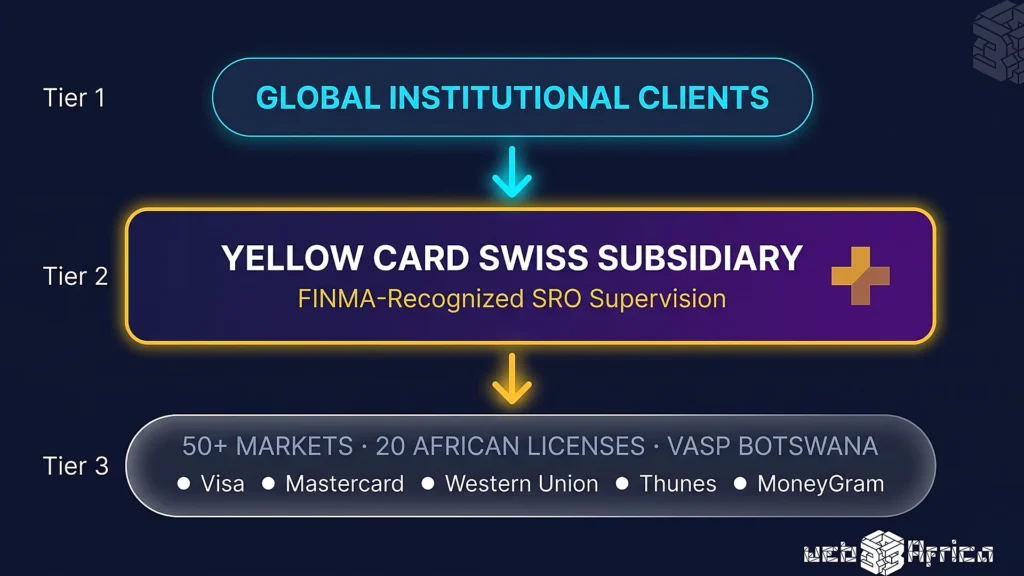
The company is establishing a permanent base in Lugano and opening a Swiss subsidiary led by Olpha Bribech, a French lawyer from its senior management team. The entity will serve as the regulated gateway for institutional clients seeking access to Yellow Card’s stablecoin infrastructure across more than 50 emerging markets.
This is stablecoin regulation in practice, but it’s a hard constraint imposed by global banking systems.
The Regulatory Shortcut That Global Banks Already Trust
Yellow Card’s approval is an AML affiliation under Switzerland’s Self-Regulatory Organization (SRO) model, governed by the Anti-Money Laundering Act (AMLA).
This is not a full FINMA banking license. It does not grant automatic access to Tier-1 correspondent banking relationships. The 27 member states of the European Union do not grant MiCA passporting rights.
RELATED: Securing Multinational Treasury Liquidity Across Africa via Swiss Compliance Frameworks
What it does provide is FINMA-recognized supervision, a regulatory status that global banks and institutional counterparties already trust.
Switzerland’s SRO model allows crypto firms to operate as supervised financial intermediaries without the capital requirements or multi-year timelines of direct FINMA licensing.
To be a member of a recognized SRO like VQF or PolyReg, a Swiss company must have at least CHF 20,000 to CHF 100,000 in capital, a director who lives in Switzerland, an AML officer, and must follow Switzerland’s AML/CFT rules. Application timelines run three to six months.
For Yellow Card, the Swiss entity functions as a compliance bridge. Institutional clients interact with a FINMA-supervised counterparty in a jurisdiction already integrated into European banking networks. Underneath are the operational infrastructure, licenses across 20 African countries, VASP registration in Botswana, and partnerships with Visa, Mastercard, Western Union, Thunes, and MoneyGram.
As General Counsel Craig Stoehr put it:
“Switzerland holds financial intermediaries to one of the highest regulatory standards in the world, and our Swiss subsidiary was built to meet these standards. Combined with the licensed infrastructure already in place across our global network, this provides our partners a rare combination of regulatory confidence and real operational reach.”
Why Institutional Capital Still Avoids African Crypto Rails
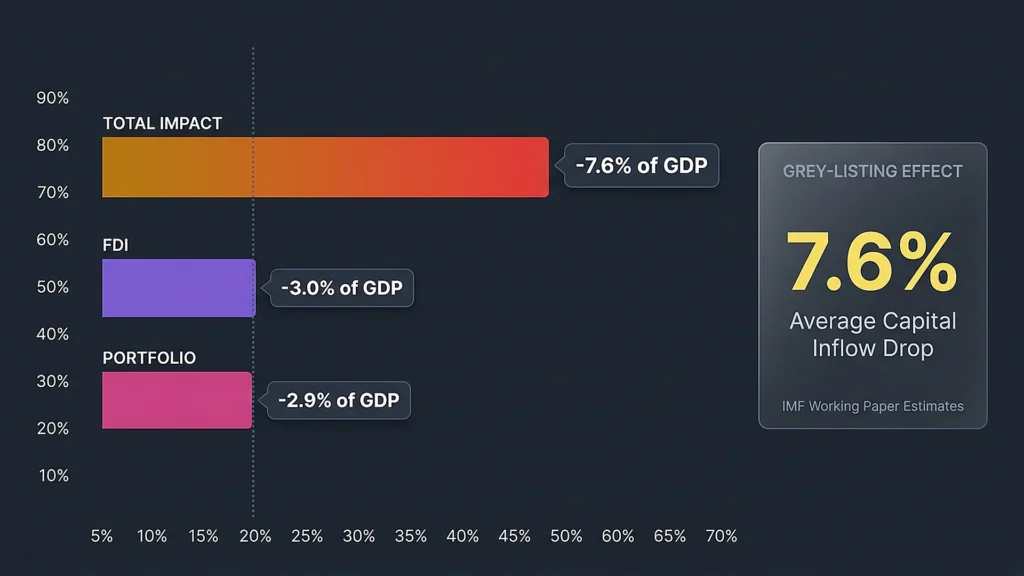
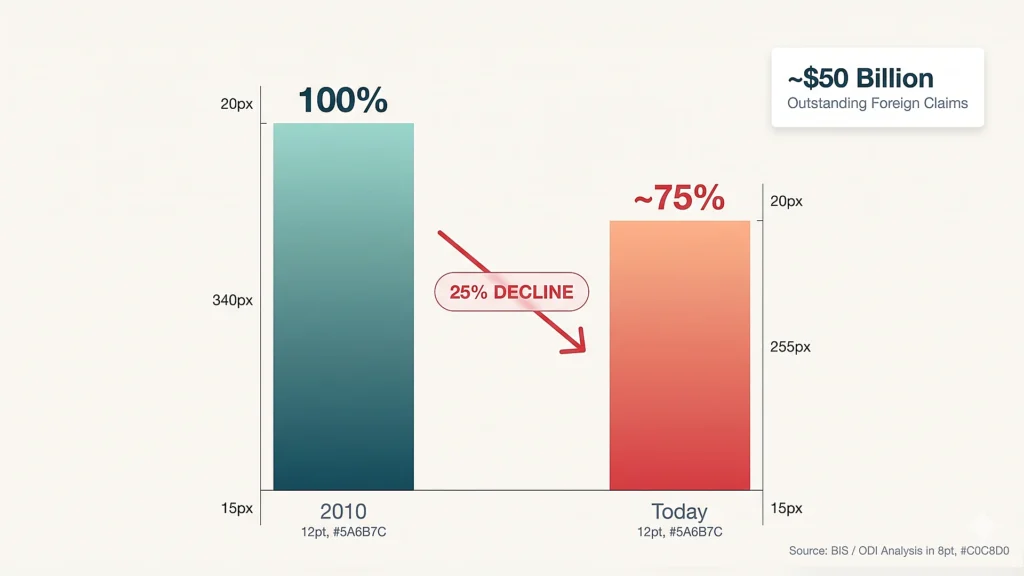
Correspondent banking relationships in Sub-Saharan Africa have declined by more than 25% over the past decade, according to multiple IMF and World Bank studies. When a country is grey-listed by the Financial Action Task Force (FATF), capital inflows drop an average of 7.6% of GDP, driven largely by banks severing ties with institutions unable to demonstrate comprehensive AML/CFT coverage.
RELATED: IMF Warns, but Kenya Leads: Shape Africa’s Crypto Revolution
For fintech companies in Africa that are developing stablecoin systems, this situation creates a Catch-22:
- They need Tier-1 global banking partners to move institutional capital into and out of African markets.
- Tier-1 global banks will not be counterparties with entities regulated solely in African jurisdictions, regardless of the quality of local frameworks.
- African regulators, however well-intentioned, cannot provide the institutional trust global banks require.
This is not a critique of African regulation. It is a description of how global banking risk management actually works.
Yellow Card’s solution is to borrow institutional credibility from a jurisdiction already recognized by global capital. The Swiss entity becomes the single point of contact. Global banks evaluate the Swiss regulatory wrapper, not the complexity of 50+ emerging-market licenses underneath.
CEO Chris Maurice explained the logic plainly:
“Stablecoins have become critical infrastructure for global institutions, and compliant access to the rails and payments is a requirement for companies looking to utilize this technology. Our Swiss subsidiary gives them a regulated, supervised counterparty for accessing our global stablecoin infrastructure.”
The MiCA Factor and European Compliance Pull
The EU’s Markets in Crypto-Assets Regulation (MiCA) has accelerated this dynamic. As of July 1, 2026, any firm operating in or serving the European Union must hold a MiCA license or cease offering crypto services.
RELATED: How Strict Stablecoin Regulation Is Reshaping African Business Payments
This creates direct exposure. Any exchange, OTC desk, or payment processor that settles transactions through European platforms now faces a significant compliance problem. Fiat on- and off-ramps routed through European payment institutions may require dual licensing under both MiCA and PSD2.
European crypto compliance is no longer optional for African operators hoping to access institutional capital. Ripple’s June 2026 preliminary MiCA license in Luxembourg, secured just days before the deadline, came on the heels of a strategic investment in African payments firm Flutterwave, explicitly aimed at bringing its RLUSD stablecoin to African markets.
BVNK, a major stablecoin infrastructure provider, scaled to $30 billion in annualized processing volume in 2025, driven by enterprise adoption. The firm holds both MiCA authorization (via a CASP license in Malta secured in February 2026) and an Electronic Money Institution (EMI) license (operational in the UK and EU). This allows it to provide regulated stablecoin and fiat payment services across the European Economic Area and United Kingdom.
European licenses signal to institutional counterparties that AML/CFT controls meet global banking standards. A single African regulatory framework has not yet achieved the same level of institutional credibility.
Inside Lugano’s Bid to Become Europe’s Stablecoin Capital
Yellow Card’s choice of Lugano is strategic. The city has positioned itself as a blockchain-friendly municipality within Switzerland’s broader crypto ecosystem. Since launching the Plan ₿ initiative with Tether in March 2022, Lugano has accepted Bitcoin and Tether for municipal taxes, parking fees, and public services. Over 400 local merchants now accept crypto payments.
More substantively, Lugano has issued multiple blockchain-based bonds on the SIX Digital Exchange. This includes a CHF 100 million bond in May 2025 that was settled via Swiss National Bank wholesale CBDC under Project Helvetia.
The bonds carry Moody’s ‘Aa3’ ratings and are approved for the SNB’s General Collateral Basket. This is proof that blockchain instruments can meet institutional-grade standards without introducing additional risk.
In March 2026, Tether and Lugano announced Plan ₿ Phase II (2026–2030), expanding the focus from payments to institutional infrastructure for digital asset management, digital trade settlement, and privacy-preserving identity systems.
For the Yellow Card, Lugano offers more than favorable regulation. It offers proximity to an emerging ecosystem where stablecoin infrastructure, municipal finance, and institutional digital asset adoption already coexist under FINMA oversight.
The Dependency Risk Nobody Wants to Name
But anchoring African stablecoin infrastructure to European regulatory frameworks introduces systemic vulnerabilities.
If Switzerland or the EU changes its regulatory stance, African fintechs relying on European subsidiaries could face sudden disruption. If several African companies set up similar businesses in Europe, African regulators might impose rules to limit money leaving the country or require foreign companies to register locally.
Johnson P. Asiama, Governor of the Bank of Ghana, told the IMF in December 2025:
“When I began my career 30 years ago, fintech and crypto didn’t exist. Today, they pose real challenges. My priority is to build an agile central bank with the manpower, agility, and resilience to manage future risks, crypto today, and something else tomorrow.”
His comments reflect a regulatory capacity gap that the MiCA impact on African crypto companies makes painfully visible. African regulators understand the risks. They lack the resources, cross-border enforcement mechanisms, and institutional banking relationships to provide the compliance infrastructure global capital demands.
Yellow Card is pioneering a model that acknowledges this reality. Whether that model proves sustainable, or whether it reinforces a dependency that limits African regulatory sovereignty, remains an open question.
FAQ Section
Why do African stablecoins need European regulation?
The article argues that global banks and institutional investors place greater trust in established European regulatory frameworks, making them an important gateway for institutional capital despite African stablecoins serving local markets.
What role does Switzerland play in African stablecoin infrastructure?
Switzerland provides a FINMA-recognized supervisory framework that allows firms like Yellow Card to present a regulated counterparty to international banks and institutional clients.
How does MiCA affect African crypto companies?
Firms serving European customers or relying on European financial infrastructure increasingly need MiCA compliance to maintain market access and institutional relationships.
Discover more from Web3Africa
Subscribe to get the latest posts sent to your email.

You must be logged in to post a comment.