










Table of Contents
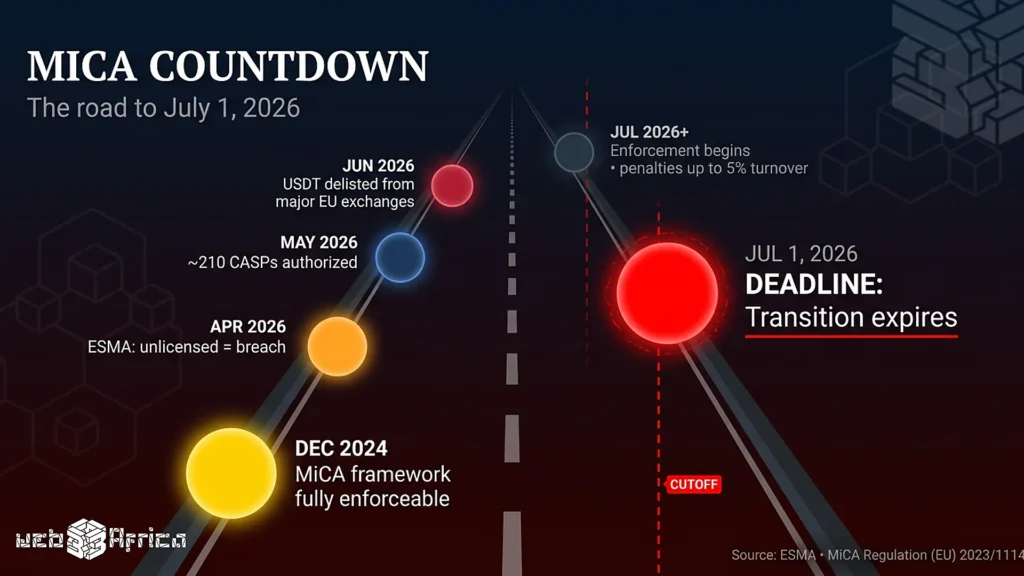
Europe just showed the world what tough VASP regulation looks like in practice. On July 1, 2026, the European Union’s transition period for its Markets in Crypto-Assets (MiCA) regime expired, forcing every crypto business serving EU clients to hold a full regulatory license or shut down.
The result? Only around 210 firms out of more than 1,200 pre-MiCA registered entities successfully converted to authorized crypto-asset service provider (CASP) status, a conversion rate of roughly 17%.
So for Africa, our focus should be on whether local frameworks will follow Europe’s aggressive licensing model or chart a different path and what that choice means for those who get to build, compete, and survive under evolving African crypto regulation.
Inside Europe’s Eighty Percent Market Attrition Under MiCA
The European Securities and Markets Authority (ESMA) made the consequences clear in its April 2026 supervisory statement: “After this date, any entity providing crypto-asset services to EU clients without a MiCA license will be in breach of EU law.” Unlicensed providers were required to wind down operations, offboard clients, and transfer assets to authorized CASPs or self-hosted wallets.
The numbers tell the story of consolidation. Germany holds 53 authorized entities. Malta hosts 13, including OKX, Crypto.com, and Gemini. Estonia, once home to 641 licensed VASPs in 2021, dropped to just 40 by early 2025. At least 30 smaller platforms confirmed EU exits due to unsustainable crypto licensing and operational compliance costs, which exceed €500,000 annually for large exchanges.
RELATED: How The NFRC Will Unify Nigerian Fintech Regulation Rules.
MiCA just raised the bar and installed a vault door. Minimum capital requirements range from €50,000 for advisory services to €150,000 for trading platforms. Every crypto transfer, regardless of size, triggers Travel Rule data collection and transmission requirements.
Stablecoins must meet strict reserve, governance, and reporting standards. Tether’s USDT, the world’s largest stablecoin, was delisted from every major EU-licensed exchange because it lacks MiCA authorization.
The result is a smaller, more concentrated, and institutionally compliant market. Coinbase, Kraken, Bitstamp, and Bitpanda hold passportable licenses that cover all 27 EU member states. Binance, the world’s largest exchange, faces potential exclusion after Greece’s regulator was set to reject its application, though Binance publicly disputes the decision and maintains it has met compliance requirements.
Tracking the Shifting Velocity of Africa’s VASP Regulation
African crypto regulation is moving in the same direction, but at a different velocity and with different constraints.
South Africa leads the continent with the most comprehensive framework under the Financial Advisory and Intermediary Services Act. The Financial Sector Conduct Authority (FSCA) had approved 248 licenses as of December 2024, according to industry trackers, a permissive regime compared to Europe’s 17% survival rate.
Nigeria made a significant pivot with its April 2025 Investment and Securities Act, formally recognizing digital assets as securities. The Accelerated Regulation Incubation Program (ARIP) has approved major exchanges, including Quidax and Busha. Yet Nigeria’s regime remains largely AML/KYC-first, with minimal prudential or reserve requirements, particularly for stablecoins.
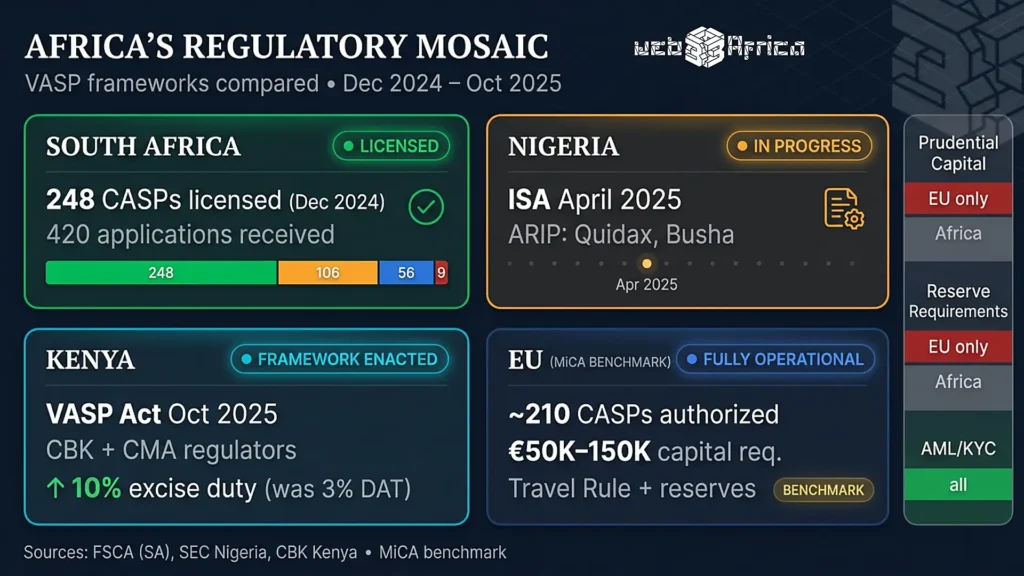
Kenya passed its Virtual Asset Service Providers Act in October 2025, assigning licensing authority to the Central Bank of Kenya. The country abolished a controversial 3% digital asset tax in July 2025, replacing it with a 10% consumption tax on VASP fees.
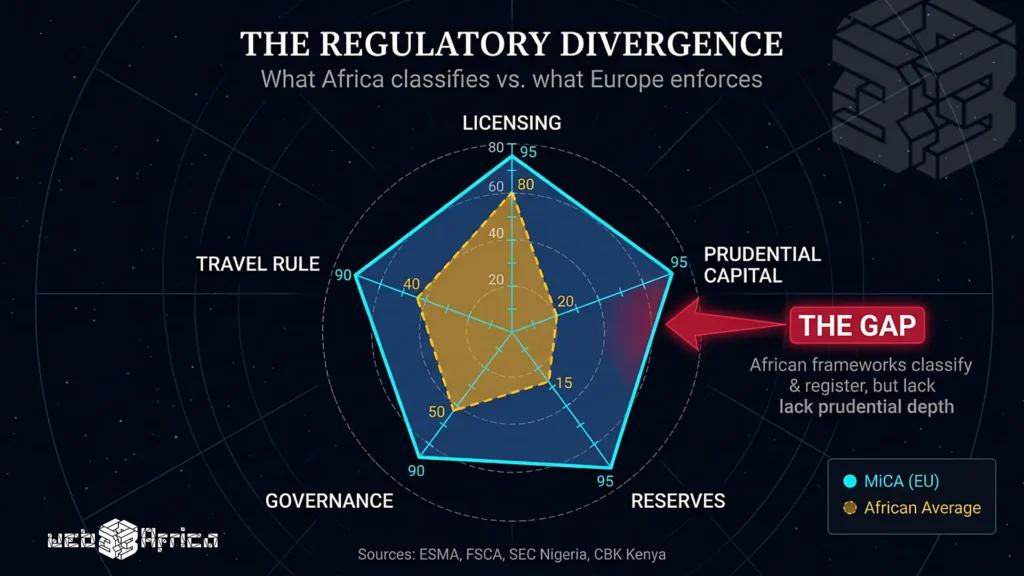
South Africa and Nigeria were removed from the FATF grey list in October 2025, signaling meaningful regulatory progress. But the key difference from MiCA remains: African frameworks classify and register, but they do not yet impose the comprehensive prudential capital, governance, or reserve requirements that Europe now enforces EU-wide, making it clear how MiCA differs from African crypto regulation.
How European Exchange Delistings Disrupt African Cross-Border Settlement
Sub-Saharan Africa’s record-breaking $200 billion is an incentive for growth. Nigeria alone accounts for 40% of regional stablecoin inflows.
This creates direct MiCA exposure for African firms. Any exchange, OTC desk, or fintech that uses a European platform for settling transactions now has a significant problem. Their primary instrument is unavailable on EU rails approved for crypto licensing.
European counterparties that didn’t get CASP licenses by July 1 have to stop working, which means African businesses need to check if their partners are approved, change how they send stablecoins, or use MiCA-approved options like USDC and EURC.
Preparing for the Economic Inevitability of Selective Policy Adoption
African regulators are unlikely to copy MiCA wholesale. The continent’s fragmented banking infrastructure, limited supervisory resources, and developer-stage fintech ecosystems argue against it. But selective adoption and stricter VASP compliance for African fintech founders around stablecoins, capital thresholds, or Travel Rule enforcement are already visible in Nigeria’s ISA and South Africa’s FSCA diagnostics.
The lesson from Europe is that strict regulation alters the ability of firms to afford innovation. MiCA concentrated the EU market among well-capitalized, compliance-ready firms. If African regulators follow that logic and implement top-heavy VASP regulation without adapting it to local realities, the 80% cull could repeat here, not as policy, but as economic inevitability.
The regulatory stress test has already begun. The question is whether your operating model, counterparty network, and compliance infrastructure can pass it.
FAQ
What is MiCA regulation in Europe?
MiCA is the European Union’s comprehensive crypto‑asset regulation. Adopted in June 2023, it became fully applicable on 30 December 2024. It sets uniform rules across all 27 EU member states for crypto issuers, exchanges, and service providers—covering areas like investor protection, market integrity, and anti‑money laundering. However, MiCA does not apply to traditional securities, NFTs, loyalty tokens, CBDCs, or assets issued by public entities.
Which economy has established the markets in crypto-assets MiCA regulation?
MiCA was established by the European Union, making the EU the first major economy worldwide to have a complete, harmonized rulebook for digital assets.
Which country has the best crypto regulation?
The EU offers the most comprehensive framework via MiCA; Singapore is praised for its structured approach under the Payment Services Act, the UAE is frequently ranked among the most crypto‑friendly jurisdictions in 2026, Kazakhstan has been recognized by IOSCO as a leader in digital asset regulation; and El Salvador stands out for adopting Bitcoin as legal tender. Each has its own strengths, so “best” is subjective.
Which nine major European banks collaborate to launch a MiCA-compliant euro stablecoin in 2026?
In September 2025, nine major European banks announced a joint effort to launch a MiCA‑compliant euro stablecoin. The original nine were:
ING (Netherlands)
Banca Sella (Italy)
KBC (Belgium)
Danske Bank (Denmark)
DekaBank (Germany)
UniCredit (Italy)
SEB (Sweden)
CaixaBank (Spain)
Raiffeisen Bank International (Austria)
Since then, the consortium—operating under the name Qivalis—has expanded significantly. BNP Paribas joined in December 2025, and by May 2026 the group had grown to 37 bank members. The stablecoin is expected to launch in the second half of 2026, pending approval from the Dutch Central Bank (DNB).
Discover more from Web3Africa
Subscribe to get the latest posts sent to your email.
You must be logged in to post a comment.