











Bitcoin is currently trading near $59,600, roughly 50% below its all-time high of $126,272 set in October 2025. For retail traders accustomed to historical patterns, the pain feels familiar.
The structural infrastructure of the asset class has fundamentally changed, even as price charts often rhyme. Understanding the current Bitcoin correction requires looking beyond red candles to see how ETF liquidity, capital reallocation, and macroeconomic policy have rewritten the rules of engagement.
Analyzing historical Bitcoin market cycles reveals that we have officially transitioned from an era of internal contagion to an era of external macroeconomic correlation.
Editor’s Note:
The Debasement Trade Explained
In macroeconomic terms, the “debasement trade” is an investment strategy where capital flows into hard assets (like gold or Bitcoin) to hedge against the devaluation of fiat currency caused by central bank money printing or prolonged inflation. In 2026, as the Federal Reserve unexpectedly held rates higher for longer (3.50%-3.75%), the urgency of the debasement trade cooled, triggering a rotation back into yield-bearing assets.
Why Every Major Bitcoin Crash Has Been Driven by a Different Trigger
To understand where the market is going, financial operators must recognize exactly where the selling pressure originates. A detailed Bitcoin cycle comparison of the last three major downturns reveals distinct, non-repeating catalysts. When analyzing the Bitcoin crashes of 2018 vs. 2022 vs. 2026, the structural differences highlight a rapidly maturing asset class.
Bitcoin’s 2018 Collapse Was a Pure Speculation Washout
The 2018 bear market was crypto-native through and through. Driven by the collapse of speculative initial coin offerings and regulatory crackdowns, the 84% drawdown was fueled by retail capitulation. There was no institutional cushion. Traditional finance widely dismissed Bitcoin market cycles as speculative manias, and recovery took nearly three years.
RELATED: Inside the Expanding African Bitcoin Ecosystem
Hidden Leverage Turned the 2022 Bear Market Into a Systemic Crisis
The 2022 collapse was a crisis of interconnected credit. Triggered by Terra/Luna’s $60 billion implosion in May 2022 and exacerbated by the FTX fraud in November 2022, this 73–77% drawdown (from a $3 trillion peak to $800 billion) was driven by dangerous levels of hidden leverage.
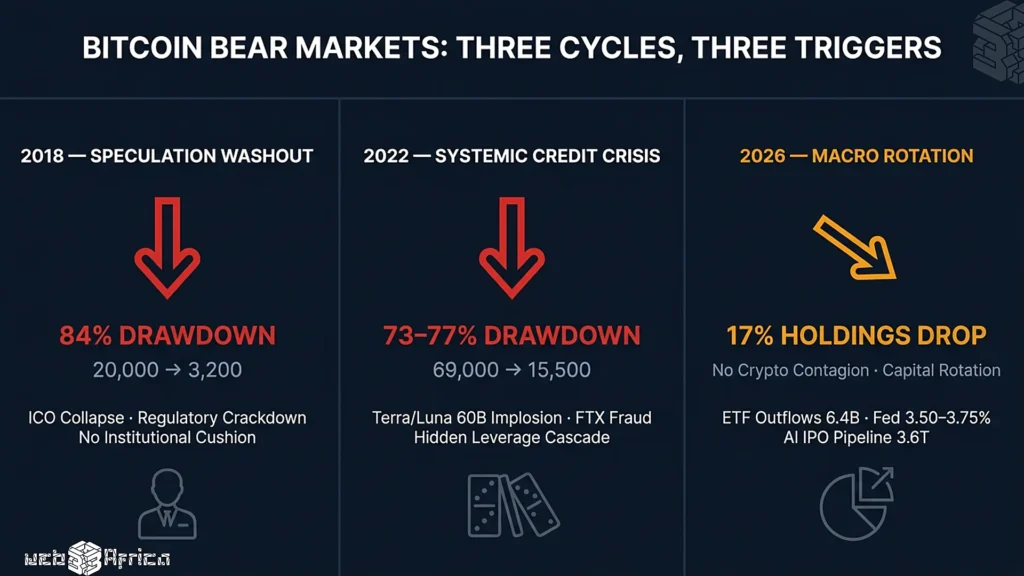
This includes the use of non-collateralized native tokens as loan collateral and opaque algorithmic stablecoin mechanisms. Centralized lenders caused a cascade of liquidations. Yet, crucially, this remained a crypto-specific contagion event; traditional equities functioned normally while digital assets burned.
The 2026 Drawdown Began When Wall Street Found Better Opportunities
The current downturn represents something fundamentally new. This is the first major bear market driven strictly by tactical reallocation. The catalyst is not a crypto failure but a capital rotation by professional portfolio managers responding to shifting risk-on preferences. To understand modern Bitcoin market cycles, one must look at Wall Street’s competitive asset classes rather than on-chain leverage.
Following the Money Behind Bitcoin’s Largest ETF Exodus
Unlike past Bitcoin market cycles, the 2026 drawdown is mechanically driven by the very infrastructure that legitimized the asset: spot ETFs. Since their launch, ETFs created new channels for accumulation. In mid-2026, those channels reversed with unprecedented force.
RELATED: Inside the Great Deleveraging and the 2026 Bitcoin price crash
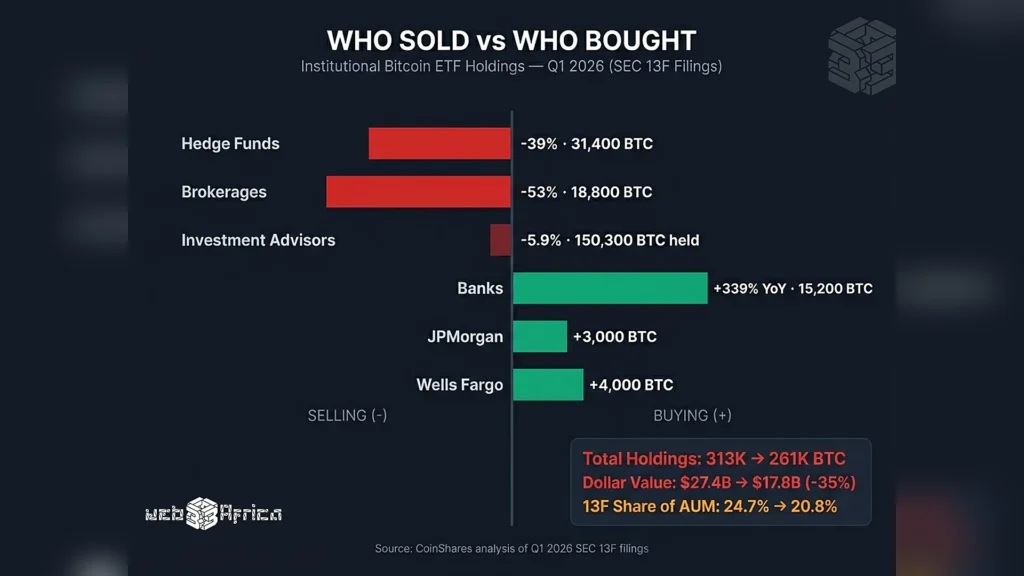
Our investigation into the mechanics of this Bitcoin correction reveals a stark divergence in how professional capital is moving. By analyzing Q1 2026 13F filings from the U.S. Securities and Exchange Commission (SEC) and cross-referencing global ETF flows, a clear picture emerges of institutional investors actively taking profits to fund mega-cap tech investments.
The data points to a highly calculated exit rather than a panic sell-off:
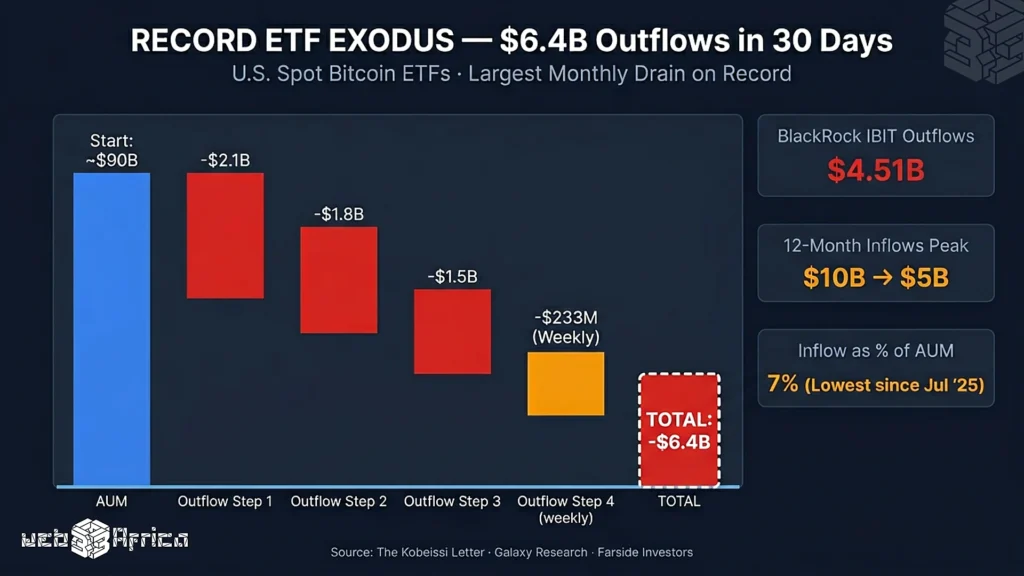
- Historic Outflows: U.S. spot Bitcoin ETFs experienced an estimated $6.4 billion in outflows over a single 30-day period, the largest monthly drain on record.
- Product-Specific Drains: BlackRock’s IBIT led specific daily outflows with $177.7 million on June 23, 2026, while Fidelity’s FBTC actually recorded inflows on that day; historically, FBTC’s outflows have been significantly lower than IBIT’s, rarely exceeding $40 million in a single session during the June 2026 correction.
- Professional Reductions: Total professional holdings fell from 313,000 BTC to 261,000 BTC, representing a 17% quarterly decline.
- Sector Divergence: Hedge funds cut exposure by 39% and brokerages by 53%. Conversely, banks, sovereign wealth funds, and family offices continued accumulating.
The primary driver of these outflows is competitive private market valuation. As select AI and semiconductor equities surged between 80% and over 800% (with leaders like Micron and AMD drastically outperforming NVIDIA’s 100% gain) over the past year, institutional investors pivoted away from high-valuation infrastructure plays toward ‘old economy’ cyclicals and AI productivity beneficiaries amid growing ‘ROI fatigue.’
Mega-IPOs from OpenAI (targeting an $852 billion valuation) and SpaceX ($1.75 trillion valuation) actively absorbed the institutional capital that had previously flowed into digital asset ETFs. Professional portfolio managers now dictate Bitcoin market cycles, treating the asset as one modular option among many rather than a self-contained speculative vehicle.
RELATED: Bitcoin etf options Approval: Bold Move for Crypto Markets
Why Bitcoin’s Institutional Selloff Matters for African Payment Networks
The divergence in Bitcoin market cycles is clear when comparing Western TradFi rotation to emerging market utility. For African markets, the mechanics of this drawdown are critical. Local liquidity on the continent often trails global institutional trends.
When U.S. trading desks unwind positions due to hawkish Fed policy and AI capital rotation, the ripple effect tightens dollar liquidity globally. This directly impacts capital access for African startups, VASP operators, and cross-border traders who rely on stablecoin liquidity pools backed by broader crypto market health.
However, for developers and founders in Africa building B2B payment rails, this shift actually signals underlying stability. The absence of crypto-native contagion (like the platform collapses of 2022) means that the core blockchain infrastructure remains sound despite the negative price action. The rails are working flawlessly; only the capital allocation has shifted.
Bitcoin Has Entered a Market Regime That Never Existed Before
Historically, major bear markets have not bottomed until prices moved near their realized cost basis, currently sitting in the $53,000 to $54,000 range. While proximity to this floor offers psychological support, the ETF structure that enabled mass institutional adoption also enables institutional distribution at scale.
Whether the current correction represents a cyclical reset or a deeper structural repricing depends entirely on global liquidity trends. Navigating future Bitcoin market cycles requires fluency in Federal Reserve policy, 13F institutional portfolio construction, and cross-border settlement realities.
These changing Bitcoin market cycles mean preparing for extended periods of tight global capital, while trusting that the foundational technology has finally evolved past its era of fragile, internal contagion.
Discover more from Web3Africa
Subscribe to get the latest posts sent to your email.
You must be logged in to post a comment.