











TL;DR,
- S&P assigned a speculative-grade B to the first bitcoin treasury company, despite roughly $70B in BTC holdings and negative adjusted capital.
- The rating highlights a critical “currency mismatch”: Strategy’s assets are in volatile Bitcoin, but its massive debt and $640M in annual dividend obligations are in U.S. dollars.
- Strengths include strong market access, equity‑heavy capital stack, and managed maturities; an upgrade likely needs sturdier USD liquidity without abandoning the BTC thesis.
What many consider a historical underdog-to-limelight shift just got a B rating from S&P Global. Strategy Inc., the first bitcoin treasury company, received a blunt review; high bitcoin concentration, narrow business focus, weak risk‑adjusted capitalization, and low U.S. dollar liquidity weigh heavily on credit quality.
Their entire business model around Bitcoin investments is what kickstarted 2025’s “institutional hype.” How did the agency get such a near-cut score?
How S&P Grades a $70 Billion Bitcoin Treasury Company
S&P uses a structured framework when evaluating financial entities. They consider business position, capital earnings, risk positions, and funding and liquidity, which are supplemented by management and governance.
Since a bitcoin treasury company is a novel model, these pillars converge in a unique manner.
FOLLOW UP: Why Altvest Became Africa’s First Publicly-Listed Firm to Add Bitcoin to Treasury Reserve
Business Position: The Bitcoin Concentration Problem
While Bitcoin essentially was the driving factor behind Strategy’s “epic comeback,” S&P has a different opinion, citing it as a “narrow business focus.” Traditional financial institutions often diversify revenue across multiple business lines.
Strategy, on the other hand, has a one-arrow mindset. As a result, the company’s software division generates minimal cash flow, operating at approximately breakeven on both earnings and operating cash flow. According to S&P, the combination of such extreme concentration and the volatility of Bitcoin’s price can lead to disastrous outcomes.
They often prefer a blend of stable, diversified revenue sources and sustainable competitive advantages. Strategy fell short.
Capital and Earnings: Why S&P Disregards Bitcoin in Equity Calculations
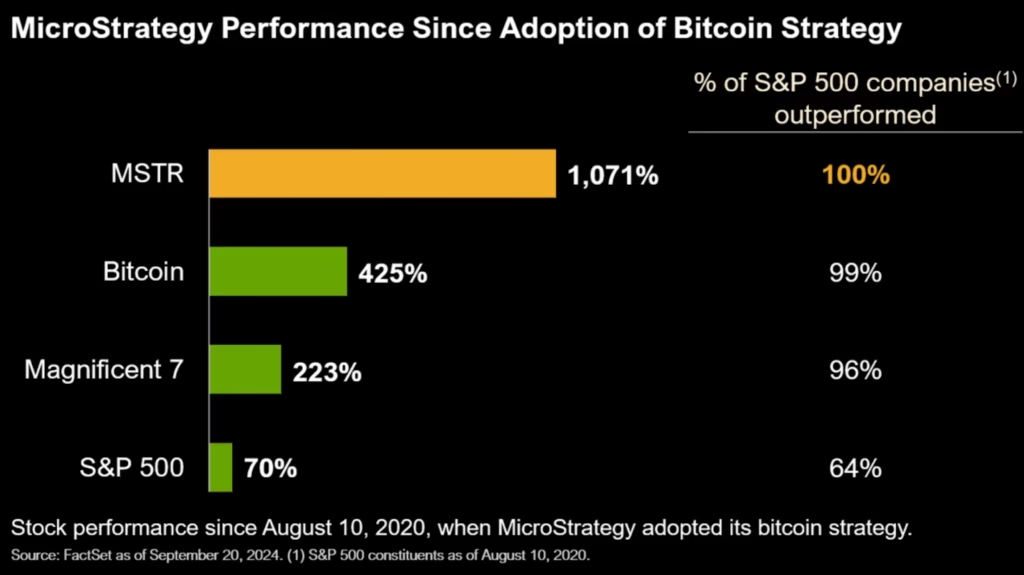
Strategy’s capital positions quickly drained its points further, despite the bitcoin treasury company holding approximately $70 billion in bitcoin. The company registers negative total adjusted capital under S&P’s Risk-Adjusted Capital (RAC) methodology as of the second quarter of 2025.
This disparity is mainly since the agency excludes bitcoin assets from equity calculations due to their “overnight” changes in prices. While the market can sustain itself even with a 50% drop in Bitcoin, it would effectively eliminate the apparent capital cushion that corporate Bitcoin holdings might suggest on a superficial balance sheet review.
To further deduct points, Strategy’s earnings profile reported negative operating cash flow of $37 million in the first half of 2025. The platform did record $8.1 billion in pre-tax earnings during this period, just over $8.1 billion derived from appreciation in the fair value of its bitcoin holdings. However, this had little effect because the gains were unrealized and generated no actual cash flow. Under S&P’s framework, a company cannot rely on operational income to service obligations.
[inline_related_posts title=”Don’t miss this:” title_align=”left” style=”grid” number=”4″ align=”none” ids=”” by=”categories” orderby=”rand” order=”DESC” hide_thumb=”no” thumb_right=”no” views=”no” date=”no” grid_columns=”2″ post_type=”” tax=””]
Risk Position: Paying Dollars with Bitcoin
What S&P categorized as an “inherent currency mismatch” between assets and liabilities was the final factor that led to Strategy receiving a “B-” rating. Strategy maintains a long bitcoin position while holding a short U.S. dollar position. All debt maturities, interest payments, and preferred stock dividends come due in dollars, yet the company holds predominantly bitcoin, investing excess cash into additional bitcoin rather than maintaining dollar liquidity buffers.
This mismatch creates substantial bitcoin liquidity risk management challenges. The agency warned that Strategy’s reluctance to sell bitcoin “increases the likelihood that when the company does have to sell it to generate cash as a last resort, it is likely to do so at severely depressed prices.”
Additional risk factors include heightened cybersecurity concerns. If hackers found their way to Strategy’s private keys, the organization could permanently lose access to portions of its bitcoins. The company manages this risk by utilizing multiple institutional-grade custodians based in the U.S., despite the occasional concentration of its holdings.
Where Strategy Inc. Is Failing
According to S&P Corporate, bitcoin holdings fail at various points.
Dollar Liquidity Shortfall
For instance, Strategy’s most acute vulnerability is its low U.S. dollar liquidity and complete dependence on capital market access. The company’s minimal dollar cash reserves are funneled to its software business operations. They have approximately $640 million in annual preferred dividend obligations and negligible operating income, meaning continuously accessing capital markets through at-the-market equity offerings is a lifeline.
The risks are groundbreaking. Hypothetically speaking, if a severe bitcoin price decline occurs where dollar liquidity needs are greater, investors’ appetite for its securities will evaporate instantly. According to S&P,
“The company will likely keep relying on its ability to raise additional capital via stock, preferred equity, and convertible debt to finance additional purchases of bitcoin, meet debt maturities, and cover debt service costs.”
Convertible Debt Maturity Risk
Strategy holds over $8 billion in notional value of convertible debt, with $5 billion currently out of the money (below conversion price) and maturing beginning in 2028 (a noteholder put right exists in September 2027). S&P identified “liquidity risks” from the possibility that “convertible debt will become due at the same time as a severe bitcoin stress.”

Such a scenario would force Strategy to liquidate bitcoin at depressed prices or restructure its obligations in ways S&P “would consider tantamount to default.”
Preferred Dividend Pressure
As mentioned, Strategy’s preferred equity obligations totaled just over $640 million in annual dividends. On the carry side, its annual convertible debt coupon is just slightly over $35 million.
Two classes (Strife and Strike) each grant preferred holders a board seat if dividends are deferred for four consecutive quarters, with an additional seat after eight quarters. The Strife preferred equity also compounds deferred dividends at a higher rate.
These structural features create pressure to maintain dividend payments regardless of bitcoin price movements or operating performance, forcing continued reliance on equity issuances that dilute existing shareholders and require sustained investor confidence.
The Partial Offsets: The Silver Linings in a B- Cloud
There are a few pointers that made Strategy attain its Bitcoin credit rating.
For instance, the platform demonstrated “strong access to capital markets,” with a market capitalization of approximately $80 billion and nearly $15 billion in combined convertible debt and preferred equity issuances. Strategy has managed convertible debt maturities prudently, maintaining a “no obligations” status within the next 12 months. The platform has also structured its capital stack primarily on equity rather than debt.
FOLLOW UP: Wall Street Meets Crypto Street: Citi-Coinbase Deal Signals $4 Trillion Stablecoin Future.
A B rating also proves that S&P expects the organization to prudently manage maturities of its convertible debt and continue to finance payments of its convertible debt and preferred stock dividends via issuances of debt, preferred equity, and equity. This approach concludes by ensuring sufficient access to capital markets.
As a novel model, the Bitcoin Treasury company has demonstrated the most modest uplift to the credit profile while still showcasing strong management capabilities. Overall, it communicates speculative‑grade risk with a steady hand on maturities. Any future changes to the rating will likely track whether Strategy can translate scale and issuance capability into sturdier dollar liquidity—without undermining the core thesis that made it the pioneering bitcoin treasury company in the first place.
Discover more from Web3Africa
Subscribe to get the latest posts sent to your email.

You must be logged in to post a comment.