











In Brief
The Africa Bitcoin Corporation has become the first publicly traded company on the continent to officially adopt a Bitcoin treasury reserve strategy by accumulating 4.55 BTC on its balance sheet.
By utilizing corporate finance tools like Domestic Medium Term Notes and equity raises, the firm mirrors global pioneers like MicroStrategy to offer shareholders regulated, leveraged exposure to digital assets.
This treasury model actively challenges traditional South African asset management guidance and provides a potential workaround for institutional investors restricted by Regulation 28 of the Pension Funds Act.
Despite an innovative dual-vertical structure that uses profitable SME lending to fund purchases, investors face significant risks including extreme weekly stock volatility, debt coverage concerns, and unproven capital-raise execution.
Africa Bitcoin Corporation (ABC), a Johannesburg Stock Exchange-listed entity formerly known as Altvest Capital, is testing a financial thesis unfamiliar to most African investors.
A public company can transform its balance sheet into a regulated Bitcoin exposure vehicle for shareholders. Recently, ABC disclosed it holds approximately 4.55 BTC, a modest absolute sum, but one accumulated through a deliberate corporate Bitcoin strategy modeled explicitly on global pioneers like MicroStrategy (now Strategy) and Japan’s Metaplanet.
This positions ABC as Africa’s first listed Bitcoin treasury company, a designation supported by the timeline: no other publicly traded African firm disclosed Bitcoin as a strategic treasury reserve ahead of Altvest’s February 2025 announcement.
ABC is leaning into “accumulate BTC as treasury reserve” mechanics, while traditional asset managers such as Sygnia have publicly urged restraint—often framing Bitcoin as something to cap at ~5% of a diversified portfolio because of volatility.
The latest disclosure: 1.35 BTC added, taking the total to 4.55 BTC
ABC’s newest widely reported purchase was approximately 1.35 BTC, taking cumulative holdings to 4.5504 BTC. Reporting indicates the recent coins were acquired at an average price around R1.14 million per BTC and funded through a mix of available cash and a R1.5 million debt facility from an independent third‑party bank.
ABC’s disclosed acquisition trail (via SENS reporting history) shows a stepwise build:
Feb 21, 2025: 1.00464 BTC (initial proof‑of‑concept allocation)
Nov 2025: multiple buys (including via VALR’s OTC desk), pushing holdings above 3 BTC
Feb 2026 (reported mid‑Feb): 1.35 BTC added, bringing total to 4.55 BTC
While 4.55 BTC is small versus global treasury leaders, ABC’s significance is structural: it is attempting to make a listed share function as a regulated on‑ramp to Bitcoin exposure, with corporate finance levers layered on top.
What Africa Bitcoin Corporation Actually Does
ABC operates a dual-vertical structure that distinguishes it from a pure-play Bitcoin fund. On one side sits the Bitcoin treasury. A growing reserve of BTC held as a strategic asset, intended to protect the balance sheet against Rand depreciation and provide shareholders leveraged exposure to Bitcoin’s potential appreciation. ABC tracks “Sats-Per-Share” (SPS), currently about 40 satoshis per share, and reports a non-IFRS metric called “BTC Yield,” which stood at 335% from the February 2025 baseline through early 2026.
RELATED: Why Altvest Became Africa’s First Publicly-Listed Firm to Add Bitcoin to Treasury Reserve
On the other side is Altvest Capital Solutions, ABC’s wholly owned subsidiary managing a private credit and SME lending operation. The Altvest Credit Opportunities Fund (ACOF) has given more than R365 million to more than 30 small and medium-sized businesses (SMEs) in South Africa. The fund has a default rate of less than 1% of assets under management and a three-year track record of high-yield secured lending. For the year to February 2025, the group posted revenue of R7.59 million and profit of R47.94 million, turning profitable in the 2025/2026 fiscal year.
The operating business generates cash flow to fund Bitcoin purchases and provides a regulatory and operational foundation that differentiates ABC from a closed-end crypto fund.
CEO Warren Wheatley stated in February 2025,
“We see Bitcoin as a strategic reserve asset that enhances our treasury portfolio while providing a hedge against economic instability and currency depreciation, particularly the depreciation of the South African Rand.”
The Debate: ABC’s Accumulation vs. Sygnia’s Caution
ABC’s approach stands in sharp contrast to guidance from Sygnia Ltd., South Africa’s largest independent asset manager, which oversees roughly $20 billion. In September 2025, Sygnia publicly recommended that investors limit Bitcoin exposure to no more than 5% of discretionary portfolios due to volatility risk, even as it launched Bitcoin-linked products benchmarked to BlackRock’s IBIT ETF.
ABC’s model concentrates on creating a robust balance sheet through the accumulation of Bitcoin as a primary reserve. In addition, it uses both equity raises and debt (via a R5 billion Domestic Medium Term Note program) to maximize BTC per share.
Their thesis revolves around Bitcoin’s absolute scarcity (21 million coin cap), which makes it superior to cash or bonds in an inflationary environment. Shareholders gain leveraged, regulated exposure to BTC appreciation through equity ownership.
On the other hand, Sygnia’s model treats Bitcoin as a high-risk, high-volatility alternative asset suitable for modest portfolio allocation within a diversified framework. They offer clients access via funds and linked-life products but frame it as one tool among many, not a balance-sheet anchor.
RELATED: Inside the Great Deleveraging and the 2026 Bitcoin price crash
This distinction is vital when considering Regulation 28 of South Africa’s Pension Funds Act, which historically banned direct crypto exposure for retirement funds.
ABC, as a JSE-listed equity in the financial services sector, may offer a workaround. Institutional mandates that prohibit crypto could theoretically hold BAC shares as “listed securities,” gaining indirect Bitcoin exposure.
How the Bitcoin Treasury Model Actually Works
Why would a company pursue this strategy at all?
A Bitcoin treasury company offers investors something neither a direct Bitcoin purchase nor a passive ETF provides. It offers the ability to use corporate finance tools, equity offerings, convertible debt, and leverage to amplify BTC accumulation over time.
The result is a stock that functions as a BTC proxy but with additional dynamics: premiums or discounts to net asset value, governance decisions around custody and risk, and potential for “BTC yield” outperformance if the company raises capital efficiently.
ABC’s playbook mirrors Strategy’s: raise capital when markets are favorable, buy Bitcoin, increase the satoshis-per-share metric, and repeat. ABC disclosed a Phase 1 target of R210 million and a multi-year goal of $210 million (R3.68 billion) in capital raises. In late 2025, it completed an R11 million equity tranche at R11.00 per share, and ACOF announced the R100 million private placement of 10-year domestic medium-term notes in February 2026.
ABC trades on JSE, A2X, NSX, OTCQB, and Frankfurt, with a proposed Aquis Exchange (London) listing under consideration. In January 2026, ABC appointed U.S. investment bank Maxim Group LLC as advisor, allocating up to 4% of shares in tranches at R11 each.
How ABC Compares to International Peers
ABC is tiny compared to global leaders, but the model is the same:
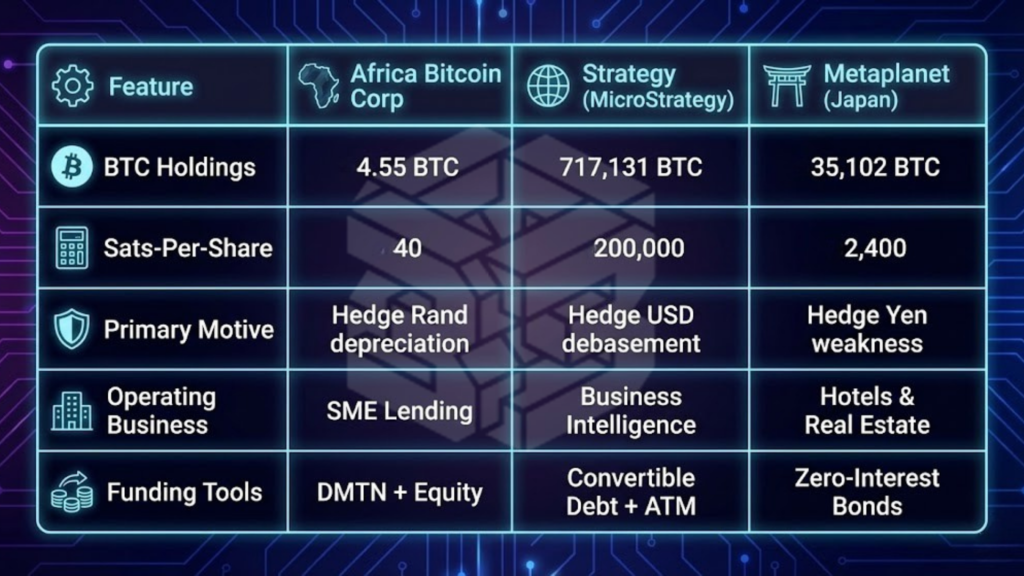
Other firms hold Bitcoin but pursue different models: MARA (Marathon) and Riot Platforms are Bitcoin miners with treasury holdings (53,250 BTC and 19,324 BTC, respectively), not pure treasury plays. The Blockchain Group (France) holds 1,904 BTC as of mid-2025. No competitor disclosed a similar strategy prior to Altvest’s February 2025 announcement, substantiating ABC’s claim as the first in Africa.
How to Invest in Bitcoin Through JSE
For South African investors asking “how to invest in Bitcoin through JSE” or seeking listed African companies holding Bitcoin, ABC represents the only current option for direct equity exposure to a Bitcoin treasury model on the continent.
Potential upside:
The potential upside involves leveraged exposure to Bitcoin appreciation through a regulated, audited public company.
Diversification into a non-fiat reserve asset within a traditional equity wrapper is another potential upside.
Mandates that prohibit direct crypto ownership constrain access for institutions.
Key risks and trade-offs:
Extreme volatility: ABC’s shares exhibit 19.3% average weekly volatility, higher than 75% of South African stocks.
Scale and execution risk: With trailing twelve-month revenue of R134.13 million and a market cap of ~R52.8 million as of late 2025, ABC’s ability to execute a $210 million capital raise remains unproven.
Debt coverage: Debt is not well-covered by operating cash flow, and the use of leverage to buy BTC introduces additional downside risk if Bitcoin prices fall.
Governance: As of January 2026, less than half the board was considered independent, and many directors are new or inexperienced.
Liquidity: Unlike a fund, shares are not redeemable; exits depend on secondary market liquidity, which can be thin on AltX.
Accounting: Under IAS 38 (revaluation model), Bitcoin is an intangible asset with an indefinite life. This means that gains go into Other Comprehensive Income and losses go into Profit and Loss, which makes earnings more volatile.
Independent analysts estimate fair value at R33.84, suggesting the stock trades at a 69.8% discount as of early 2026 (current price R10.30), but this assumes successful execution.
A Johannesburg Experiment in Treasury 2.0
Africa Bitcoin Corporation growing its disclosed treasury to 4.55 BTC is not important because of the absolute number of coins. It’s important because ABC is testing whether an Africa‑listed company can run a credible Bitcoin‑treasury playbook while operating a real business inside the governance, accounting, and liquidity realities of local public markets.
The next chapters will be defined less by slogans and more by execution: capital discipline, risk controls, and whether shareholders are adequately compensated for the added complexity versus simpler Bitcoin exposure routes.
Discover more from Web3Africa
Subscribe to get the latest posts sent to your email.
You must be logged in to post a comment.