











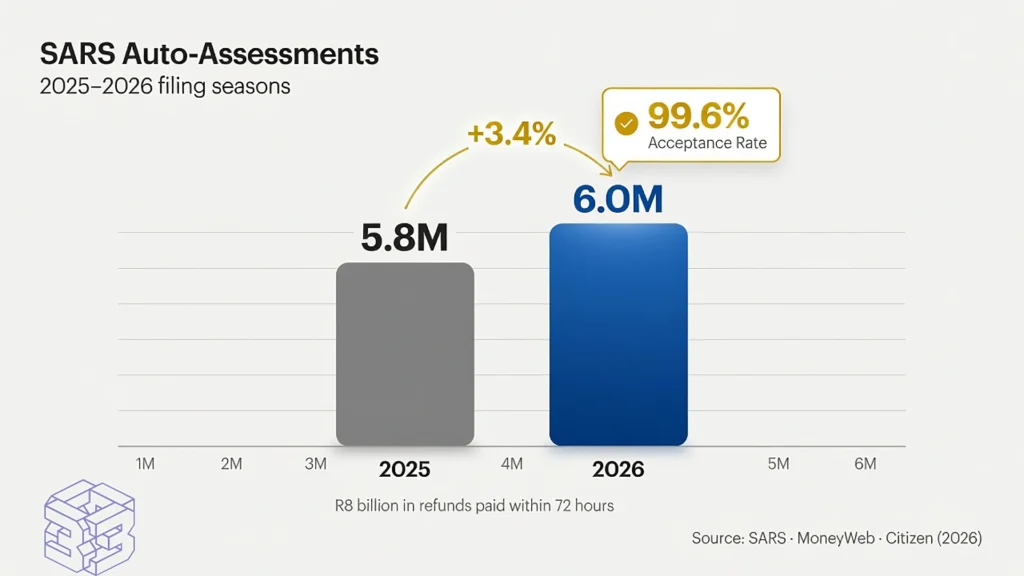
South Africa’s Revenue Service processed nearly 6 million auto-assessments during the 2026 filing season. To place that figure into perspective, that’s a 99.6% acceptance rate that signals both the success of AI-driven tax administration and the limits of systems built for a pre-digital world.
As SARS warns taxpayers against common mistakes, including undeclared crypto tax liabilities from trading, staking, and NFT sales, the agency’s own reports highlight a recurring issue. Traditional tax frameworks “based on outdated, pre-digitalization principles” cannot keep pace with the digital economy.
The auto-assessment model works exceptionally well when income flows through legacy reporting rails. Think of employers submitting payroll data, banks reporting interest, and medical schemes filing certificates. But SARS’s 2021/22 annual report acknowledged that the PAYE and personal income tax architecture was never designed for fragmented gig earnings, self-custody crypto wallets, or cross-border platform income.
RELATED: Standard Bank And Sanlam Back The New Solana-Based ZARU Stablecoin
More than 5.8 million South Africans now hold digital assets, yet only a fraction appears in the auto-assessment data stream because blockchain technology operates outside traditional intermediary reporting.
The Architecture Flaw Preventing Effective Crypto Tax Enforcement
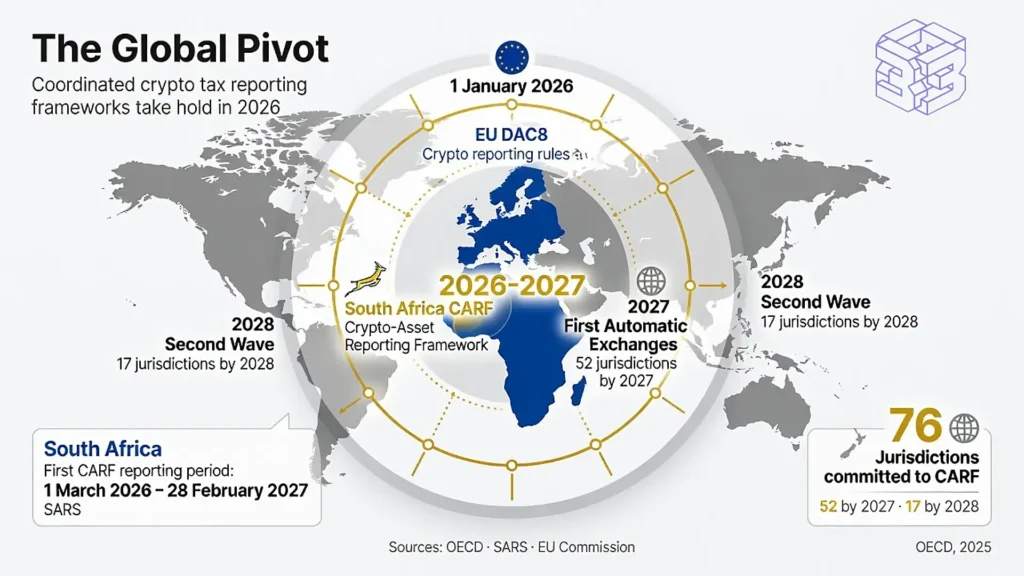
Tax authorities worldwide are responding by forcing digital platforms into the reporting infrastructure. South Africa implemented the OECD’s Crypto-Asset Reporting Framework (CARF) on 1 March 2026, requiring exchanges and wallet providers to collect customer identity and transaction data. This effectively turned them into “agents of the state,” as tax practitioners described draft regulations. The EU activated identical rules via DAC8 in January 2026, and 76 jurisdictions have committed to first exchanges by 2027.
Parallel frameworks target gig and platform work. The OECD’s Model Rules for Platform Operators, already live in the EU as DAC7, compel ride-hailing apps, freelance marketplaces, and delivery platforms to report seller earnings.
The World Bank estimates 154–435 million people now work online gig jobs globally. Sub-Saharan Africa saw platform postings surge 130% between 2016 and 2023. Yet without mandated third-party reporting, most of this income remains invisible to auto-assessment algorithms.
What SARS’s Experience with Crypto tax
SARS Commissioner Edward Kieswetter stated that the agency is “working hard to give taxpayers the best service, where ‘tax just happens.'” But its practicability is a bit wanting. For instance, taxpayers fail to declare crypto gains, rental income, or consulting fees not captured by IRP5 certificates, demonstrating that “tax just happens” only when intermediaries report it.
Modernizing tax systems for crypto and gig income requires more than AI and blockchain analytics.
It demands new legal architecture that embeds reporting obligations into the platforms themselves, cross-border automatic exchange agreements to capture offshore wallets, and taxpayer education that assumes digital, multi-source, pseudonymous income is now the norm rather than the exception.
The UN Tax Committee’s 2025 work program clearly lists “taxation of cryptoassets” and “digitalization of tax administration” as two of its top priorities.
SARS’s auto-assessment success proves the model scales, but only within the boundaries of 20th-century income structures.
FAQ
Why does the SARS auto-assessment system miss cryptocurrency income?
The system relies on traditional third-party reporting from employers and banks. Because blockchain technology and self-custody wallets operate outside these legacy intermediary rails, decentralized income remains largely invisible to the auto-assessment algorithm.
How are global tax authorities responding to undeclared digital assets?
Tax authorities are implementing frameworks like the OECD’s Crypto-Asset Reporting Framework (CARF) and the EU’s DAC8. These rules compel cryptocurrency exchanges and digital wallet providers to collect and report customer transaction data automatically.
When did South Africa implement the Crypto-Asset Reporting Framework?
South Africa implemented the OECD’s Crypto-Asset Reporting Framework (CARF) on 1 March 2026.
Discover more from Web3Africa
Subscribe to get the latest posts sent to your email.
You must be logged in to post a comment.