










Table of Contents
The largest blockchain adoption story is unfolding quietly, far from cryptocurrency headlines and retail speculation. Behind corporate treasury walls, a new medium of exchange is redefining how businesses move capital across borders, and our continent, African youths, are becoming steadfast adopters.
Enterprise stablecoin adoption is an infrastructure response to a persistent business problem: the inefficiency, cost, and unpredictability of international settlement.
The Cross-Border Settlement Problem Businesses Can No Longer Ignore
When a Ghanaian pharmaceutical distributor pays a European supplier, the transaction enters a multi-day limbo. Funds move through correspondent banks, each adding time, fees, and foreign exchange spreads. Settlement typically takes two to five days. During that window, capital sits frozen, unavailable to either party.
For businesses operating across fragmented African markets, these delays compound. Limited access to U.S. dollars, the decline of banking connections, and high costs for sending money create problems that affect cash flow, relationships with suppliers, and a company’s ability to compete.
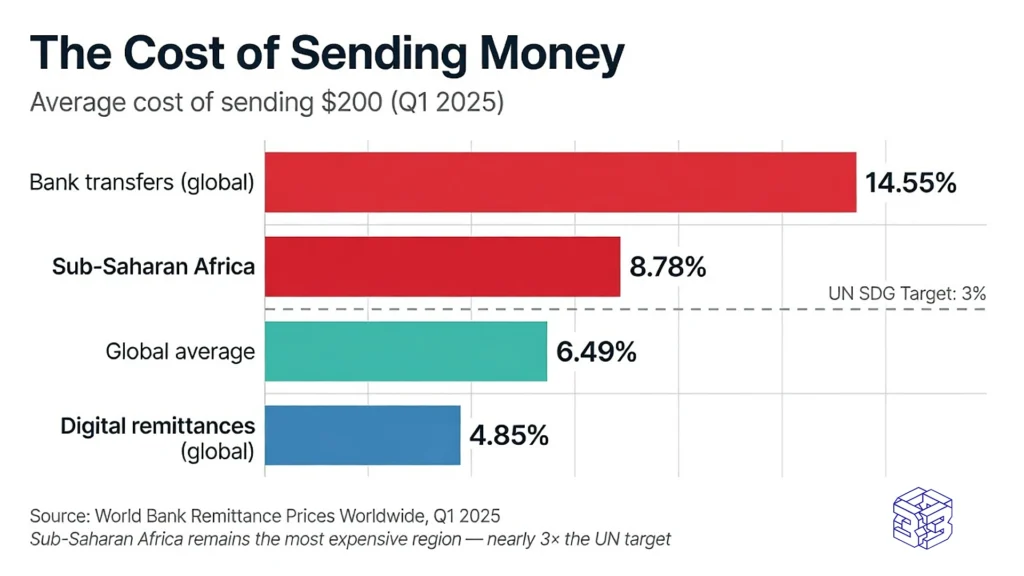
According to the World Bank, the average cost of sending a $200 remittance stands at 6.49 percent globally. In Sub-Saharan Africa, that figure rises to 8.78 percent. For businesses moving larger supplier payments, foreign exchange margins can add another 2.5 to 3 percent above interbank rates—particularly on local corridors where liquidity is thin.
Between 2024 and 2025, 127 African financial institutions lost correspondent banking relationships as global banks withdrew from markets deemed too costly or risky to service. This led to longer settlement chains, higher costs, and greater uncertainty for importers, exporters, and service providers who depend on reliable dollar access.
How Stablecoin Settlement Works Behind the Scenes
This is where enterprise stablecoin settlement enters as treasury infrastructure.
The dominant enterprise model involves stablecoin-powered settlement with fiat interfaces. Treasury teams interact exclusively in their local currency or U.S. dollars. The blockchain layer operates invisibly beneath the surface, managing the transfer, compliance screening, and final settlement in minutes rather than days.
Circle’s stablecoin treasury management platform, launched in April 2026, exemplifies this architecture. The company’s CPN Managed Payments system allows financial institutions and payment providers to embed stablecoin settlement into existing operations without requiring corporate clients to hold, custody, or manage digital assets.
RELATED: Quidax Report: How OTC and Stablecoins Are Changing African Payments
Partners “interact solely in fiat,” according to their announcement, while the platform handles minting, burning, orchestration, and compliance in the background.
Visa has similarly integrated stablecoins as invisible plumbing. In December 2025, the payments network launched USDC settlement in the United States on Solana, enabling partner banks to settle obligations on-chain.
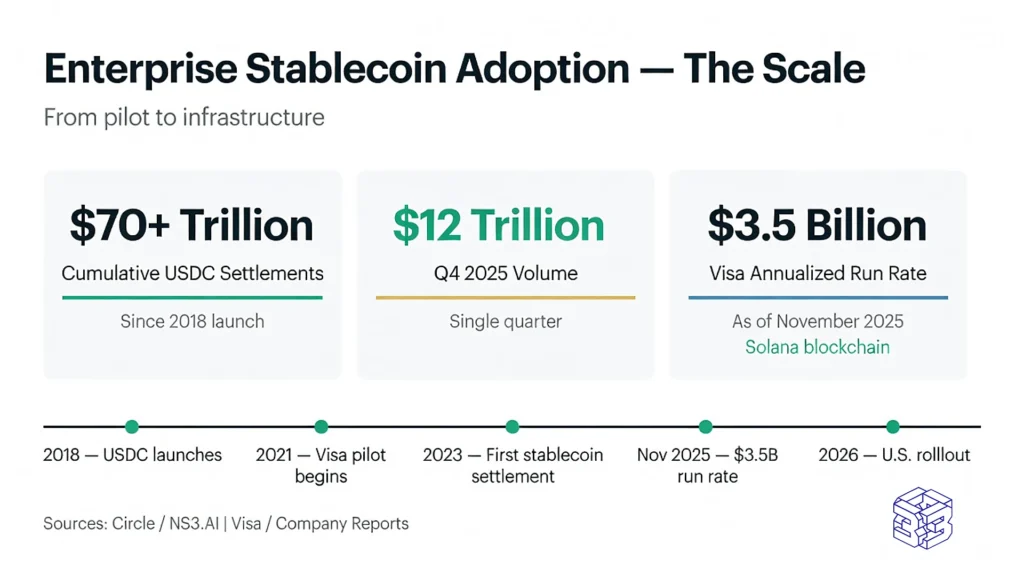
At the time of its U.S. launch in December 2025, Visa revealed that it already processed more than $3.5 billion in annualized stablecoin settlement volume across its programs.
For end customers, the experience remains unchanged. For treasury departments, settlement windows compress from days to minutes.
“Financial institutions are looking for faster, programmable settlement options,” Rubail Birwadker of Visa explained in December 2025.
The Scale of the Shift
Cross-border liquidity is no longer moving exclusively through traditional banking rails.
Circle claims cumulative on-chain settlements exceeding $70 trillion in USDC since launch, with approximately $12 trillion in on-chain volume during the fourth quarter of 2025 alone.
BVNK, a stablecoin infrastructure provider that Mastercard agreed to acquire for up to $1.8 billion in March 2026, processed more than $30 billion in enterprise flows during 2025.
Industry data suggests the trend is accelerating.
While raw metrics show massive scale, McKinsey and Artemis Analytics found that of the $35 trillion in stablecoins moved on-chain in 2025, only about $390 billion (roughly 1%) represented identifiable real-world payments like payroll, remittances, and B2B transactions, indicating both a nascent infrastructure and significant room for growth.
EY-Parthenon found that 13 percent of financial institutions and corporates already use stablecoins, while 54 percent of non-users expect to adopt within six to twelve months. Yet the Association for Financial Professionals’ 2026 liquidity survey reported that only 1 percent of treasury organizations are currently piloting or using stablecoins.
Understanding enterprise adoption correctly resolves the apparent contradiction. Most companies access stablecoin settlement indirectly, through payment service providers, correspondent banks, or fintech platforms, without holding stablecoins on their own balance sheets.
The treasury department may never interact with a blockchain interface, but the settlement rail beneath their wire transfer has fundamentally changed.
Why African Businesses Are Moving Faster Than Many Global Peers
Local businesses face compounding inefficiencies that make enterprise stablecoin adoption especially attractive.
The African Development Bank’s 2025 Trade Finance Report identified a $74 billion to $92 billion trade finance gap in 2024, projected to widen to as much as $102.6 billion by 2027 under severe scenarios.
Limited foreign exchange liquidity has become the primary constraint, cited by 36 percent of surveyed African banks—double the rate reported before the pandemic.
Nigeria alone accounts for approximately 60 percent of Sub-Saharan Africa’s stablecoin inflows since 2019. The IMF noted that Nigerian businesses use stablecoins both as a hedge against local currency volatility and as a practical tool for paying international suppliers when dollar access through banking channels is constrained or delayed.
Yellow Card, one of Africa’s largest digital asset platforms, processed over $3 billion in transactions in 2024, spanning an operational footprint across 20 African countries. Its also working with 106 banking partners. Stablecoins represent 99 percent of transactions on the platform, 88.5 percent in Tether’s USDT and 9.9 percent in Circle’s USDC. The company reports clients across sectors, including food production, pharmaceuticals, logistics, and technology services.
“Businesses in Africa want to hold and transact in dollars. Stablecoins make that possible with near-instant settlement and minimal fees.” ~ Maurice, Yellow Card
Flutterwave partnered with Polygon Labs to enable real-time USDC and USDT settlement across 34 African countries, targeting enterprise clients including Uber and Audiomack. In the same year, Onafriq and Circle launched a pilot across 40 African markets, claiming reach to one billion wallets and 500 million bank accounts.
RELATED: Onafriq and Conduit unite to Industrialize Digital Asset Liquidity
Stablecoin Treasury Management Comes With New Risks
Stablecoin treasury management introduces new operational considerations.
Regulatory frameworks remain in flux. While the United States enacted the GENIUS Act in July 2025 and the European Union’s MiCA framework has begun phased implementation, an October 2025 Financial Stability Board peer review found significant gaps in how jurisdictions are implementing stablecoin oversight.
African regulatory environments vary widely. Ghana enacted its Virtual Asset Service Providers Act in April 2026. Kenya closed its VASP Regulations consultation period in April 2026 and is currently awaiting finalization of the framework. South Africa’s central bank issued Exchange Control Circular No. 3-2026, addressing policy implications for rand-pegged and foreign-currency stablecoins. Nigeria launched cNGN, a regulated naira-pegged stablecoin, in February 2025. However, many jurisdictions still lack clear frameworks, creating legal and operational uncertainty for enterprises.
Stablecoin issuers themselves represent concentration risk. Two providers dominate the market: Tether, holding approximately 58 to 60 percent of the market share, and Circle, which accounts for the remainder. Corporate treasurers adopting stablecoin settlement must evaluate reserve transparency, redemption mechanisms, regulatory standing, and counterparty risk.
RELATED: Kenya VASP Bill 2025 Passes Third Reading: One Signature Away From Becoming Law
Cybersecurity, custody arrangements, and internal controls also require attention. Unlike traditional bank transfers, stablecoin transactions are irreversible. Operational errors, compromised credentials, or inadequate wallet security can result in permanent capital loss.
Regulation Will Decide How Fast Enterprise Adoption Expands
Enterprise stablecoin settlement is becoming financial infrastructure rather than a speculative technology experiment.
Settlement time drops from days to minutes, costs fall from 6 to 9 percent to below 1 percent, and working capital efficiency improves significantly. Freed liquidity can be redeployed faster. Supplier relationships benefit from predictable, reliable payment execution. Treasury forecasting becomes more accurate when settlement windows collapse.
The technology itself is increasingly invisible. Leading platforms abstract blockchain complexity behind familiar financial interfaces, allowing enterprises to access efficiency gains without requiring specialized technical expertise or custody infrastructure.
But adoption is not universal, and infrastructure maturity varies significantly by corridor, jurisdiction, and sector. Regulatory clarity will determine how quickly enterprises can integrate stablecoin rails into core treasury operations and how confidently they can plan multi-year strategies around them.
The shift from consumer crypto narratives to enterprise settlement infrastructure represents blockchain’s most significant commercial validation to date. It is a transformation defined by measurable improvements in capital efficiency, settlement certainty, and cross-border liquidity access, particularly in markets where those advantages matter most.
FAQ
Does enterprise stablecoin adoption mean businesses are using cryptocurrency for speculation?
No. The growing enterprise use case is centered on payment infrastructure rather than investment. Stablecoins are increasingly being used as settlement rails that move value more efficiently, while the underlying blockchain remains largely invisible to the businesses using the service.
What are the biggest risks businesses should consider before adopting stablecoin settlement?
Enterprises still need to evaluate regulatory compliance, issuer concentration risk, cybersecurity, custody arrangements, and internal payment controls. Because blockchain transactions are generally irreversible, operational safeguards remain just as important as the technology itself.
Why are enterprises using stablecoins instead of traditional banking rails?
Traditional cross-border payments often involve multiple correspondent banks, foreign exchange spreads, and settlement delays that can take several days. Stablecoin settlement reduces those frictions by enabling near-instant transfers, improving working capital, and giving treasury teams faster access to liquidity.
What is enterprise stablecoin adoption?
Enterprise stablecoin adoption is the use of stablecoin-powered settlement infrastructure by businesses, banks, and payment providers to move money across borders more efficiently. In most cases, companies continue paying and receiving fiat currencies while the blockchain operates behind the scenes to complete settlement in minutes instead of days.
Discover more from Web3Africa
Subscribe to get the latest posts sent to your email.
You must be logged in to post a comment.