










Nigeria is in the middle of a fundamental reset of how cryptocurrency businesses are allowed to operate. The Securities and Exchange Commission (SEC) has moved from ad hoc circulars to a structured regime that combines new SEC crypto regulations, detailed anti‑money‑laundering (AML) expectations, and a defined path into the formal market for licensed virtual asset service providers (VASPs).
Alongside South Africa, Nigeria is on its way to a concrete licensing, reporting, and enforcement framework that will determine who can operate in Nigeria’s high‑adoption crypto market and on what terms.
TL;DR,
- Nigeria’s SEC crypto regulations now require VASPs to hold ₦500M capital, submit monthly reports to FIRS, and pay 25% capital gains tax from 2026 under the Investment and Securities Act (ISA) 2025, effective June 30.
- After banning crypto banking in 2021, Nigeria reversed course in 2023. Now, licensed exchanges like Quidax and Busha can operate through the SEC’s ARIP sandbox—but face strict AML/CFT obligations and monthly transaction reporting.
- ISA 2025 classifies crypto as securities in Nigeria, requiring local incorporation, ₦500M capital, and KYC for all users. The framework balances oversight with innovation but risks pushing smaller startups offshore.
How Nigeria’s Updated SEC Crypto Regulations Evolved
To understand the current overhaul, it helps to see the regulatory steps that led here:
-
2017—The Central Bank of Nigeria (CBN) warned banks about crypto‑related risks.
-
February 2021—The CBN issued directives prohibiting all financial institutions from processing cryptocurrency transactions, effectively barring exchanges from the traditional banking system. The move cited the need to “protect the public from threats by unregulated activities.” Nigerians reported bank accounts frozen for crypto involvement, and trading activity was forced underground, fueling peer-to-peer markets and undermining transparency.
-
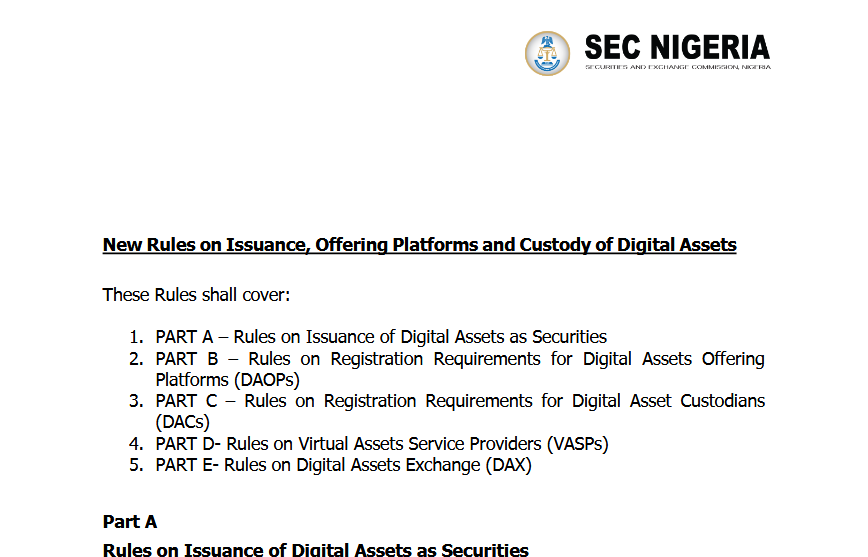
May 2022—SEC issued its first digital asset rules on issuance, trading platforms, and custody, and the government adopted a National Blockchain Policy. Nigeria’s SEC first published Rules on Issuance, Offering Platforms, and Custody of Digital Assets, establishing foundational guidelines.
-
2022—The Money Laundering (Prevention and Prohibition) Act was amended to explicitly cover “virtual assets.”
-
December 2023—the CBN reversed course with its Guidelines on Bank Accounts for VASPs, permitting banks to service SEC-licensed crypto firms under strict compliance conditions. A conditional CBN crypto ban reversal that allows banks to serve only SEC‑licensed crypto firms under strict compliance rules. Licensed exchanges can now open bank accounts and offer fiat on/off ramps, a critical infrastructure need for onboarding Nigeria’s largely under-30 user base.
-
March 2024—SEC launched the Accelerated Regulatory Incubation Program (ARIP) to give provisional licenses and bring crypto firms into supervised operations. Platforms like Busha and Quidax were among the first exchanges to secure this status, receiving Approval-in-Principle to operate under SEC oversight.
-
Investment and Securities Act (ISA) 2025—Signed in March 2025 and effective June 30, 2025, this law formally classifies cryptocurrencies and other virtual assets as securities, putting them squarely under SEC oversight. From 2026, crypto profits will also fall under a capital gains tax of up to 25%.
Core Elements of the Nigeria SEC Crypto Guidelines
The current Nigeria SEC crypto guidelines and related instruments are designed around three pillars: licensing, AML/CFT controls, and ongoing supervision.

Licensing and VASP Registration Requirements
Under ISA 2025 and existing SEC rules, a firm that wants to operate as a VASP in Nigeria must:
-
Incorporate locally with the Corporate Affairs Commission (CAC).
-
Maintain a minimum paid‑up share capital of ₦500 million.
-
Complete formal VASP registration and obtain the relevant SEC license(s).
-
Join the ARIP sandbox where applicable, operating under close supervision while final licensing is finalized.
Generally, both international exchanges and domestic startups cannot rely on a purely offshore structure. They need a Nigerian corporate presence, capital commitment, and a compliance function capable of dealing with securities‑style regulation.
Examples like Quidax and Busha illustrate how exchanges are beginning to move through this pipeline.
AML/CFT and Transaction Reporting Duties
At the core of the Nigeria SEC crypto guidelines lies a detailed compliance manual outlining the AML and CFT measures every licensed VASP must implement. These requirements are designed to eliminate anonymity and trace illicit financial flows. This is a persistent concern in a market that has attracted an estimated ₦1 trillion in losses to crypto Ponzi schemes over 25 years.
Registration and Capital Requirements
Any entity wishing to operate legally must:
-
Incorporate with Nigeria’s Corporate Affairs Commission (CAC)
-
Maintain a minimum paid-up share capital of ₦500 million
-
Obtain formal SEC registration and licensing
-
Establish Know Your Customer (KYC) procedures for all users
Monthly Reporting Obligations
Unlike many jurisdictions that rely on annual declarations, Nigeria mandates monthly reporting to the Federal Inland Revenue Service (FIRS), including:
-
Transaction types and specific dates
-
Transaction volumes and customer identification details
-
Encrypted data transfers for sensitive tax information
Dr. Adeola Williams, Fintech Researcher at the University of Lagos, notes:
“Effective cryptocurrency regulation requires careful calibration. Excessive reporting burdens could stifle innovation, while insufficient oversight enables tax evasion. Nigeria’s monthly reporting requirement represents a middle ground between real-time surveillance and annual declarations.”
Tax Framework
From 2026, Nigeria will impose:
-
30% corporate income tax on VASP earnings
This positions Nigeria between the UK (10–20% CGT) and South Africa (18–45% income tax on crypto).
Enforcement Powers and Penalties
Under ISA 2025 and SEC rules, failure to comply is not a minor risk. The SEC can:
-
Investigate and audit VASPs.
-
Suspend or revoke licenses.
-
Impose fines and administrative cautions.
-
Freeze or place liens on bank accounts and other assets.
-
Seize property of entities operating illegally and seek forfeiture orders.
-
Request data from telecom and internet providers to investigate suspected violations.
Unlicensed platforms that continue to target Nigerian users face blacklisting and potential enforcement, even if they are headquartered abroad.
The Role of the CBN Crypto Ban Reversal
The banking side of the story matters as much as the capital‑markets rules. CBN’s 2021 directive cutting off crypto exchanges from the banking system made naira on‑ and off‑ramps extremely difficult and drove users further into opaque P2P trading.
With the 2023 CBN crypto ban reversal (conditional as it is), the message shifted from “keep banks away from crypto” to “banks may serve SEC‑licensed VASPs under tight controls.”
However, there were some downsides. For instance:
-
Licensed VASPs can open corporate accounts and offer fiat gateways.
-
Banks must apply strict AML/CFT checks and confirm SEC licensing before onboarding VASP clients.
-
CBN continues to supervise payment flows and systemic risk, while SEC concentrates on securities law and market integrity issues.
Risks and Trade-offs of the New Framework
Potential to Stifle Innovation
Monthly reporting and high capital requirements create barriers to entry. Startups and DeFi protocols, often built on decentralization and permissionless access, may find compliance costly or structurally incompatible. If enforcement is rigid, Nigeria risks losing agile innovators to more permissive jurisdictions.
CHECK OUT: Inside ISA 2024: How Nigeria Is Legalizing Crypto and Cracking Down on Ponzi Scheme Laws
Enforcement and Corruption Risks
The SEC’s expanded powers, including asset seizure and data demands from telecoms, raise concerns about abuse or selective enforcement. Transparency in how licenses are granted and violations prosecuted will be critical to maintaining trust.
Unverified Claims and Regulatory Uncertainty
Some claims circulating in industry media, including alleged platform-specific restrictions, executive detentions, and steep fee increases, cannot be verified from official sources. The absence of clear, public enforcement data creates uncertainty for operators trying to assess risk. The SEC should publish detailed enforcement statistics and criteria to improve predictability.
Tax Compliance and Capital Flight
Nigeria’s 25% capital gains tax (starting 2026) and 30% corporate levy are competitive regionally but depend on robust enforcement. If platforms or users migrate offshore to evade taxes, the policy may fail to achieve its revenue goals.
What This Means for Key Stakeholders
For International and Local Exchanges
Platforms seeking Nigerian market access face a clear but demanding pathway:
-
Secure provisional licensing through ARIP, demonstrating operational readiness and compliance infrastructure
-
Meet capital thresholds (₦500 million minimum)
-
Implement real-time KYC and transaction tracking systems
-
Submit monthly tax and AML reports with customer data
One of its few downsides is that this model favors well-capitalized, compliance-ready operators. Smaller startups may struggle with the capital and reporting overhead, potentially consolidating the market around a few licensed incumbents.
For Policymakers and Observers
Nigeria’s structured onboarding through ARIP represents a model for African regulators balancing inclusion and control. The sandbox approach allows regulators to learn from live operations while maintaining oversight.
A Stricter but Clearer Path Under Nigeria’s SEC Crypto Regulations
Nigeria’s SEC crypto regulations and the VASP registration framework established under ISA 2025 represent how its government has accepted the reality of digital assets. The answer is simply to adapt their regulation to accommodate the new change.
RELATED: Nigeria Crypto Tax 2026 Guide: Calculate and Report Your Gains
Nigeria’s new approach is to embed AML/CFT standards, capital requirements, and monthly reporting into law to create a transparent ecosystem. The updated SEC crypto regulations aren’t foolproof. They have their fair share of drawbacks, but when comparing to an unregulated environment, they stand triumphant.
For exchanges, investors, policymakers, and individual traders, the stakes are high, and Africa is catching up to the change. A regulated market could unlock billions in investment and formalize millions of users. A heavy-handed rollout could drive activity back underground, or across borders.
Discover more from Web3Africa
Subscribe to get the latest posts sent to your email.

You must be logged in to post a comment.