


Table of Contents
The prevailing narrative of blockchain adoption has long focused on consumer-facing complexity: non-custodial wallets, private key management, and decentralized applications. Yet, in the world’s most mature digital payment corridors, a different structural transformation is quietly taking place.
Financial institutions, telecommunications giants, and fintech platforms are bypassing consumer education entirely. Instead, they are embedding blockchain technology directly into the backend of existing, trusted financial interfaces.
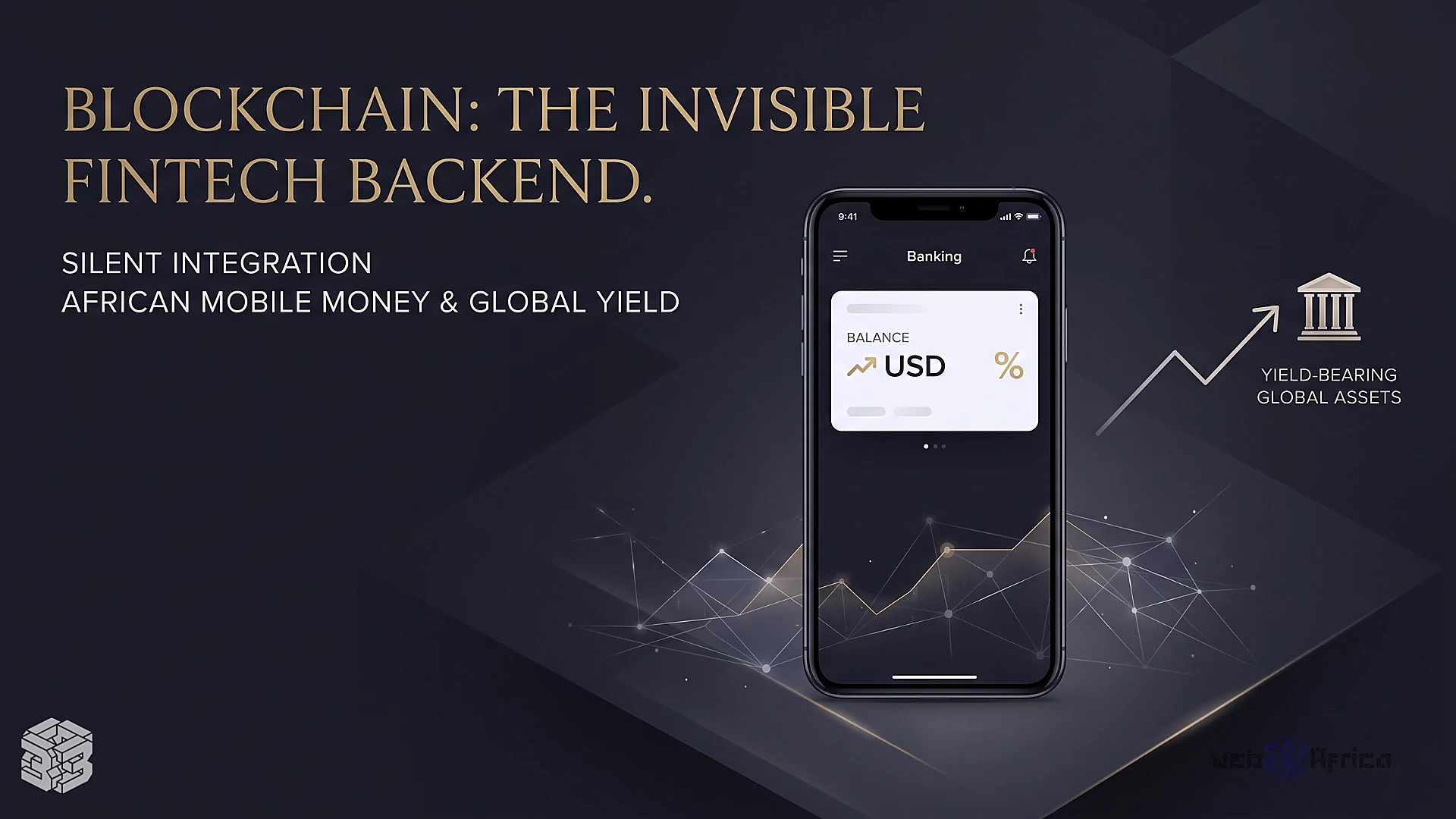
By treating blockchain as database infrastructure rather than a speculative asset class, fintech operators are beginning to link everyday African savers to high-quality, yield-bearing global assets without altering their daily payment habits.
Blockchain Doesn’t Need More Users Anymore
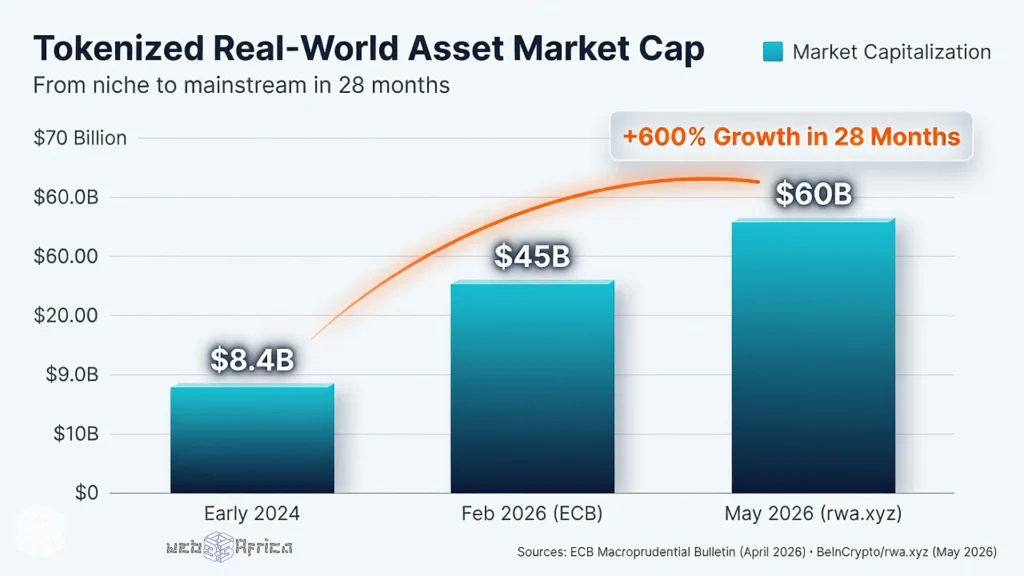
The global market for tokenized assets has reached approximately $31.8 billion as of mid-2026, dominated by tokenized U.S. Treasury bills and money market funds. BlackRock’s BUIDL fund alone holds roughly $1.7 billion to $2.1 billion in assets under management, while Franklin Templeton’s BENJI and similar products represent hundreds of millions more.
These are not speculative crypto investments. They are programmable representations of traditional securities, designed to move faster and settle more efficiently than legacy financial rails.
RELATED: African Stablecoins Cannot Scale Without Europe’s Regulatory Trust
For local fintech providers, the appeal is straightforward.
Sub-Saharan Africa is the dominant driver of the global mobile money ecosystem, a network that boasts over 1.6 billion registered accounts globally and processes more than $1.4 trillion in annual transaction value, according to GSMA data.
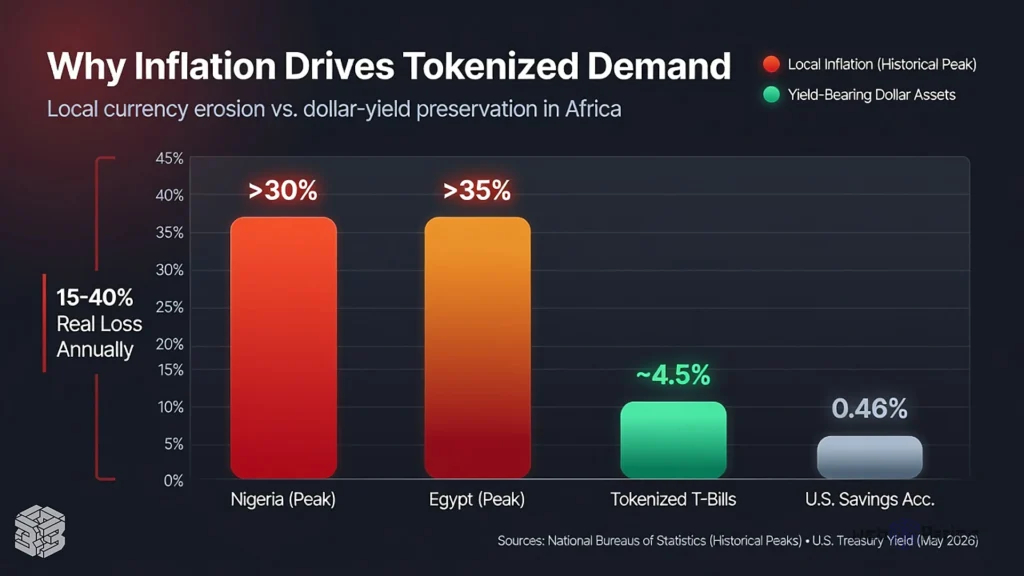
Yet inflation across major markets routinely erodes savings. In Nigeria, inflation has exceeded 30 percent. In Egypt, it has topped 35 percent. A local-currency savings account in these environments can generate a real loss of 15 to 40 percent annually, even with nominal interest.
Tokenized assets offer a structural alternative. A fintech app can let users put money into a tokenized U.S. Treasury product that yields about 4.5 percent in U.S. dollars, protecting against local currency depreciation without needing to understand blockchain mechanics.
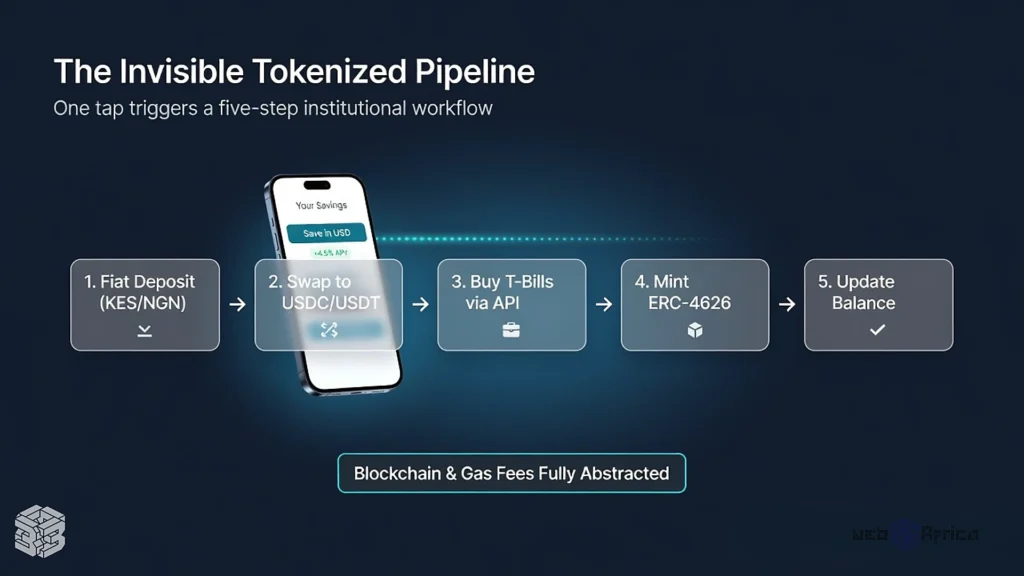
The user taps “Save in USD.” Behind that interaction, middleware converts local currency to stablecoins, purchases the tokenized security, and updates the user’s balance. The entire chain of custody, settlement, and yield accrual happens through blockchain API integration, invisible to the customer.
Elizabeth Rossiello, CEO of AZA Finance, stated:
“The future of African fintech isn’t about teaching 100 million people how to use Metamask. It’s about M-Pesa using BlackRock’s BUIDL as a backend treasury tool so a shopkeeper in Nairobi can hedge against inflation without knowing what an ERC-20 token is.”
How Silent Integration Works
The architecture enabling this transformation relies on abstraction at every layer.
At the asset level, institutions mint tokenized assets on public blockchains—Ethereum, Polygon, or Base—using standards such as ERC-4626, which automate yield compounding. These tokens represent fractional ownership of the underlying security, whether a Treasury bill, money market fund, or corporate bond.
Custody and settlement happen through institutional-grade infrastructure. Providers like Fireblocks and Copper offer multi-party computation wallets that manage private keys without exposing fintech customers to blockchain complexity.
A mobile money provider’s master wallet aggregates all user holdings on-chain, while individual balances remain recorded on traditional SQL databases. From the user’s perspective, nothing has changed. From a technical perspective, the entire ledger has migrated.
The critical innovation is the API abstraction layer. Middleware platforms—Crossmint, ZeroDev, and others—offer Wallet-as-a-Service products that translate familiar REST API calls into blockchain transactions.
RELATED: Kenya Pilot Proves Blockchain Drought Insurance Viability
When a customer deposits funds, the fintech triggers an on-chain mint. When they withdraw, the system executes a redemption. The server-side handles gas fees, transaction confirmations, and chain-specific quirks. server-side. The user sees only a deposit confirmation, identical to any other mobile money transaction.
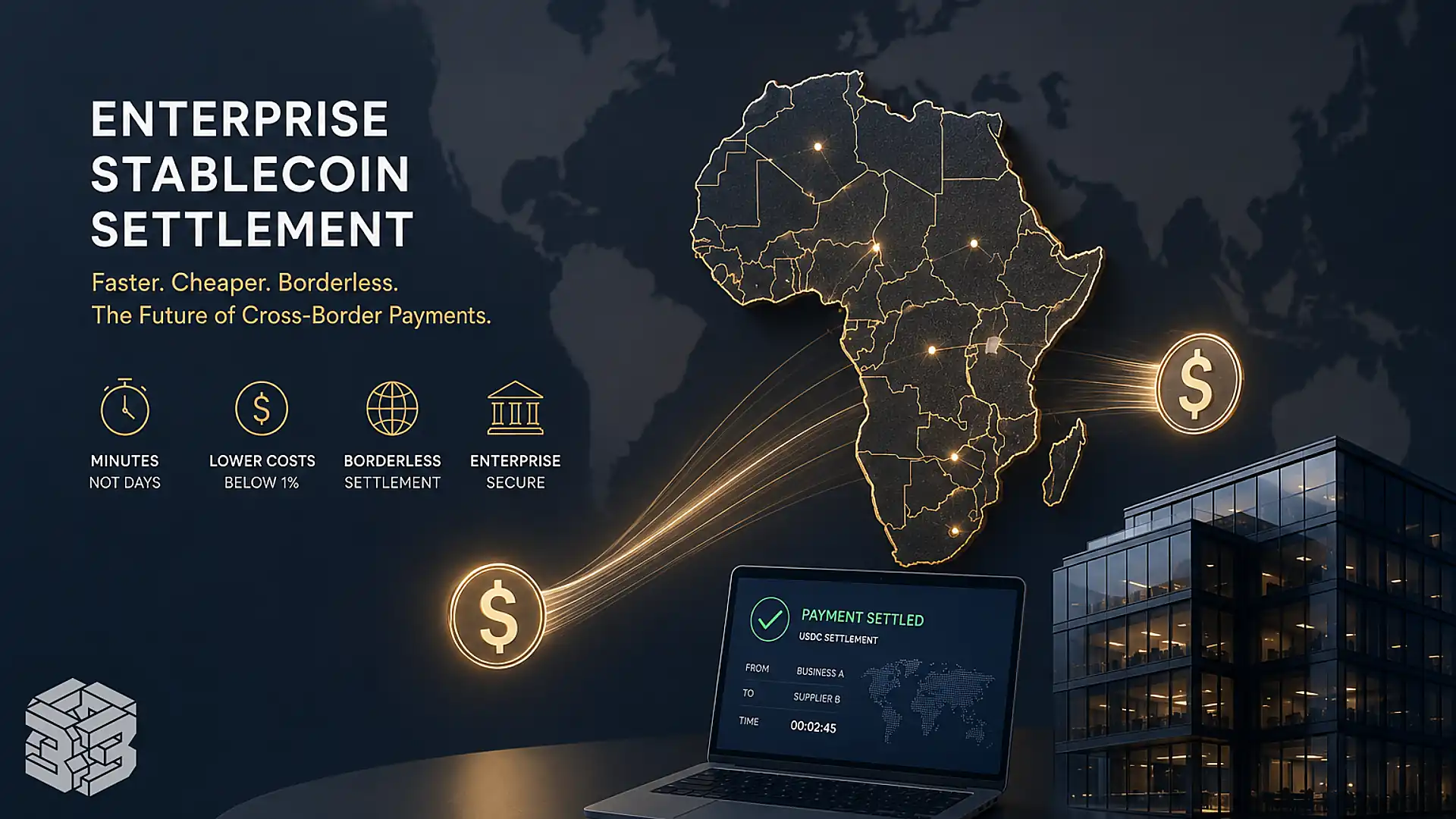
Liquidity providers like Yellow Card and Onafriq convert local currencies such as Kenyan shillings, Nigerian naira, or Ghanaian cedis into stablecoins like USDC or USDT, which are then used to buy the tokenized security.
Chainlink’s Cross-Chain Interoperability Protocol (CCIP) acts as a communication tool for financial technology companies, helping them connect their off-chain records with on-chain assets so that balance updates happen in real-time across different systems.
This digital asset infrastructure prioritizes functionality over visibility.
Regulatory Clarity Accelerates Adoption
For years, African financial institutions hesitated to integrate blockchain technology due to regulatory ambiguity. That recently changed.
In March 2025, Nigeria enacted the Investments and Securities Act 2025, formally recognizing digital assets as securities under the oversight of the Securities and Exchange Commission. It has taken the lead in this domain, utilizing its Accelerated Regulatory Incubation Program (ARIP) to create a supervised sandbox for digital asset providers, while the Central Bank of Nigeria (CBN) focuses heavily on stablecoin and payment licensing frameworks.
After the public consultation for its Virtual Asset Service Provider (VASP) regulations ended in April 2026, Kenya is creating a clear licensing process that will likely involve oversight from both the Central Bank of Kenya and the Capital Markets Authority. The law distinguishes between payment tokens and investment tokens, providing a clear licensing pathway for tokenization platforms.
South Africa included crypto assets in the Financial Advisory and Intermediary Services Act, and by March 2026, the Financial Sector Conduct Authority (FSCA) had officially approved 310 licenses for Crypto Asset Service Providers (CASPs) out of 533 applications, bringing these businesses into the official financial system.
The Financial Sector Conduct Authority has also incorporated stablecoins and tokenization into its digital payments roadmap.
These regulatory developments do more than permit blockchain integration—they signal institutional endorsement.
A Nigerian SEC official remarked in a 2025 circular:
“We are no longer debating ‘crypto.’ We are regulating ‘digital representations of value.’ Our goal is to ensure that if a Nigerian youth buys a fraction of a U.S. Treasury bill through a local app, consumer protection is as ironclad as that of a traditional bank deposit.”
Why Fintech Companies Are Building This Now
For product managers and fintech executives, tokenized assets represent a category expansion rather than a technical migration.
Mobile money platforms have already demonstrated that consumers trust embedded financial services—bill payments, microlending, insurance—when delivered through familiar interfaces. Embedded finance is now extending into investment and treasury products, powered by the same infrastructure principles: APIs, middleware, and abstraction.
Although detailed information on how companies are using these assets is not widely shared, infrastructure providers have seen a noticeable rise in interest from African tech startups wanting to keep their money in yield-bearing tokenized assets to protect against currency loss and access dollars.
The Fintech Association of Nigeria projects that 35 percent of active mobile money users may engage with embedded yield products by the end of 2026.
The operational advantage for mobile money providers is significant. Unlike purely digital banks, platforms like M-Pesa and MTN MoMo maintain vast physical agent networks—trusted intermediaries who can explain and facilitate new products.
MTN MoMo alone serves 69.5 million monthly active users across Africa, processing approximately $500 billion in transactions. Embedding tokenized assets into that ecosystem does not require user re-education. It requires only backend integration.
Sergey Nazarov, co-founder of Chainlink, described the model in a 2026 infrastructure report:
“APIs are the ‘great bridge.’ By abstracting blockchain complexity into a simple REST API, we’ve allowed legacy mobile money providers to plug into global liquidity pools in weeks, not years.”
Invisible Doesn’t Mean Risk-Free
Silent integration introduces risks that differ fundamentally from consumer-facing crypto products.
Smart contract vulnerabilities represent systemic exposure. If a widely adopted tokenized Treasury fund experiences an exploit, millions of mobile money users could lose funds—many without realizing their savings were ever on-chain.
Unlike DeFi platforms where users accept experimental risk, embedded products carry the trust expectations of traditional banking.
RELATED: Truth Behind Kenya’s Now-Withdrawn VASP Bill Exposed
Liquidity remains constrained outside major Treasury products. While tokenized U.S. Treasuries benefit from deep institutional demand, tokenized corporate bonds, trade receivables, or real estate in African markets may struggle to find secondary buyers.
If a mobile money provider needs to liquidate holdings quickly to meet customer withdrawals, illiquid tokenized assets could create operational stress.
Regulatory disclosure requirements also pose strategic uncertainty. If consumer protection rules mandate that fintech apps prominently label products as “crypto-backed,” the invisibility thesis could collapse. User trust may fragment.
Uptake may stall. The success of silent integration depends, in part, on regulators permitting the abstraction to remain intact.
Custody and operational complexity should not be underestimated. While institutional-grade wallets mitigate key management risks, fintechs must still navigate gas fee volatility, chain congestion, and cross-border compliance. These are solvable challenges, but they require technical and legal resources that smaller providers may lack.
Adoption Without Awareness
The future of blockchain in African finance may look nothing like the crypto industry imagined. There may be no viral wallet apps, no mass consumer awareness campaigns, and no cultural movement around decentralization. Instead, tokenized assets may simply become the infrastructure beneath savings accounts, remittance corridors, SME treasury products, and pension platforms.
This mirrors the trajectory of cloud computing. Few consumers know whether their email is hosted on Amazon Web Services or Google Cloud. They simply expect it to work. Similarly, future users may never ask whether their mobile money savings are tokenized. They will care only whether the product delivers safety, liquidity, and yield.
The most successful digital asset infrastructure will be the kind users never see.
FAQ
Why are fintech companies hiding blockchain from users?
Because most customers care about convenience, not the technology powering a financial product. By hiding wallets, private keys, gas fees, and settlement in the backend, fintechs can offer dollar-based savings and investment products through familiar mobile money apps without changing the user experience.
Do customers need to own cryptocurrency to access tokenized assets?
Not necessarily. As outlined in the article, users may simply choose options like “Save in USD” while the fintech platform handles stablecoin conversion, blockchain settlement, custody, and redemptions behind the scenes. The blockchain infrastructure remains largely invisible to the customer.
Why are tokenized U.S. Treasury products attracting African fintech platforms?
Tokenized Treasury products give fintechs a practical way to offer dollar-denominated savings with yield in markets where inflation can significantly erode local currency deposits. They also settle more efficiently than many traditional financial rails.
What role does blockchain API integration play in this model?
Blockchain APIs act as the bridge between traditional fintech applications and on-chain financial infrastructure. They allow developers to trigger blockchain transactions using familiar software interfaces while the middleware manages wallets, settlement, gas fees, and other blockchain-specific processes in the background.
Discover more from Web3Africa
Subscribe to get the latest posts sent to your email.