








Table of Contents
Africa’s digital transformation is colliding with its underlying issues: the physical and regulatory systems that underpin innovation are becoming as important as the innovation itself. While headlines celebrate funding rounds and user growth, a less visible battle is reshaping the continent’s technology landscape.
This battle involves data centers, power grids, compliance frameworks, and cloud architectures that determine whether platforms can scale, survive regulatory scrutiny, or secure institutional capital.
Fintech infrastructure has moved from a back-office concern to a board-level strategic imperative. The ability to guarantee uninterrupted service, store data within national borders, execute flawless sanctions screening, and maintain multi-jurisdictional disaster recovery now constitutes an existential requirement. For local builders, this shift represents both profound friction and strategic opportunity.
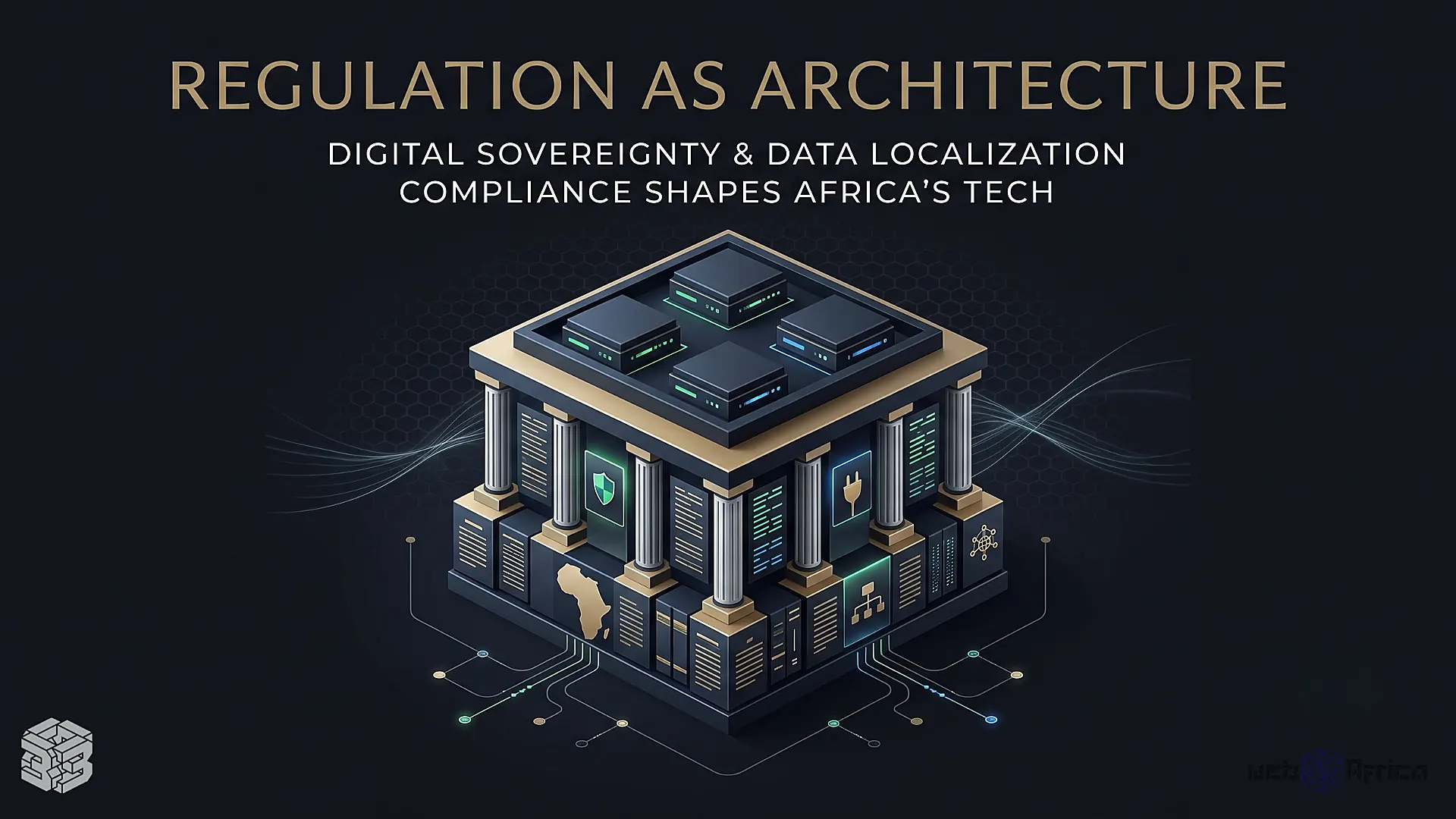
When Regulation Becomes Architecture
By the end of 2025, over 35 African nations had enacted data protection laws, with enforcement moving from vague guidelines to punitive, high-stakes actions.
Nigeria’s Data Protection Act (NDPA), supported by the General Application and Implementation Directive (GAID) in March 2025, identifies certain “Data Controllers of Major Importance” that must undergo yearly audits and follow rules about transferring data across borders. Penalties reach ₦10 million or 2% of annual gross revenue.
The Central Bank of Nigeria issued a directive in June 2026, mandating the storage of all payment data on local servers by January 2027. This is the first comprehensive financial-sector data localization mandate issued by a major African central bank.
With approximately six Tier-III data centers in Nigeria and fintech infrastructure budgets already allocating 15–25% to compliance, the scramble to migrate is forcing rapid vendor selection and architectural redesign.
Kenya’s Data Protection Commissioner levied fines of KES 400,000–500,000 per incident in 2025, while the High Court ordered Worldcoin to delete biometric data, establishing rigid precedent against unlawful data extraction.
South Africa’s Protection of Personal Information Act (POPIA), fully enforceable since July 2021, imposes fines up to R10 million or 10 years’ imprisonment, with updated 2025 guidelines covering AI-generated content and mandatory data protection officer appointments.
These policies are forcing enterprises to engineer multi-tier architectures that physically anchor sensitive data within national borders while routing non-sensitive workloads to global hyperscale clouds. This situation introduces hidden operational costs, increases the number of cybersecurity attack surfaces, and requires disaster-recovery sophistication that tier-one global banks previously reserved for themselves.
RELATED: Why Nigeria and South Africa Dominate Global Stablecoin Utility
As Gbenga Adebayo, Chairman of the Association of Licensed Telecommunications Operators of Nigeria (ALTON), observed:
“We cannot continue to outsource [data hosting] to other jurisdictions. For every transaction involving data hosted outside our shores, communication has to take place from your location to the host and back. It increases latency and also increases the cost of data retrieval.”
The Physical Layer: Capacity, Power, and Investment
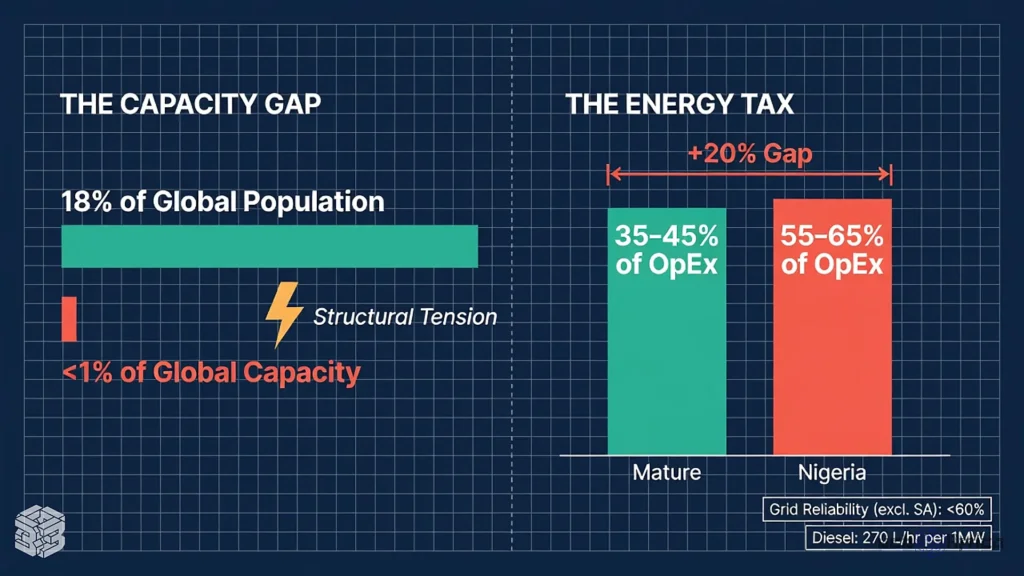
Africa’s cloud infrastructure market is projected to grow from $7.2 billion in 2025 to approximately $12 billion by 2028, representing a 28% year-on-year increase. Yet the continent hosts less than 1% of global data center capacity while representing 18% of the world’s population, creating structural tension between digital ambition and physical readiness.
Conservative estimates from Xalam Analytics place Africa’s active, fitted data center capacity at approximately 250–300 MW, with a pipeline to 1.2 GW by 2030. More aggressive projections from Mordor Intelligence suggest IT load capacity could reach 3.46 GW by 2030, but the discrepancy reflects the difference between planned capacity and live, operational infrastructure.
Currently, South Africa, Nigeria, Kenya, and Egypt host 46% of Africa’s 211 active data centers. Utilization outside South Africa sits at approximately 33% of built capacity; within South Africa, it reaches 74%.
RELATED: Is Nigeria Web3 Ecosystem a Goldmine? $3B Stablecoin Data Reveals
New investment is pouring in. Global operators like Equinix have anchored their South African presence with investments like the $160 million JN1 facility in Johannesburg, prioritizing critical enterprise interconnection. On the other hand, Airtel Nigeria launched a 38 MW hyperscale facility in Eko Atlantic in Q1 2026, the first GPU-ready environment in West Africa, with racks supporting up to 25 kW to accommodate AI training and inference.
However, energy costs remain the defining operational constraint. In Nigeria, energy consumes 55–65% of operating expenses for data centers, compared to 35–45% in mature markets. Grid reliability outside South Africa sits below 60%, forcing operators to maintain diesel generators that consume approximately 270 liters per hour for a 1 MW facility, costing over ₦275,400 hourly.
Nigerian telecommunications operators collectively spend more than $350 million annually on diesel—over 40 million liters per month—to bridge grid deficits, creating tension between digital growth and sustainability.
Hybrid Cloud as Mandatory Model
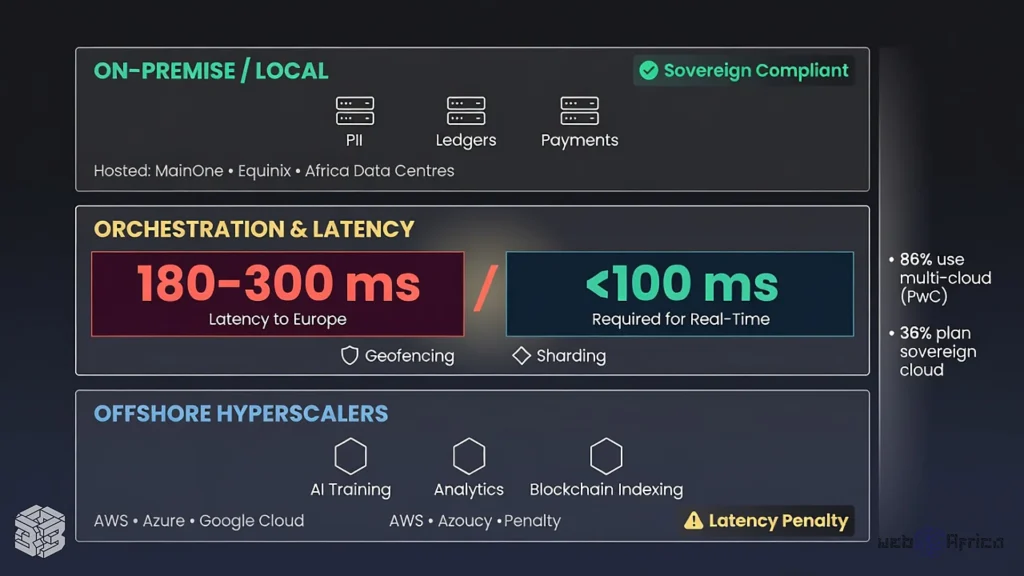
A hybrid setup comes from the clash between the need for local data control and the fact that advanced computing is mostly located outside Africa. Sensitive personally identifiable information (PII) and financial ledgers must reside on local colocation servers provided by firms such as MainOne, Equinix, and Africa Data Centres.
Non-sensitive, compute-heavy workloads—credit scoring models, AI analytics, and blockchain indexing—run on offshore hyperscale clouds from AWS, Microsoft Azure, or Google Cloud.
According to PwC’s 2025 Africa Cloud Business Survey, 86% of African enterprises now use multi-cloud environments, with approximately 90% adjusting cloud strategies due to regulation. Thirty-six percent are using or planning sovereign public cloud deployments, while 40% are engaging national partner clouds.
This setup causes delays in data synchronization, taking 180–300 milliseconds to reach Europe instead of the less than 100 milliseconds needed for real-time payments, and complicates the database due to sharding and geofencing.
Middleware layers must prevent accidental cross-border data migration, while disaster recovery plans must account for active-active configurations across geographically distinct data centers to mitigate fiber-optic vulnerabilities and grid instability.
The Compliance Tax: Blockchain, Sanctions, and Global Standards
African fintechs are tethered to global compliance through correspondent banking and stablecoin liquidity. The UK’s Office of Financial Sanctions Implementation (OFSI) now operates under strict liability following the Economic Crime Act 2022, allowing fines up to £1 million or 50% of breach value without proof of intent.
The UAE imposed objective liability in 2025, punishing firms that “ought reasonably to have known” of illicit funds. These extraterritorial rules cascade downstream.
To mitigate contagion risk, platforms integrate blockchain analytics tools—Chainalysis, Elliptic, and TRM Labs—costing a median of approximately $174,709 annually.
To mitigate contagion risk, platforms integrate blockchain analytics tools—costing a median of approximately $174,709 annually. While navigating traditional NIBSS clearing rules—which can demand 150% collateral of a firm’s highest net debit position—crypto operators must also build real-time transaction monitoring to satisfy the CBN’s strict new VASP bank account guidelines.
South Africa’s draft Capital Flow Management Regulations, released in April 2026, propose mandatory asset declarations and licensed intermediaries for large crypto transfers, threatening to restrict access to foreign market makers.
Compliance is now a direct driver of unit economics. Chipper Cash developed an in-house AI-based identity verification system (Chipper ID) coupled with OpenSanctions intelligence, reducing screening costs by 99% and contributing to achieving positive free cash flow in late 2025.
Zone Network deployed a blockchain-based decentralized card routing system integrated with NIBSS to meet the CBN’s PTSA mandate, achieving instant reconciliation and full regulatory transparency. VALR overhauled withdrawal architecture to integrate Sumsub’s Travel Rule solution, automating sanctions checks while maintaining institutional latency requirements.
As Gianluca Sacco, COO of VALR, explained:
“Sumsub’s Travel Rule solution has become a key part of our daily compliance workflow… It supports both automation at scale and the oversight required for regulated financial infrastructure.”
AI, Edge, and the Compute Gap
AI infrastructure demands GPU-dense, high-power-density racks that strain African grids. While edge data centers in Nairobi, Lagos, and Johannesburg increasingly handle inferencing, Global North hyperscalers still primarily conduct the energy-intensive training of large models.
National AI strategies in Egypt, Kenya, Senegal, and Rwanda are establishing frameworks for AI model access to domestic data, but the physical infrastructure to support sovereign AI training remains nascent.
RELATED: Why Africa Cannot Scale AI Without Better Identity Rails
Airtel’s Lagos facility and Equinix’s South African expansion represent early attempts to close this gap, but the energy, cooling, and capital requirements remain formidable.
Digital Sovereignty as Competitive Differentiator
Ladi Okuneye, CEO of Unicloud Africa, framed it as
“This is about digital autonomy. Data is now a strategic asset. Africa must control its digital infrastructure, not just consume it.”
Unicloud’s sovereign cloud offering differentiates itself with zero data egress fees, local-currency billing, and jurisdictional control. Attributes that resonate as enterprises navigate fragmented regulatory landscapes.
But this only solves a fragment of the issue. Data localization is championed as economic independence but criticized as a regressive tax on startups, fragmenting the African Union’s Digital Single Market ambition and forcing reliance on less feature-rich local alternatives.
Ayotunde Coker, CEO of the Open Access Data Centres (OADC), acknowledged the challenge:
Competing on price and scale against hyperscalers will take time. But sovereignty is a differentiator users increasingly care about.”
Can AI Infrastructure Outpace Africa’s Power Grid?
Infrastructure architecture is now a business risk that determines scalability, regulatory compliance, and investment attractiveness. Enterprises that master this friction secure institutional capital and market share. Those that do not face asset freezes, loss of correspondent banking, customer attrition, and valuation pressure.
Local startup funding in H1 2026 continued to face severe macro headwinds, remaining well below the $1 billion mark, and investor scrutiny has fundamentally shifted.
Due diligence now examines disaster recovery architectures, infrastructure control, and sovereign compliance alongside revenue growth.
RELATED: How blockchain privacy failures threaten enterprise payments in Africa
The Africa Finance Corporation committed $100 million to technology funds, noting that “technology is no longer an independent vertical; it is the operating system for physical infrastructure.”
For builders, this demands adopting containerization (Kubernetes), modular microservices, and multi-cloud strategies to maintain portability and avoid vendor lock-in. It requires engineering teams to collaborate closely with legal, compliance, and government-relations functions. It means treating power reliability, fiber redundancy, and sanctions screening as core product features, not afterthoughts.
The Invisible Substrate of Innovation
The next competitive battleground in Africa’s digital economy is the resilience, compliance maturity, and sovereignty of the infrastructure layer. Platforms that engineer for this reality—embedding compliance, securing reliable power, and building hybrid architectures that reconcile sovereignty with global compute—are defining the next generation of African technology leadership.
Infrastructure is the substrate upon which every digital promise stands or falls.
FAQ
Why is fintech infrastructure suddenly a board-level priority in Africa?
The ability to guarantee uninterrupted service, store data within national borders, execute flawless sanctions screening, and maintain multi-jurisdictional disaster recovery has become an existential requirement. Regulatory pressure, energy constraints, and investor scrutiny are forcing leadership teams to treat infrastructure as a strategic asset rather than a back-office function.
What data localization rules are reshaping fintech in Africa?
Nigeria’s Central Bank mandated local storage of all payment data by January 2027, while the Data Protection Act and GAID enforce annual audits and cross-border transfer restrictions. Kenya fined firms up to KES 500,000 per incident, and South Africa’s POPIA includes penalties of up to R10 million or 10 years’ imprisonment. These policies force multi-tier architectures that keep sensitive data within national borders.
How are power grid challenges affecting data center operations?
In Nigeria, energy consumes 55–65% of data centre costs, with grid reliability below 60%. Operators run diesel generators that burn roughly 270 litres per hour for a 1 MW facility, costing over ₦275,400 per hour. Nigerian telcos collectively spend more than $350 million annually on diesel, creating tension between digital growth and sustainability.
What is a hybrid cloud model and why is it mandatory for African fintechs?
A hybrid model places sensitive personally identifiable information and financial ledgers on local colocation servers, while compute-heavy workloads like AI analytics run on offshore hyperscale clouds. This setup reconciles data sovereignty mandates with access to advanced computing power, but it introduces latency and database complexity that must be carefully engineered.
Discover more from Web3Africa
Subscribe to get the latest posts sent to your email.
You must be logged in to post a comment.