









Table of Contents
For the last five years, African fintech founders faced a punishing paradox. Investors demanded sophisticated AI-driven products that included predictive lending, automated fraud detection, and a presentation claiming, “My product can rival anything OpenAI can throw.” However, the capital required to build those capabilities from scratch often exceeded the size of a seed round.
A three-person team in Lagos launching a digital lender faces significant upfront hurdles, potentially investing $50,000 to $300,000 to develop and validate a proprietary credit scoring model capable of assessing thin-file customers, depending on data acquisition costs and model complexity. By the time they had working infrastructure, they were out of runway.
RELATED: Why Africa Cannot Scale AI Without Better Identity Rails
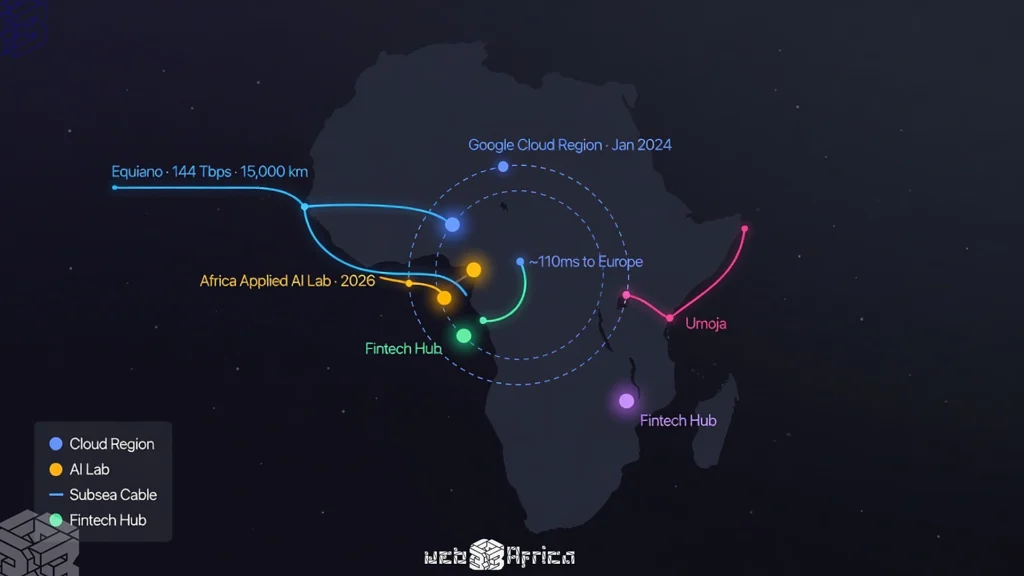
That economic equation is now fundamentally changing. It’s all thanks to Google’s Johannesburg cloud region, live since January 2024; the Equiano subsea cable, delivering enterprise-grade latency; and the Google for Startups Accelerator, offering up to $350,000 in cloud credits.
Now, African fintech startups can presently access industrial-strength machine learning infrastructure on a pay-per-use basis: no upfront capital, no GPU clusters, and no six-figure engineering bills.
The result is a new type of AI tools that work like a hidden partner, handling the tough computing tasks so founders can concentrate on getting their product out and making it work locally.
Applied AI Is Replacing the Need to Build Machine Learning From Scratch
Now, let’s get a bit technical; applied AI is not about training foundational models. It’s about integrating pre-trained, production-ready APIs into live business processes to automate decisions that previously required human judgment or expensive bespoke systems.
For African fintech startups, this distinction is vital.
Instead of hiring a machine learning team to build a fraud detection engine, a Nigerian payment processor can call Google’s Vertex AI endpoint, pass transaction metadata, and receive a fraud probability score in under 50 milliseconds, all for fractions of a cent per call.
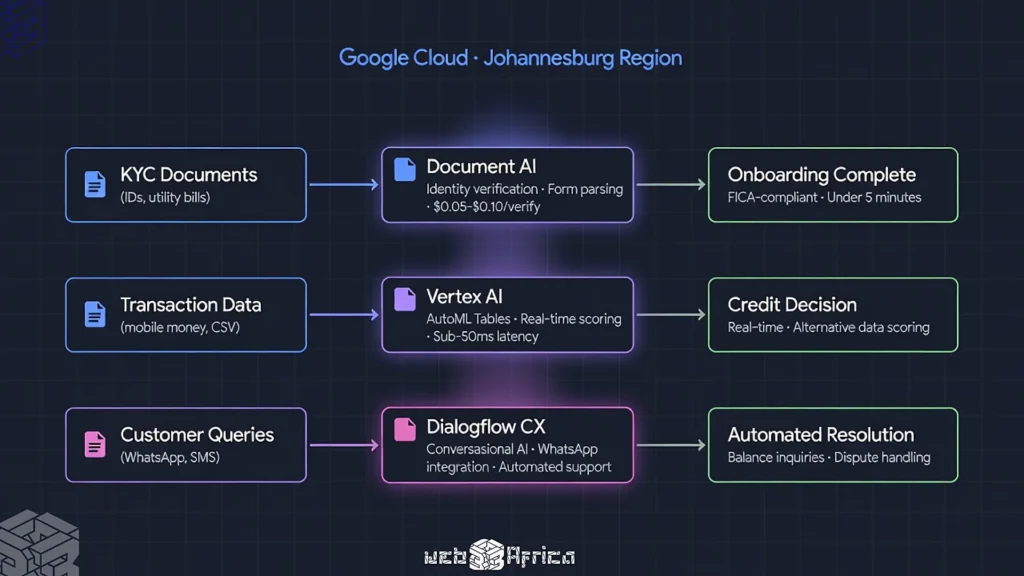
Document AI, another core service, can process KYC documents for as little as $0.05 to $0.10 per identity verification. Compare that to the cost of manually reviewing scanned IDs, utility bills, and proof-of-address forms across multiple regulatory jurisdictions.
RELATED: Stateless Ethereum Node Cuts Storage Needs, Boosts Network Security
TymeBank, a leading South African neo-bank, leveraged automated biometric KYC linked to national databases to reduce customer onboarding time from days to under five minutes, enabling rapid scaling to millions of users.
Felix Ike, CTO of Moniepoint, put it plainly:
“Google Cloud has been a key enabler in fueling Moniepoint’s growth journey from day one. With Google Cloud’s scalable infrastructure, we are confident we can grow our customer base exponentially.
Moniepoint uses Vertex AI and BigQuery ML to power fraud modeling, risk analytics, and transaction processing at scale. The unit economics are simple. Google Cloud infrastructure allowed the company to reach massive scale without the CAPEX burden of maintaining on-premise GPU clusters or building every component in-house.
How Google Cloud Infrastructure Is Lowering the Cost of Innovation
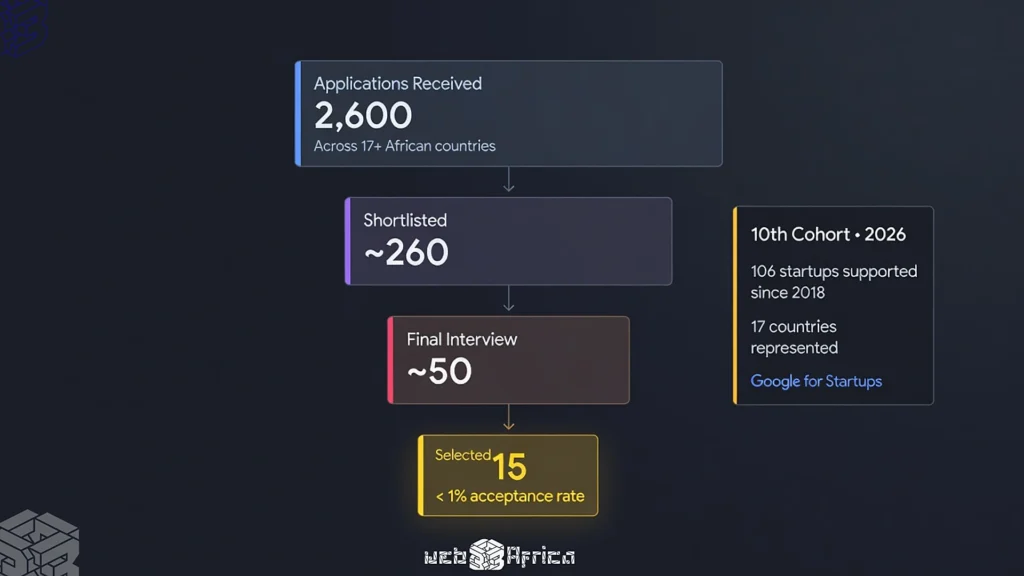
The Google for Startups Accelerator, which announced its 10th Africa cohort in 2026, doesn’t just provide mentorship. It provides applied AI tools on Google’s dime.
Startups selected from roughly 2,600 applicants gain equity-free support, TPU access, and cloud credits that can cover 100% of their AI infrastructure costs for the first 18 to 24 months.
For bootstrapped founders, this shifts the traditional venture math. Instead of raising a Series A to afford cloud computing, they first reach product-market fit and revenue traction and then raise from a position of strength.
Anda Africa, an Angolan fintech selected for the 2026 cohort, is building AI products in Africa to formalize and finance the informal moto-taxi sector using alternative-data credit scoring. Without Google’s infrastructure and credits, the cost of training and hosting those models would have been prohibitive.
RELATED: The Illusion of Legal Digital Assets Inside Zimbabwe’s Contradictory Financial Framework
With them, Anda can iterate weekly, retrain models on fresh data, and deploy real-time scoring in production, all before raising institutional capital.
Other fintech companies in the same group include MasteryHive AI (Nigeria), which uses AI to check transactions and monitor anti-money laundering, and Regxta (Nigeria), which evaluates unbanked micro-businesses using a mix of digital agents and alternative data.
The Real-World Tech Stack: APIs African Fintechs Are Using Right Now
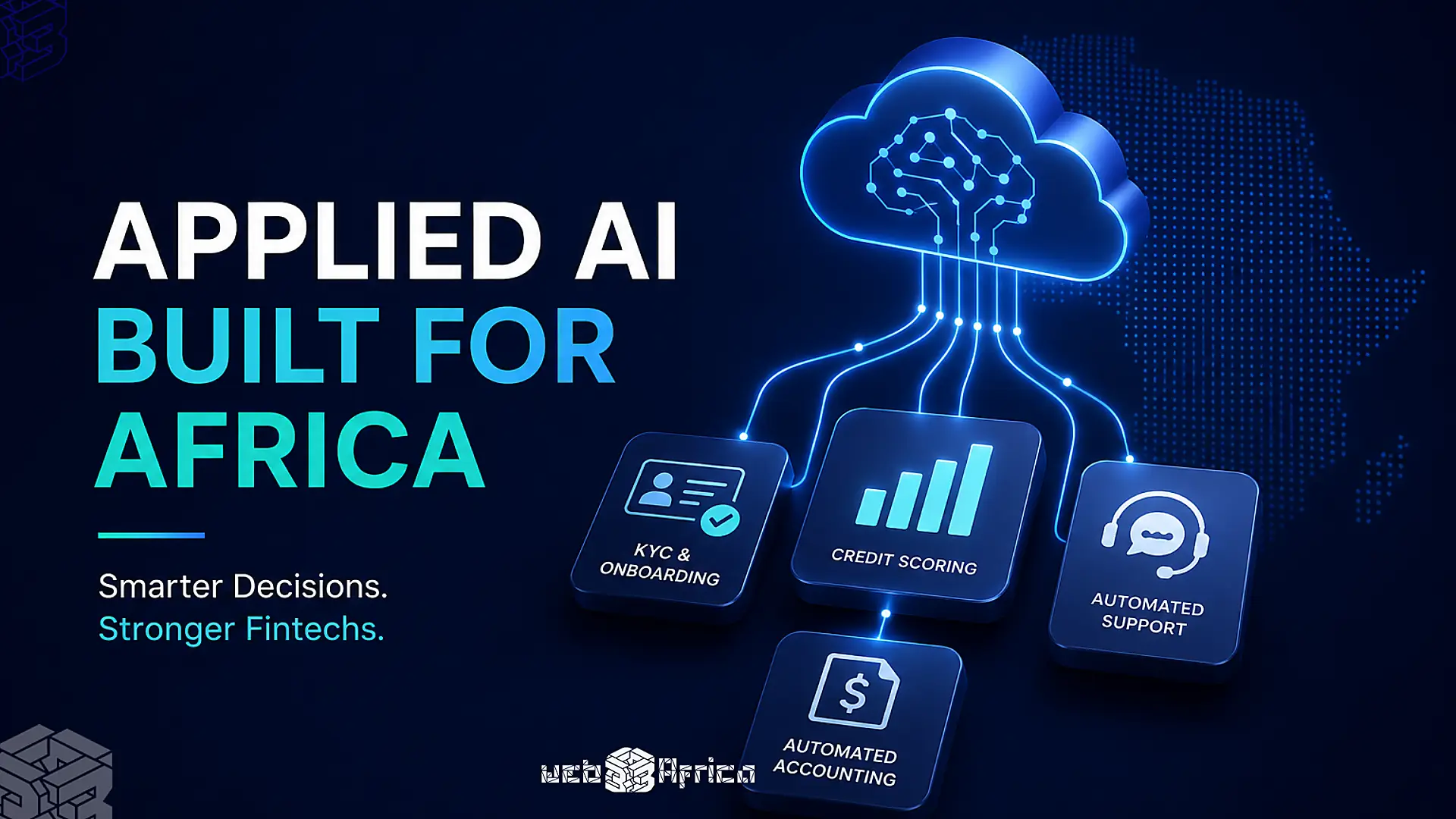
So applied AI tools can plug into fintech workflows in several ways. For instance:
KYC and onboarding
Document AI (Identity Document Processor, Form Parser) plus the Vision API automatically extract and verify IDs, utility bills, and compliance documents. This satisfies regulatory requirements like South Africa’s FICA without manual review teams.
Credit scoring
Vertex AI AutoML Tables let a lender upload a CSV of mobile money transactions, train a custom risk model in hours, and deploy real-time scoring with sub-50 ms latency. Weekly retraining loops on alternative data keep models current.
Automated accounting and support
Document AI processes invoices and receipts. Gemini flags anomalies and reconciles transactions while Dialogflow CX deploys conversational AI on WhatsApp for balance inquiries and disputes.
All of these components can now run in the Johannesburg cloud region, keeping sensitive financial data within Africa to meet the data sovereignty requirements of central banks.
Hilda Moraa, CEO of Pezesha, a Kenyan digital lending platform, frames the advantage simply:
“Scalability for us means the ability to score a merchant in rural Kenya in seconds. We don’t need to build the engine; we need to fuel it with the right local data.”
How Startup Credits Are Changing the Economics of Early-Stage Growth
The economics are compelling, but they come with some strings attached.
Deep integration with proprietary APIs, Vertex AutoML, Feature Store, and Document AI pipelines creates architectural lock-in.
Switching costs can reach 50% to 200% of annual cloud spend and take 6 to 18 months. For regulated fintechs, retraining models, revalidating compliance, and obtaining fresh regulatory approvals add friction.

However, the real risk is ownership. If a startup trains its credit scoring model using Google’s AutoML features, it cannot simply export that intellectual property to an on-premise server or migrate to AWS. The weights, schemas, and features: Google’s ecosystem ties the weights, schemas, and features together.
RELATED: Nigeria’s AI Debate Has Moved Into Enforcement
Google waived data egress fees for customers leaving as of March 2024, reducing one barrier. But the more profound issue remains: credits act as a powerful on-ramp, but they can reduce long-term negotiating power once a startup’s entire product architecture depends on a single vendor’s APIs.
The New Competitive Advantage Is Knowing What Not to Build
The shift from “build everything” to “integrate strategically” is lowering the floor for entry and raising the ceiling for execution. African fintech startups no longer need venture-scale capital just to compete on product sophistication.
A technical founder with strong distribution instincts and deep market knowledge can now deploy enterprise-grade AI capabilities and use saved capital for customer acquisition, regulatory compliance, and talent.
But the same infrastructure that democratizes access also centralizes dependency. The startups that win won’t just be the ones that move fastest. They’ll be the ones that understand which parts of their stack must remain portable and which can safely rely on rented intelligence.
Google’s investment in the Johannesburg cloud region, Equiano and Umoja subsea cables, and the newly announced Africa Applied AI Lab in Accra represents a multi-year bet that the continent’s next generation of tech companies will be built on its infrastructure.
For founders, the opportunity is real. So is the trade-off.
FAQ
What does applied AI mean for African fintech startups?
Applied AI refers to integrating pre-trained AI services into business workflows instead of developing proprietary machine learning models. This allows startups to deploy capabilities like fraud detection, credit scoring, and document processing more quickly and at lower cost.
How do Google Cloud credits benefit early-stage fintech founders?
The credits can significantly reduce AI infrastructure expenses during a startup’s early growth, enabling founders to focus on product development, customer acquisition, and reaching product-market fit before raising larger funding rounds.
What are the risks of relying heavily on one cloud AI provider?
Deep integration with proprietary AI services can create vendor lock-in, making future migration more expensive and complex due to application architecture, model deployment, and regulatory compliance requirements.
Why is this shift important for building AI products in Africa?
The article argues that affordable cloud AI enables founders to compete with enterprise-grade technology without building every component themselves, fundamentally changing the economics of fintech innovation across Africa.
Discover more from Web3Africa
Subscribe to get the latest posts sent to your email.
You must be logged in to post a comment.