











In Brief
African payments infrastructure must transition from fragmented national silos to a “federated” ecosystem to unlock the continent’s projected $1 trillion cross-border market.
CEO Wole Ayodele warns that the current trend of rebuilding treasury operations from scratch in every new market is a primary inhibitor of corporate scaling.
The high cost of intra-continental trade, currently routing through USD/EUR, drains nearly $5 billion from the African economy every year.
The “Afincran” movement aims to unite builders and regulators to ensure that payment rails become a foundational public good rather than a proprietary moat.
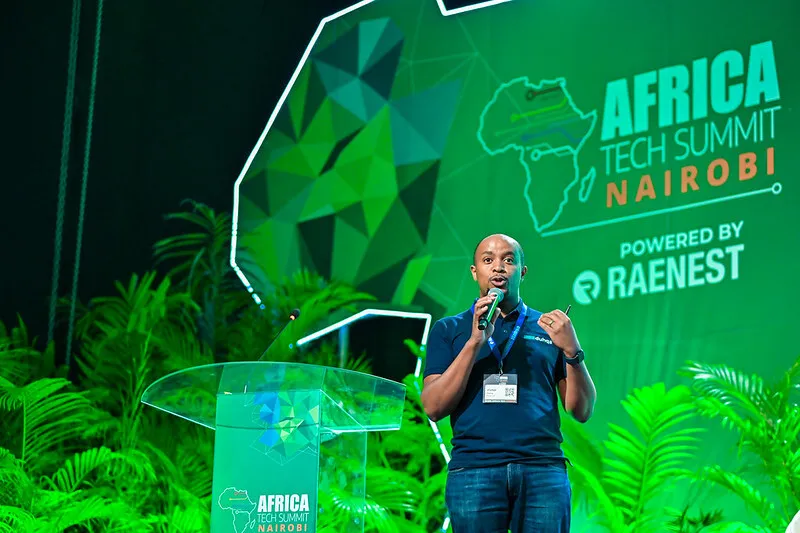
African payments infrastructure is no longer an afterthought in the continent’s growth story—it is the story. That was the clear message Wole Ayodele, CEO of Fincra, delivered at the 8th Africa Tech Summit (ATS) in Nairobi on February 12, 2026, in a keynote titled Building the Payment Rails for an Integrated Africa.
Speaking at the Sarit Expo Centre, Ayodele offered a pointed departure from the optimism that has long dominated Africa’s fintech narrative. “The question is not potential,” he told the audience. “It is infrastructure. Without the rails, growth cannot scale.”
What Ayodele was really warning about
Ayodele’s critique focused more on the operational reality finance teams face when they try to expand cross-border payments: settlement delays, inconsistent approval pathways, currency convertibility constraints, and duplicated compliance work.
His key point: a company that has already built solid treasury and payment operations in Nigeria often cannot “reuse” that setup when expanding to Kenya or South Africa. Instead, it must rebuild corridor by corridor, with new rules, new licenses, new banking partners, new capital requirements, and new FX exposure.
RELATED: The 2026 Borderless Report on Africa’s Global Execution Spread Premium
That’s what he meant by moving from “fragmentation” (each market operating like a silo) to “federation” (systems that interoperate enough that scaling doesn’t feel like starting over each time). And he stressed it can’t be solved by one firm alone:
“Federation is not a company project. It’s an ecosystem decision.”
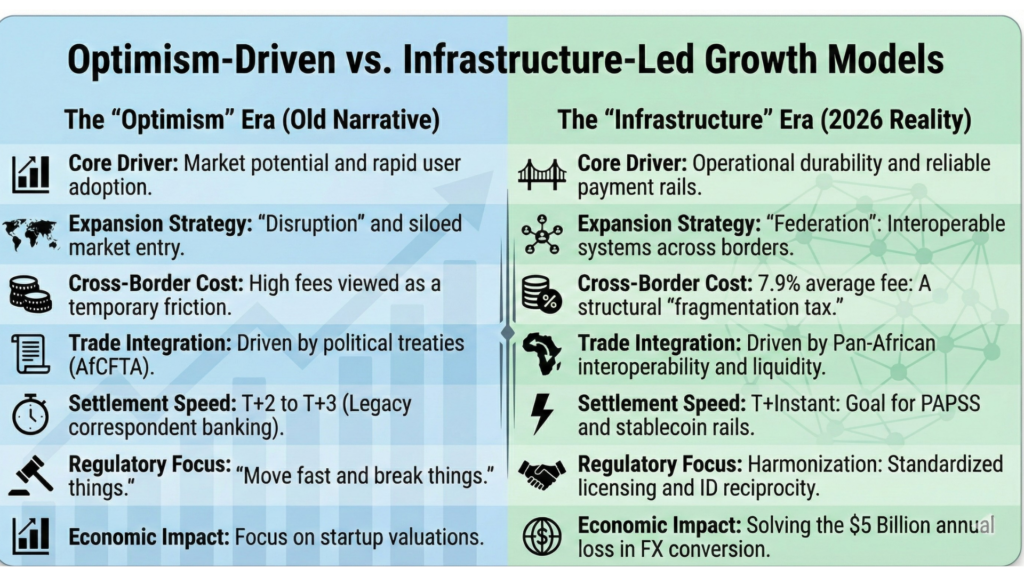
ATS Nairobi 2026 focused mainly on providing less hype about “disruption” and more urgency around “durability,” infrastructure, and regulatory harmonization.
The numbers behind Ayodele’s argument are difficult to ignore:
The average cost to send $200 to Sub-Saharan Africa was 7.9% in 2023, far above the G20’s 3% target, an ongoing drag on households and SMEs.
Intra-African trade still hovers around 15% of total trade (versus 60% in Asia and 70% in Europe), reinforcing Ayodele’s point that commercial integration lags political integration.
The cost of currency convertibility for intra-African trade, often routing through USD/EUR, has been estimated at nearly $5 billion annually.
Correspondent banking relationships declined by 20% globally between 2011 and 2018, shrinking the traditional plumbing many African corridors still rely on.
In a nutshell, even when there is demand to trade regionally, the “border” shows up as fees, delays, uncertainty, and failed settlements. That’s the practical ceiling Ayodele was describing.
AfCFTA’s promise vs. execution: AfCFTA payment infrastructure requirements are the missing middle.
Ayodele’s argument connects to the African Continental Free Trade Area (AfCFTA) challenge: integration cannot be willed into existence through treaties alone. It requires pan-African payment interoperability, aligned rules, and dependable settlement.
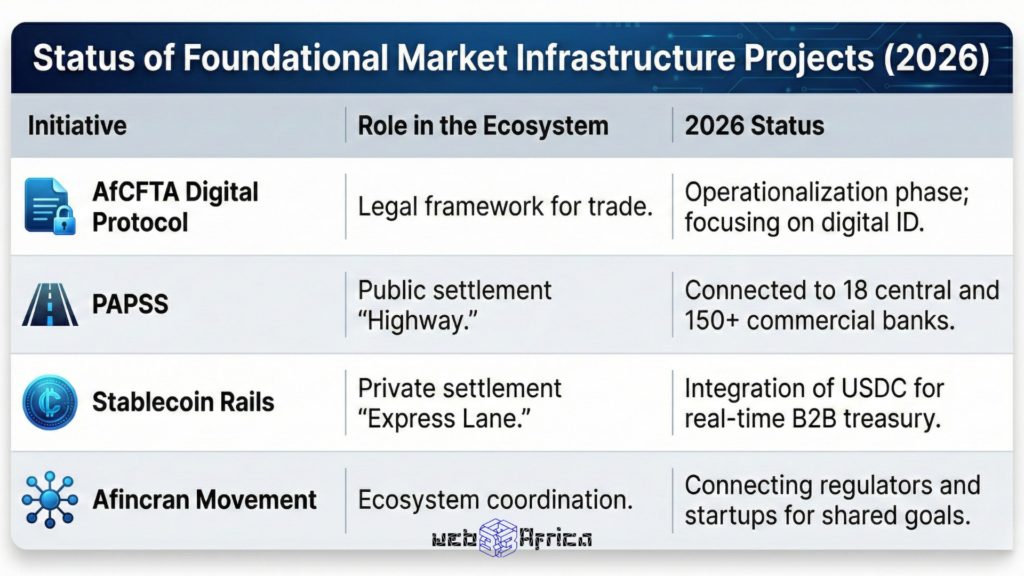
Two major AfCFTA-adjacent building blocks are now in motion:
The AfCFTA Digital Trade Protocol, approved by State Party Ministers in February 2024 and now in its operationalization phase, addresses some of this. Its current focus includes cross-border data transfer frameworks and digital identity reciprocity. Progress is real. But domestication by individual member states remains slow and uneven—and that unevenness is precisely where the fragmentation lives.
PAPSS (Pan-African Payment and Settlement System), backed by Afreximbank and the AU as an official settlement layer for AfCFTA. As of Aug. 2025, PAPSS reported connections to 18 central banks and 150+ commercial banks. PAPSS leadership has claimed savings of “up to 27% for end users” (presented as a claim rather than an independently verified benchmark).
But Ayodele’s “thick borders” point still holds because legal alignment and technical connectivity don’t automatically solve liquidity positioning, FX shortages, and uneven national rulebooks.
How African Regulation Is Shaping Fintech Outcomes
Ayodele’s “start from scratch” complaint becomes clearer when you look at how differently major markets regulate payments and digital assets.
Nigeria: Integrity and Enforcement as the New Gate
Nigeria’s removal from the FATF grey list on Oct. 24, 2025, was a de-risking milestone, but it also came with tighter expectations. The Central Bank of Nigeria’s early-2026 fintech report emphasized fraud controls (noting 87.5% of Nigerian fintechs use AI for fraud detection) and a more structured approach to innovation. Crypto regulation remains dual-track: SEC VASP licensing under existing rules, with CBN guidance (Dec. 22, 2023) allowing VASPs to maintain bank accounts under strict conditions.
RELATED: Four African nations removed from the FATF grey list in 2025.
Nigeria’s approach provides higher compliance, but it edges into a competitive moat, raising the cost of expanding in (or from) Nigeria.
South Africa: licensed crypto, formal stablecoin pilots
South Africa’s FSCA has processed 512 CASP applications, approving 300+ by end-2025, and initiated 81 enforcement investigations against unlicensed entities. Analysts and regulators have described 2026 as a “year of stablecoins” locally, with clearer rules enabling pilots, often mediated through bank participation.
In the region, clarity increases trust, but “licensed-first” frameworks can be expensive for local startups, causing a massive dependency on foreign entities.
How South Africa Built Africa’s Most Trusted Crypto Framework
Kenya: mobile money leadership, but licensing bottlenecks
Kenya’s CBK regulates PSPs under the National Payment System Act (2014), with core capital requirements ranging from $38,780 (KES 5 million) to $387,800 (KES 50 million). Cross-border expansion can remain corridor-by-corridor, requiring specific approvals and banking partnerships. Kenya also launched BiasharaLink and Deal House in February to digitize trade diplomacy, but the licensing bottleneck for pan-African payment interoperability remains unresolved.
Ghana and Rwanda: sandboxing and speed as strategy
The Bank of Ghana passed the Virtual Asset Service Providers Bill in December 2025, bringing Ghana into the regulated crypto fold under the existing Payment Systems and Services Act. While Rwanda launched its National Fintech Strategy (2024–2029), targeting a standardized licensing timeline of three to four months, positioning it as a jurisdiction of choice for fintech domiciliation.
The hard edge: prohibitions and ambiguity elsewhere
Egypt’s Law No. 194 of 2020 (Article 206) restricts crypto-related activity without Central Bank approval, while Moroccan authorities have warned virtual currencies are unauthorized (with a draft law reportedly in progress). Mauritius, by contrast, offers explicit licensing structures for fintech and digital assets.
The same product can be legal, licensable, or effectively blocked depending on where you land, exactly the fragmentation Ayodele described.
PAPSS and stablecoins both face “infrastructure math.”
Ayodele’s infrastructure-first lens helps explain why the continent is now experimenting with multiple rail options at once.
For instance, PAPSS is a public “highway,” including products like the Pan-African Currency Marketplace (PACM, launched July 2025) and PAPSSCARD (June 2025). Yet PAPSS can still face liquidity/FX bottlenecks when central banks struggle to settle net positions.
Onafriq and Conduit unite to Industrialize Digital Asset Liquidity
On the other hand, private stablecoin rails are the “express lane.” At ATS Nairobi 2026, Onafriq and Conduit announced stablecoin-based treasury integration (USDC). Flutterwave has discussed building stablecoin rails and piloting USDC settlements (Polygon), targeting low settlement costs. Chipper Cash has also partnered to reduce remittance costs.
RELATED: Accelerating Global Commerce with a Flutterwave Stablecoin Settlement
But stablecoins don’t magically erase fragmentation. In a previous article, we cited how Africa had the highest stablecoin-to-fiat conversion spreads globally (median 3%), peaking at 19.4% in Botswana. This is often because local liquidity and regulatory postures vary widely. So the “off-ramp” can reintroduce the same friction in a new place.
“Federation Is Not a Company Project”
Fincra, which reportedly operates across 50+ markets with 20+ global integrations, launched “Afincran” at the summit—a movement designed to connect regulators, investors, and startups around shared infrastructure goals to enhance Fincra pan-African payments. The initiative reflects Ayodele’s core conviction: no single operator can resolve structural fragmentation alone.
African payments infrastructure will only scale when regulators accelerate licensing passporting across borders, when the AfCFTA Digital Trade Protocol is domesticated into enforceable national law, and when liquidity is positioned where trade actually flows—not where legacy correspondent banking relationships happen to survive.
The $329 billion cross-border payments market projected for 2025 is on a trajectory toward $1 trillion by 2035. Whether African businesses capture that value or continue paying a fragmentation tax to access it depends on decisions being made right now—by regulators, infrastructure builders, and capital allocators alike.
As Ayodele made clear in Nairobi, the potential was never in question. The rails are.
FAQ
Why does Wole Ayodele believe “optimism” is no longer enough for African fintech?
Wole Ayodele argues that while the potential of the African market is undeniable, the lack of underlying payment infrastructure acts as a hard ceiling on growth. He believes that without pan-African payment interoperability and interoperable “rails”—systems that work across different currencies and regulations—growth cannot scale, regardless of how much optimism exists in the ecosystem.
What is the “fragmentation tax” in African payments?
The fragmentation tax refers to the cumulative costs, delays, and complexities arising from Africa’s siloed financial systems. Businesses expanding cross-border payments must often rebuild their treasury and payment operations from scratch for each new country, incurring new licensing, compliance, and currency conversion costs that Ayodele estimates at nearly $5 billion annually for the continent.
What is the “Afincran” movement mentioned at ATS Nairobi 2026?
Launched by Fincra at the 2026 Africa Tech Summit to support Fincra pan-African payments, Afincran is a movement designed to connect regulators, investors, and startups. Its goal is to move the industry from individual company projects toward shared “federated” infrastructure goals, ensuring that scaling across the continent doesn’t require starting over in every new market.
How does the AfCFTA Digital Trade Protocol impact payment infrastructure?
The AfCFTA Digital Trade Protocol, which entered its operationalization phase in early 2026, aims to harmonize cross-border data flows and digital identities. This provides the legal and regulatory framework necessary for systems like PAPSS to function, addressing AfCFTA payment infrastructure requirements, allowing for seamless intra-African trade and reducing the reliance on traditional correspondent banking relationships.
Discover more from Web3Africa
Subscribe to get the latest posts sent to your email.
You must be logged in to post a comment.