










In Brief
Stablecoin conversion costs in Africa reached a median of 3% in early 2026, marking the highest regional fees in the global market.
Data reveals a 44x cost difference between African corridors and Asian markets where spreads are as low as 0.07%.
Provider competition is the strongest predictor of cost, with multi-provider markets like South Africa offering rates as low as 1.5%.
The “TradFi Premium” in Africa sits at 119 basis points, reflecting severe hard currency shortages and a reliance on parallel-market pricing.
A recent report from Borderless.xyz has quantified what many African crypto users already feel. The stablecoin conversion costs they pay to turn digital dollars into local cash are the highest in the world.
According to the report, and based on 93,971 rate observations across 66 currency corridors in January 2026, the data reveals that Africa’s median stablecoin-to-fiat rates carry an execution spread of approximately 299 basis points, or 3%, dwarfing the 128 basis points (1.3%) in Latin America and just 7 basis points (0.07%) in Asia.
This matters especially with Africa’s stablecoin adoption outpacing its crypto adoption. Today stablecoins function as a utility rail for cross-border payments, remittances, and inflation hedging rather than speculative trading. These crypto off-ramp costs and high stablecoin conversion costs represent a structural tax on economic activity, one that disproportionately affects small businesses, freelancers, and remittance recipients who can least afford it.
What the Data Reveals: Africa’s Stablecoin Conversion Costs
The Borderless Benchmark methodology is rigorous. Hourly buy and sell quotes were collected from anonymized network providers throughout January 2026, then median-aggregated per corridor.
RELATED: The Massive Surge of Stablecoin Adoption as a Remittance Lifeline for Sub Saharan Africa
“Spread” is defined as the gap between what a provider will pay to buy stablecoins (USDT, USDC) from a user versus what they charge to sell them. This is analogous to a bid-ask spread in traditional foreign exchange markets. It represents the real execution cost a user pays at the cash-out point.
The findings are not all that welcoming. Stablecoin conversion costs in Africa are 44 times higher than in Asia. A Kenyan business importing goods and paying via stablecoins faces a transaction cost burden materially greater than a competitor in Manila or Jakarta. This directly challenges the narrative that cryptocurrencies are automatically a “leveler” for global finance.
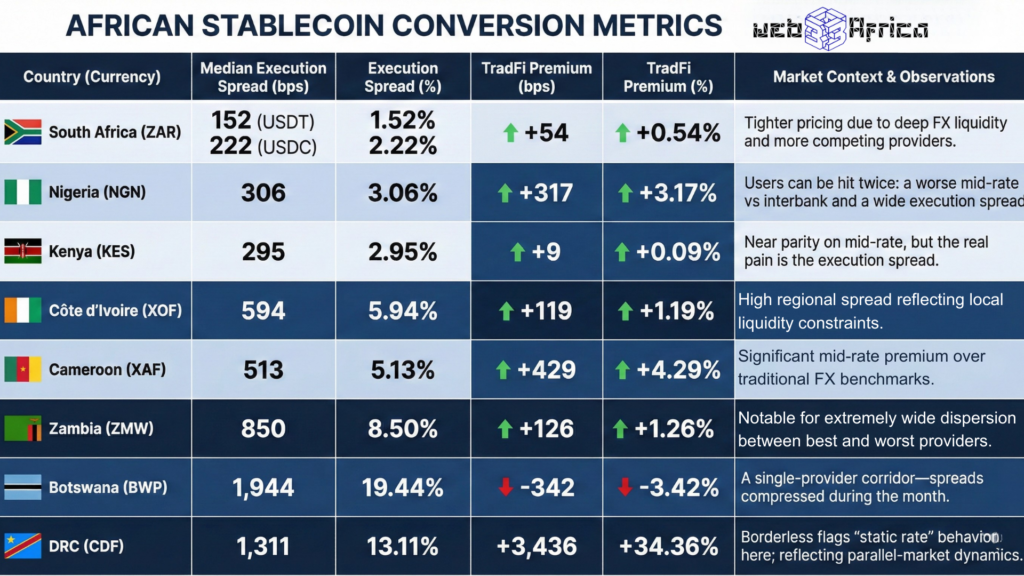
Within Africa itself, the report identifies a 13-fold variation in costs. South Africa, with the continent’s most liquid FX market and multiple competing providers, recorded a median spread of 152 basis points (1.52%) for USDT to ZAR conversions. Nigeria clustered around 306 basis points (3.06%), and Kenya at 295 basis points (2.95%). At the extreme end, Botswana stablecoin conversion costs posted a staggering 1,944 basis points (19.44%), while the Democratic Republic of Congo sat above 1,311 basis points (13.11%).
Why Africa Pays More: The Mechanics of High Spreads
Kevin Lehtiniitty, CEO and founder of Borderless. XYZ stated that barriers in high-cost markets “stack,” and limited banking access compounds regulatory uncertainty, which sits atop shallow liquidity.
“When these barriers are overcome, spreads compress fast,” he noted.
Thin liquidity
When a stablecoin provider in Botswana or Zambia runs out of local currency inventory, they cannot easily replenish it from deep interbank markets. They must wait for offsetting flow (users buying stablecoins and depositing local fiat) or pay a premium to source hard currency. This inventory risk forces providers to widen spreads to discourage one-sided conversion flows.
Fewer compliant off-ramps
In South Africa, the Financial Sector Conduct Authority had processed 512 Crypto Asset Service Provider (CASP) license applications by late 2025, approving 300. This regulatory clarity has enabled licensed firms to secure direct banking relationships, reducing the “fiat leg” settlement cost. By contrast,In markets with hostile or opaque regulations, providers face the risk of account freezes and higher compliance overhead, all priced into the stablecoin conversion costs.
Constrained FX access
The Borderless report introduced a “TradFi Premium” metric, measuring divergence between stablecoin mid-rates and traditional interbank FX rates. Globally, this premium is near zero (5 basis points).
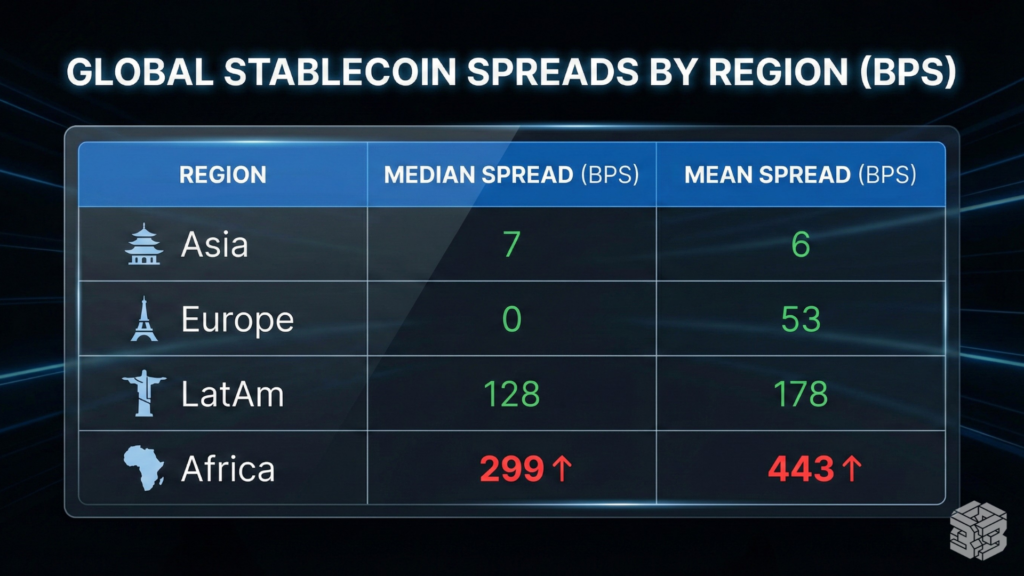
In Africa, it widens to 119 basis points (1.2%), with Nigeria alone showing a +317 basis point premium. This gap reflects scarcity of hard currency. In jurisdictions where official rates are managed or suppressed, the stablecoin rate acts as a price discovery mechanism for the “true” market demand for dollars. In Congo, the premium surged to +3,436 basis points, a quantitative signature of parallel-market dynamics where crypto has effectively decoupled from the official banking system.
Corridor structure
Borderless data shows that markets with multiple active providers cluster between 152 and 436 basis points, while single-provider corridors routinely exceed 13%. Zambia, for instance, exhibited a 650-basis-point dispersion between the best and worst provider, a spread range wider than the entire median cost in most developed markets.
Where Stablecoins Are Used: Utility, Not Speculation
Despite high stablecoin conversion costs, adoption remains high due to necessity. Chainalysis ranks Nigeria #6 globally on its 2025 Global Adoption Index (it was #2 in 2024), Ethiopia at #12, and Kenya at #28. Sub-Saharan Africa received over $205 billion in on-chain value from July 2024 through June 2025, a 52% year-over-year increase.
Stablecoins account for 43–45% of all crypto transactions in the region, and Nigeria’s transfers are 85% retail-sized (under $1 million), indicating real-economy usage rather than institutional speculation.
Chainalysis explicitly links this activity to cross-border remittances, where traditional services charge an average of 7.9% on a $200 transfer to Sub-Saharan Africa, and to macro pressures like currency depreciation and inflation.
Nigeria’s naira has depreciated over 75% since 2021. Roughly 12 to 15 African countries have experienced inflation above 20% since the pandemic. Chris Maurice, co-founder and CEO of Yellow Card, noted at the Bloomberg Africa Business Summit that “the user experience of the dollar sucks” when routed through SWIFT and intermediary banks. Stablecoins as inflation hedges and payment rails offer speed, accessibility, and preservation of purchasing power.
In Kenya, SMEs use stablecoins to pay suppliers in China and the UAE, bypassing dollar shortages in local banks. A Mercy Corps Ventures pilot showed stablecoin micropayments reduced fees from 29% to 2% for Kenyan freelancers.
In South Africa, Christo de Wit, Country Manager at Luno, explained:
“The transaction experience is identical to card or QR payments from the merchant’s perspective. There’s no volatility exposure, no technical burden, and settlement happens in rands through normal banking channels.”
The February 2026 partnership between Onafriq and Conduit (a global B2B stablecoin platform) signals institutional maturation. By integrating stablecoin rails into treasury management and cross-border settlement, the partnership aims to bypass correspondent banking inefficiencies and compress settlement times from T+2 to T+0.
The Cost of Overuse: Digital Dollarization and Systemic Risk
Yet the efficiency narrative has a darker counterpoint. Widespread USD-stablecoin adoption introduces digital dollarization risk. When businesses and individuals substitute volatile local currencies with dollar-pegged tokens, central banks lose monetary policy effectiveness. If Nigerian commerce prices and settles in USDC rather than naira, the Central Bank of Nigeria cannot influence economic activity through interest rate adjustments.
RELATED: Governor Kganyago delivers a stark warning on the future of South African money
Capital flight pressures intensify.
Stablecoins bypass traditional FX windows and capital controls, enabling wealth to exit jurisdictions without passing through the central bank’s monitoring infrastructure. The high TradFi premiums in Nigeria (+317 bps) and Congo (+3,436 bps) are quantitative signals of this flight dynamic. The market is willing to pay a significant premium to escape local currency exposure.
Public finance becomes more complex.
Widespread stablecoin usage can complicate tax collection and oversight where transaction flows move outside conventional banking rails. South Africa’s central bank has issued dedicated stability briefings on stablecoins, treating the issue as systemic-risk adjacent.
The IMF’s 2025 stablecoin overview highlights macro-financial risk channels, including how reserve structures and liquidity management can create fragility that transmits into broader markets, plus challenges for cross-border enforcement of AML/CFT and consumer protection.
Nigeria’s Crypto Boom: IMF Warns of FX Risks & Urges Tighter Regulation
Furthermore, high stablecoin conversion costs in parallel-market corridors like Congo signal capital flight. African nations are effectively outsourcing monetary stability to U.S. companies (Circle, Paxos) and U.S. regulators. A decision by the U.S. Treasury’s OFAC to sanction specific addresses could freeze assets critical to African trade without input from African governments, a new vector of external vulnerability.
Efficiency Gains Meet Sovereignty Costs
The Borderless.xyz January 2026 data provides the most comprehensive evidence to date that stablecoin conversion costs in Africa remain a material friction point. The 3% median spread and the 19% extremes in monopolistic corridors reveal that the blockchain’s efficiency gains are largely captured by intermediaries at the “last mile,” not passed to end users.
Competition and regulatory clarity demonstrably compress spreads. South Africa’s multi-provider, licensed market sits at 1.5%, while Botswana’s single-provider corridor hits 19.4%. The institutional response through aggregated B2B rails (Onafriq-Conduit) offers a pathway to lower costs for businesses.
But as crypto off-ramp costs fall and adoption accelerates, African policymakers face a delicate balancing act: harnessing the speed, inclusion, and cost advantages of stablecoin infrastructure while protecting monetary sovereignty, preventing capital hemorrhage, and maintaining fiscal oversight. The challenge for 2026 is whether African institutions can shape the rules of engagement before the infrastructure becomes too entrenched to regulate effectively.
Related Reading:
Discover more from Web3Africa
Subscribe to get the latest posts sent to your email.
You must be logged in to post a comment.