











In Brief
Stablecoin Adoption is currently transforming African financial infrastructure by reducing legacy remittance costs from an average of nine percent to under three percent.
The 2026 Davos consensus confirms that digital assets are no longer niche products but essential global infrastructure for households in Nigeria, Kenya, and Ghana.
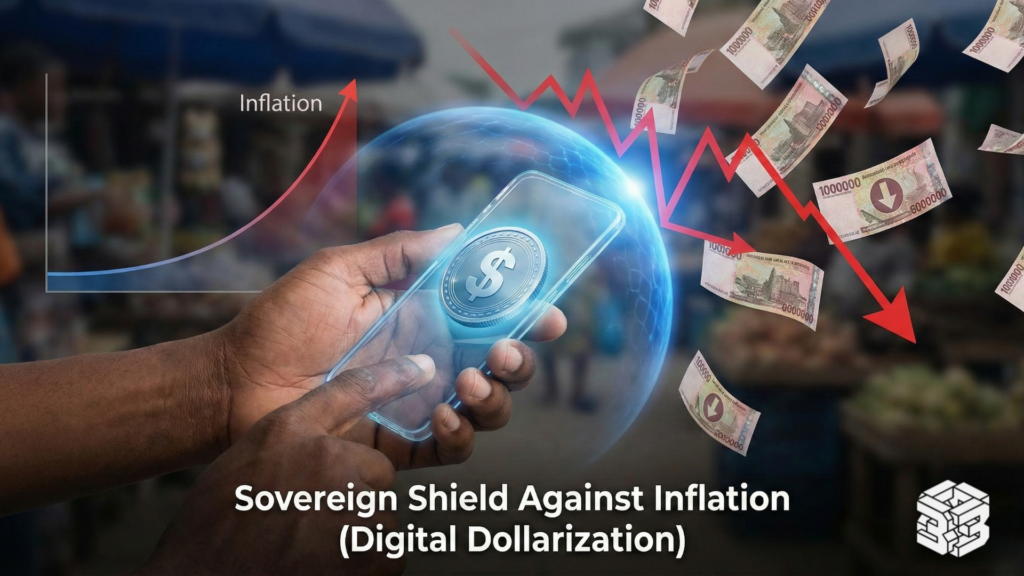
With inflation exceeding twenty percent in fifteen African nations, digital dollarization provides a sovereign shield for personal savings and SME working capital.
The mobile-first transition led by MiniPay has reached over twelve million activated wallets across major regional hubs like Nairobi, Lagos, and Johannesburg.
Stablecoin adoption has carved a growing share of African household and small‑business support through its efficiency. The 2026 analysis of Africa’s “digital dollarization” frames stablecoins less as speculative crypto and more as payment infrastructure that can route value to families and firms faster, and often cheaper, than legacy remittance rails.
This issue matters because remittances to Africa now triple official development assistance (ODA), and 2024 inflows exceeded $100 billion. When transfer fees absorb a meaningful slice of that, it functions like a regressive tax on the people who can least afford it.
The core claim: stablecoins are competing with aid by cutting remittance “leakage.”
A session titled “Where Are We on Stablecoins?” at the World Economic Forum (WEF) in Davos (Jan 19–23, 2026) crystallized what this report argues is a critical turning point.
Stablecoins are being treated as global financial infrastructure, not a niche product. Data presented revealed that stablecoin transfers in 2024 already surpassed the combined transaction volumes of Visa and Mastercard, reaching $27.6 trillion.

RELATED: $300 Billion Reasons Why Africa’s Stablecoin Revolution Can’t Be Ignored
Vera Songwe (former UN Under-Secretary-General and founder of the Liquidity and Sustainability Facility) summarized the remittance argument with unusually concrete numbers:
“For every $100 sent in remittances to Africa, $6 disappears in transaction costs and processing delays… Stablecoins reduce that cost to approximately $1 and settle in minutes rather than days.”
This is the “replacing aid” dynamic in plain terms. If remittances are already larger than ODA, then lowering the loss rate on remittances can rival (or exceed) the impact of many aid programs—without waiting for appropriations, project cycles, or intermediaries.
Crypto remittances: how the stablecoin route works (and where costs really sit)
For many African nations, remittances are the largest source of foreign exchange. In 2024, remittance inflows to Africa exceeded $100 billion. Yet the World Bank reported a different story.
Stablecoins, primarily USDT ($143 billion market cap) and USDC ($58 billion market cap), reduce that cost to approximately $1 and settle in minutes rather than the 3–5 days typical of SWIFT transfers.
The savings are dramatic across key corridors:
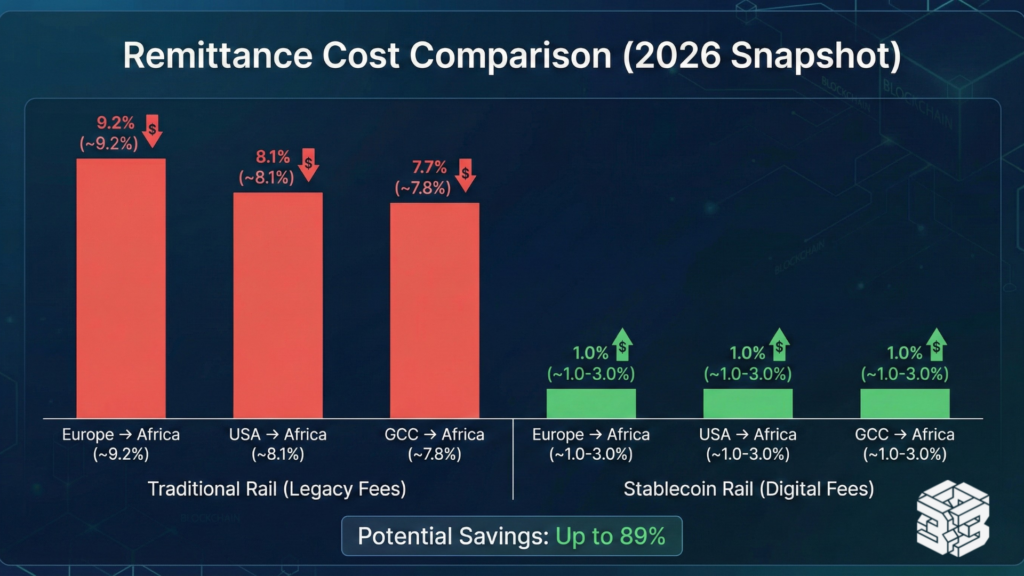
Europe to Africa: Traditional fees average 9.2%; stablecoin fees run 1.0–3.0%, yielding 67–89% savings.
USA to Africa: Traditional 8.1% vs. stablecoin 1.0–3.0% (63–88% savings).
GCC to Africa: Traditional 7.8% vs. stablecoin 1.0–3.0% (62–87% savings).
While the savings usually come from removing correspondent banks and compressing settlement time, it shifts costs to on‑ramps/off‑ramps:
Sender acquisition: A Diaspora user buys a stablecoin (often USDT or USDC) via an exchange, broker, or wallet partner.
Transfer: Stablecoin is sent wallet‑to‑wallet, typically settling in minutes.
Recipient conversion: The recipient either
The recipient either holds stablecoins as savings, which is a common inflation-hedge behavior noted in the report, or cashes out to local currency via mobile money, an exchange, an agent network, or P2P markets.
cashes out to local currency via mobile money, an exchange, an agent network, or P2P markets.
Quidax Report: How OTC and Stablecoins Are Changing African Payments
Where people get surprised: the blockchain transfer fee may be small, but cash‑out spreads, local liquidity, and compliance checks can dominate total cost. This is why distribution partnerships (wallets, mobile money, regulated exchanges) are the real battleground, not the token alone.
Why Stablecoin Adoption Surged: Inflation, FX Shortages, and “Digital Dollarization”
Currency instability directly correlates with stablecoin adoption rates in hyperinflationary economies. Since COVID‑19, inflation has exceeded 20% in roughly 12–15 African nations.
By early 2026, inflation remained severe across the continent:
Egypt: 10.3% (December 2025)
Nigeria: 15.15% headline inflation (December 2025), with peaks near 30%
South Sudan: 97.5%
Sudan: 87.2% (with a 2026 forecast of 54.6).
Zimbabwe: 89.0%
Songwe explained at Davos:
“The fastest way poverty increases is inflation. With a smartphone, you have access to a stablecoin, so you can actually save in a currency that is not exposed to the fluctuations of inflation.”
That backdrop helps explain stablecoin adoption rates in hyperinflation economies and high‑volatility markets.
For instance, in Ethiopia, after a 30% birr depreciation in 2024, the country saw an estimated 180% YoY growth in retail‑sized stablecoin transfers by 2025 (the fastest‑growing retail market in Africa in the report’s framing).
RELATED: Harnessing Hydropower: Ethiopia’s Blueprint for Dominating Global Bitcoin Mining
Chris Maurice, CEO of Yellow Card, observed:
“Businesses are struggling to get access to the dollars they need to operate. Stablecoins provide an opportunity for these businesses to continue to operate, grow, and strengthen the local economy.”
Reducing cross-border settlement time for African SMEs
One of the report’s most actionable insights is that stablecoins are increasingly a working‑capital tool.
For small importers and regional traders, stablecoins can:
cut settlement from 3–5 days (common in SWIFT flows) to minutes,
reduce failed/returned payments, and
Avoid multi‑hop FX conversions that erode margins.
For instance, in Nigeria, Africa’s dominant force in stablecoin adoption, 85% of transfers are under $1 million. By early 2026, approximately 30% of African stablecoin users deploy them for business operations, with corporate transaction volumes growing 25% annually.
MiniPay and the Mobile-First Infrastructure
Tether and Opera recently announced the expansion of USDT and Tether Gold (XAUT) support within the MiniPay wallet, built on the Celo blockchain. By February 2026, MiniPay had reached 12.6 million activated wallets and processed 350 million transactions, designed specifically for low-end smartphones common in emerging markets.
This mobile-first approach is critical. GSMA data shows mobile money account ownership in Sub-Saharan Africa rose from 21% (2017) to 33% of adults (2021), and smartphone adoption is projected to reach 81% by 2030.
Formalization in 2026: the rules are catching up (Nigeria and Ghana).
A recurring weakness in “stablecoins will fix remittances” narratives is regulatory ambiguity. The report is specific about what changed:
Ghana: Parliament passed the Virtual Asset Service Providers Act, 2025 (Act 1154), on Dec 23, 2025, with phased supervision beginning in 2026. On Jan 22, 2026, BoG/SEC/FIC issued “Ghana’s Policy Position on Virtual Assets and Service Providers.”
Nigeria: The Nigerian Tax and Tax Administration Acts (NTAA 2025) took effect Jan 1, 2026, shifting taxation of digital asset profits toward personal income tax (up to 25% in the report summary). The ISA 2025 classifies crypto assets (including stablecoins) as securities under SEC oversight. Reporting/KYC expectations tightened via UTIN (Tax ID plus NIN linkage) and monthly VASP returns, with penalties cited for non‑compliance.
RELATED: Inside ISA 2024: How Nigeria Is Legalizing Crypto and Cracking Down on Ponzi Scheme Laws
Dan Katz of the IMF emphasized at Davos that “we shouldn’t wed ourselves to a particular framework frozen in time,” noting that central banks regularly update operational frameworks.
Jeremy Allaire described stablecoins as “money as a native data type,” moving from speculation to scale in cross-border trade settlement and platforms like Stripe and Shopify.
Risks and trade‑offs (what the report implies but doesn’t “sell”)
Stablecoins can reduce friction, but they introduce new failure modes that policymakers and users should plan for:
Issuer and reserve risk: USDT/USDC are large (USDT $143B; USDC $58B market cap cited), but trust still depends on reserve quality, redemption access, and transparency.
Policy conflict (FX controls): Regulators (e.g., South Africa’s SARB) have flagged stablecoins as financial stability risks tied to exchange‑control circumvention.
Consumer harm: scams, fake OTC agents, and “wrong network” errors are common practical losses in real usage.
Compliance exposure: Ethiopia’s NBE governor Eyob Tekalign issued a “final warning” in early 2026 to remittance providers suspected of illegal activity; Ghana’s act includes governance and segregation requirements.
Dollar Dependence: While USDT and USDC provide stability, they reinforce dollar dominance. Songwe introduced an innovative concept at Davos: an African stablecoin platform backed by Special Drawing Rights (SDRs)—linked to a basket of currencies (dollar, euro, yuan, yen, pound)—to mirror Africa’s diverse trading relationships and reduce reliance on a single reserve currency.
Quidax and IFS Data Shows Most Users Earn Under ₦250k, Stablecoins Lead, and CEX Is Preferred
What this means for stakeholders
For diaspora senders and recipient households
Compare total cost: on‑ramp fee + spread + off‑ramp fee (not just “network fee”).
Prefer regulated providers where possible; keep receipts and transaction records (tax/AML scrutiny is rising).
If holding stablecoins as savings, define a cash‑out plan (where, at what spread, and how quickly).
For SMEs using stablecoins for trade
Map payment steps and failure points (supplier acceptance, time zones, compliance checks).
Choose rails that minimize reversals and speed reconciliation—this is often more valuable than the lowest nominal fee.
Treat stablecoin balances as treasury assets: set internal controls, limits, and approval workflows.
For policymakers evaluating remittance modernization
Focus on on‑/off‑ramp licensing, disclosure, and consumer protection—this is where most real‑world risk sits.
Require interoperable standards (travel rule, audits, redemption clarity) without freezing frameworks “in time,” echoing IMF’s Dan Katz.
Track whether stablecoins are reducing remittance costs in priority corridors (Europe/US/GCC→Africa), not just overall crypto volumes.
Why stablecoin adoption is being framed as “more important than aid”
The Vera Songwe WEF 2026 stablecoin report analysis crystallized a fundamental shift. Stablecoins are now “more important than aid” for millions in Africa. By reducing remittance costs from $6 to $1 per $100 sent, enabling instant settlement, and providing inflation hedging in economies where local currencies lose 15–97% of purchasing power annually, crypto remittances via stablecoins have become essential financial infrastructure.
The regulatory formalization in Ghana and Nigeria, the mobile-first innovation of platforms like MiniPay, and the institutional validation at Davos 2026 signal that Africa is not merely adopting stablecoins—it is defining the next era of global financial inclusion. As Songwe noted,
“Africa has been at 5 days of settlements, whereas Europe is 1 hour. We’re hurrying to efficiency.”
The 2026 inflection point marks the transition from informal digital dollarization to formal, regulated financial sovereignty.
Discover more from Web3Africa
Subscribe to get the latest posts sent to your email.
You must be logged in to post a comment.