











In Brief
- Africa crypto regulation fundamentally shifted in 2025 from a legal “grey zone” to a framework of binding primary legislation in powerhouse economies like Nigeria, South Africa, and Kenya.
- New fiscal policies have solidified the “fiscal net,” including a 10% Capital Gains Tax in Nigeria and a 10% Excise Duty on transaction fees in Kenya.
- The East African Community (EAC) has approved a masterplan to integrate fintech and regulated stablecoins into regional payment infrastructure by 2031.
- A widening continental divide has emerged as Algeria (Law No. 25-10) and Egypt maintain total criminalization of digital assets, contrasting with Sub-Saharan formalization.
For years, Africa crypto regulation existed in a legal grey zone; high adoption rates met with regulatory silence or outright bans. That changed definitively in 2025. Between January and December, a few economic powerhouses soon demonstrated a massive change in how they approach Africa crypto regulation.
Nigeria, South Africa, Kenya, and Ghana replaced ad-hoc circulars with binding primary legislation, fundamentally altering the compliance landscape for virtual asset service providers (VASPs).
Urgent macroeconomic pressures, particularly the need to exit or avoid the Financial Action Task Force (FATF) grey list, forced regulators to operationalize FATF Recommendation 15 with unprecedented speed, setting a new benchmark for Africa crypto regulation.
Below is a highlight of the most consequential 2025 milestones, and how they reshape operating expectations in 2026.
Nigeria: The ISA 2025 Watershed and What It Means for Operators
On March 29, 2025, President Bola Ahmed Tinubu signed the Investments and Securities Act (ISA) 2025 into law, repealing the outdated 2007 framework.
The Act was gazetted on May 2, 2025, and represents the cornerstone of Nigeria ISA 2025 crypto compliance.
Some of the key highlights of the ISA Act include:
SEC’s expanded powers: ISA 2025 authorizes SEC registration and regulation of “virtual and digital asset exchanges” and VASPs and includes unusual enforcement concepts like a “National Confiscation Wallet” and powers supporting freezing/sequestration assistance and cross‑border cooperation.
Tax clarity: The Nigeria Tax Administration Act (NTAA) 2025 (enacted June 26, 2025) confirms a 10% capital gains tax on disposal of digital assets and clarifies that not all “virtual assets” are necessarily SEC‑regulated securities, foreshadowing continued perimeter questions for payment tokens and stablecoins.
Barrier to entry via capital rules: the SEC’s revised minimum capital requirement for Digital Asset Exchanges is ₦2 billion (referenced in a January 2026 circular tied to the 2025/2026 licensing cycle). In practice, thresholds like this push the market toward consolidation and make audited controls and bankable governance non‑negotiable.
Marketing controls: SEC amendments in January 2025 require a “no‑objection” letter before using third‑party promoters or influencers (effective June 30, 2025), increasing liability for both platforms and “influencers.”
Simultaneously, the Nigeria Tax Administration Act (NTAA) 2025, enacted June 26, introduced a 10% Capital Gains Tax on digital asset disposals, solidifying the fiscal net around the sector within the broader context of Africa crypto regulation.
These regulations were accompanied by impressive adoption rates. Chainalysis reported $92.1 billion in on-chain value received (July 2024–June 2025), with a notable March 2025 surge tied to Naira devaluation and centralized exchange activity. Nigeria was officially removed from the FATF grey list in October 2025, validating its AML/CFT progress.
Nigeria Fuels Africa’s $125B Crypto Market: Stablecoins and Devs Lead the Charge
South Africa: Licensing Scale-Up, Enforcement, and FATF Exit
South Africa’s 2025 story centers on aggressive enforcement and redemption. The Financial Sector Conduct Authority (FSCA) processed a massive licensing influx under the FAIS Act, which classifies crypto assets as “financial products.”
By December 12, 2025, the FSCA had:
Received 512 Crypto Asset Service Provider (CASP) applications
Approved 300 licenses
Declined 14 applications
Seen 121 withdrawn voluntarily
Rejection reasons were explicit, with applicants failing on operational ability (lack of coherent business plans) and competency (key individuals lacking demonstrated crypto risk management experience).
The FSCA levied over R119 million in fines in 2025, primarily targeting unlicensed operators and initiating 81 investigations. This enforcement blitz was critical to demonstrating “effectiveness” of Africa crypto regulation to the FATF.
RELATED: Four African nations removed from the FATF grey list in 2025.
Furthermore, the Travel kicked in with Directive 9, issued by the Financial Intelligence Centre (FIC). This addition mandates the collection, verification, and transmission of sender/beneficiary data for crypto transfers, operationalizing FATF’s Travel Rule.
The payoff came on October 24, 2025, when South Africa was officially removed from the FATF grey list, restoring investor confidence and reopening global banking channels.
Kenya: Statutory Clarity and Fiscal Course-Correction
Kenya ended its regulatory grey area with the Virtual Asset Service Providers Act, No. 20 of 2025, assented October 15, 2025, gazetted October 21, and commenced November 4, 2025.
Core provisions:
Dual-regulator model: The Central Bank of Kenya (CBK) oversees stablecoins and payment tokens; the Capital Markets Authority (CMA) licenses exchanges and trading platforms.
Mandatory licensing: All VASPs must obtain licenses; penalties for non-compliance include fines up to KES 10 million ($77,000) or 10 years imprisonment for individuals.
Consumer protection: Mandates customer fund segregation, a direct response to global exchange collapses.
Clear definitions: Explicitly defines “virtual asset,” “stablecoin,” “NFT,” and “anonymity-enhancing services.”
As a key player in Africa crypto regulation, Kenya’s Finance Act 2025 (effective July 1) repealed the controversial 3% Digital Asset Tax (DAT) on gross transaction value, replacing it with a 10% Excise Duty on transaction fees.
RELATED: Nigeria Crypto Tax 2026 Guide: Calculate and Report Your Gains.
Approximately 6 million Kenyans (10% of the population) already use crypto, with the country ranked third in Africa in on-chain weighted transaction volume.
Ghana: From Registration to Legislation
Ghana’s 2025 journey progressed in two phases:
Phase 1 (Binding Action): On July 10, 2025, the Bank of Ghana issued Notice BG/GOV/SEC/2025/18, mandating VASP registration by August 15. More than 100 VASPs registered, covering a user base exceeding three million Ghanaians.
Phase 2 (Primary Legislation): Parliament passed the Virtual Asset Service Providers Bill, 2025 (laid November 13, announced December 22, 2025). The bill formally legalized cryptocurrency use, ending legal uncertainty.
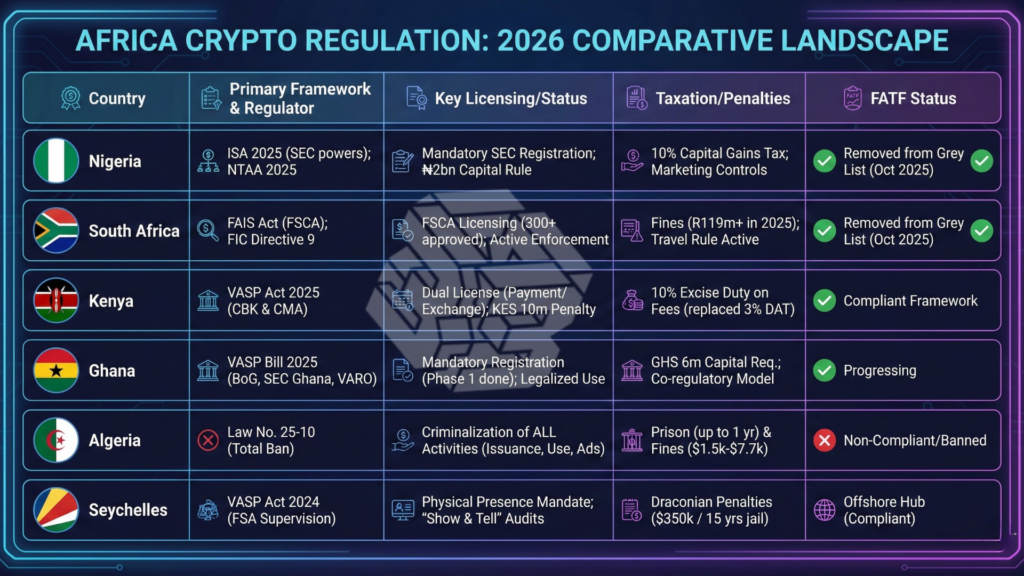
This particular iteration of Africa crypto regulation employs a co-regulatory model involving the Bank of Ghana (BoG), the Securities and Exchange Commission (SEC Ghana), and a new Virtual Assets Regulatory Office (VARO) for supervision. Capital requirements are set at GHS 6 million ($380,000).
BoG Governor Dr. Johnson Asiama stated that the legislation establishes clear, accountable, and well-governed boundaries for crypto.
“within clear, accountable, and well-governed boundaries.”
Algeria: Law No. 25-10 and the Criminalization Strategy
On July 24, 2025, Algeria enacted Law No. 25-10, taking immediate effect upon publication in the Official Gazette. Unlike its Sub-Saharan neighbors, Algeria chose not regulation but criminalization, imposing a total ban on the issuance, purchase, sale, possession, use, or promotion of digital assets.
Law No. 25 prohibits:
All core activities: Issuance, trading, holding, and promotional activities related to digital assets are now criminal offenses.
Platform operations: Development or operation of trading platforms and digital wallets, whether self-managed or via third-party services, is explicitly banned.
Influencer marketing: Social media promotion of cryptocurrency is criminalized, echoing Nigeria’s finfluencer clampdown but with jail time instead of administrative penalties.
Mining: The law prohibits “block reward mining,” despite Algeria’s relatively modest mining footprint.
Violators face up to one year imprisonment and fines ranging from 200,000 to 1 million dinars ($1,540–$7,700). Penalties escalate if crypto usage links to organized crime or money laundering.
Law No. 25-10 strengthens the original prohibition introduced in the 2018 Finance Law (Article 117), shifting crypto from a regulatory grey area to active criminalization. The Algerian government frames the move as essential protection against money laundering and terrorist financing. However, there might be a deeper motive, such as maintaining strict capital controls and protecting foreign reserves in a tightly controlled financial system.
Egypt’s Law No. 194 of 2020 mirrors this stance, further dividing the continent. While Sub-Saharan powerhouses embrace formalization, Northern African nations maintain outright bans. The IMF’s June 2025 Departmental Paper warned that this divergence complicates cross-border crypto tax implications in Africa and creates arbitrage risks.
RELATED: Nigeria’s Crypto Boom: IMF Warns of FX Risks & Urges Tighter Regulation
Seychelles: From Offshore Haven to Supervised Financial Hub
Seychelles represents the opposite trajectory in Africa crypto regulation, a former “light touch” offshore hub undertaking aggressive regulatory maturation to retain legitimacy and capital.
The Virtual Asset Service Providers Act, 2024 (Act 12 of 2024), was enacted August 30, 2024, and entered force September 1, 2024. Existing operators faced a challenging deadline, December 31, 2024, to transition from grandfathered status to full licenses under the new regime.
Seychelles moved from policy intent to binding supervision, introducing requirements that rival or exceed onshore jurisdictions:
Physical presence mandate: VASPs must operate a fully staffed local office with qualified personnel and accessible records—no more “brass plate” registrations.
Substantive governance: At least one resident director is required, with a minimum of two board meetings and four management meetings held in Seychelles annually.
“Show and tell” sessions: Starting in 2025, the Financial Services Authority (FSA) introduced mandatory three-hour operational deep dives, where applicants must demonstrate live systems for AML/CFT, cybersecurity, and risk management—no cut-and-paste compliance manuals accepted.
Draconian penalties: Operating without a license carries fines up to $350,000 and imprisonment for up to 15 years, among the steepest penalties globally.
Seychelles historically attracted major platforms like BitMEX and OKX due to lenient oversight. However, FATF pressure and the FTX collapse forced a reckoning. The FSA’s Circular 14 (November 2025) explicitly stated that “placeholder submissions” would be rejected, triggering an exodus of shell companies.
Despite stricter rules, Seychelles attracted 31% of all blockchain funding in Africa over the past year, demonstrating that credible regulation can enhance, not repel, institutional capital. The jurisdiction is positioning itself as a compliant offshore hub.
The EAC Masterplan and Cross-Border Tax Implications
On May 9, 2025, the East African Community Monetary Affairs Committee approved the Cross-Border Payment System Masterplan in Mombasa, Tanzania. This blueprint explicitly acknowledges “innovations such as fintech and cryptocurrencies” and proposes pathways to integrate them into formal regional payment infrastructure to support the goal of a single currency by 2031.
This generally means that traders may soon settle cross-border EAC transactions using regulated stablecoins on interoperable rails, bypassing traditional correspondent banking friction.
However, while this addition in is a positive development, it also presents several challenges. The IMF’s Departmental Paper No. 2025/004 (published June 27, 2025) warns that inconsistent national tax treatments create arbitrage opportunities. Nigeria’s 10% CGT, Kenya’s 3% excise duty, and Tanzania’s 3% digital asset tax each create different incentives. This trend translates into cross-border crypto tax implications, with Africa becoming a live compliance topic in 2026.
VASP compliance checklist for African Fintechs (2026 decision points)
Operators navigating this new landscape should prioritize:
Licensing perimeter mapping: Which activities are exchange, brokerage, custody, issuance, stablecoin, or payments, and which regulator owns each?
Capital and solvency plan: Can you meet paid‑up capital (where specified) and fund ongoing AML, audits, and security operations?
Travel Rule and KYC stack: Collect/verify/send originator/beneficiary data where required; document thresholds, exceptions, and vendor controls.
Governance and “key person” competence: Prepare evidence of crypto risk management experience and clear accountability lines.
Customer asset segregation: Policies, reconciliations, and auditability—especially where statutes mandate segregation.
Marketing approvals: Where “no‑objection” or similar approval is required (notably Nigeria), treat influencer campaigns as regulated financial promotions.
Tax operations: Build defensible reporting for capital gains (Nigeria) and fee-based excise duty models (Kenya); plan for API‑style data requests as enforcement ramps.
Incident response and cyber controls: Expect cybersecurity to be an explicit licensing criterion, not an informal best practice.
2026 Outlook: Consolidation, Enforcement, and Opportunity
The high capital requirements introduced in 2025 will force a wave of consolidation in 2026. Smaller local exchanges unable to meet thresholds will merge or exit. Revenue authorities in Nigeria, Kenya, and Ghana will likely integrate API access to VASP data to automate tax collection.
Chainalysis characterized 2025 developments:
Africa in 2025 showed how regulation is slowly catching up with already-entrenched, real-world crypto use. “
Sub-Saharan Africa received over $205 billion in on-chain value (July 2024–June 2025), 52% higher than the prior year, demonstrating that thoughtful Africa crypto regulation can coexist with robust adoption.
The 2025 legislative convergence laid a foundation. The challenge for 2026 is ensuring these frameworks enable innovation rather than stifle the grassroots energy that made Africa a global crypto leader. For policymakers, operators, and investors, the era of ambiguity is over.
Discover more from Web3Africa
Subscribe to get the latest posts sent to your email.

You must be logged in to post a comment.