











Table of Contents
Fintech has etched its way into Africa’s ecosystem, and this year stablecoins are the driving force. Throughout its journey, building and funding a startup has evolved. A few years back, an early-stage startup could launch a wallet, exchange, or remittance service with modest infrastructure and grow compliance capabilities later.
Today, the sequence has reversed. Startups must comply with regulations ensuring even their infrastructure meets the set standard. Governments and regulatory bodies, particularly in Africa, now require monitoring, reporting, and risk management from any local or international fintech or exchange operating in the region.
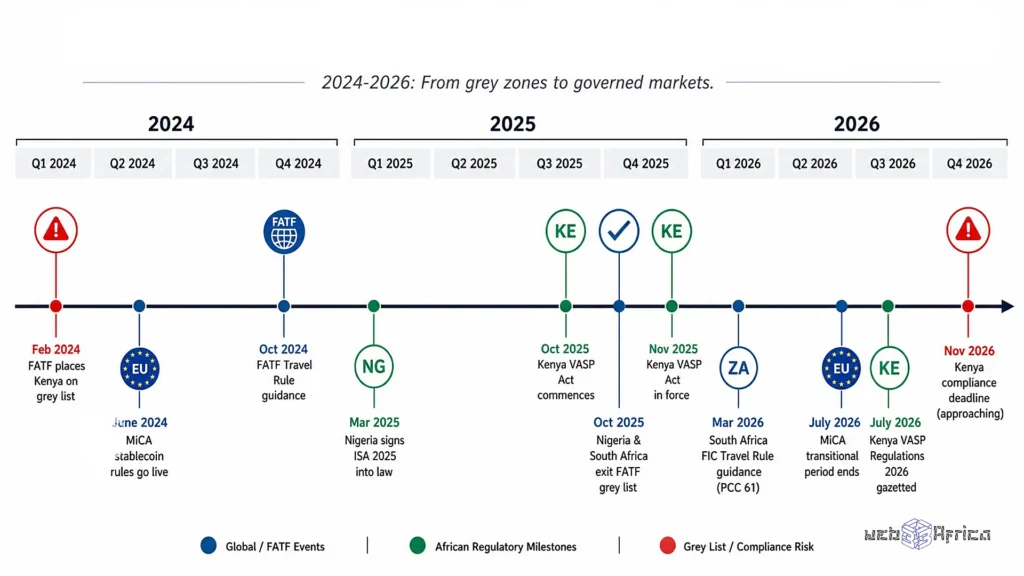
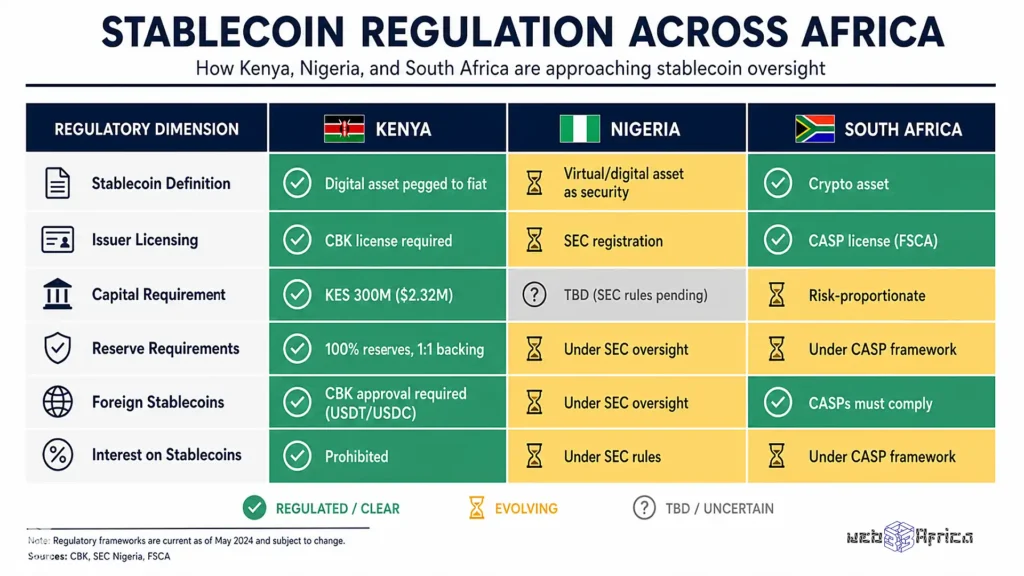
Think about it: Kenya’s VASP laws, South Africa’s Travel Rule and CASP laws, and Nigeria’s ISA 2025 each share a common goal to regulate, but their applications vary. Currently, a region’s requirements influence product architecture, banking partnerships, investor due diligence outcomes, and access to global payment networks.
How FATF and Europe’s MiCA Framework Shape Global Tech Stacks
As a continent, our sheer potential is limitless, especially in Web3. However, most, if not all, upcoming regulations each derive from a common blueprint: international regulatory frameworks.
VASP regulations, the rules governing all global exchanges, emerged as a global standard following Financial Action Task Force (FATF) recommendations. Any e-crypto exchanges, wallet providers, and blockchain-based payment platforms must implement sophisticated AML compliance systems.
Europe’s MiCA regulation raised the bar further. While MiCA is a European Union framework, its influence extends far beyond Brussels.
For many local fintechs, partnering with European banking infrastructure paves access to many users who send money back home. This also includes EU-based payment providers or even finding a VC willing to fund a startup. MiCA standards shape each of these relationships.
In a nutshell, the MiCA regulation focuses on asset custody, transaction monitoring, and operational resilience. For an entrepreneur, this means rethinking the software’s functionality, its data storage, and even the governance structure.
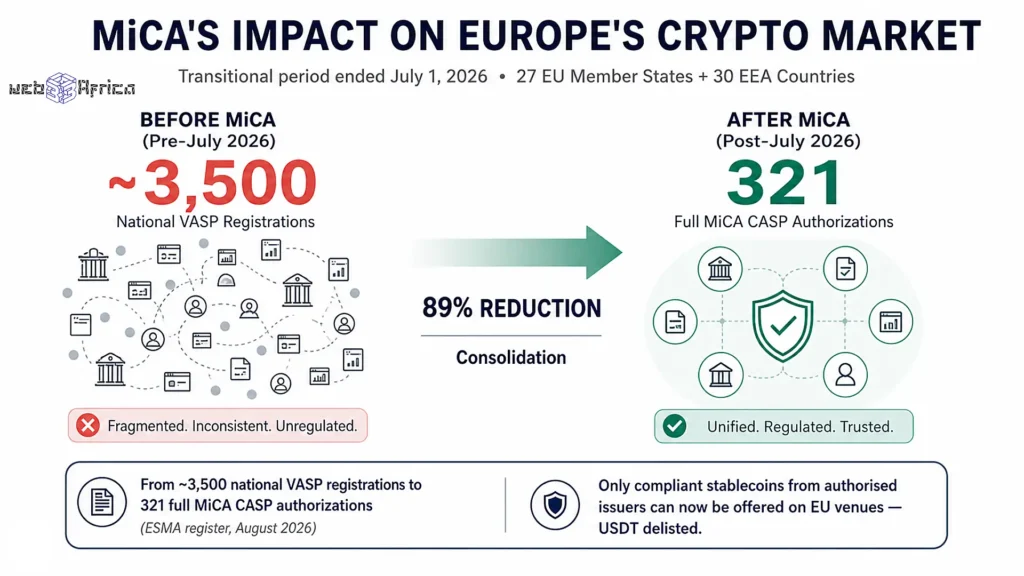
When blockchain broke into traditional finance, governments weren’t satisfied with documentation alone. VASP regulations require continuous transaction monitoring, automated sanctions screening, politically exposed person (PEP) checks, and real-time risk scoring.
MiCA regulation demands audit trails, cybersecurity protocols, and governance systems that extend deep into technical architecture.
Related: African Fintechs in the Crosshairs of Europe’s MiCA Compliance Deadline
Regional Fragmentation and Regulatory Execution Across African Markets
The MiCA law set the foundation of most blockchain-related frameworks. For instance, Nigeria’s ISA introduced digital asset licensing requirements that mirror international standards. Any local or international crypto platform operating within Nigeria must maintain comprehensive transaction records.
Kenya’s latest update brings new rules around digital lending and payments, with a greater focus on consumer protection and data privacy, where M-Pesa and Airtel Money are dominant.
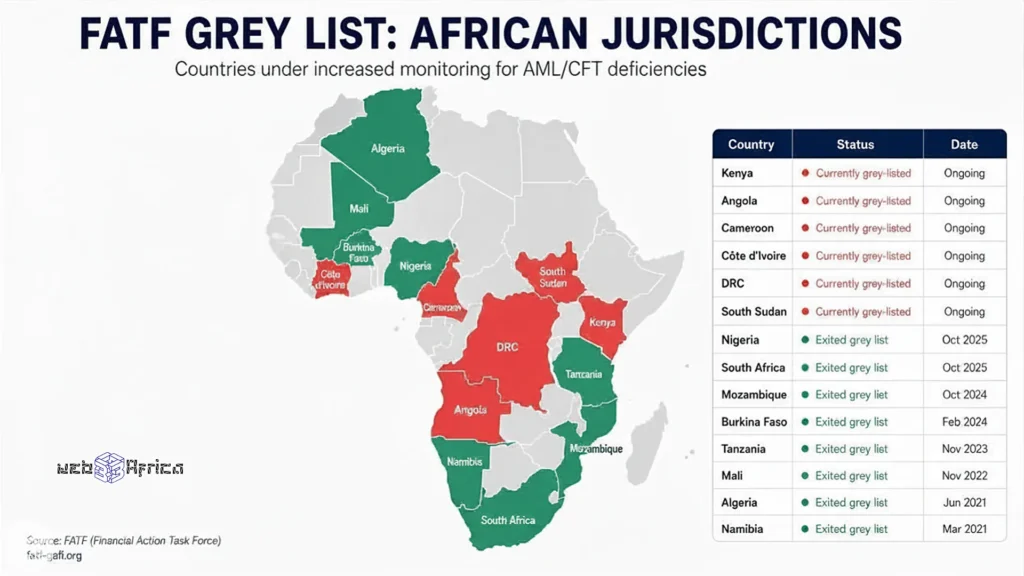
The Financial Sector Conduct Authority of South Africa takes a principles-based approach to crypto regulation. Companies must have strong systems of risk management and maintain adequate levels of capital. This provides a baseline for detecting any form of financial crime.
Ghana and Rwanda are developing their own regulatory frameworks, each with distinct requirements but converging on similar infrastructure expectations.
RELATED: SA Slams the Door on Crypto Loopholes: Cross-Border Rules Drop in 2025!
A few things become eerily clear. For starters, Africa’s regulatory structure is very fragmented; besides how 80% of Africa is still in a grey zone, these laws are tailored within a region. So for someone expanding regionally, they have to ensure their system meets their standards.
On a positive note, while fragmented, their differences are not a deterrent. Local startups like Kotani Pay, GoChapaa, and even Tando are steadily maneuvering and expanding their services within Africa.
Turning Compliance Infrastructure into a Defensible Commercial Moat
Market gatekeepers are also raising their standards. African fintechs must be more operationally mature before international banks will open correspondent relationships or process connections.
Banks verify AML compliance at onboarding by requesting automated monitoring systems, compliance audits, and governance processes.
During onboarding, banks scrutinize AML compliance, with banks requesting evidence of automated monitoring systems, regular compliance audits, and documented governance processes.
Payment networks are also developing similar criteria. For global card networks like Mastercard and Visa, having compliance infrastructure is an edge against most competitors. When blockchain entered the picture, it became about speed, efficiency, and having a system that ensures due diligence.
Investors are now backing local fintechs who answer detailed questions about compliance systems, your returns, and if the system can work outside its jurisdiction without delayed licensing.
But it’s not all roses.
While compliance infrastructure represents a significant cost center, it is also becoming a competitive differentiator.
First, they reduce operational risk.
Automated AML compliance systems help mitigate the risk of processing sanctioned transactions, onboarding high-risk customers, and failing regulatory audits. For many regulators these issues can lead to revocation of license, termination of banking relationships, or reputational damage that is difficult to repair.
Second, they accelerate partnerships.
You can speed onboarding to banking partners and payment networks when you have mature compliance capabilities to demonstrate.
Third, they improve fundraising prospects.
Startups and fintechs that have operational discipline and long-term viability often attract more prospects than startups with a life-changing idea.
Fourth, they enable scale.
Our regulatory framework is fragmented as a continent; thus, a fintech that can handle the regulatory complexity can support geographical expansion and product diversification without redesigning or reinventing itself.
The era of treating compliance as a future problem is ending.
RELATED: Kenyan Regulators Prioritize Consumer Protection, Vendor Risk Mapping, and AML/CFT Oversight
Compliance architecture should inform technology decisions from the initial design phase. This encompasses the selection of databases with robust audit logging capabilities, the development of APIs that facilitate the integration of transaction monitoring, and the deployment of identity verification systems that can satisfy both the licensing requirements for digital assets and the standards of conventional financial services.
But in the present day, engineering leaders must possess a sufficient understanding of regulatory requirements to develop systems that comply with them in the most efficient manner. Modern fintech compliance is not an issue of policies and procedures; rather, it pertains to software capabilities.
The functioning of financial infrastructure is perpetually evolving as a result of the increasing number of domestic regulations in African markets, as well as the VASP and MiCA regulations. Technology architecture, operational processes, and competitive positioning have all been integrated with compliance.
Numerous established fintechs and startups that anticipate this reality will shape the next phase of the industry. Those who disregard compliance as an afterthought are at risk of being disconnected from the banking relationships, payment networks, and capital markets that are essential for their growth.
What are VASP regulations and why do they matter for African fintech?
VASP regulations govern virtual asset service providers globally, based on Financial Action Task Force (FATF) recommendations. They require exchanges, wallet providers, and blockchain payment platforms to implement sophisticated AML compliance systems, including transaction monitoring, sanctions screening, and PEP checks.
How is MiCA regulation affecting African fintech companies?
MiCA standards extend beyond the European Union, influencing African fintechs that partner with European banking infrastructure or payment providers or seek EU-based VC investment. MiCA requires asset custody controls, transaction monitoring, audit trails, and governance systems integrated into technical architecture.
Why are African fintechs finding it more difficult to secure banking partnerships now?
International banks require evidence of operational maturity before opening correspondent relationships. This includes automated monitoring systems, regular compliance audits, and documented governance processes. Payment networks like Mastercard and Visa apply similar criteria.
What are the compliance challenges of expanding fintech services across Africa?
Africa’s regulatory structure is fragmented. Kenya has VASP laws, South Africa applies principles-based CASP regulations, Nigeria introduced ISA 2025, and Ghana and Rwanda are developing distinct frameworks. Each region has different requirements, making scalable compliance infrastructure essential for regional expansion.
How can compliance become a competitive advantage for fintech startups?
Compliance infrastructure reduces operational risk, accelerates banking and payment network partnerships, improves fundraising prospects, and enables geographical expansion without system redesign. Startups with mature compliance capabilities often attract more investment opportunities.
Discover more from Web3Africa
Subscribe to get the latest posts sent to your email.

You must be logged in to post a comment.