











Table of Contents
Key Takeaways
- Banking access will determine success. Zimbabwe’s crypto framework cannot formalize the market unless licensed VASPs can access banking services.
- P2P trading remains deeply embedded. Informal crypto markets continue to thrive because they solve real problems like remittances, inflation, and cross-border payments.
- Zimbabwe could shape African crypto regulation. The country’s experience will show whether licensing can bring informal crypto markets into the regulated economy.
Zimbabwe has built a legal pathway for cryptocurrency businesses to register and comply with international anti-money laundering standards. But the country has not yet resolved whether those businesses can open bank accounts.
That contradiction between regulatory intent and operational reality will determine whether local crypto regulation can transition millions of dollars in monthly peer-to-peer trading.
In June 2026, Finance Minister Mthuli Ncube gazetted Statutory Instrument 99 of 2026, requiring all Virtual Asset Service Providers (VASPs) to register with the Financial Intelligence Unit (FIU) housed within the Reserve Bank of Zimbabwe.
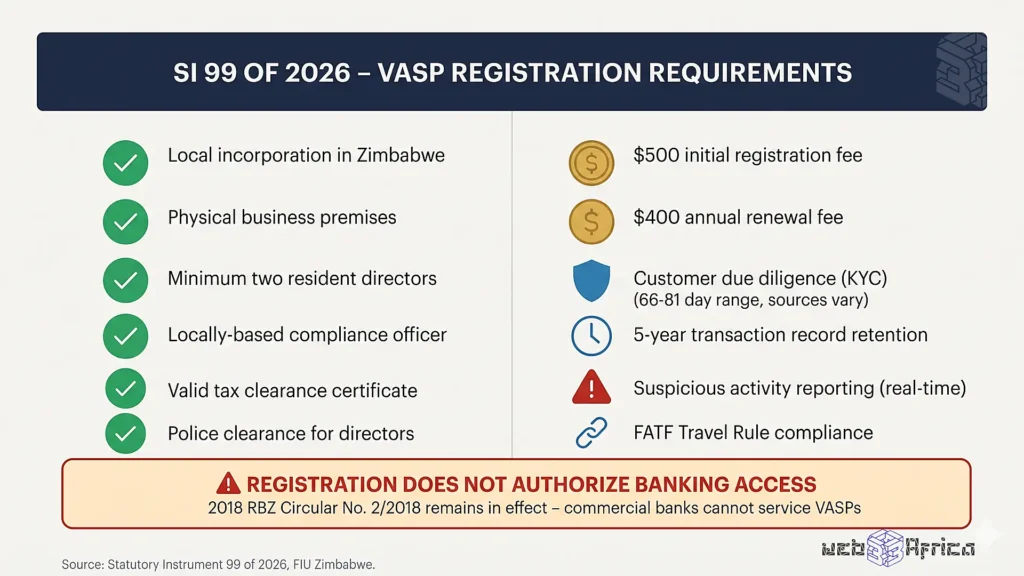
The framework mandates local incorporation, physical offices, resident directors, and strict anti-money laundering compliance. Registration requires a $500 initial fee and a $400 annual renewal fee, with operating without registration classified as a criminal offense subject to prosecution.
Six days after the regulations took effect, FIU Director-General Oliver Chiperesa issued a public clarification that registration “does not, in itself, constitute authorization to carry on business in Zimbabwe.
RELATED: Zimbabwe’s Crypto Rules Cast the Widest Regulatory Net in Africa
Additionally, the 2018 central bank circular that ordered commercial banks to exit all cryptocurrency relationships remains unrepealed. A business can be fully compliant with SI 99, registered, audited, and monitored and still be unable to access the banking system.
This gap transforms Zimbabwe’s regulatory experiment into a test case for a question confronting policymakers across Sub-Saharan Africa. Whether licensing frameworks can successfully formalize informal crypto markets built on necessity, or whether they simply push activity further underground.
The Scale of What Regulation Is Trying to Formalize
Zimbabwe’s P2P crypto trading networks are significant. Industry sources estimate millions of U.S. dollars move through informal channels every month, primarily serving two functions. First, they are used for cross-border remittances to families receiving support from abroad; secondly, they serve as payments to foreign suppliers when formal banking channels are slow or restricted.
After the Reserve Bank barred financial institutions from processing crypto transactions in May 2018, trading migrated entirely to peer-to-peer platforms.
The mechanics are straightforward. Participants use WhatsApp, Telegram, Signal, and Facebook to find counterparties. In a predominantly cash economy, trades typically happen face-to-face. Someone needing cryptocurrency meets a seller, exchanges U.S. dollar cash for a crypto transfer, and pays a commission of 3% to 10% depending on volume. The reverse happens when individuals want cash in exchange for crypto.
Without access to locally licensed exchanges, most Zimbabweans use international platforms like Binance and Coinbase that support P2P features and accept mobile money or bank transfers.
RELATED: Zimbabwe’s Crypto Rules Cast the Widest Regulatory Net in Africa
This system emerged from economic necessity. Hyperinflation during the late 2000s eroded savings and pensions. Multiple currency changes weakened public confidence in traditional banking. Remittances, which accounted for 7% of Zimbabwe’s GDP in 2020 according to Finance Minister Ncube, face high costs through formal channels.
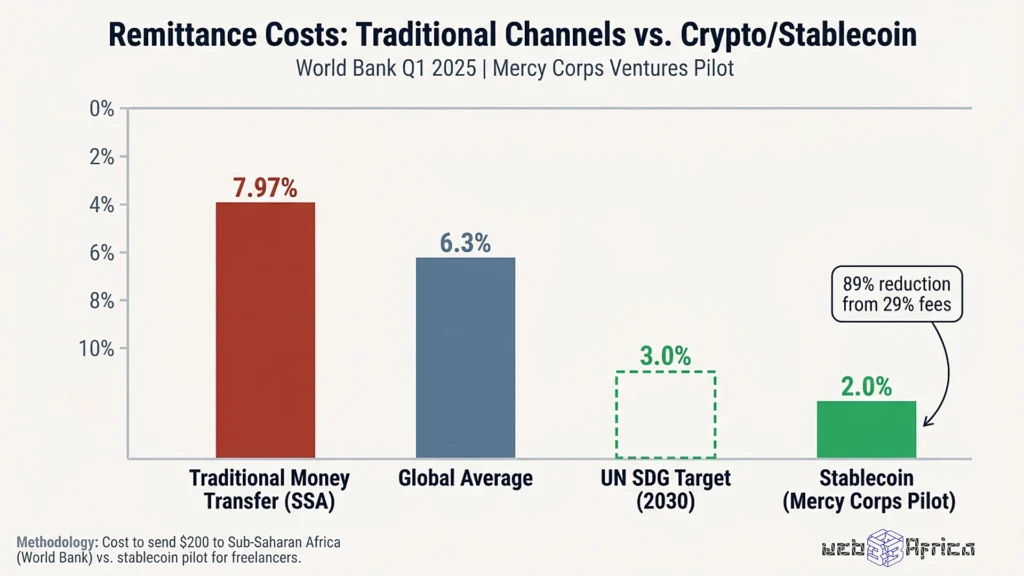
The World Bank found that sending $200 to Sub-Saharan Africa via traditional money transfer operators costs an average of 7.9%. A Mercy Corps Ventures pilot in Kenya testing stablecoin remittances for freelancers reduced fees from 29% to 2%, demonstrating the economic rationale for crypto adoption.
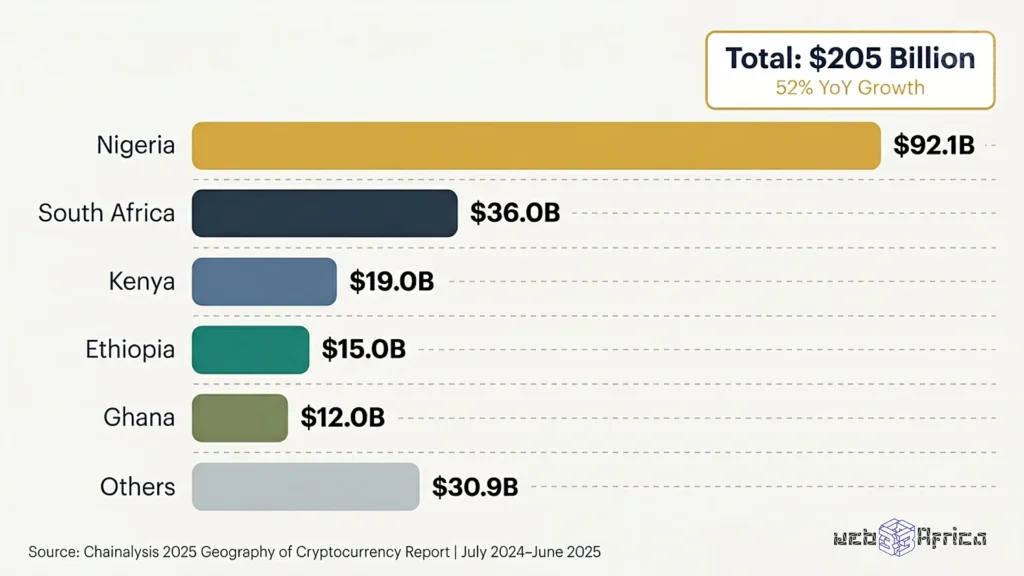
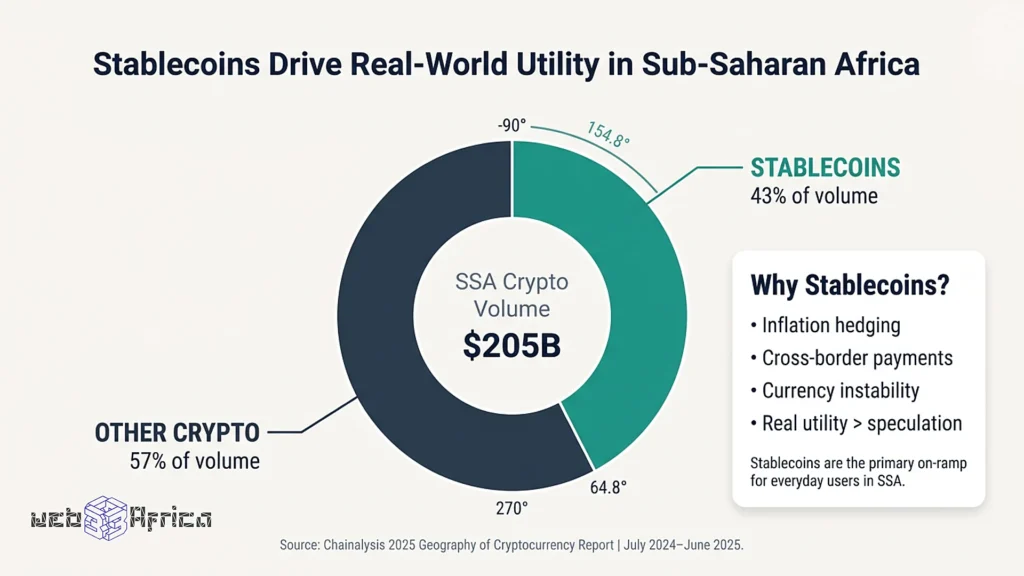
Regional data from independent sources confirms that restrictive policies have not suppressed cryptocurrency demand. Sub-Saharan Africa processed over $205 billion in on-chain value in the 2024–2025 period, driven primarily by currency instability and real payment needs, such as inflation hedging and cross-border settlements, rather than speculation, with stablecoins alone accounting for 43% of transaction volume. Nigeria, despite a ₦500 million capital requirement for licensed exchanges, recorded $92.1 billion in transactions.
According to the 2025 World Crypto Rankings by Bybit, Kenya ranked fifth globally in transaction volume. This is supported by Chainalysis data showing $19 billion in crypto inflows and Triple-A estimates of over six million users between July 2024 and June 2025, driven primarily by stablecoin adoption for remittances and cross-border payments. South Africa leads the continent in ownership at 10%, processing $36 billion in volume alongside nearly 20,000 crypto payments worth R7.77 million in the first half of 2025 alone.
Ethiopia posted East Africa’s highest stablecoin growth at 180%, while Tanzania saw robust adoption driven by currency instability. Meanwhile, Zimbabwe witnessed a 200% surge in peer-to-peer trading volume (2024–2025) as citizens turned to stablecoins to hedge against ZiG depreciation and historical hyperinflation, with crypto ownership now reaching 15–20% of the urban population. The market reality is unequivocal: people use cryptocurrency whether regulators permit it or not.
RELATED: Africa Records $205 Billion Crypto Flows Breaking Growth Records
Tracing the Policy Shift From Banking Bans to Formal Oversight
The 2018 banking ban did not make cryptocurrency illegal for individuals. The Reserve Bank of Zimbabwe issued Circular No. 2/2018 to financial institutions, not citizens, directing them to close accounts for crypto exchanges and cease processing related transactions within 60 days.
The move was framed as prudential risk management, protecting the financial system from unregulated digital assets. Notably, Zimbabwe had no law explicitly prohibiting cryptocurrency; the central bank acted under its general mandate to oversee monetary and financial stability.
Local exchange Golix challenged the ban in court.
In 2020, the High Court of Zimbabwe ruled that the Reserve Bank had exceeded its authority. The court held that only Parliament could outlaw cryptocurrency activities, and the central bank’s directive was ultra vires, beyond its legal powers.
The procedural victory, however, proved hollow. Golix won the case but lost access to banking services anyway, and the company eventually closed. The collapse illustrated how legal vindication without operational infrastructure is insufficient.
For eight years, Zimbabwe’s crypto market existed in regulatory limbo. The central bank’s overreach was struck down, but no affirmative framework replaced it. Trading continued informally, volume grew, but businesses could not operate openly.
The Finance Act No. 7 of 2025, gazetted on December 29, 2025, changed the legislative foundation by amending the Money Laundering and Proceeds of Crime Act to include VASPs in the statutory definition of financial institutions. This enabled the Minister of Finance to issue SI 99 six months later, creating the first parliamentary-authorized crypto regulation framework.
The timing reflects external pressure as much as domestic policy evolution. Zimbabwe was removed from the Financial Action Task Force grey list in 2022 after improving its anti-money laundering controls.
Failing to regulate virtual assets risked a return to that list, which deters foreign banks and investors.
“A big part of S.I. 99 is really Zimbabwe showing its homework to the world.”
Analyzing the Strict Compliance Mandates of Statutory Instrument 99
SI 99 of 2026 imposes bank-level compliance obligations on crypto businesses. Applicants must incorporate locally in Zimbabwe, maintain physical business premises, appoint a resident compliance officer, and employ at least two resident directors.
They must submit valid tax clearance certificates, police clearance for directors and beneficial owners, and detailed anti-money laundering, cybersecurity, and risk management policies. The FIU conducts “fit and proper” assessments examining financial standing, criminal records, regulatory history, and conflicts of interest.
Once registered, VASPs face ongoing obligations such as implementing customer due diligence procedures and retaining transaction records for at least five years. They must also report suspicious activity to the FIU in real time without tipping off customers and comply with the FATF Travel Rule.
This last requirement mandates that ordering VASPs collect and transmit originator and beneficiary details for all virtual asset transfers, while beneficiary VASPs must verify information and block incomplete transfers. For transactions involving self-hosted wallets exceeding $1,000, VASPs must perform cryptographic proof of wallet ownership and apply enhanced monitoring.
The regulations extend beyond traditional exchanges. The definition of VASP captures operators of software protocols, smart contracts, and decentralized applications if they commercially market or control such systems. This represents one of the broadest regulatory scopes in Africa, though practical enforcement against anonymous smart contract operators remains an open question.
Penalties are substantial. Providing false information during registration carries fines up to $10,000 plus criminal liability. Failure to maintain compliance can result in fines up to $50,000 per violation.
RELATED: Why Nigeria and South Africa Dominate Global Stablecoin Utility
The FIU Director-General holds discretionary power to suspend registration immediately if delay poses a threat to public or financial stability, forcing an instant shutdown of trading operations.
The registration fee structure, with a $500 initial fee and a $400 annual renewal, is much lower than Nigeria’s capital requirements. The low threshold shows an intent to attract rather than exclude informal crypto market participants.
Yet the indirect costs may be prohibitive for small operators. Fledgling startups must incorporate locally, lease physical premises, hire resident directors and compliance officers, implement Travel Rule messaging software, and conduct annual independent audits.
These requirements favor well-capitalized exchanges over the individual P2P brokers currently moving millions monthly through WhatsApp.
The unresolved banking question undermines the entire framework. A registered VASP may be legally compliant with all FIU obligations yet unable to open a domestic bank account. That operational reality determines whether formalization succeeds or fails.
How South Africa Successfully Transitioned Informal Crypto Markets
Regional experience suggests that formalizing crypto markets succeeds when registration comes with genuine banking access and regulatory clarity removes uncertainty. South Africa provides the clearest evidence.
The Financial Sector Conduct Authority began licensing crypto asset service providers in 2022–2023 under a comprehensive framework with Category I registration fees around R50,000 ($2,700). The regime includes consumer protection provisions, net asset requirements, and ongoing supervision.
Marius Reitz, General Manager Africa for Luno, a South Africa-based exchange, reported that
“Over the last 3 years, the number of customers holding a meaningful crypto balance on Luno has increased by almost 50%.”
He added,
“In markets with no regulatory bans, we tend to see the industry develop more responsibly as the market operates above the ground, with more productive interaction between regulators and exchanges. But bans aren’t stopping people from wanting crypto. The crypto industry will continue to grow with or without regulation.”
The 50% growth in customers holding meaningful balances reflects sustained participation. South Africa’s framework demonstrates that when licensing provides legal certainty and operational infrastructure, including banking access, formal channels can attract volume from informal markets.
| Country | Framework | Regulator | Fee (USD) | Capital (USD) | Banking Access | Travel Rule | Status |
|---|
Kenya offers another instructive model. The 2025 Virtual Asset Service Providers Bill proposes a dual oversight system. The Central Bank regulates stablecoin issuers, wallet providers, and payment processors, while the Capital Markets Authority licenses exchanges, tokenization platforms, and investment advisors.
The split-by-function approach aims to match regulatory expertise to market activity. The framework remains under implementation, but the design acknowledges that effective oversight requires specialized capacity.
Ghana passed comprehensive crypto legislation in December 2025, and Zambia now requires crypto businesses to register with its central bank. Mauritius has operated a full licensing regime since the 2021 Virtual Assets and ITOS Act. Across the continent, the regulatory direction is consistent, moving away from blanket bans and toward supervised integration.
Understanding the Risk of a Two-Tier Digital Asset Economy
Nigeria demonstrates what happens when regulatory frameworks impose high barriers without eliminating the economic drivers of informal demand. The Securities and Exchange Commission requires crypto service providers to maintain approximately ₦500 million ($367,000) in a local bank account before obtaining a license. The capital requirement effectively excludes informal P2P operators and small startups.
Yet Nigeria ranks sixth globally in cryptocurrency adoption and leads Sub-Saharan Africa with $92.1 billion in transaction volume. The restrictive licensing regime created a small number of formally licensed platforms serving institutional clients and high-net-worth individuals, while the vast majority of retail activity continues through international exchanges, P2P platforms, and informal networks.
High regulatory barriers did not reduce demand; they simply determined who could participate in the formal economy.
Zimbabwe risks replicating this pattern. Even with a $500 registration fee, the compliance infrastructure costs, local incorporation, physical offices, resident directors, specialized compliance officers, Travel Rule software, and annual audits may exceed what informal P2P brokers can absorb.
If these operators cannot formalize and banking access remains unresolved, volume will stay underground or migrate to offshore platforms beyond FIU jurisdiction.
The regulatory approach to privacy tools further complicates formalization. SI 99 requires VASPs to identify and manage risks associated with crypto mixers, tumblers, and privacy-enhancing technologies.
The FIU may reject applicants unable to block or control anonymity-enhancing tools, reflecting capital flight and anti-money laundering concerns. For users choosing cryptocurrency specifically for financial privacy, whether to protect savings from currency volatility or to avoid capital controls, these restrictions make formal channels less attractive than unregistered alternatives.
RELATED: African Stablecoins Cannot Scale Without Europe’s Regulatory Trust
Forecasting the Future of Digital Asset Compliance in Zimbabwe
Available evidence suggests three plausible paths for Zimbabwe’s crypto regulation experiment:
Successful partial formalization would see large domestic and regional exchanges register, secure banking relationships through explicit RBZ clarification, and offer competitive pricing that draws significant remittance and trading volume from informal channels.
Hard-to-reach users remain in P2P crypto trading networks, but the formal sector captures the majority of economically significant activity. This outcome requires rapid resolution of banking access, sufficient FIU enforcement capacity, and formal channels that match or beat informal pricing.
Two-tier persistence would create a small cohort of registered VASPs serving corporate clients and affluent individuals, while most retail users continue using unregistered P2P networks or offshore platforms.
Compliance costs keep local informal operators unregistered. Banking access uncertainty makes registration unattractive and economic incentives favor the status quo. Regulatory arbitrage intensifies as users shift to platforms beyond FIU reach. A likely scenario, given Nigeria has experienced it firsthand
Formalization failure and deeper informalization would occur if enforcement proves inconsistent, banks remain conservative despite SI 99, and users perceive formal channels as intrusive and uncompetitive.
Activity shifts further toward offshore exchanges, privacy-enhancing protocols, and non-custodial wallets. Volume disappears from visibility rather than entering supervised channels, undermining the policy goal.
Several variables will determine which scenario materializes. Banking access is the most critical. If the Reserve Bank explicitly amends or repeals Circular No. 2/2018 and permits commercial banks to serve registered VASPs, formalization becomes operationally viable.
Without that clarity, registration remains largely symbolic. Jeffrey Mutambiranwa, a Harare crypto trader, stated that the regulations were “a welcome development” because “traders don’t have to operate underground.” But welcome intentions mean little if operational infrastructure does not follow.
Enforcement capacity matters equally. The FIU must develop blockchain analytics capabilities, train specialized staff, and demonstrate consistent oversight of registered entities. Sporadic enforcement or visible regulatory capture would erode trust in the framework.
The agency must also address jurisdictional overlap. The Securities Exchange Commission of Zimbabwe is reportedly licensing VASPs separately from the FIU, creating potential dual-regulator confusion.
Economic incentives will shape user behavior. If registered exchanges offer faster transaction settlement, better exchange rates, legal recourse for disputes, and seamless integration with mobile money and banking rails, users have reasons to migrate from informal channels. If registration adds cost and friction without tangible benefits, existing P2P networks retain their advantages.
Essential Takeaways for the Broader African Web3 Ecosystem
Zimbabwe’s framework offers insights for regulators across the continent weighing how to respond to growing informal crypto markets. Low registration fees offer the notion of inclusivity, but they don’t guarantee formalization if indirect compliance costs remain high.
Broad regulatory definitions that capture DeFi protocols demonstrate technical sophistication but raise practical enforcement questions. Alignment with FATF standards builds international credibility but does not resolve domestic banking access.
RELATED: Six Pillars to Power Uganda’s Digital Financial Revolution
The South Africa comparison is instructive because it isolates the banking variable. Both countries now require VASP registration under anti-money laundering frameworks. Both impose governance, compliance, and reporting obligations.
The difference is that South African exchanges can access banking services, while Zimbabwean businesses face unresolved uncertainty. That single variable may determine whether crypto regulation can reduce P2P trading or simply drive it into less visible channels.
The question Zimbabwe’s experiment ultimately tests is whether it changes behavior in markets built on informality and necessity. When formal financial systems fail to serve economic needs, people create alternative rails.
Crypto regulation that brings those alternatives into supervised channels must offer genuine advantages. Legal certainty, operational infrastructure, cost competitiveness, and user protection. Frameworks that impose obligations without enabling infrastructure risk creating compliance theater rather than functional formalization.
Zimbabwe now has the regulatory architecture. Whether it develops the operational substance will determine if this becomes a model for successful formalization or a case study in why licensing alone cannot transition informal markets into formal economies.
FAQ Section
What is Zimbabwe’s new crypto regulation?
Zimbabwe’s Statutory Instrument 99 of 2026 requires Virtual Asset Service Providers (VASPs) to register with the Financial Intelligence Unit, comply with anti-money laundering rules, and meet governance and reporting requirements before operating legally.
Can crypto regulation reduce P2P trading in Zimbabwe?
Potentially, but only if licensed crypto businesses can access banking services. Without operational banking support, many users may continue relying on informal P2P crypto trading networks.
How does Zimbabwe’s crypto regulation compare with other African countries?
Zimbabwe has adopted one of Africa’s broadest VASP licensing frameworks. However, countries such as South Africa have paired regulation with banking access, while Nigeria demonstrates that high compliance barriers alone do not eliminate P2P crypto trading.
Why is banking access important for crypto regulation?
Registration alone does not allow a crypto business to operate efficiently. Licensed exchanges need bank accounts to process payments, settle customer funds, and compete with informal crypto markets.
What are informal crypto markets?
Informal crypto markets are trading networks that operate outside licensed exchanges. In Zimbabwe, they typically use platforms such as WhatsApp, Telegram, and international P2P exchanges to facilitate transactions directly between buyers and sellers.
Why do Zimbabweans use P2P crypto trading?
The article explains that P2P crypto trading grew because of banking restrictions, expensive remittances, currency instability, and limited access to licensed exchanges, making peer-to-peer markets a practical financial alternative.
Discover more from Web3Africa
Subscribe to get the latest posts sent to your email.

You must be logged in to post a comment.