











Table of Contents
Key TakeAways
- Retail crypto is giving way to infrastructure. African exchanges are prioritizing enterprise services over consumer trading apps.
- Stablecoin rails are driving the next growth phase. Businesses increasingly demand faster, cheaper cross-border payment infrastructure.
- Regulation is creating competitive advantages. Licensed infrastructure providers are better positioned to serve institutions than retail-focused exchanges.
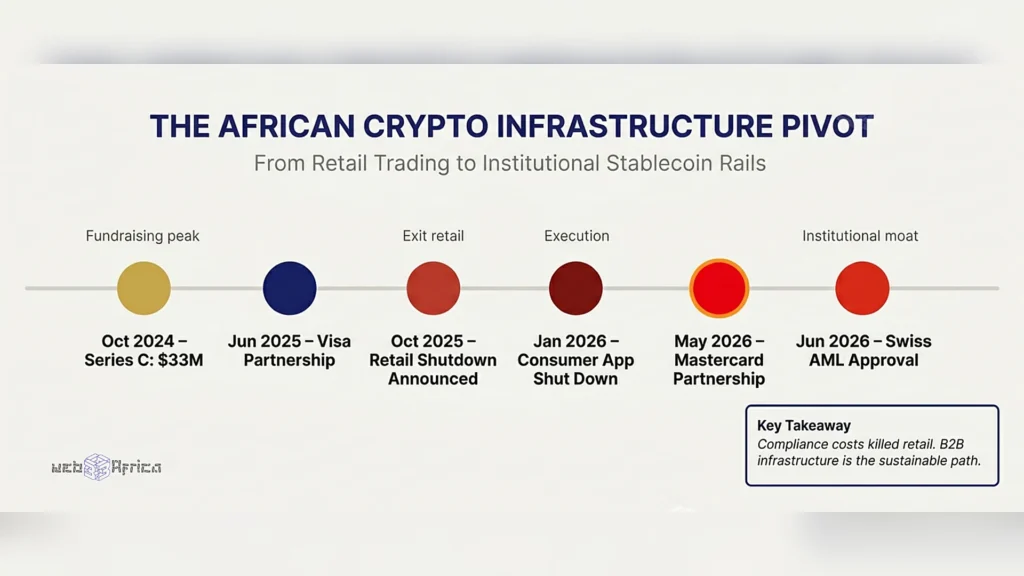
On January 1, 2026, Yellow Card, one of Africa’s most established cryptocurrency exchanges, permanently shut down its consumer trading application. Seven months later, the company secured regulatory approval in Switzerland to operate as a supervised financial intermediary to serve institutional clients across more than 50 emerging markets through stablecoin rails and treasury infrastructure.
This sequence reveals more than one company’s strategic repositioning. It exposes a structural inflection point reshaping the entire African crypto infrastructure landscape. The retail trading app model that built the first generation of digital asset companies is collapsing under its compliance costs. Business-to-business stablecoin infrastructure is emerging as the only economically sustainable path forward.
In March 2026, Nigeria’s Quidax cut jobs across its sales, design, and operations divisions while restructuring to focus on enterprise crypto payment products. The previous month, Busha launched a dedicated B2B infrastructure division offering API access to digital asset rails for banks and fintechs. It’s a recurring pattern if you’re keen.
Across the continent, platforms including Roqqu, Dantown, and even global operators like Luno have expanded beyond retail trading to include infrastructure and institutional services.
This trend represents the decline of crypto retail trading apps as a viable business category in regulated markets, driven by unit economics that break down completely under modern anti-money laundering obligations. And it signals where venture capital, technical talent, and institutional partnerships are flowing next.
The Broken Unit Economics Destroying Retail Crypto Margins
The failure of retail crypto trading apps is fundamentally an economics problem, not a demand problem.
Consider the revenue structure of a typical retail cryptocurrency transaction. A user converts $100 of local currency into USDT. The platform generates revenue through a combination of spread and transaction fees, typically between 0.5% and 1.5% of the total value, producing between $0.50 and $1.50 in gross revenue per trade.
Against that revenue, the platform must absorb compliance costs that do not diminish with transaction size. This includes checking customer identities, following Know Your Customer rules, screening for sanctions on OFAC and UN lists, analyzing blockchain transactions, monitoring activities, providing customer support, detecting fraud, handling chargebacks for card payments, and paying local banking partners to convert fiat money.
Chris Maurice, Yellow Card’s CEO, described the breaking point directly when announcing the company’s $33 million Series C in October 2024. Compliance screening applies to all customers regardless of transaction size, he explained, but “margins were too thin” for small retail users.
The company had begun raising minimum transaction thresholds and focusing on business volume but ultimately concluded the retail model itself was unsustainable.
John Colson, Yellow Card’s chief marketing officer, framed the shift as a response to the market rather than internal preference:
“Over the years, we’ve seen a drastic increase in demand from businesses seeking seamless cross-border payments and treasury management. This clear market signal gave us the conviction to make this strategic decision.”
The company’s October 2025 announcement about shuttering its retail app explicitly emphasized the point:
“This decision is not a pivot away from our mission but a doubling-down on our core strength, providing world-class institutional-grade stablecoin infrastructure that businesses need to grow.”
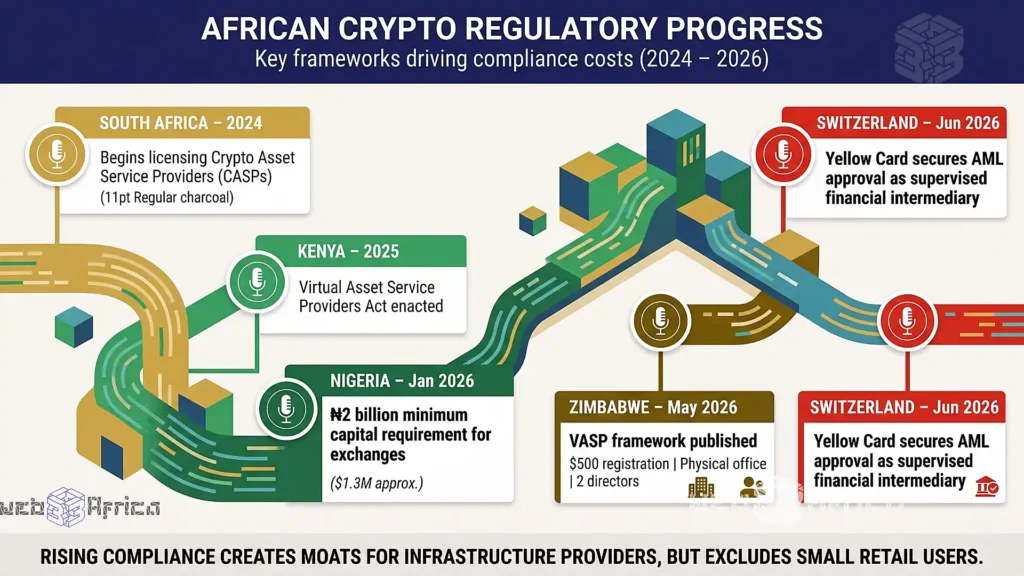
What makes retail economics particularly untenable is the regulatory trajectory. As African jurisdictions introduce formal licensing for virtual asset service providers, the baseline compliance obligations are rising, not falling. The progress is visible, with Zimbabwe publishing its VASP framework in May 2026, Kenya enacting its Virtual Asset Service Providers Act in 2025, and South Africa beginning licensing crypto-asset service providers in 2024.
RELATED: Truth Behind Kenya’s Now-Withdrawn VASP Bill Exposed
Each framework introduces enhanced customer due diligence, transaction monitoring, Travel Rule data collection, and cybersecurity requirements that increase fixed operational expenses.
These are reasonable regulatory expectations for supervised financial intermediaries. But they create an economic structure that systematically excludes small-value transactions from formal platforms.
A licensed exchange operating under modern AML frameworks cannot profitably serve a user making a $20 or $50 transaction. The compliance overhead per customer exceeds the revenue that relationship generates.
So platforms face three options: charging fees high enough to cover costs (becoming uncompetitive against informal channels), achieving massive scale with minimal support burden (extraordinarily difficult in fragmented African markets), or subsidising retail operations with venture capital while building a different revenue model.
Yellow Card chose the third path initially, then abandoned retail entirely when the alternative revenue model proved viable at scale.
The Ecosystem Shift Towards Enterprise APIs and B2B Infrastructure
Yellow Card’s transformation is the most complete example of African crypto startups pivoting to infrastructure.
Quidax now markets a stablecoin API explicitly targeting fintechs, exchanges, and neobanks, offering on-ramps, off-ramps, and payment infrastructure rather than consumer trading services. The company’s March 2026 workforce reductions across consumer-facing divisions accompanied its shift towards enterprise products.
Busha launched Busha Business in February 2026, providing API access to stablecoin and digital asset infrastructure for businesses across Africa and globally. The platform positions itself as “a trusted partner for stablecoin infrastructure in Nigeria,” offering treasury services, cross-border payment rails, and developer tools rather than retail trading interfaces.
The convergence towards B2B stablecoin payments and infrastructure reflects shared economic logic. Business clients transact in larger volumes, generate higher revenue per customer, exhibit lower churn rates, and create more predictable cash flows than retail traders.
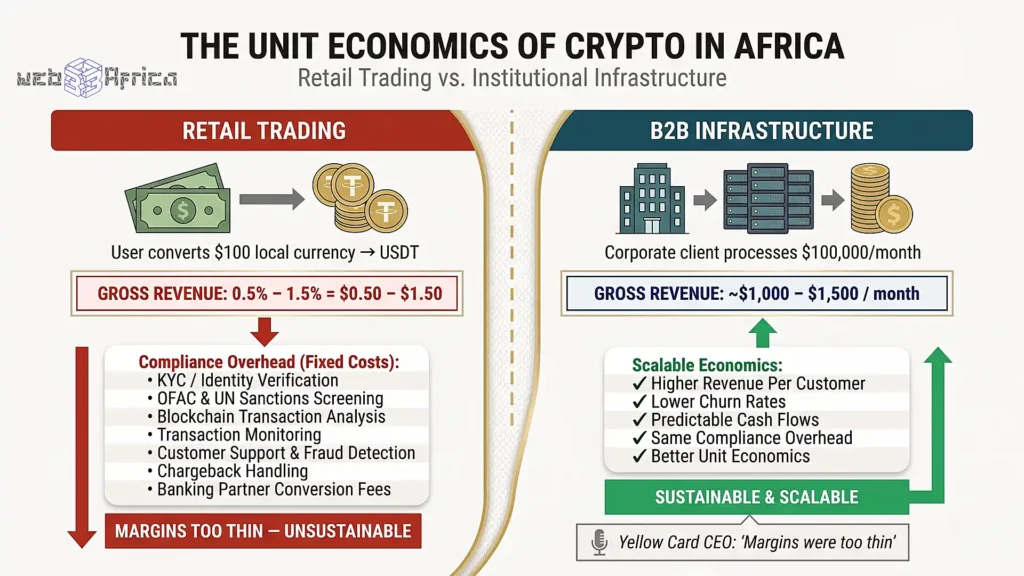
A corporate client processing $100,000 in monthly cross-border payments might generate $1,000 to $1,500 in platform revenue at comparable fee rates. However, corporate clients face the same baseline compliance overhead as retail users who make a single $100 trade.
More importantly, enterprise clients value different attributes than retail traders. Speed, regulatory compliance, settlement finality, accounting integration, and transaction transparency matter more than speculative trading features or token variety.
This creates product differentiation that retail platforms struggle to achieve, where competition drives fees and spreads to unsustainable levels.
The venture capital community has followed the same narrative. New infrastructure-focused entrants have attracted substantial seed and pre-seed funding.
- Daya raised $2.4 million for a stablecoin-native financial operating layer targeting African cross-border trade.
- Checker secured $8 million for stablecoin-powered payment infrastructure serving banks and fintechs.
- Kotani Pay raised $2 million for crypto on-ramp and off-ramp services.
These companies are launching infrastructure-first, bypassing retail entirely. Their presence indicates that the market has clearly moved towards services for businesses, settlement systems, and accessible APIs instead of apps for regular consumers.
The Multibillion Dollar Surge in Corporate Stablecoin Volume
The scale of the B2B stablecoin payments opportunity becomes clear in aggregate transaction data.
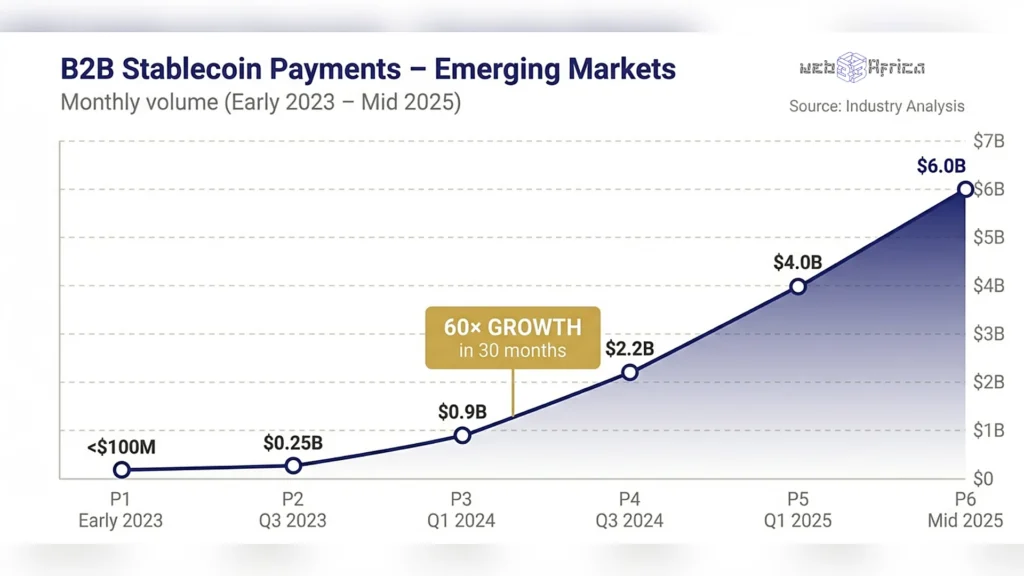
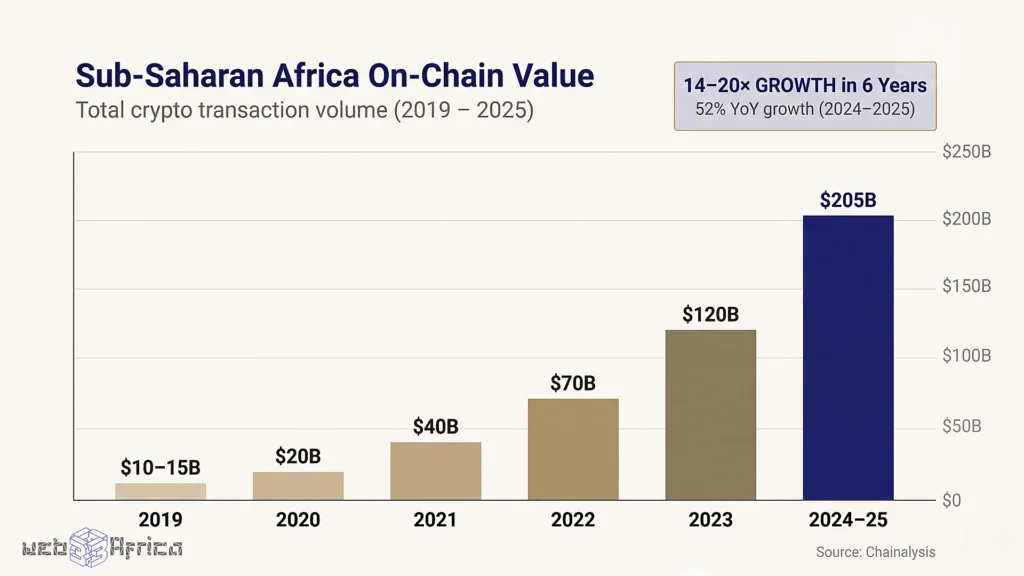
According to industry analysis, business-to-business stablecoin payments across emerging markets surged from under $100 million per month in early 2023 to over $6 billion per month by mid-2025. That’s a 60-fold increase in just 30 months. Total stablecoin and crypto volume in Sub-Saharan Africa reached an estimated $205–208 billion in the 2024–2025 period, up from approximately $10–15 billion in 2019. This is a 14-to-20-fold growth over six years driven by currency instability and the rapid adoption of stablecoins for cross-border payments and inflation hedging.
Sub-Saharan Africa processed over $205 billion in on-chain value in the 2024–2025 period, while Bybit’s 2025 World Crypto Rankings placed Kenya fifth globally specifically for stablecoin transactional use, highlighting the region’s accelerating adoption.
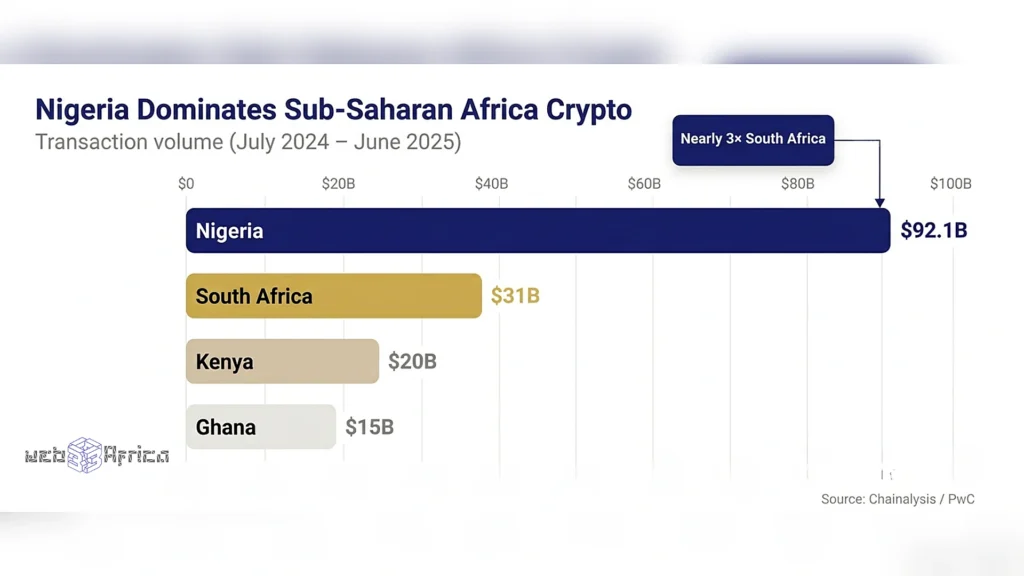
Nigeria alone accounted for $92.1 billion in transactions between July 2024 and June 2025, despite the country raising its minimum capital requirement for licensed exchanges to ₦2 billion in January 2026.
Yellow Card’s Regulatory Report further notes that stablecoins account for 43% of all crypto transaction volume in Sub-Saharan Africa, with Ethiopia posting the highest stablecoin growth in East Africa at 180%, followed by Tanzania at 53%, as users increasingly turn to dollar-pegged assets for savings and cross-border payments.
Traditional cross-border payment infrastructure in African markets imposes costs ranging from 3% to 6% for businesses, with settlement times measured in days and compliance processes that remain opaque to participants. The World Bank reports global average remittance costs at 6.36%, with many African corridors substantially higher.
Stablecoin rails offer fundamentally different economics. For instance, stablecoin rails enable settlement in minutes instead of days, charge fees typically under 1%, provide 24/7 availability independent of banking hours, and offer transparent on-chain transaction records that simplify reconciliation and auditing. Yellow Card’s internal analysis suggests businesses can achieve up to 90% cost reduction compared to traditional remittance providers for certain corridors.
RELATED: Yellow Card Becomes Core Participant Of Fireblocks Enterprise Network
These efficiency gains translate directly into different customer economics. Yellow Card processed more than $3 billion in transactions during 2024, predominantly in stablecoins and increasingly through business clients. By October 2024, when the company announced its Series C funding, it served approximately 30,000 businesses across its network.
The institutional validation has followed. In June 2025, Yellow Card signed a partnership with Visa to promote stablecoin use for cross-border payments in emerging markets.
In May 2026, Mastercard announced a collaboration focused on Eastern Europe, the Middle East, and Africa, establishing joint working groups to develop interoperable solutions for banks and financial institutions. This would primarily focus on cross-border remittances, B2B settlements, digital loyalty programs, and treasury management.
Chris Maurice framed the Mastercard partnership in terms that highlight the infrastructure thesis:
“Emerging markets represent the greatest opportunity for payment innovation, but success requires deep local expertise and regulatory navigation. We bring years of experience building compliant stablecoin infrastructure where traditional banking falls short. Mastercard’s global network amplifies these capabilities.”
These are partnerships that would be unlikely for retail-focused crypto exchanges. They reflect the repositioning of African crypto infrastructure companies as institutional service providers operating in the payments and settlement layer rather than consumer speculation platforms.
African Crypto Infrastructure Funding Landscape
Swiss Regulatory Oversight as an Institutional Defensibility Moat
Yellow Card’s June 2026 regulatory approval in Switzerland represents a sophisticated approach to infrastructure-layer competition. Yellow Card is constructing regulatory barriers through geographic arbitrage, all the while sustaining its operational presence in high-demand emerging markets.
Under Switzerland’s anti-money laundering act, financial intermediaries that professionally accept, hold, invest, or transfer assets belonging to others must either affiliate with a FINMA-recognized self-regulatory organization or obtain direct supervision from the Swiss Financial Market Supervisory Authority.
RELATED: Securing Multinational Treasury Liquidity Across Africa via Swiss Compliance Frameworks
Yellow Card’s Swiss branch works as a supervised financial intermediary, probably because it is a recognized self-regulatory organization, which means it has to go through annual audits, follow written anti-money laundering procedures, monitor transactions, and meet reporting requirements.
This is not the same as obtaining a Swiss banking license or fintech approval. But it does provide what Craig Stoehr, Yellow Card’s general counsel, described as “regulatory confidence and real operational reach” for institutional counterparties.
Viewing the situation through the lens of institutional procurement clarifies the strategic logic. A multinational corporation, commercial bank, or payment network seeking to move capital into African markets through stablecoin infrastructure faces complex multi-jurisdiction compliance and counterparty risk assessment.
Directly engaging entities registered in less-developed regulatory environments creates procurement challenges, legal uncertainty, and compliance documentation burdens.
A Swiss-supervised entity provides a single regulated counterparty through which institutional clients can access Yellow Card’s operational network across more than 50 emerging markets. The Swiss subsidiary handles institutional onboarding and compliance ownership, while the company’s African licenses and registrations provide the ground-level infrastructure for transaction execution. This also includes VASP licenses in Botswana and South Africa, MSB registration in the United States, and VASP registration in Poland.
Yellow Card is establishing its Swiss operations in Lugano, a city that has positioned itself as a blockchain experimentation zone through its Plan ₿ initiative with stablecoin issuer Tether. Lugano has issued multiple CHF 100 million blockchain bonds since 2023, committed up to CHF 5 million to advancing blockchain infrastructure development, and enabled more than 400 local merchants to accept Bitcoin and stablecoins for payments.
This adds institutional signaling value beyond regulatory approval itself. Lugano represents one of the few jurisdictions globally where local government has actively facilitated blockchain-based financial infrastructure experimentation at a municipal scale.
The Swiss strategy does carry some risks. If multiple African fintechs establish Swiss subsidiaries for institutional access, African regulators may respond with restrictions on capital outflows or require local registration of foreign entities operating in domestic markets.
Relying on one place for all institutional flows can be risky if Swiss regulations change or if the relationship with the specific SRO alters.
But the first-mover advantage appears meaningful. Yellow Card holds the first VASP license ever issued on the African continent (Botswana, September 2022), established a regulatory presence before most competitors, and now combines that footprint with European supervision.
The Strategic Reallocation of African Web3 Venture Capital
The transformation from retail applications to wholesale infrastructure has clear implications for venture capital allocation and startup strategy in African crypto markets.
Yellow Card has raised at least $88 million across multiple funding rounds, with backing from Polychain Capital, Blockchain Capital, Valar Ventures, and crypto-native investors, including Coinbase, Kraken, OpenSea, and Worldcoin.
In its Series C announcement in October 2024, the company emphasized B2B growth and business client acquisitions rather than retail metrics, even though it had already begun the retail exit before the formal shutdown.
Aleks Larsen, General Partner at Blockchain Capital, framed the investment thesis around infrastructure rather than consumer applications:
“The future of payments lies in fast, affordable rails… powered by open networks.”
The venture capital flowing to new entrants reinforces the infrastructure focus. Daya, Checker, and Kotani Pay are all building API-first, compliance-forward, B2B-oriented products from inception. None are launching consumer trading applications as their primary offering.
This represents a fundamental shift from the 2018-2021 generation of African crypto startups, which predominantly built retail interfaces first and explored enterprise products later. The new group of startups focuses on building the underlying systems first, learning from the past mistakes of starting with consumer products in a challenging regulatory environment.
Customer acquisition costs for retail users remain high, and churn rates create persistent revenue pressure. Compliance costs consume margins faster than scale economies can offset them. Enterprise infrastructure businesses exhibit opposite dynamics. First, enterprise infrastructure businesses benefit from higher revenues per customer, lower churn rates, and compliance costs that scale more favorably with increased transaction volumes.
The risk is that enterprise adoption remains dependent on regulatory progress that has proven uneven across African markets. Kenya’s VASP Act provides a licensing pathway, but implementation remains in early stages. Nigeria’s regulatory framework continues evolving through the Securities and Exchange Commission’s fintech programs. South Africa has begun licensing, but proposed regulations on capital flows in 2026 threatened to restrict stablecoin usage for cross-border payments, prompting industry warnings that overregulation could “leave SA behind.
RELATED: Kenya’s 2025 Crypto Bill Officially Becomes Law: A Trader’s Guide to VASP Licensing and Compliance
Zimbabwe’s May 2026 VASP framework, requiring all virtual asset service providers to register with the Financial Intelligence Unit, exemplifies the compliance trajectory. The regulations mandate physical offices, resident compliance officers, at least two resident directors, detailed AML policies, and implementation of FATF’s Travel Rule for transaction data collection. Annual registration costs $500, with $400 renewals.
These requirements are precisely the fixed costs that make retail operations unviable, but they create defensible moats for licensed infrastructure providers who can absorb the overhead across high-value enterprise transactions.
The Unresolved Questions and Structural Constraints
While this viewpoint does provide some economic logic, there are still uncertain variables. For instance, no African fintech has yet demonstrated sustained profitability in stablecoin infrastructure at meaningful scale.
The revenue models remain unproven beyond transaction volume growth. The question remains whether infrastructure providers can establish businesses that yield attractive returns on the venture capital invested.
The retail gap creates ecosystem fragmentation. Yellow Card exited retail entirely, but retail users still need access to digital assets. They are migrating to competitors maintaining both retail and B2B offerings or remaining in informal peer-to-peer channels outside regulated perimeters. This creates a market where licensed entities serve institutional and high-value users, while informal channels serve everyone else.
Yellow Card Partnership Ecosystem
The very regulations designed to formalize crypto markets may instead push small-value activities permanently underground, defeating the policy objective of bringing digital asset transactions under supervision.
Infrastructure dependence on off-ramps represents another constraint. Stablecoin rails provide efficient on-chain settlement, but most use cases require conversion to local currency through banking relationships or mobile money integrations.
Even with Swiss regulatory approval and several licenses in Africa, Yellow Card and its competitors still struggle with getting access to banks, facing liquidity issues in some areas, and negotiating mobile money partnerships that are crucial for their success in specific markets.
As infrastructure becomes the battleground, competition from traditional fintech giants intensifies. Flutterwave has processed more than $50 billion in transaction volume across African payments. Paystack and other established players are building stablecoin capabilities. These companies bring existing banking relationships, regulatory approvals, and enterprise sales channels that crypto-native startups lack.
The Swiss bridge strategy may prove non-replicable, giving Yellow Card a structural advantage. However, if competitors achieve similar European regulatory positions, it could lead to commoditization. The durability of first-mover advantages in regulatory arbitrage strategies remains uncertain.
Additionally, regulatory fragmentation across 50-plus markets creates ongoing compliance costs that may exceed infrastructure providers’ ability to serve smaller markets economically. The promise of African crypto infrastructure operating at a continental scale confronts the reality that each jurisdiction requires separate legal entities, local partnerships, distinct compliance programs, and market-specific operational adaptations.
Operational Constraints Inside the New Institutional Market Model
The death of the African crypto retail trading app is the logical consequence of unit economics that cannot support small-value transactions under modern anti-money laundering frameworks.
The companies that built the first generation of African crypto infrastructure through retail applications are systematically exiting that business line. Most are repositioning as wholesale settlement providers, treasury infrastructure operators, and API-accessible stablecoin rails for enterprise clients.
Yellow Card’s transformation, from consumer exchange to Swiss-regulated institutional infrastructure provider with partnerships spanning Visa, Mastercard, Western Union, Thunes, and MoneyGram, represents the most complete example of this strategic pivot. But the pattern extends across Quidax, Busha, and newer entrants, building B2B-first from inception.
The B2B stablecoin payment market has grown 60-fold in 30 months. Venture capital is flowing towards infrastructure plays rather than consumer applications.
However, success depends on a regulatory environment that balances oversight with accessibility. If compliance costs remain too high, the informal market will remain the default for the majority of users. Regulation can formalize the market, but only if it offers better value than an informal one. Until then, the infrastructure builders will serve the enterprises, while the people will continue to trade peer-to-peer.
FAQ Section
Will retail crypto trading disappear in Africa?
Not necessarily. The article argues that enterprise infrastructure is becoming the industry’s primary growth model, while retail activity is likely to continue through specialized exchanges and peer-to-peer markets.
Why did Yellow Card shut down its retail trading app?
The company concluded that retail trading generated insufficient margins to offset growing compliance costs and redirected its focus toward institutional stablecoin infrastructure and enterprise payment services.
What are B2B stablecoin payments?
B2B stablecoin payments allow businesses to send and receive funds using stablecoins for treasury management, supplier payments, remittances, and international settlements instead of traditional banking networks.
Why are stablecoin rails becoming more important?
Stablecoin rails enable faster cross-border payments, lower transaction costs, 24/7 settlement, and greater transparency, making them attractive for businesses, banks, and fintech companies.
What is African crypto infrastructure?
African crypto infrastructure refers to the technology and financial services that enable businesses to use digital assets for payments, treasury management, settlement, APIs, and cross-border transactions rather than consumer trading.
Discover more from Web3Africa
Subscribe to get the latest posts sent to your email.
You must be logged in to post a comment.