










Table of Contents
A microfinance bank’s balance sheet tells a simple story. On the left, you have what you own. On the right, you have what you owe. When the left side shrinks below the right, you’re technically insolvent.
Recently, that straightforward equation caused 46 Nigerian microfinance banks, including several fintech-branded digital lenders, to collapse. The Central Bank of Nigeria revoked their operating licenses for “insufficient assets to meet liabilities.”
However, how does a digital lender end up with insufficient assets in a high-inflation, high-default macroeconomic environment? Furthermore, what does the collapse reveal about fintech capitalization vulnerabilities across Nigeria’s lending sector?
Poor fintech capitalization is at the heart of the crisis.
The Balance Sheet Problem Behind Nigeria’s Latest MFB Failures
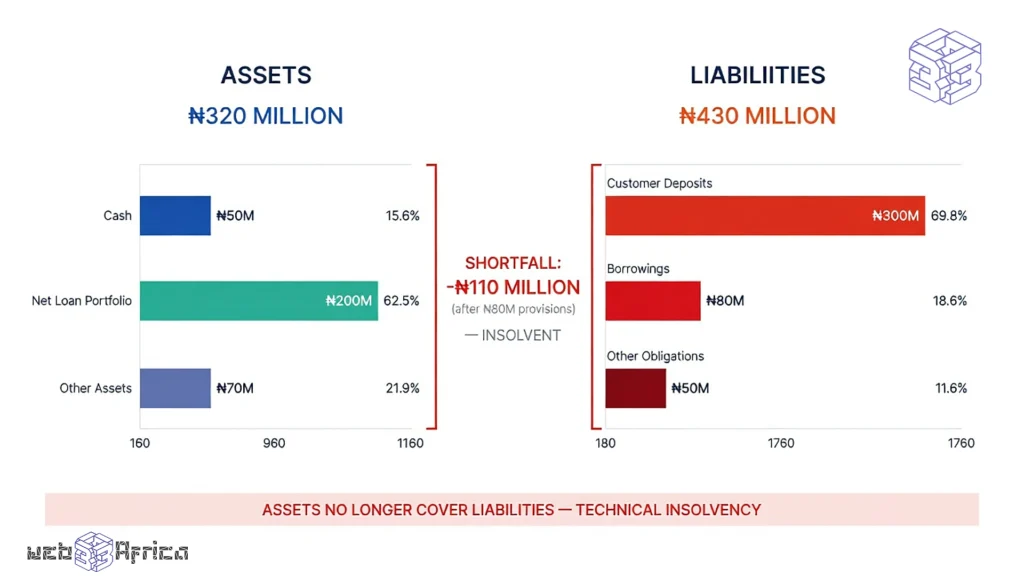
Consider a simplified digital MFB balance sheet in distress:
Assets: ₦320 million (₦50m cash, ₦200m net loan portfolio after ₦80m provisions, ₦70m other assets)
Liabilities: ₦430 million (₦300m customer deposits, ₦80m borrowings, ₦50m other obligations)
Shareholders’ Equity: Negative ₦110 million
Total assets no longer cover total liabilities. The institution is insolvent.
RELATED: CBN compliance Department Introduces Proactive Measures Against Financial Crime
This situation occurs when a severe asset liability mismatch meets macro stress. The scenario proves fatal when credit quality collapses. Without adequate fintech capitalization, the institution’s equity cushion disappears rapidly.
Why Asset Liability Mismatch Accelerates Insolvency
Nigeria’s microfinance banks face a portfolio-at-risk (PAR) ratio of 12.7%, three times the 4.1% rate at commercial banks, according to Agusto & Co. That disparity serves as a clear indicator. When 12.7% of your loan book stops performing, IFRS 9 Expected Credit Loss accounting forces you to provision heavily, reducing the net value of assets. This deepens the asset liability mismatch because liabilities remain sticky while assets shrink.
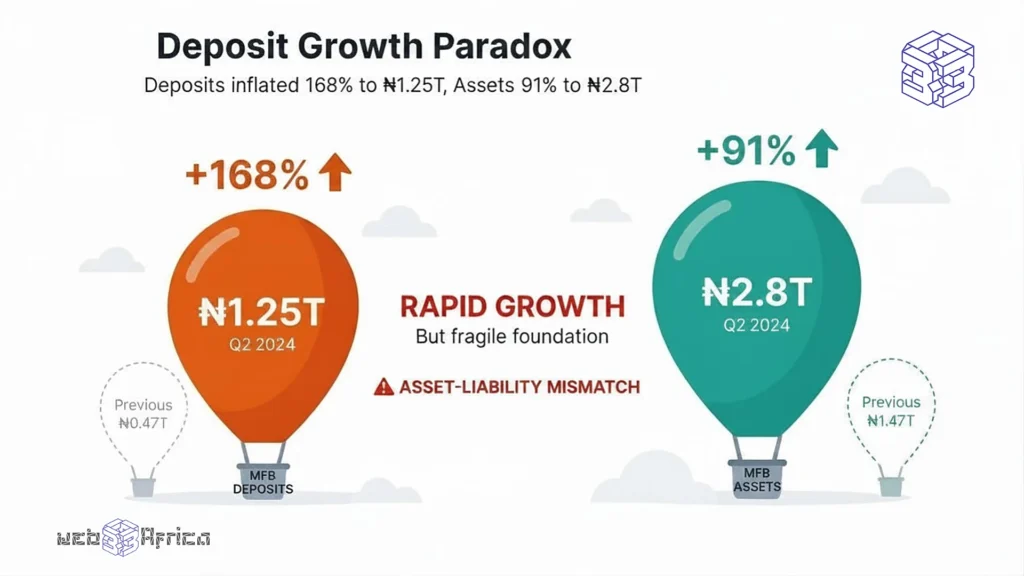
Meanwhile, deposit liabilities, which surged 168% to ₦1.3 trillion across the MFB sector in 2024, remain fixed obligations. The capital gets consumed. When your capital adequacy ratio falls below the 10% minimum, you’re critically undercapitalized. When cumulative losses exceed shareholders’ equity entirely, your balance sheet “breaks.” For digital lenders, weak fintech capitalization turns a liquidity squeeze into a solvency crisis.
How Inflation, Defaults, and Currency Devaluation Erode Fintech Capitalization
CBN’s culling strategy occurred at the convergence of three macro forces that created what credit analysts call a “death spiral.”
Inflation eroded repayment capacity.
At 15.93% headline inflation in May 2026 (with food inflation reaching 17.8%), borrowers, predominantly informal sector workers and small businesses, faced cost-of-living shocks that made loan repayment a secondary priority. The result: mass defaults.
The Monetary Policy Rate hit 26.5%.
While the CBN reduced rates by 50 basis points in February 2026, the weighted average lending rate remained prohibitively high. Microfinance banks that had issued fixed-rate loans at 30-35% found themselves unable to reprice their portfolios as funding costs rose. Borrowers couldn’t service loans priced for a different economic reality.
Currency devaluation destroyed dollar-denominated cost structures.
Digital lenders often carry technology infrastructure costs in dollars (cloud services, third-party APIs, international vendors) while earning naira-denominated interest income. As the naira traded at ₦1,370-1,410/USD, as per the time of writing, tech-enabled lenders saw their unit economics collapse. This erosion of margins directly undermines fintech capitalization, forcing many to operate with razor-thin buffers.
RELATED: CBN Deputy Director Explains NFC Integration for Digital Currency
Dr. Amina Yusuf, a credit risk specialist, summarized the structure:
“The 46 failed MFBs weren’t just victims of bad luck; they were victims of a flawed unit economic model. They priced risk as if Nigeria were a low-inflation environment. When the Naira devalued, their dollar-denominated tech costs rose while their Naira-denominated assets evaporated.”
How to Calculate Capital Adequacy for Digital Lenders
Understanding why the CBN revoked these licenses requires understanding digital lender capital requirements and how they’re calculated. The CBN’s requirements are clearly defined, yet many operators ignored the warning signs until it was too late.
Capital Adequacy Ratio (CAR) = (Tier 1 + Tier 2 Capital) / Risk-Weighted Assets
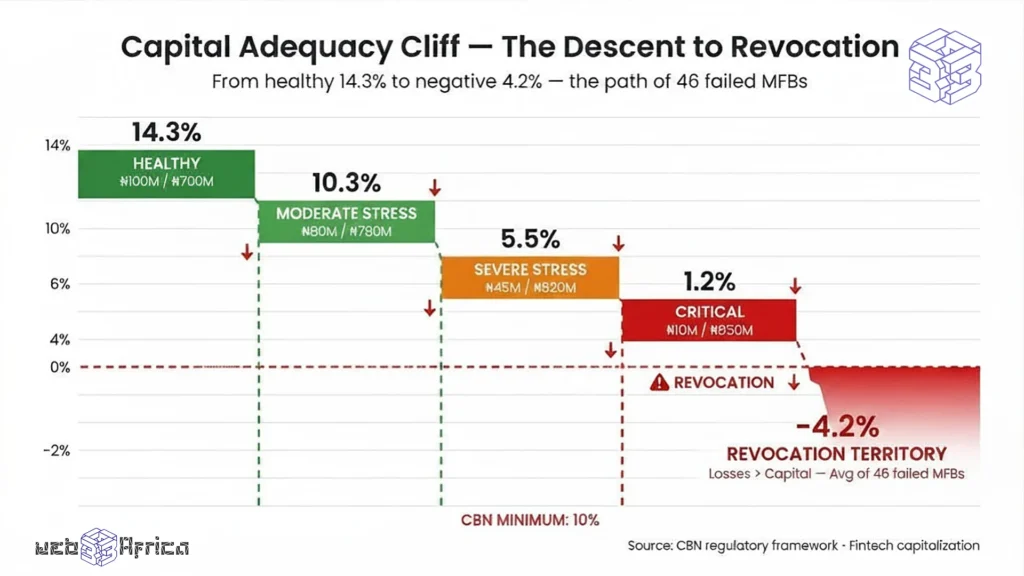
The CBN requires a minimum 10% CAR for microfinance banks.
Here’s how deterioration looks:
- Healthy stage: ₦100m capital / ₦700m RWA = 14.3% CAR (compliant)
- Moderate stress: ₦80m capital / ₦780m RWA = 10.3% CAR (marginal)
- Severe stress: ₦45m capital / ₦820m RWA = 5.5% CAR (non-compliant)
- Critical failure: ₦10m capital / ₦850m RWA = 1.2% CAR (revocation territory)
Step-by-Step: How to Calculate Capital Adequacy for Digital Lenders
For the 46 revoked institutions, the estimated average CAR stood at negative 4.2%. This indicates that losses had completely consumed the capital, leaving institutions with debts exceeding their assets.
The problem compounds for digital lenders because unsecured digital loans carry 100-150% risk weights versus 0-20% for secured commercial lending. Every naira of unsecured digital lending requires significantly more capital backing than secured lending. When NPLs spike, the erosion accelerates. Meeting digital lender capital requirements becomes impossible without fresh equity, and fintech capitalization rounds have dried up.
The revocation of Goldman Microfinance Bank, a preview of the July action, included explicit CBN language:
“The bank’s capital adequacy ratio had fallen significantly below the minimum required by the CBN, indicating a severe lack of financial buffer.”
The Deposit Growth Paradox: How Rapid Liabilities Worsen Asset Liability Mismatch
Counterintuitively, many of the failed institutions were growing rapidly before collapse. MFB sector deposit liabilities surged 168% to ₦1.3 trillion in 2024, a sign of aggressive customer acquisition and market expansion.
But rapid deposit growth without commensurate improvement in credit quality creates structural fragility. Digital lenders offered 25-30% annual percentage yields to attract deposits, which were short-term (30-90 day) obligations. Those deposits funded longer-term (180-day) unsecured loans issued at fixed rates. This widening asset liability mismatch left digital lenders dangerously exposed.
When inflation accelerated and borrowers defaulted en masse, the liability side remained sticky. Depositors expected 30% returns. By June 2026, the asset side, with ₦1 out of every ₦8 in the loan book non-performing, could no longer generate sufficient income to cover obligations. The asset-liability mismatch that had fueled growth now accelerated the collapse.
Winston Osuchukwu, CEO of credit infrastructure firm Mathesis, identified the root cause.
“While digital transformation has improved customer onboarding and loan disbursement processes, the systems underpinning credit risk management remain largely outdated. Many lenders rely on internal transaction records and credit bureau reports, which often provide only a limited picture of a customer’s financial behavior.”
In short, fintech capitalization strategies put growth and distribution ahead of underwriting infrastructure.
The Fintech Acquisition Trap: Hidden Risks in Digital Lender Capital Requirements
The revocation list includes digital-branded institutions: Sycamore Microfinance Bank, NOW NOW Digital MFB, OurPass MFB, Creditville MFB, and Casha MFB.
Their presence reveals a hidden regulatory risk in Nigeria’s fintech ecosystem.
Several fintechs acquired existing MFB licenses rather than applying for new ones, a faster path to deposit-taking capabilities. Yet, acquiring a license means inheriting its regulatory history. This directly impacts digital lender capital requirements because legacy balance-sheet weaknesses can suddenly trigger regulatory action.
RELATED: The New Rules for Stablecoin-Based Trade Settlement in Nigeria
Sycamore explained after losing its license that the problems are linked to old issues from the Kano-based tier-2 MFB it bought when expanding into banking, and these issues existed before the acquisition, not because of its current operations.
The company has since obtained a finance company license and continues operating.
This due diligence on MFB acquisitions must include full regulatory history audits, not just current financial statements. Legacy compliance issues can surface years later, destroying fintech capitalization overnight.
What Credit Analysts Should Monitor to Assess Fintech Capitalization and Asset Liability Mismatch
The banking sector’s NPL ratio climbed to 9.85% in February 2026, significantly above the CBN’s 5% regulatory threshold, following the exit from regulatory forbearance.
The 46 microfinance banks whose licenses were revoked were closed mainly for insolvency (insufficient assets to meet liabilities), prolonged inactivity, and failure to maintain minimum capital requirements, not because of a specific disclosed NPL ratio of 38%.
Rating agencies signaled vulnerability months before enforcement. Agusto & Co. downgraded Baobab MFB to “BBB” in January 2026 on “higher leverage and lower equity cushion,” six months before the mass revocations.
The regulatory sequence is now clear. Commercial banks faced recapitalization deadlines through March 2026, and MFBs are next. The CBN increased national MFB capital requirements from ₦2 billion to ₦5 billion in January 2026. Industry observers expect a formal MFB recapitalization program announcement imminently.
RELATED: African Stablecoins Cannot Scale Without Europe’s Regulatory Trust
For undercapitalized institutions unable to raise equity, it is particularly challenging, as Nigerian startup funding fell 28% year-over-year to $78.6 million in Q1 2026; the alternative is license revocation. We’ve broken down how to calculate capital adequacy for digital lenders, but the real challenge is maintaining it when the macro pincer tightens and asset liability mismatch spirals.
The July 2026 enforcement action removed 46 institutions. The May 2023 purge removed 132 MFBs. This action is a major cleanup of a sector where problems with assets and liabilities, economic stress, and poor credit systems came together and caused big financial issues.
The Nigeria Deposit Insurance Corporation now serves as a liquidator. For the 46 failed institutions’ depositors, protection mechanisms activate. For investors and fintech startups, CBN’s stance is pretty clear-cut: show me your PAR ratio, your CAR trend, and your deposit maturity profile. The rest is commentary.
FAQ
What is fintech capitalization?
Fintech capitalization refers to the equity and regulatory capital available to absorb losses and support lending activities while meeting minimum capital requirements.
What caused the collapse of 46 Nigerian microfinance banks?
The institutions became insolvent after assets could no longer cover liabilities due to rising loan defaults, heavy credit loss provisions, inflation and insufficient capital.
Why are unsecured digital loans more capital intensive?
They carry higher regulatory risk weights than secured lending, requiring lenders to hold more capital against potential losses.
Why can rapid deposit growth become a risk?
Deposit growth can worsen an asset liability mismatch if liabilities expand faster than loan quality improves, leaving institutions exposed when defaults rise.
Discover more from Web3Africa
Subscribe to get the latest posts sent to your email.
You must be logged in to post a comment.