










Table of Contents
First it was Bitcoin, then came Ethereum, and what followed is a crypto boom that caught the globe’s attention. Soon Bitcoin, or rather its underlying technology, found a way to merge both traditional finance and digital assets: stablecoins.
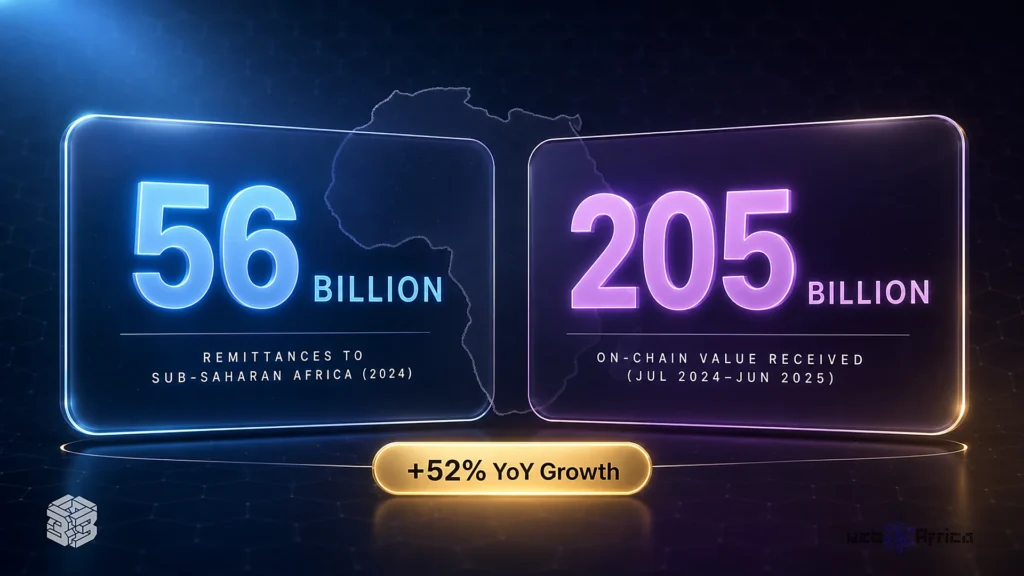
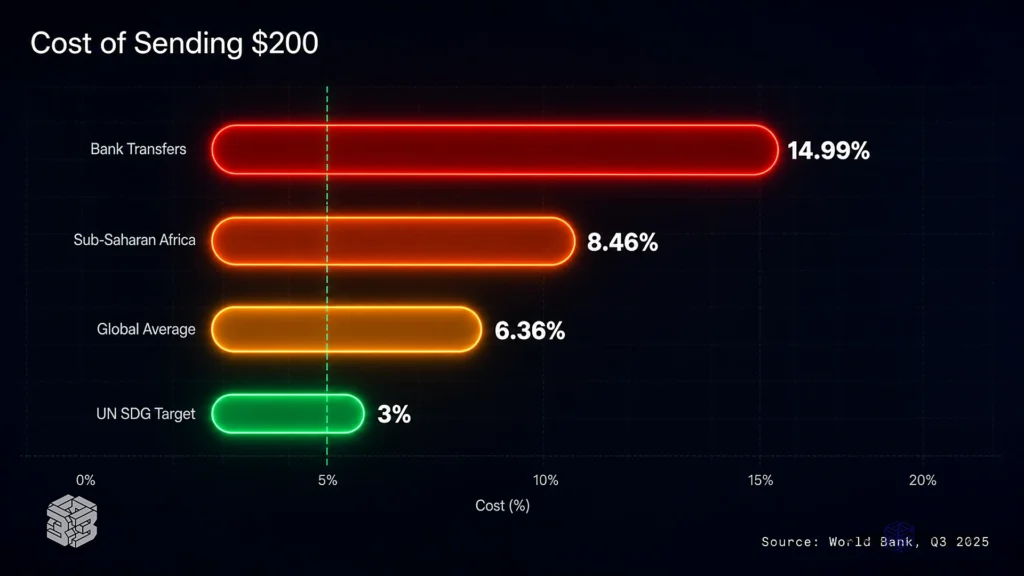
Its success is evident. In 2024, according to the World Bank’s Migration and Development Brief, Africa received $56 billion in remittance inflows. The average method of sending money even with mobile money is still expensive. In Q3 2025, the average cost of remitting $200 to Africa stood at 8.46%. That’s triple the UN Sustainable Development Goal Target of 3%.
Now, stablecoin remittances do the same but better. Over the past eighteen months, the world’s largest money transfer operators have launched stablecoin products. Local fintechs have secured institutional licenses to operate digital asset on-ramps, and on-chain transaction volumes have surged to levels that rival formal remittance flows.
The latest surge of stablecoin inflows, approximately $88 billion in 2025, has fostered a new demand: stablecoin infrastructure.
The Brutal Reality of Legacy Remittance Fees Across Africa
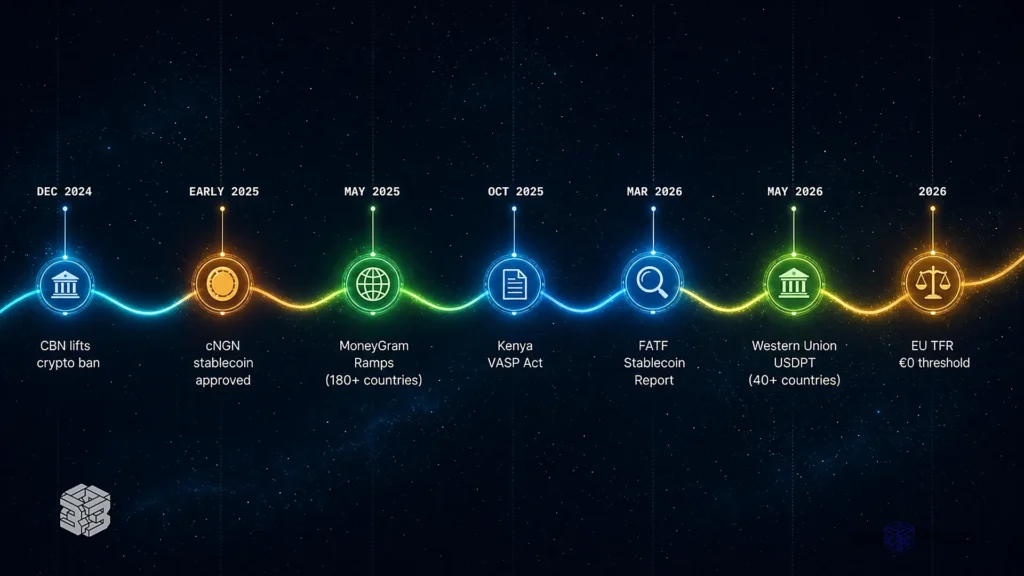
In May 2026, Western Union launched “Stable by WU” across more than 40 countries, offering its USDPT stablecoin, built on Solana, through 500,000+ agent locations. The company’s CEO, Devin McGranahan, described stablecoins as “the next evolution” of how remittances will move.
RELATED: Western Union’s USDPT to Launch on Solana, Accelerating Stablecoin Remittances Worldwide
MoneyGram deployed a different model. Its stablecoin on/off-ramp infrastructure, built on Stellar and supporting USDC, went live across 180+ countries and 350,000 retail partners. Think of it as a cash-in and cash-out system enabling a local user to convert USDC into their local currency. This basically turned MoneyGram’s global agent network into liquidity infrastructure for decentralized applications.
Yellow Card has demonstrated how a local vision can expand. In 2025, it acquired a Third-Party Payment Provider (TPPP) license in South Africa, with Standard Bank as its sponsoring institution. This paved the way to partnerships such as Mastercard expanding its services all the way to the UAE.
It’s steady, but the shift is happening, and stablecoin rails and compliance have become 2026’s theme.
The Multibillion Dollar Surge in Corporate Stablecoin Volume
The $88.15 billion figure is distributed throughout Africa’s Web3 titans.
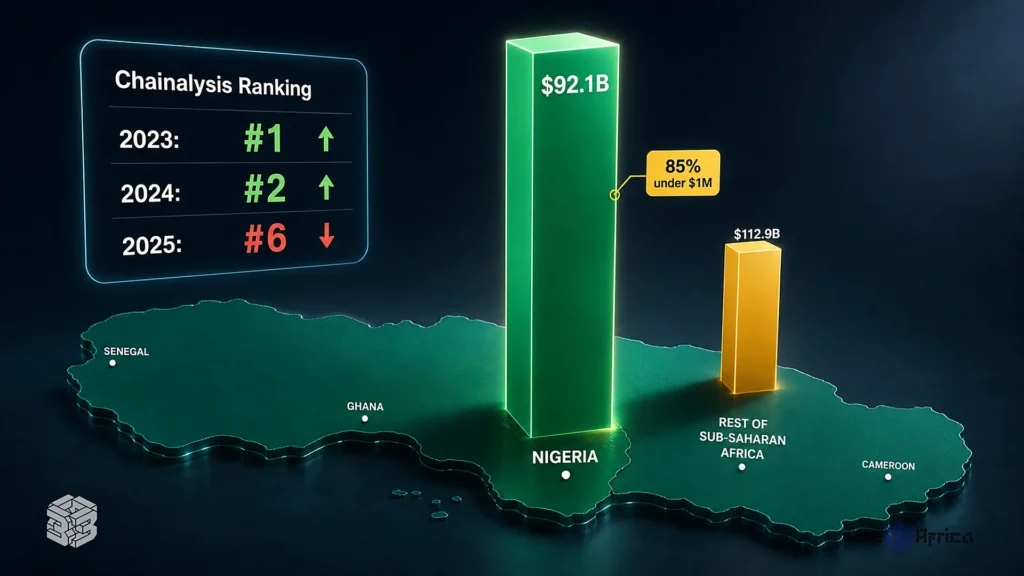
Nigeria alone received $92.1 billion in on-chain value during the period and ranked sixth on Chainalysis’s 2025 Global Crypto Adoption Index, down from second in 2024. Peak monthly Sub-Saharan activity reached approximately $25 billion in March 2025, driven by naira devaluation and capital control pressure.
Moyo Sodipo, COO of Nigerian exchange Busha, noted that approximately 85% of Nigeria’s crypto transfers during the measured period were under $1 million. A metric consistent with retail and SME cross-border payment use cases rather than speculative trading.
Chainalysis also found that large transfers of stablecoins worth millions of dollars are linked to trade between Africa, the Middle East, and Asia, showing that the system for sending digital assets is being used for business payments, not just for individual users.
RELATED: Busha Exchange Milestone: Serving 800,000+ Crypto Users in Africa
Overcoming the Fiat Conversion Hurdle in Local Markets
The operational challenge in stablecoin remittances is not the blockchain transfer—sending USDT on Tron costs approximately $0.01 and settles in under 30 seconds. The friction occurs at the fiat interfaces: converting local currency into stablecoins (on-ramp) and converting stablecoins back into local currency or mobile money (off-ramp).
While stablecoin rails do alleviate many bottlenecks, they still have their issues. Primarily, its fiat interface is a tasking matter, especially considering most African countries’ economic situations.
Local fintech has found several solutions for the issue.
Yellow Card operates a B2B payment API enabling businesses to accept stablecoin payments and disburse local fiat or mobile money. The platform supports USDT and USDC across multiple blockchains and integrates with local banking and mobile money infrastructure.
Kotani Pay connects mobile money accounts to stablecoin wallets, enabling USDT TRC-20 payouts to mobile money recipients. A UNICEF Venture Fund pilot found that average off-ramp times were approximately 19 minutes, though the range varied from under one minute to over two hours depending on liquidity provider availability.
RELATED: Kotani Pay Becomes South Africa’s First Licensed On/Off-Ramp Fintech
Visa, M-PESA, and Onafriq announced a pilot in the Democratic Republic of Congo using stablecoins as invisible settlement infrastructure for cross-border mobile money top-ups. Users send and receive local currency. The stablecoin layer operates beneath the interface as a settlement rail.
It’s basically using stablecoins as infrastructure rather than consumer-facing products. Mobile money providers retain customer relationships and regulatory simplicity while stablecoin platforms supply speed and cost efficiency in the backend.
The technology is not the constraint; compliance is.
The Financial Action Task Force (FATF) Travel Rule requires virtual asset service providers to collect and transmit originator and beneficiary information for transactions, screen against OFAC, EU, and UN sanctions lists, and retain records for five years.
The European Union’s Transfer of Funds Regulation lowered the reporting threshold to €0 in 2026, demanding strict compliance even for small-value transfers. The US GENIUS Act created the first federal framework for stablecoins, requiring 100% reserve backing, monthly audits, and full AML/KYC compliance. The law establishes the de facto minimum standard for any local fintech processing USDC or seeking to interoperate with US financial infrastructure.
In its targeted report on stablecoins published in March 2026, FATF noted that 84% of the illicit virtual asset volume was stablecoin-related, and much of this activity was taking place in secondary peer-to-peer markets rather than regulated exchanges. AML compliance systems and customer due diligence are now front and center for any regulator, especially when talking about stablecoins.
Securing Predictable Payment Frameworks Across Fragmented Jurisdictions
However, African jurisdictions are adapting.
Nigeria’s Securities and Exchange Commission approved a naira-backed stablecoin in early 2025 after the Central Bank lifted its crypto banking ban. Kenya’s Virtual Asset Service Provider (VASP) Act, passed in October 2025, created a split of oversight between the Central Bank and the Capital Markets Authority.
South Africa’s greenlighting of Yellow Card’s TPPP license was institutional validation of stablecoin infrastructure under existing payment system regulation. Mauritius, an early mover with its VAITOS Act in 2021, issued stablecoin-specific guidance in 2025.
The fragmentations do create operational complexity; however, all, if not most, existing laws share common baselines that aren’t too restrictive. A fintech expanding from Nigeria to Kenya to South Africa might go through several regulatory bodies, but as long as their systems meet the criteria, expanding becomes much easier.
Stablecoin rails are becoming embedded in mainstream payment infrastructure through partnerships between money transfer operators, mobile money providers, card networks, and regulated fintechs. The cost advantage over traditional rails is measurable but depends on corridor-specific liquidity and compliance architecture. The companies building that infrastructure today are basically setting the groundwork for Africa’s next-generation financial system.
FAQ
What are stablecoin remittances?
Stablecoin remittances involve using stablecoins, which are digital assets pegged to a stable currency like the US dollar, to send money across borders. They offer a faster and potentially cheaper alternative to traditional remittance services.
Why is Africa a key market for stablecoin remittances?
Africa is a key market because it receives a large volume of remittances—$56 billion in 2024—and the average cost to send money is very high, at 8.46% in Q3 2025, which is triple the UN’s target. Stablecoins offer a way to significantly reduce these costs.
What are the main technical challenges for stablecoin remittances?
The main challenge is not the blockchain transfer, which is fast and cheap, but the “fiat interface.” This involves converting local currency into stablecoins (on-ramp) and back into local currency or mobile money (off-ramp), which can be complex.
How are companies like MoneyGram involved in stablecoin remittances?
MoneyGram deployed a stablecoin on/off-ramp infrastructure on the Stellar network. This system allows users to convert USDC into local currencies at their 350,000 retail partners, effectively turning their network into liquidity infrastructure for stablecoin remittances.
Discover more from Web3Africa
Subscribe to get the latest posts sent to your email.
You must be logged in to post a comment.