






Table of Contents
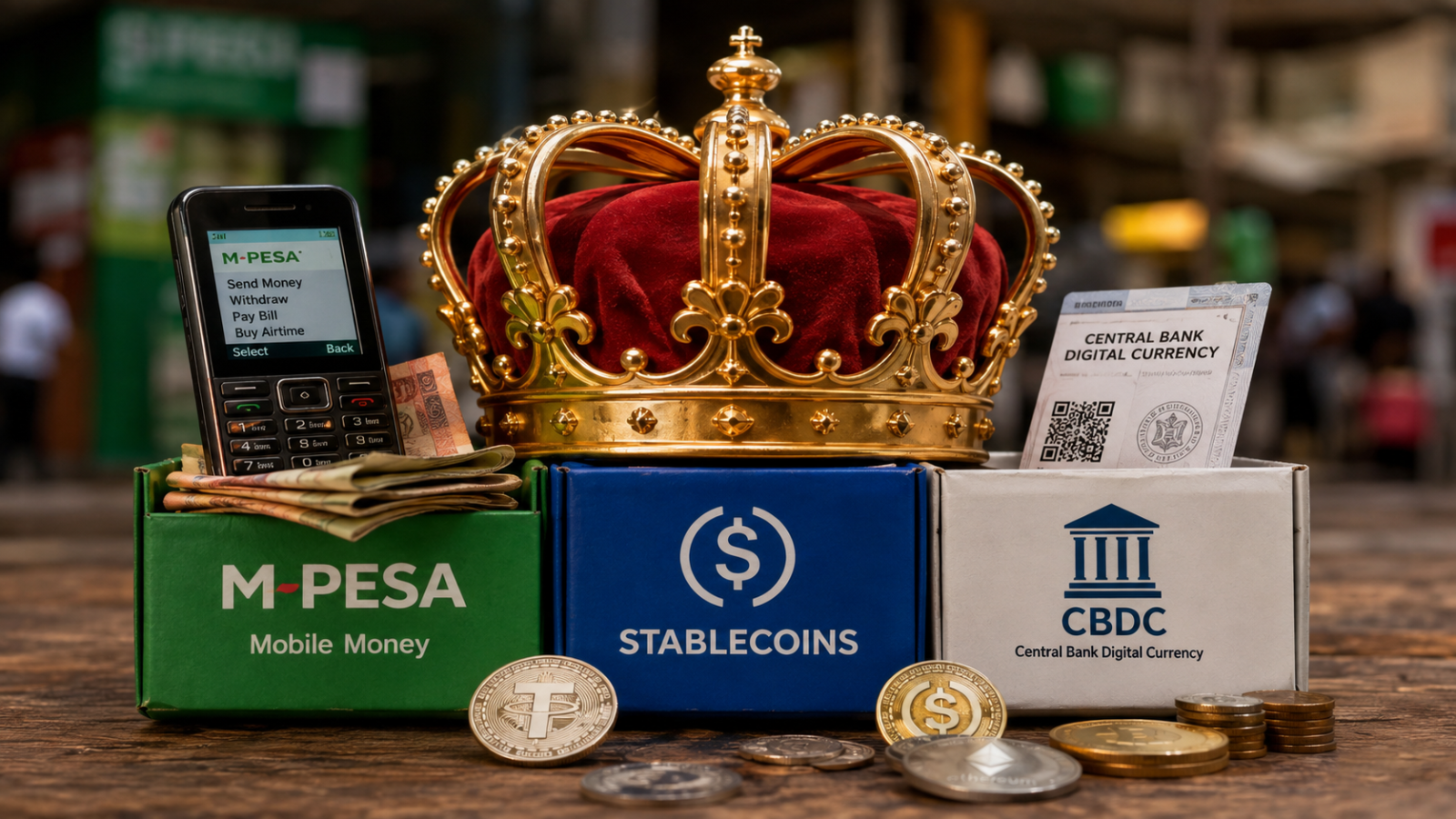
Mobile money has reigned supreme as the undisputed king of digital finance in Africa. Its throne is built on the backs of 602,470 agents in Kenya alone and $1.4 trillion in annual African transaction value.
However, today, two formidable opponents challenge the throne: stablecoins and CBDCs.
Future payments in Africa are split between the comfort of an established structure like M-Pesa or Airtel Money, the convenient and inflation-proof stablecoins, and the regulated alternative CBDCs.
It’s a heated debate, one that you can see, like, at the African Blockchain Festival in Nairobi on October 15-17. The event has a dedicated panel, “Stablecoins, CBDCs, and the Future of African Payments,” which will feature a head-to-head conversation with active players.
But let’s provide you with a summary and determine which option takes the lead.
Three Philosophies, Three Promises
Mobile money was one of the first iterations of digital finance. The majority of the readers have used M-Pesa, MTN, Airtel Money, or another mobile money service provider. For many of us it’s our go-to since it provides financial access through agent networks and USSD codes that work on any phone.
According to the GSMA’s State of the Industry Report 2026, Africa now has 1.2 billion registered mobile money accounts and 347 million active users. In Kenya, Safaricom holds an 89.1% market share, and M-Pesa has evolved from payments into a full financial platform, with 2.42 million subscribers holding KES 19.8 billion in assets through its investment product.
Stablecoin is by far the newest disruptor, especially with 2026 focused on stablecoins and regulations. International-backed stablecoins like USDT or EURC provide a hedge against inflation and easier and faster cross-border transactions. Even local stablecoins like CNGN and ZARP have their uses beyond their monetary value.
RELATED: The Payroll Problem Driving Stablecoin Adoption
On platforms like Yellow Card, which operates across 20+ African countries, USDT represents 88.5% of transaction volume. “Yellow Card was one of the first companies to find product-market fit for stablecoins with businesses outside the crypto industry,” says co-founder and CEO Chris Maurice.
CBDCs are the sovereign alternative. They are state-backed digital currencies designed to modernize money while maintaining central bank control. Their promise is the stability of fiat combined with digital efficiency.
However, the situation quickly changed given the downfall of the eNaira.
The Good, the Bad, the Ugly, and the Useful
Mobile Money: Distribution is Destiny
Mobile money dominance is often attributed to its unmatched distributions. Mpesa’s 602,470 agents create a cash-in/cash-out network. MTN MoMo processed $500.3 billion in 2025 across multiple African markets (+37.6% year-over-year), while Vodacom Group platforms, including Safaricom, handled $525.6 billion. The GSMA’s Director General Vivek Badrinath describes it as having “evolved into a global financial ecosystem.”
Its dominance is mainly due to domestic peer-to-peer transfers, bill payments, and cash conversion. M-Pesa’s Kadogo service processed 17.1 billion zero-rated small-value transactions in FY2026.
However, it has a closed-loop architecture where moving money between M-Pesa and Airtel Money or any other service involves fees of 7-9%. In addition, market concentration also raises a concern. If Safaricom servers were to shut down due to system malfunction or “other reasons,” that’s 89.1%, making it a national event.
RELATED: X Money Beta Testing: From Tweet to Mobile Banking Reality
Stablecoins: Fast Money, Hard Questions
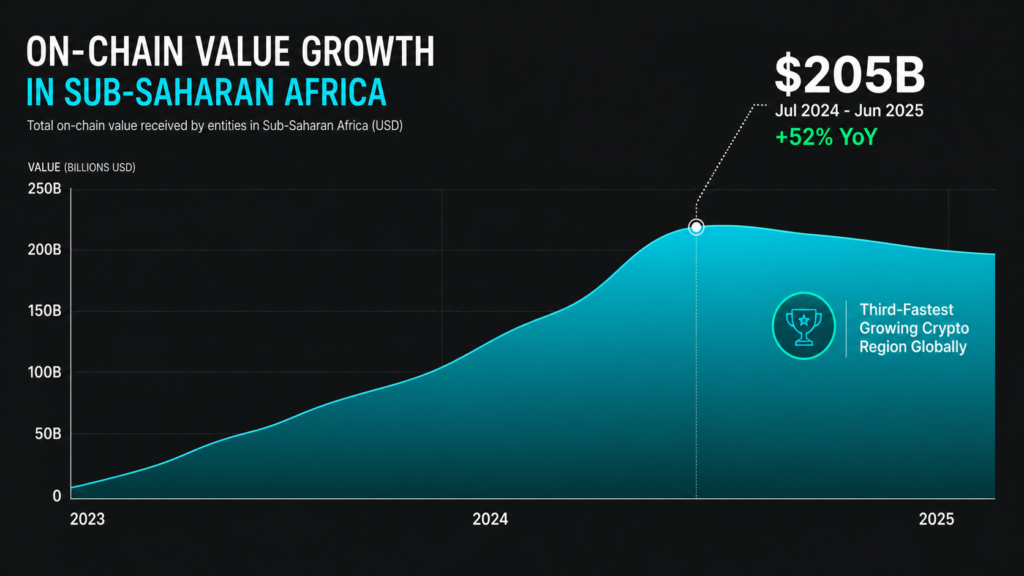
The Good: Sub-Saharan Africa received $205 billion+ in on-chain value between July 2024 and June 2025, up 52% year-over-year, according to Chainalysis. For cross-border B2B settlement, treasury management in FX-constrained environments, and remittances, stablecoins offer speed and cost advantages mobile money cannot match.
Stablecoins have become the main topic in the African ecosystem. In a nutshell, it’s just too good of an upgrade. It’s faster and cheaper for cross-border B2B settlement, treasury management in FX-constrained environments, and remittances. It hedges against inflation and is an upcoming alternative for African freelancers and its gig community.
This, however, leads to over-reliance. USD-backed stablecoins are a direct threat to a nation’s economic sovereignty. Africa’s Reserve Bank Deputy Governor Rashad Cassim explicitly flagged “currency substitution and the possibility of circumventing exchange controls” as stablecoin concerns in June 2026.
CBDCs: Sovereignty Searching for Adoption
CBDCs technically come in for the save when it comes to protecting economic sovereignty. It offers a digital payment system that allows for flexible government spending, lower costs for distributing money, and better access to financial services, all while keeping control of money within the government instead of handing it over to private companies.
Reality, however, tells of a different story. Adoption, for starters, is one of its main issues. The eNaira has 98.5% wallet inactivity. In addition, one of the main factors is the privacy concerns. CBDCs enable surveillance at such a high degree. Basically, the concept of “switching off your money” becomes all too real. Even the South African Reserve Bank (SARB) halted its retail digital rand, concluding that there was “no compelling immediate need.”
It’s not all bad news. Wholesale and cross-border applications show promise. Ghana’s Bank of Ghana Governor Dr. Johnson Pandit Asiama announced in May 2026 that the e-Cedi “has completed its pilot phase, and we are now actively designing its use for cross-border settlements and wholesale payments.”
His vision: “A payment initiated in Accra should clear in Abidjan or Lagos as easily as in Kumasi.”
Interoperability Could Matter More Than Choosing a Single Payments Winner
Unfortunately, there is no single winner. Instead, a hybrid ecosystem where systems interoperate and specialize is a better alternative. For instance, the Pan-African Payment and Settlement System (PAPSS) now connects 28 countries and 190+ banks and fintechs, enabling local currency settlement in under two minutes.
PAPSS partnered with Kenya’s Pesalink to create a bank-to-mobile-money-to-bank continental network. A non-crypto answer to the cross-border pain points stablecoins currently solve.
Mobile-to-stablecoin bridges are already an ongoing industry.
Flutterwave’s Circle integration and various M-Pesa partnerships blur the lines between telecom and blockchain rails. Mobile money platforms are also adapting. Safaricom’s Ziidi trading service attracted 688,000 opt-ins with 103,000 active traders, while M-Pesa’s investment platform manages KES 19.8 billion in assets.
CBDCs may find their role not as consumer wallets competing with M-Pesa but as wholesale settlement infrastructure complementing private rails like Ghana’s and South Africa’s approach.
At ABF 2026, the People Building Africa’s Payments Future Will Face the Hard Questions
Understanding the competing philosophies intellectually is one thing. Watching local industry leaders each give their side is another
At the Africa Blockchain Festival on October 15–17 at Nairobi’s Sarit Expo Centre, the “Stablecoins, CBDCs, and the Future of African Payments” panel will force proponents of each system to answer their hardest questions:
- Mobile money executives must explain how closed loops will compete with permissionless global rails.
- Stablecoin advocates must address dollarization risks and reserve transparency.
- CBDC architects must confront the eNaira’s 98.5% inactivity rate and explain why their design will avoid the same fate.
If nothing else, the future of payments in Africa will change. Will it reflect Kenya’s 157.7% mobile penetration, or will it tip towards Nigeria’s $92.1 billion stablecoin?
Each represents a different bet on the future.
This October in Nairobi, you won’t just read about that future. You’ll witness the people building it argue, shape, and contest it. The ABF is your front-row seat to the clash of ideas that will define African digital payments for the next decade.
The throne is under siege.
You should get front-row seats.
Discover more from Web3Africa
Subscribe to get the latest posts sent to your email.
You must be logged in to post a comment.