










Table of Contents
The Bank of Tanzania, like many local central banks, had to make a choice. To remain in a regulatory grey zone or watch while its peers, Kenya, Uganda, and Nigeria, respond to an asset class that has inflows of $92.1 billion, $19 billion, and $1.1 billion, respectively.
Governor Emmanuel Tutuba recently declared that a formal Tanzanian crypto regulation is underway and will be designed to supervise cryptocurrencies and stablecoins.
Below is a description of Tanzania’s journey so far and what to expect with this upcoming crypto policy.
Tanzania’s crypto evidence base grew from 2019 to 2024
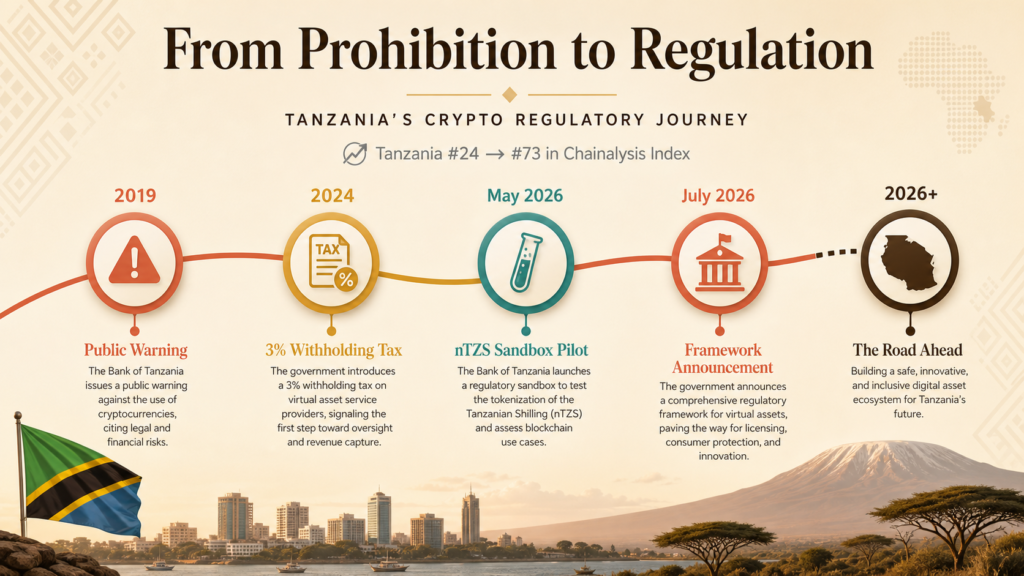
In November 2019, the Bank of Tanzania issued a public notice warning that virtual currencies were “not legally authorized” and contrary to foreign exchange regulations.
However, the use and trading of cryptocurrency was conveniently undefined.
Like most regions, the ban only boosted its adoption but drove it underground. By the time the Finance Act 2024 was assented on June 30, 2024, Tanzanian authorities had accumulated sufficient market evidence, and a $117 billion (2023 figures) market was completely untapped.
The Act introduced a 3% withholding tax on digital asset exchanges and transfers, effective July 1, 2024. The tax applied to payments made “in respect of exchange or transfer” of digital assets, defined broadly to include cryptocurrencies, tokens, and NFTs.
RELATED: Kenya Scraps 3% Crypto Tax: New Fee-Based System Explained.
The tax did receive some backlash, but it represented an institutional recognition that digital assets are the future.
The 2024 tax effectively moved digital assets from the category of “not legally authorized” to “taxable economic reality.”
Between 2019 and 2024, the Bank of Tanzania also observed regional developments. Kenya, Nigeria, South Africa, and Ghana were moving toward licensing regimes rather than outright bans.
During this period its adoption steadily grew from $2 billion in 2024 to $3 billion in 2025.
ChapSmart, a Tanzanian startup bridging Bitcoin’s Lightning Network to M-Pesa for remittances and bill payments, was operating in a regulatory grey area, structuring its operations carefully to avoid direct conflict with the 2019 notice while serving real demand.
Tax, sandbox, and framework formed Tanzania’s regulatory path
Tanzania’s regulatory journey occurred in several phases:
Fiscal integration (July 2024)
The withholding tax brought digital assets into the tax perimeter, requiring precise definitions. The Finance Act 2024 includes detailed language defining “digital asset” and specifying the tax base as the gross fair market value at the point of exchange or transfer.
The institutional work required to draft, debate, and implement this language forced ministries and regulators to engage seriously with how digital assets functioned.
Controlled testing (May 2026)
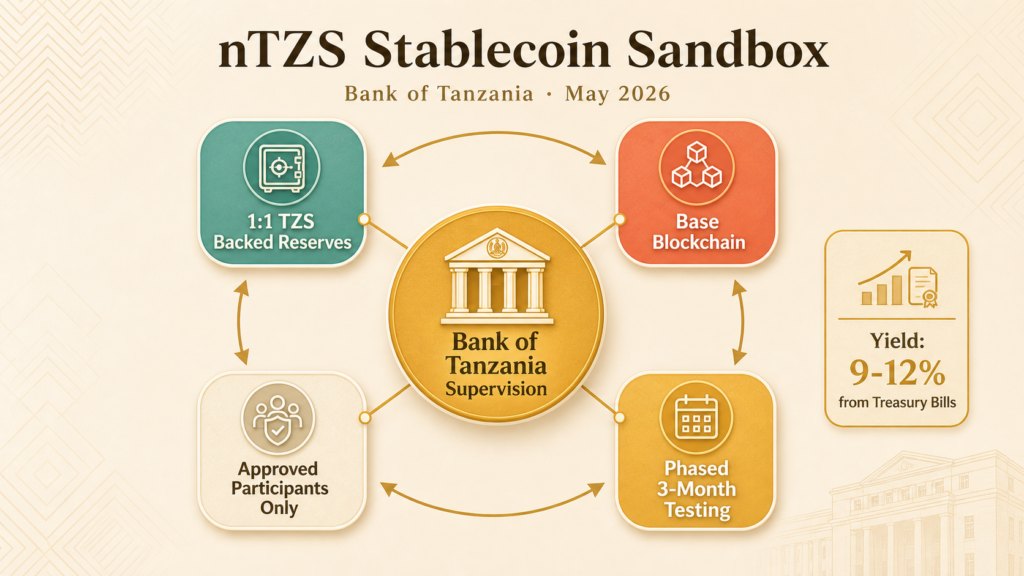
In May 2026, the Bank of Tanzania approved the first stablecoin sandbox pilot, nTZS, developed by NEDA Labs. The central bank is testing its issuance, transfer, and redemption under its supervision.
The sandbox, formalized under Government Notice No. 540 of 2024, represents a “test-and-learn” approach. Rather than writing comprehensive rules for a market the regulator does not yet fully understand, the sandbox provides real-time monitoring of its behavior, identifies risks, and calibrates responses.
The program was a success; the Bank of Tanzania had announced a third cohort for its Fintech Regulatory Sandbox.
Framework announcement (July 2026)
Governor Tutuba’s statement at the 50th Dar es Salaam International Trade Fair provided a much clearer picture:
“We are currently finalizing the preparation of laws and regulations for the supervision of digital assets, particularly virtual assets, cryptocurrencies, and stablecoins, so that we can strengthen regulation and oversight.”
He cited that various drivers included youth participation, consumer complaints and losses, and anti-money laundering and terrorist financing risks. The framework was being developed “in line with international best practices” following Tanzania’s participation in global discussions on digital asset regulation.
The Power of Regional Peer Pressure
Tanzania’s government also phases off peer pressure from its peer nations, which are already far ahead. Kenya has a VASP act that establishes a dual-oversight model where the Central Bank of Kenya supervises payments and stablecoins, and the Capital Markets Authority regulates securities.
Nigeria has implemented the ISA Act, the ARIP program, and an active Crypto Asset Reporting Framework (CARF) for tax reporting.
RELATED: Inside ISA 2024: How Nigeria Is Legalizing Crypto and Cracking Down on Ponzi Scheme Laws
Tanzania risked losing fintech talent, investment, and regional influence if it remained locked in a 2019 prohibition posture while neighbors built licensing pipelines and developer ecosystems.
Adoption data compounded the competitive pressure. Sub-Saharan Africa received $205 billion in on-chain value between July 2024 and June 2025, up 52% year-over-year. The region’s March 2025 monthly volume peaked at approximately $25 billion. Over 8% of transfers were under $10,000, indicating retail activity rather than institutional speculation. Stablecoins dominated remittances, cross-border trade, and inflation hedging.
Tanzania’s Chainalysis Global Crypto Adoption Index ranking fell from #24 in 2023 to #73 in 2025, partly due to methodology changes but also reflecting relative inactivity in a fast-growing regional market.
Consumer protection and learning drove Tanzania’s reversal
Governor Tutuba’s explicit reference to consumer complaints is the most revealing element of the July 2026 announcement:
“Many young people are investing in this area, but we have also received complaints from people who have lost money. We are therefore looking at how to put in place an enabling environment that will protect Tanzanians from further harm.”
The 2024 tax and 2026 sandbox were institutional learning exercises, allowing the central bank to build expertise, observe market behavior, and develop regulatory capacity before committing to a full supervisory framework.
The framework itself remains unpublished. Tanzania’s reversal serves as confirmation that digital assets are a permanent fixture. The question now is how long it will take other nations to reach the same strategic conclusion.
Discover more from Web3Africa
Subscribe to get the latest posts sent to your email.


You must be logged in to post a comment.