










Table of Contents
Local stablecoins may lack the value-retaining advantages of their international counterparts, but their successful implementation could be the crucial connection that integrates digital assets into everyday use.
Recently, ZARU, a South African rand stablecoin, went live on Circle’s Arc blockchain, becoming the country’s first institutional stablecoin joining a layer-1 network. The partnership focus is on financial markets, launching a founding pair on Circle’s StableFX foreign-exchange engine.
South Africa’s Regulatory Gap Meets a Regulated Rand Token
Loop South Africa (Pty) Ltd issued the ZARU stablecoins by trading as BlockTower, which holds an FSCA FSP No. 55172 license. In a nutshell, South Africa’s FSCA recognized and authorized the company as a Category I Financial Advisory and Intermediary Services (FAIS) operator.
The license allows them to legally trade crypto and digital assets within and outside South Africa’s borders.
South Africa’s current legal system does recognize stablecoins; however, they fall under a different category despite having a similar structure. Even the Intergovernmental Fintech Working Group (IFWG) published a diagnostic concluding that “no existing framework is adequate without amendment” for rand-pegged stablecoins.
Fortunately, its legal backbone and current regulation suffice in categorizing both crypto assets and stablecoins as mediums functioning outside the National Payment System Act.
RELATED: Standard Bank And Sanlam Back The New Solana Based ZARU Stablecoin
BlockTower’s FSP authorization means it operates as a regulated crypto-asset service provider under existing conduct-of-business rules. But the token itself, the reserve obligations, the redemption mechanics, and the insolvency treatment remain outside a purpose-built regulatory regime.
ZARu is regulated, and through this “regulation-first mentality,” it’s found its way into Circle’s vast network.
Reserves, Custody, and Attestation Behind ZARU
Stablecoins must operate with reserves since one ZARU is pegged to one South African rand.
ZARU’s reserves sit with Standard Bank in segregated accounts. Absa was added as a second banking partner for redundancy, while Sanlam Specialised Asset Management provides asset-liability management under an ALM agreement. BlockTower retains exclusive mint authority and freeze/recovery controls.
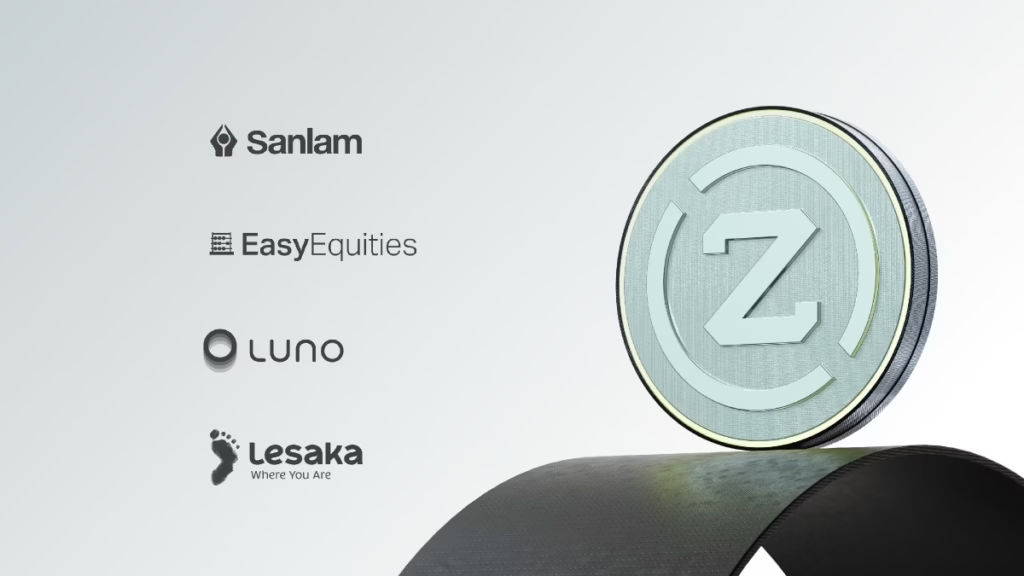
Moore Johannesburg, an IRBA-registered firm, attested to BlockTower’s reserve structure, verifying its on-chain supply, reserve balances, segregation, and coverage at a single point. At the time of writing there are 52,946,200 ZARU in circulation backed by ZAR 53,716,955 in reserves (coverage ratio of 101.46 percent).
Arc and StableFX Give ZARU an Institutional Edge
ZARU’s reserve and compliance structure were monumental factors in passing the Partner Stableocins program. This led to its integration with Circle’s Arc blockchain and StableFX engine, which offer much more than a vast network.
StableFX enables request-for-quote execution and atomic settlement for stablecoin foreign-exchange pairs. Both legs of a ZARU/USDC trade settle simultaneously, or they both fail to settle, eliminating settlement timing risk between counterparties.
The system does face several constraints. The South African rand is often dependent on banks and has a narrow offshore trading window. To make ZARU\USDC trade possible, Luno serves as the primary exchange venue for ZARU/USDC liquidity, bringing regulated infrastructure and institutional access to the pair.
However, liquidity continues to be a major concern. USDT settled approximately R27 billion on South African exchanges in the year to April 2026; on the other hand, ZARU’s circulating supply in late July was ZAR 53 million.
ZARU is both a commercial product and a policy experiment. It operates within the constraints of South Africa’s existing crypto-asset framework while anticipating the institutional standards that a future stablecoin regime may require.
RELATED: The Quiet Rise of Stablecoins as Global Business Infrastructure
The IMF warned in August 2026 that local-currency stablecoins can accelerate dollarization rather than curb it. This warning was mainly because rand-linked tokens have drawn even less interest than dollar-backed stablecoins in South Africa. Whether ZARU changes that calculus depends on whether institutional demand outweighs the liquidity and volatility trade-offs.
The local stablecoin does have its perks. Among the continents, local stablecoins like ZARU offer a documented reserve structure, third-party attestation, regulated issuer accountability, and integration with global digital-asset infrastructure.
This development is a major win, proving that local stablecoins actually have a chance.
The reserve architecture is in place. The institutional test has just begun.
Discover more from Web3Africa
Subscribe to get the latest posts sent to your email.