











In Brief
Ethiopia has pivoted to a state-led, equity-partnership model for a hydro-powered bitcoin mining project managed by Ethiopian Investment Holdings (EIH).
Ethiopia is the 8th largest mining jurisdiction, contributing ~2.6% of the global network hash rate.
Mining serves as a “virtual export,” converting stranded energy from the Grand Ethiopian Renaissance Dam (GERD) into USD revenue.
Effective December 2025, a multi-phase Time-of-Use (TOU) and Availability-Based Tariff (ABT) system is in place.
Ethiopia is no longer treating Bitcoin mining as a side business run mainly by private operators. Speaking at the Finance Forward Ethiopia 2026 conference in Addis Ababa, Prime Minister Abiy Ahmed said the government is actively seeking international partners to co-invest in national-scale hydro-powered Bitcoin mining through Ethiopian Investment Holdings (EIH).
His aim is simple: to turn Ethiopia’s low-cost renewable electricity into foreign-exchange earnings through a state-backed, equity-partnership model.
This initiative is explicitly tied to the Digital Ethiopia 2030 strategy, adopted by the Council of Ministers in June 2025, which envisions leveraging blockchain and AI infrastructure to generate foreign exchange, finance digital development, and position Ethiopia as a regional data hub.
Ethiopia Seeks Hydro-Powered Bitcoin Mining Partners
Ethiopian Investment Holdings (EIH), Ethiopia’s sovereign wealth fund, will spearhead a new partner-driven mining buildout, with the state taking a deeper stake in projects rather than acting mainly as an electricity supplier.
RELATED: Can Ethiopia Turn Renewable Energy Into Bitcoin Billions? The Full Story
According to the Prime Minister’s remarks, EIH is looking for partners who can provide three core components:
Capital: Funding for large-scale acquisition of next-generation ASIC mining hardware, particularly hydro-cooled units that operate efficiently in Ethiopia’s high-altitude industrial environments.
Technology: Access to the latest mining equipment (such as Antminer S21 Pro or Whatsminer M66 models) and cooling infrastructure that can sustain efficiency standards of 15–18 joules per terahash.
Operational expertise: Proven experience managing gigawatt-scale data centers, optimizing hash rate performance, and navigating global mining pool dynamics.
This is best understood as an industrial policy project that involves revenue-sharing or joint-venture agreements in which the state retains long-term infrastructure ownership and the foreign partner gains access to competitively priced renewable power.
The stated goal is “skills transfer,” ensuring Ethiopian engineers build capacity in hardware maintenance, network security, and data center operations, capabilities that align with the Digital Ethiopia 2030 strategy’s emphasis on sovereign technology and Industry 5.0 readiness.
The Ethiopian Investment Holdings crypto partnership model seeks to capture more value domestically than the previous licensing regime, which allowed licensed Bitcoin miners in Ethiopia to operate as independent tenants.
Ethiopia’s Mining Infrastructure: Scale and Energy Context
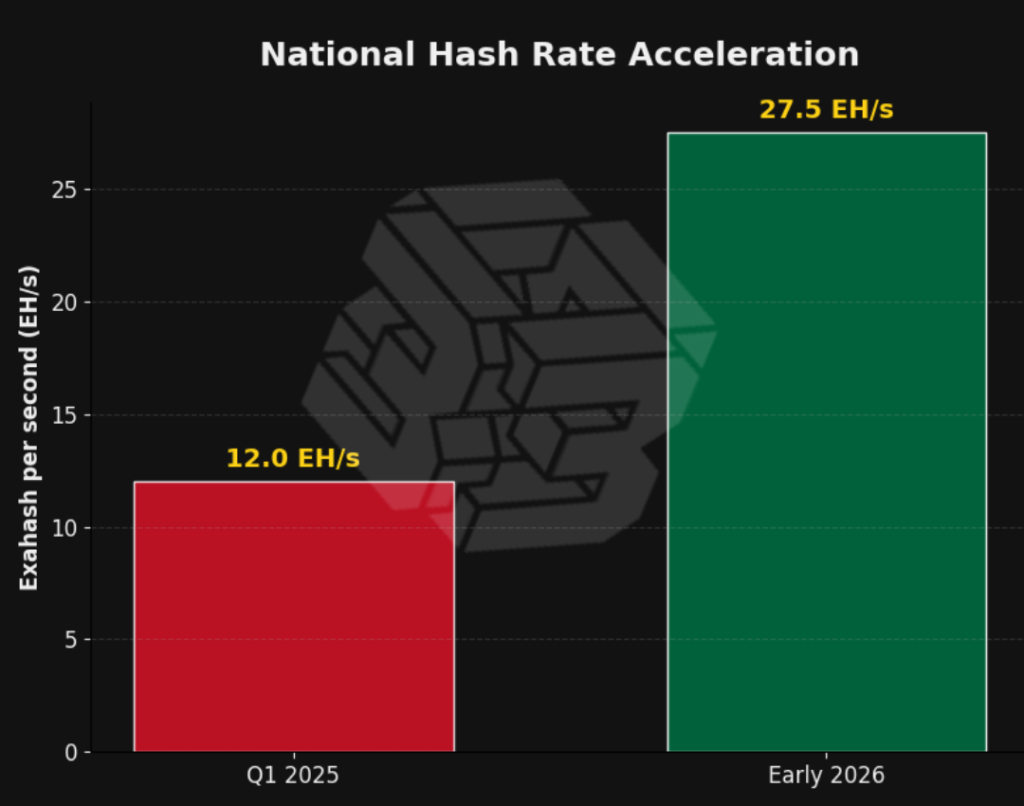
Ethiopia has rapidly ascended to become the eighth-largest Bitcoin mining jurisdiction globally, controlling approximately 2.5%–2.6% of the global network hash rate as of early 2026 (about 27.5 EH/s, up from 12 EH/s in Q1 2025). That rise is attributed largely to hydropower availability anchored by the Grand Ethiopian Renaissance Dam (GERD), plus supportive licensing during the earlier growth phase.
Operationally, the country had roughly 23–25 licensed Bitcoin mining operations in the country, collectively consuming about 600 MW of power. That’s equivalent to roughly one-third of the nation’s usable industrial electricity. That scale helps explain why Ethiopia is now trying to renegotiate how value is captured from mining.
How the state-backed model is expected to work
The proposed EIH-led approach is essentially a “national partner program” for mining infrastructure. While the government hasn’t published a full project prospectus in the provided text, the intended mechanics are implied:
EIH seeks co-investors/operators with hardware procurement capability and facility know-how.
Mining facilities are developed near substations/industrial parks, where power delivery is more controllable and losses are lower. The text notes modular sites can be deployed in ~5,000-square-meter footprints.
The state captures more upside through equity or revenue-sharing—potentially increasing returns versus a simple electricity sales contract.
Skills transfer is treated as an explicit deliverable, not a side effect.
Projects like this typically succeed or fail on two operational realities: (a) how reliably power can be delivered at contracted terms, and (b) whether the partner can keep fleets modern enough to survive network difficulty increases and post-halving margin compression.
Energy anchor: GERD surplus and the “virtual export” argument
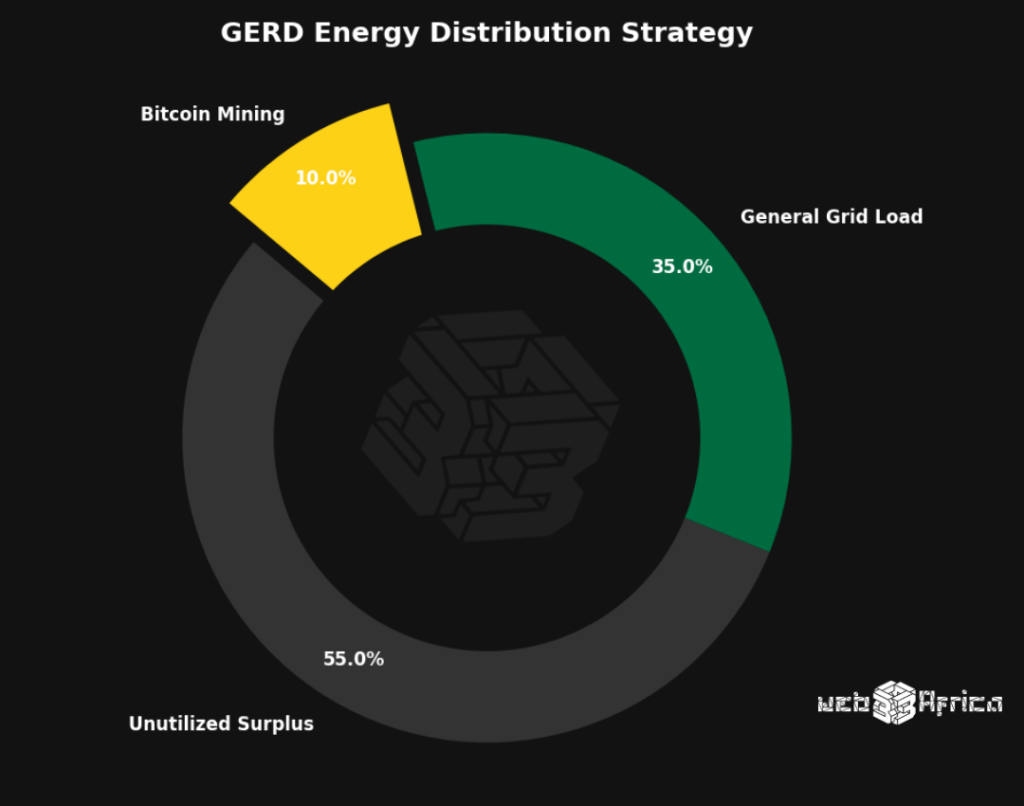
The hydro-powered bitcoin mining push is closely tied to GERD’s generation potential (>6,000 MW ultimate target) and the stated challenge that <50% of capacity is currently utilized because the national grid and cross-border transmission cannot absorb all output.
This “stranded” energy, or power that cannot be efficiently transmitted to end-users or exported across borders due to infrastructure constraints, provides the economic rationale for the state’s mining push. Bitcoin mining acts as a “virtual export,” converting surplus electricity into U.S. dollar revenue without requiring thousands of kilometers of new transmission lines.
According to Ethiopian Electric Power (EEP), the utility earned $55 million from Bitcoin mining contracts in the 2024 fiscal year (a 10-month period) and projects mining revenue will reach $312.5 million by June 2026. For context, EEP’s total power export revenue in 2024 was $338 million, underscoring the mining sector’s significance as a foreign exchange earner.
GERD energy tariffs for licensed Bitcoin miners
A major change affecting partner economics is the tariff overhaul that took effect December 1, 2025. EEP moved away from a flat-rate system (previous baseline cited as $0.032/kWh) to Time-of-Use (TOU) and an Availability-Based Tariff (ABT) designed to better match pricing with grid conditions.
For data miners, the published multi-year trajectory in the provided text is
Phase 1 (2025/26): Base daily average of $0.040/kWh, with peak-hour rates at $0.060/kWh and off-peak at $0.035/kWh.
Phase 2 (2026/27): base $0.050, peak $0.063, off-peak $0.0465
Phase 3 (2027/28): base $0.065, peak $0.072, off-peak $0.0635
The ABT feature matters because it partially shares reliability risk. When daily grid availability falls below 80%, rates are dynamically adjusted downward. For example, if availability drops to 50%–59%, Phase 1 miners pay only $0.0318/kWh.
Eskom’s Debt Crisis Sparks Bitcoin Mining and AI Data Centre Exploration
For a partner evaluating returns, this tariff design is as important as the headline “cheap power.” Deploying latest-generation hardware with efficiencies of 15–18 J/TH, the Phase 1 off-peak rate of $0.035/kWh remains profitable, with break-even electricity costs for such units typically around $0.08–$0.09/kWh.
However, older hardware (such as the Antminer S19 series) now operates near the margin during peak-hour windows, accelerating the need for hardware upgrades.
Regulatory Reality and Contrast Between Ethiopian Crypto Laws and Digital Strategy
Ethiopia’s framework is described as a “paradox.” Industrial mining is licensed and encouraged, while domestic crypto payments remain illegal.
The National Bank of Ethiopia stated in 2022 that digital currencies cannot be used for domestic transactions, reaffirmed under Proclamation No. 1359/2025.
Mining/data-center operations fall under INSA oversight (registration and technical clearance for “cryptographic products”).
Compliance expectations include AML/KYC controls and rapid Suspicious Transaction Reporting.
Despite its regulatory conundrum, the hydro-powered Bitcoin mining project does fall in line with the Digital Ethiopia 2030 strategy. The comprehensive framework positions blockchain alongside artificial intelligence, machine learning, and high-performance computing as essential Industry 5.0 tools.
The strategy outlines four pillars, with the mining initiative directly supporting two:
Accelerating inclusive economic growth: Using mining revenue to scale digital infrastructure and finance grid expansion.
Positioning Ethiopia as a global digital investment destination: Attracting digital foreign direct investment through state-backed partnerships and competitive renewable energy services.
By 2030, the government envisions hosting the “Cloud of Africa,” providing data center and compute services to neighboring states. Hydro-powered Bitcoin mining serves as both the initial capital source and the operational proof-of-concept for these larger ambitions.
The strategy explicitly aims to increase national electricity capacity to approximately 20 GW and achieve 96% grid coverage by the decade’s end, with mining revenue helping to finance transmission upgrades that currently limit GERD utilization.
Existing precedent: Phoenix Group and operational modernization
The state-led pitch is not happening in a vacuum. UAE-based Phoenix Group’s involvement, including an 80 MW PPA (January 2025) and a 30 MW facility energized at Bole Lemi Industrial Park in November 2025, using hydro-cooling technology for newer-generation fleets.
RELATED: Harnessing Hydropower: Ethiopia’s Blueprint for Dominating Global Bitcoin Mining
From an engineering standpoint, the move toward liquid/hydro-cooling is a sign Ethiopia is targeting modern, high-density facilities, which is important if EIH wants partners who can run efficient fleets under TOU pricing and rising network difficulty.
Trade-offs and open questions Ethiopia will need to answer
The allocation of 600 MW to licensed Bitcoin miners in Ethiopia, in a country where approximately 57 million people still lack reliable electricity access, remains contentious. Critics argue that power should be prioritized for manufacturing and social infrastructure that create more local employment than the capital-intensive, low-labor mining sector.
Additionally, the success of the partnership model depends on EIH’s ability to attract world-class operators and successfully manage the inherent volatility of Bitcoin markets. Projections of $312.5 million in annual revenue assume stable or rising Bitcoin prices and network conditions, variables beyond the government’s control.
A High-Stakes Bet on Digital Sovereignty
The initiative serves various purposes, such as aligning with the Digital Ethiopia 2030 strategy, channeling partnerships through EIH, and converting renewable energy surplus into long-term digital infrastructure and technical capacity.
The opportunity is real and doable, with Ethiopia already having the capacity to back its claims. Whether this model successfully balances foreign exchange generation, energy equity, and technology transfer will depend on the transparency of partnerships, the reliability of the GERD energy tariffs for licensed Bitcoin miners, and the government’s ability to deliver on broader electrification commitments.
Discover more from Web3Africa
Subscribe to get the latest posts sent to your email.
You must be logged in to post a comment.