










In brief
- Quidax P2P shutdown took effect January 23, 2026, ending Nigeria’s largest homegrown exchange’s peer-to-peer marketplace just four months after launch
- Nigeria’s Investment and Securities Act 2025 (signed March 2025) now classifies all digital assets as securities under SEC jurisdiction by default
- SEC Circular No. 26-1 imposes ₦2 billion minimum capital requirements for digital asset exchanges, due June 30, 2027
- P2P trading created “opaque transaction flows” and parallel exchange rates that regulators viewed as threats to Naira stability
Quidax, one of Nigeria’s best-known homegrown crypto exchanges, ended its peer-to-peer marketplace in a move that captures the practical impact of tightening SEC Nigeria crypto regulations. The Quidax P2P shutdown took effect on January 23, 2026, roughly four months after the feature launched on September 21, 2025.
It’s an aggressive regulatory recalibration forcing even provisionally licensed platforms to abandon decentralized trading models in favor of state-sanctioned, institution-grade operations.
What Quidax actually shut down (and what stayed live)
Quidax officially launched its peer-to-peer trading feature on September 21, 2025, with mobile app releases appearing by September 16.
The platform marketed the service as a “safe and moderated” environment where Nigerian users could trade directly with one another using escrow services, merchant advertisements, and integrated chat tools to coordinate transactions.
Initially, the feature only supported USDT (Tether), and it restricted merchant status to users who completed Level-3 KYC verification and met strict participation requirements.
However, on January 9, 2026, Quidax posted a Help Center article announcing the discontinuation. By early February, customers received an emailed notice titled “Notice regarding your account,” stating that the company was “retiring” the P2P marketplace to focus on “higher-demand features” like instant swaps and order-book trading.
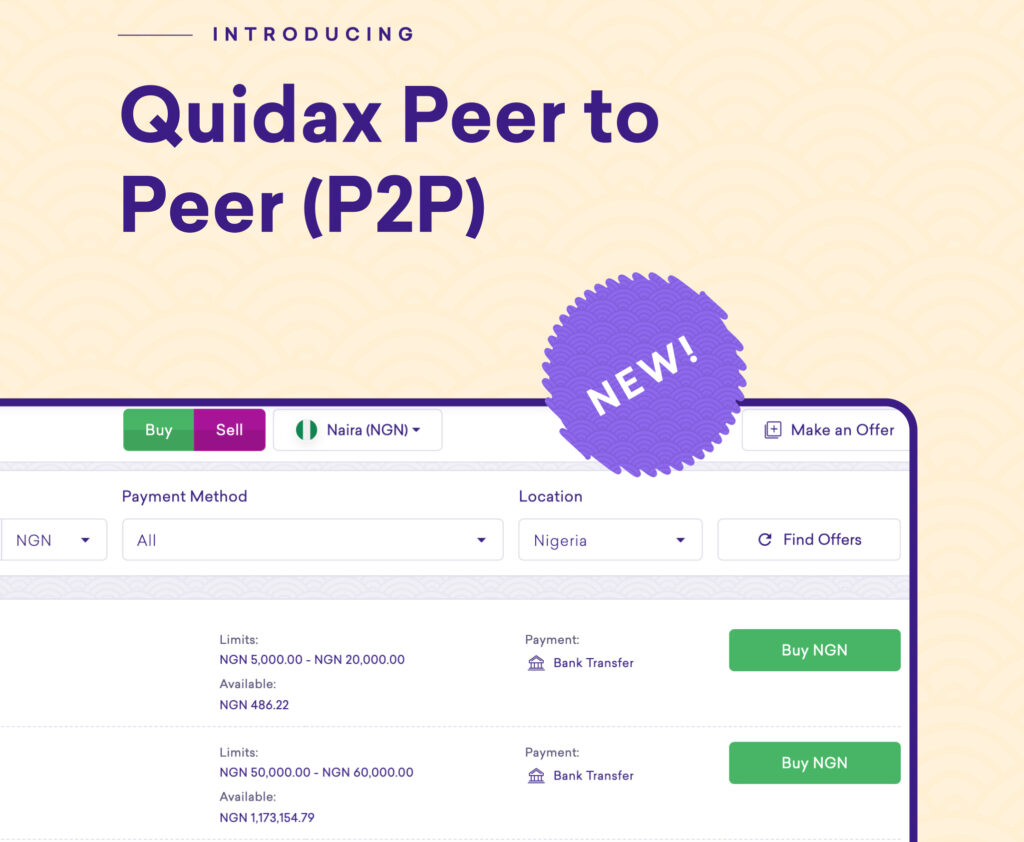
The platform began automatically closing all remaining merchant ads by January 14, 2026.
The shutdown was comprehensive:
Merchant Advertisements: Users could no longer post buy or sell orders.
Escrow Services: Automated fund-locking until payment confirmation was disabled.
In-Platform Communication: Chat features between buyers and sellers were removed.
Fortunately, Quidax clarified that core services, such as NGN deposits, withdrawals, and spot trading via its central order book, would remain operational.
Basically it’s a shift from a decentralized “marketplace” model (similar to Binance or Paxful) to a traditional, centralized exchange model where an automated engine matches all trades.
Pulse of Progress: Navigate Nigeria’s Crypto Dawn with Tactile Clarity and Bold Vision
What Really Drove This Change: The ISA 2025 and SEC Enforcement
The Quidax P2P shutdown directly prompted Nigeria’s sweeping legislative overhaul.
In late March 2025, President Bola Ahmed Tinubu signed the Investment and Securities Act 2025 into law, repealing the eighteen-year-old Investment and Securities Act 2007. The legislation was officially gazetted on May 2, 2025, as Federal Republic of Nigeria Official Gazette No. 19, Volume 112, Act No. 2.
RELATED: Quidax and IFS Data Shows Most Users Earn Under ₦250k, Stablecoins Lead, and CEX Is Preferred
Section 357: Digital Assets as Securities
Section 357 of the ISA 2025 is the legal cornerstone, expressly expanding the definition of “securities” to include virtual and digital assets (cryptocurrencies, tokens, and blockchain-based instruments). This classification grants the SEC Nigeria complete jurisdiction over the following entities:
Virtual Asset Service Providers (VASPs): Any entity facilitating crypto purchase, sale, or exchange.
Digital Asset Platform Operators (DAPOs): Marketplaces providing trading infrastructure.
Digital Asset Intermediaries (DAIs): Brokers or agents acting as middlemen.
Under the new framework, any digital asset investment is treated as a security by default unless the issuer can prove otherwise to the SEC’s satisfaction. The penalties for non-compliance are severe: operating an unregistered VASP carries a ₦20,000,000 minimum fine, with daily default penalties of ₦200,000.
Circular No. 26-1: The Capital Shock of 2026
On January 16, 2026, the SEC issued Circular No. 26-1, announcing revised minimum capital requirements for all capital market operators, including digital asset exchanges. The circular set a compliance deadline of June 30, 2027, and introduced thresholds that represent a massive barrier to entry:
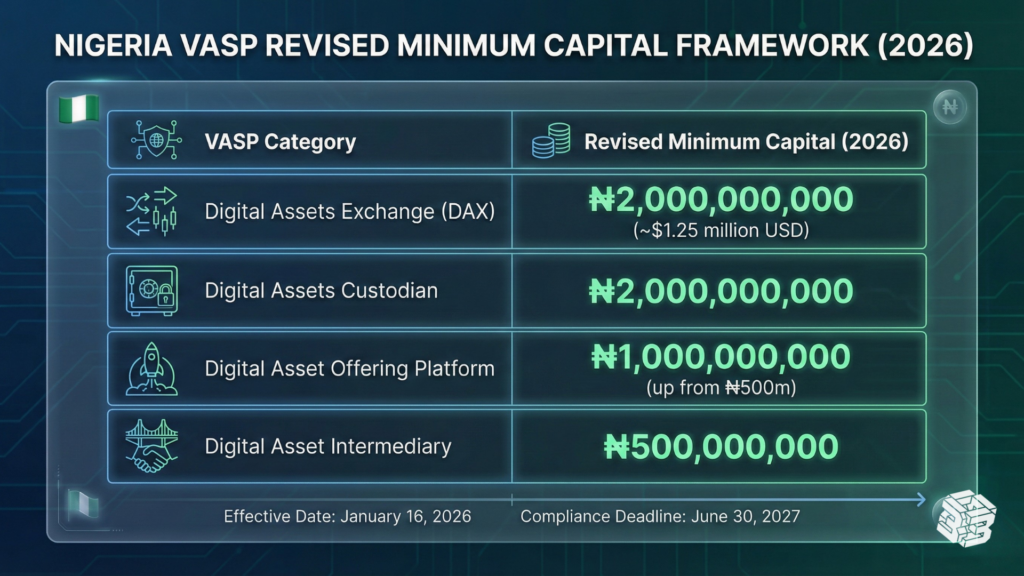
Keep in mind, the ₦2 billion requirement for exchanges like Quidax and Busha is roughly 1,000 times the original ₦2,000,000 non-refundable processing fee required to enter the Accelerated Regulatory Incubation Program (ARIP) sandbox in 2024.
The ARIP Sandbox and the Licensing Freeze
Quidax and rival exchange Busha were granted “Approval-in-Principle” (AIP) status under the Accelerated Regulatory Incubation framework in August 2024, making them the first legally recognized digital asset exchanges in Nigeria. The ARIP was designed as a temporary sandbox to allow the SEC to monitor firms while finalizing long-term rules.
RELATED: Nigeria’s SEC and Quidax Host Powerful Blockchain Training Series
Industry observers initially expected participants to transition to full licenses by August 2025, but that timeline stalled. SEC Director General Emomotimi Agama noted that the Commission postponed issuing new licenses to conduct “additional layers of due diligence.”
The “licensing freeze” was frustrating operators, with little visible progress since September 2024.
This regulatory limbo, combined with the looming capital requirements, created an environment where even compliant firms like Quidax had to reconsider product offerings that might complicate their path to full licensure.
Why P2P Became Untenable: The SEC’s Naira-Stability Agenda
SEC Nigeria crypto regulations have long raised concerns about P2P trading, citing opaque transaction flows that complicate oversight and increase investor risks. In May 2024, the SEC explicitly met with industry leaders to demand that exchanges “delist the Naira” from their P2P trading pairs.
This was a directive aimed at stabilizing the local currency by removing the most visible source of parallel market rate discovery.
Regulators alleged that P2P marketplaces allowed users to set exchange rates that deviated from official conditions, contributing to Naira devaluation. Federal High Court testimony quoted an SEC director stating that platforms like Binance’s “Naira P2P” adversely affected the official exchange rate and became a reference point for informal markets.
The Quidax P2P shutdown is the final realization of this policy directive. It forced all Naira-crypto activity into a “closed-loop” system of bank-integrated, order-book exchanges, ensuring the SEC regained control over capital flows by eliminating informal price discovery mechanisms.
Token Delisting: Further Compliance Tightening
Concurrent with the P2P exit, Quidax announced the delisting of 35 digital assets, including meme coins, gaming tokens, and higher-risk assets like Worldcoin (WLD) and World Liberty Financial (WLFI). The company stated this was necessary to align with “regulatory expectations” and ensure “safer trading,” reducing exposure to hard-to-supervise assets.
This winnowing of available tokens illustrates a secondary enforcement layer. Now, only assets that can be clearly classified and monitored will be permitted on licensed Nigerian exchanges.
What This Means for Nigerian Crypto Users
The Quidax P2P shutdown introduces friction for traders who valued P2P for its speed and the absence of delays caused by banks. Users must now:
Rely on centralized order books where the exchange matches trades automatically.
Accept bank integration for all Naira on- and off-ramps, reintroducing the delays crypto was designed to bypass.
Migrate to state-sanctioned stablecoins like cNGN, a Naira-pegged token issued by the African Stablecoin Consortium and currently in the SEC’s Regulatory Incubation program.
Is P2P crypto trading illegal in Nigeria under ISA 2025?
P2P trading is not explicitly prohibited, but operating a P2P platform without SEC registration, meeting capital thresholds, and adhering to strict KYC/AML rules is effectively illegal and carries severe penalties. In practice, this makes compliant P2P offerings economically unviable for most platforms.
The Quidax P2P shutdown is a signal of the market structure regulators want.
The Quidax P2P shutdown is a symptom of Nigeria’s forced market maturation. By the June 30, 2027, compliance deadline, the Nigerian digital asset landscape will likely be dominated by a small group of highly capitalized, institutional-grade exchanges operating as extensions of the formal financial system.
There will be fewer informal marketplaces and an increase in centralized, reportable exchange activity due to SEC Nigeria crypto regulations, which are supported by the statutory authority of the Nigeria Investment and Securities Act 2025.
For Quidax, it’s a pragmatic bet; by sacrificing short-term flexibility, they intend to secure long-term legitimacy in a market where only the most resilient will survive.
FAQ
Q: Is P2P trading now illegal in Nigeria under the ISA 2025?
A: P2P trading is not explicitly banned, but operating a P2P platform without SEC registration and meeting the ₦2 billion capital requirement is effectively prohibited.
Q: Why did Quidax shut down its P2P marketplace in 2026?
A: Quidax retired P2P to align with SEC Nigeria’s preference for transparent, bank-integrated order-book trading and to comply with the new ISA 2025 regulatory framework.
Q: What is the deadline for Nigerian crypto exchanges to meet the new capital requirements?
A: Under SEC Circular No. 26-1, all digital asset exchanges (DAX) must meet a minimum capital requirement of ₦2,000,000,000 by June 30, 2027.
Discover more from Web3Africa
Subscribe to get the latest posts sent to your email.
You must be logged in to post a comment.