











In Brief
Blockchain privacy is the critical missing component that prevents mainstream cryptocurrency adoption for corporate payrolls and government infrastructure.
The radical transparency of public ledgers exposes enterprises to severe risks including competitive sabotage, internal morale collapse, and the mapping of sensitive treasury reserves by market rivals.
Beyond corporate espionage, a lack of shielded transactions actively endangers users, evidenced by a 75 percent increase in physical wrench attacks resulting in over 40 million dollars in stolen assets.
African governments and financial institutions are pioneering programmable privacy solutions like zero-knowledge proofs and selective disclosure to balance public auditability with vital operational confidentiality.
Blockchain privacy is the missing component that keeps cryptocurrency from becoming a mainstream payments medium, particularly in enterprise and government contexts. Changpeng “CZ” Zhao, co-founder of Binance, has pinpointed the transparency of public ledgers as the primary structural barrier to corporate crypto adoption.
In a recent statement, CZ framed the problem bluntly:
“Imagine, a company pays employees in crypto on-chain… you can pretty much see how much everyone… is paid (by clicking the from address).”
While this radical openness was once hailed as a tool for accountability, it now exposes enterprises and African governments experimenting with blockchain for public payments to competitive sabotage, compliance breaches, and violent physical attacks.
Why Blockchain Privacy Is Critical for Business Crypto Payments
CZ’s argument centers on a simple but devastating reality. Privacy risks on the blockchain make every transaction public. When a company pays employees or contractors on a transparent ledger, any observer with a block explorer can map the entire compensation structure by tracing the “from” address. Rivals can analyze procurement patterns, infer trade negotiations, monitor inventory cycles, and profile treasury reserves in real time.
As CZ stated,
“I think privacy plays a very fundamental role in our society… But right now… Bitcoin and most cryptocurrencies do not have enough privacy features.”
He noted that Bitcoin’s original pseudonymity has eroded:
“Every transaction on the blockchain can be traced, especially now… exchange with KYC.”
For enterprises, this leakage is operationally catastrophic. Payroll visibility leads to internal morale collapse and talent poaching. Procurement exposure strips away negotiating leverage. Treasury profiling makes companies vulnerable to front-running and predatory market positioning.
As Deloitte’s tokenization brief warned, distributed ledgers present a “special conundrum, a conflict between transparency and privacy,” anticipating the need for selective visibility where counterparties and regulators can see identities, but competitors cannot.
Quantifying the Wrench Attack Surge
CZ also highlighted a visceral consequence of transparent ledgers: physical coercion. He argued that if third parties know a merchant’s blockchain receiving address, “they will know that you will be in that hotel.”
The CertiK Skynet Wrench Attacks Report for 2025 documented 72 verified wrench attacks worldwide, incidents where crypto holders were physically forced to surrender keys or transfer assets. This represents a 75% increase versus 2024, with confirmed financial losses exceeding $40.9 million.
The attacks are no longer isolated; they reflect a professionalization of criminal targeting, often beginning with OSINT reconnaissance and address clustering to link pseudonymous wallets to real-world identities.
In Africa’s mobile-first, high-adoption markets, this physical security gap is acute.
As Nolwazi Hlophe, Senior Fintech Specialist at South Africa’s Financial Sector Conduct Authority (FSCA), noted in 2025:
“Blockchain’s inherent transparency means that all transactions are publicly recorded and accessible, ensuring accountability but also posing risks to user privacy. Individuals can trace back sensitive financial data.
Why This Matters Even More for African Governments
Private companies are not the only ones using CZ’s payroll example. African governments are actively piloting blockchain for public-sector wage bills, procurement, and social transfers, precisely the use cases where transparency can backfire.
Guinea-Bissau launched a blockchain platform in May 2024 for managing public sector wage bills, covering eligibility, budgeting, approvals, and disbursements, according to the IMF. If implemented on a fully public ledger, this system could expose politically sensitive salary disparities, map patronage networks, and make civil servants targets for extortion or fraud.
RELATED: A False Sense of Security as Africa’s Prominent Distributor Challenges Bitcoin ETF Narrative
Nigeria’s eNaira CBDC, launched in October 2021 on Hyperledger Fabric (a permissioned chain), illustrates the opposite risk. The Central Bank had absolute visibility on a closed ledger, while the public had no access to it. This lack of reciprocal transparency fueled mistrust, and adoption remained below 0.5% a year after launch. Citizens preferred the pseudonymity of public cryptocurrencies despite regulatory hurdles.
The South African Reserve Bank’s Project Khokha offers a middle path. Using zero knowledge proof techniques (Pedersen commitments and range proofs within a quorum-based network), Khokha proved that wholesale interbank settlement could maintain full transaction confidentiality for participating banks while preserving the central bank’s oversight capability—a model of “accountable confidentiality.”
African states also face risks in:
Public procurement and supplier payments: Transparent ledgers could show bid strategies, vendor IDs, and negotiated unit prices, which would make it harder to investigate corruption or map patronage.
Cross-border trade settlements: Fintechs like MFS Africa, processing millions of accounts, could inadvertently expose trade finance details (counterparties, volumes, timing) to competitors.
Aid/social benefit disbursements: On-chain visibility could expose vulnerable recipients to targeting or exclusion, creating tension with data protection laws like South Africa’s POPIA, which requires explicit consent and the right to delete personal information.
Privacy-Preserving Technologies: From Problem to Deployment
To move from awareness to action, enterprises and governments need practical privacy solutions for enterprise blockchain. The following technologies enable selective disclosure—revealing only what is necessary for a specific interaction:
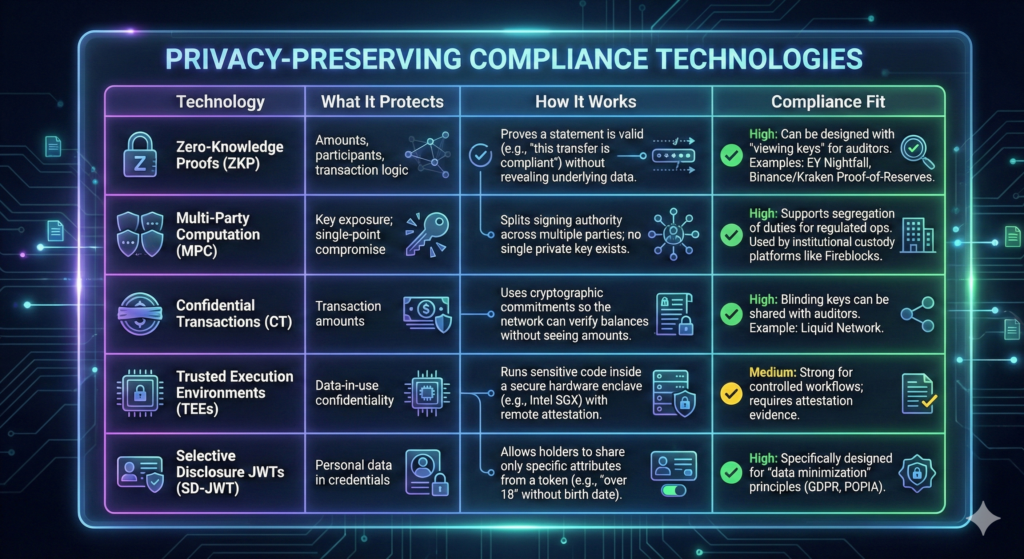
As Joe Mucheru, President of JUMO;
“At JUMO, regulation isn’t something we respond to after building products; it’s integrated into the design process from the start.”
By 2025, 39 of 55 African nations had enacted data protection laws, making privacy by design not just a technical choice but a legal imperative.
Privacy Benefits Beyond Hiding Salaries
Blockchain privacy unlocks value for businesses and governments beyond confidentiality:
Competitive advantage: Enterprises that meet regulatory privacy expectations earn greater customer trust—a competitive differentiator in digital payments.
Fraud reduction: Network tokenization (as deployed in Zambia’s Lupiya system) replaces real credentials with device-bound tokens, reducing fraud while maintaining transaction integrity.
Audit efficiency: ZK-proofs and viewing keys allow real-time compliance verification by authorized auditors without public exposure.
Physical safety: Shielded addresses and confidential transactions reduce the attack surface for wrench attacks and targeted extortion.
Policy flexibility: Governments can maintain public auditability for anti-corruption (via permissioned access) while protecting individual civil servants and beneficiaries from de-anonymization and targeting.
The Core Tradeoff: Transparency Versus Security
Africa’s institutions often pursue blockchain precisely for transparency and anti-corruption benefits. However, if they deploy fully public rails for sensitive payments, payroll, procurement, and social transfers, they risk importing a new class of privacy and physical-security threats. As the IFWG/FSCA warns, traditional financial regulations may not apply in decentralized finance, “potentially leaving users vulnerable to data breaches and misuse.”
The path forward requires a hybrid model of programmable privacy, combining zero-knowledge proof, MPC, and SD-JWTs to deliver “accountable confidentiality.” This allows African governments and enterprises to harness blockchain’s auditability without compromising operational integrity or citizen safety.
RELATED: Stateless Ethereum Node Cuts Storage Needs, Boosts Network Security
Project Khokha and the Africa Bitcoin Corporation (which uses Bitcoin-backed balance sheets to fund African SMEs while protecting treasury strategy) demonstrate that the continent is uniquely positioned to define the global standard for privacy by design.
In 2026, corporate crypto adoption will depend not on abandoning transparency, but on redesigning it, ensuring that visibility serves accountability, not exploitation.
Discover more from Web3Africa
Subscribe to get the latest posts sent to your email.
You must be logged in to post a comment.