








Table of Contents
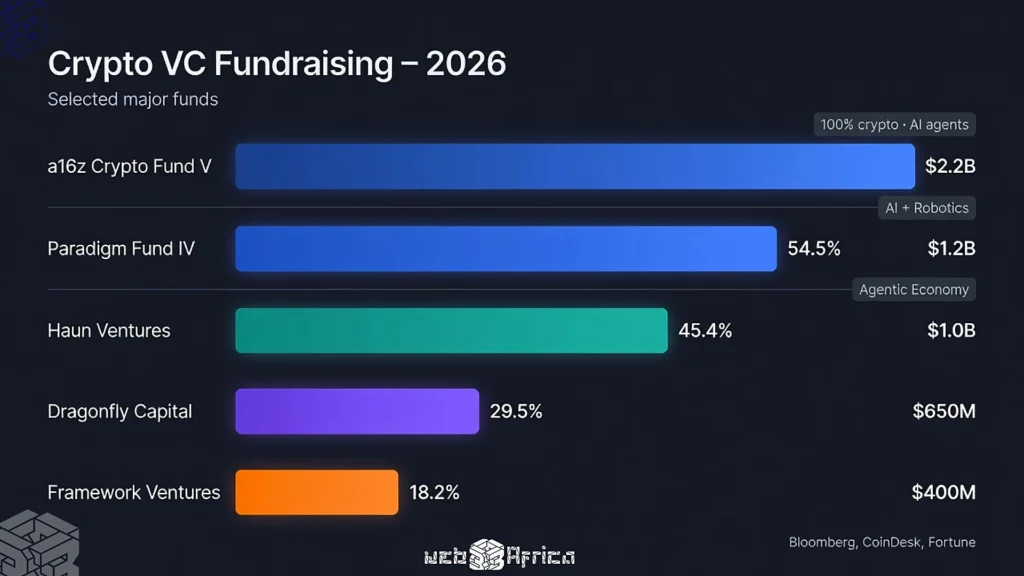
When Paradigm closed a $1.2 billion fourth fund, the announcement carried a detail that represented one of the biggest mergers in tech: AI and blockchain.
One of crypto’s most prominent venture firms now invests “across AI, robotics, and other frontiers” alongside digital assets. The fund’s existing portfolio includes Zipline, the drone-delivery company valued at $7.6 billion, and True Anomaly, a space-defense startup worth $2.2 billion, neither of which touches blockchain.
Paradigm is deeply involved in blockchain infrastructure, from developer tooling like Foundry and Reth to security research conducted jointly with OpenAI.
The capital reallocation is structural, not cyclical.
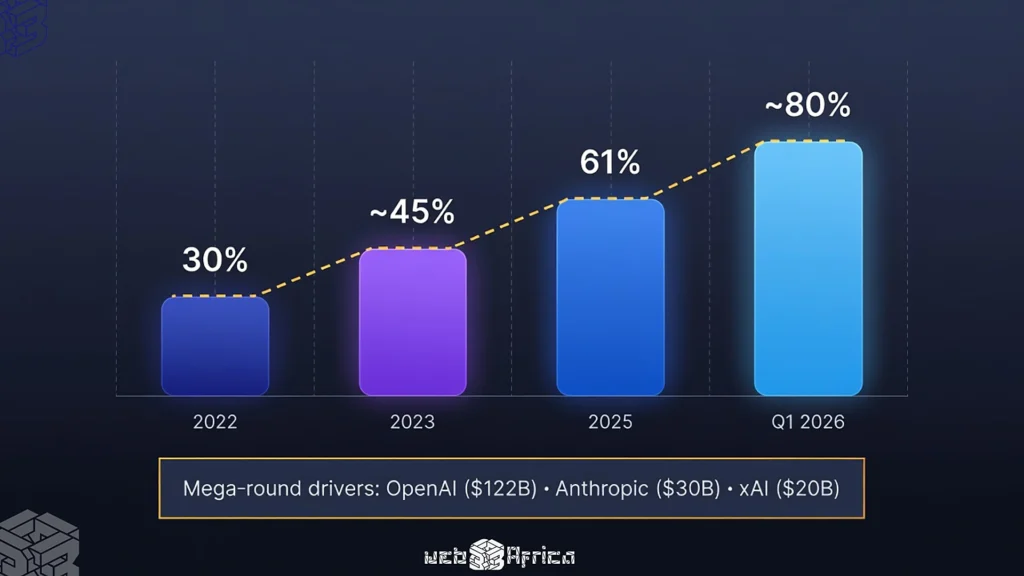
Venture capital has become overwhelmingly AI-focused. According to the OECD, AI firms captured 61% of global venture funding in 2025, approximately $258.7 billion of $427.1 billion deployed. By the first quarter of 2026, AI accounted for roughly 80% of all venture investment, with mega-rounds to OpenAI ($122 billion), Anthropic ($30 billion), and xAI ($20 billion) driving headline totals.
While crypto, or better framed as blockchain startups, had to compress. Galaxy Research tracked roughly $20 billion across 1,660 deals in 2025, with $10.8 billion deployed in the first half of 2026. New fund formation slowed to its lowest level since Q3 2020, with just $1.1 billion raised across eight new funds in Q1 2026.
RELATED: Alliance DAO Data Reveals Africa’s Growing Crypto Startup Influence
Yet several crypto-native general partners responded by widening mandates. Haun Ventures announced $1 billion in new funds in May 2026, framed around the “agentic economy.” Framework Ventures raised $400 million in June for crypto, AI, robotics, and energy. Dragonfly Capital closed $650 million. Even Andreessen Horowitz’s $2.2 billion Fund V, which remains 100% crypto-dedicated, positions AI agents as a blockchain use case.
The narrative clearly highlights the convergence of AI and blockchain, emphasizing their focus on infrastructure and practicality.
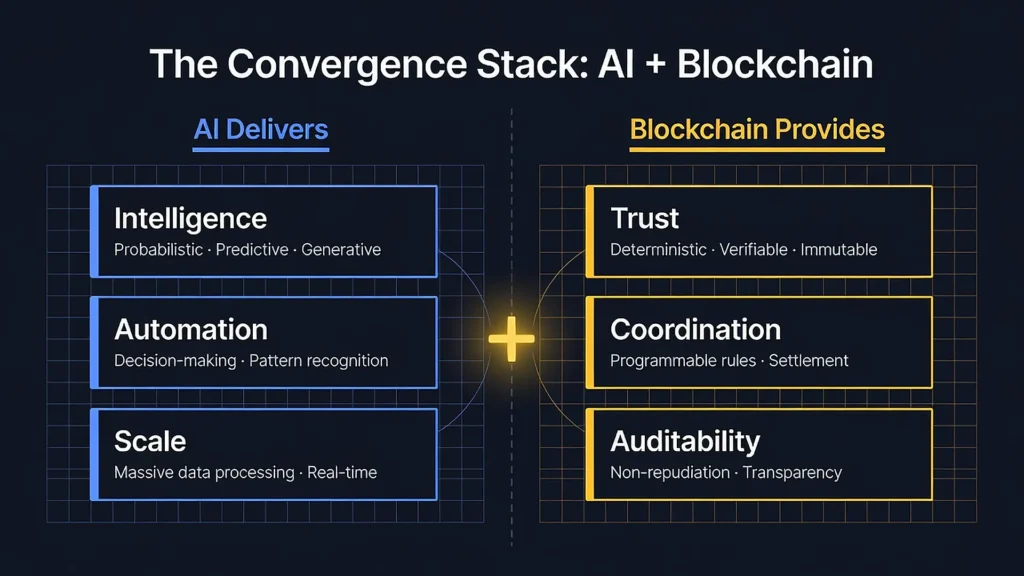
AI Delivers Intelligence; Blockchain Provides Trust and Coordination
AI systems are probabilistic. They generate predictions, automate decisions, and produce outputs but are imperfect. They can hallucinate, act opaquely, and lack native mechanisms for accountability or settlement.
Blockchains and cryptographic systems are deterministic. They provide audit trails, non-repudiation, programmable rules, and verifiable settlement. Together, they enable software agents that can act autonomously while remaining accountable.
The technical intersections are already operational:
Smart-contract security automation.
OpenAI and Paradigm’s EVMbench evaluates AI agents’ ability to detect, patch, and exploit vulnerabilities in Ethereum smart contracts. As AI-generated code proliferates, demand grows for verifiable security in environments where billions of dollars settle programmatically.
Privacy-preserving compliance.
The IMF’s recent Nigeria analysis and Stanford economist Darrell Duffie’s model of zero-knowledge KYC tokens demonstrate how cryptographic primitives enable “compliance-native” payments. This approach proves regulatory adherence without exposing underlying identity data. AI handles policy evaluation and risk classification; zero-knowledge proofs handle verification.
RELATED: Liberland Partners With Dubai AI Innovation Hub To Launch Startup Desk
Agent-driven payments.
Andreessen Horowitz argues that blockchains fill missing infrastructure for autonomous agents, including micropayment protocols that allow software to transact without human intervention. While measurement disputes persist, the firm reports $1.6 million per month in organic agent-driven activity after filtering speculative flows.
The synthesis is not “AI versus blockchain.”
It is AI for intelligence and blockchain for trust, a stack that answers the governance, audit, and settlement needs of systems designed to act without constant human oversight.
African Fintechs Demonstrate the Convergence in Practice
Africa offers live evidence of how AI and blockchain intersect under real-world constraints. Payment fragmentation, foreign-exchange friction, and high informality create immediate returns for stablecoin rails paired with machine-learning risk systems.
Nigeria received approximately $59 billion in crypto-asset inflows between July 2023 and June 2024, ranking second globally on Chainalysis’s adoption index. In an article we showcased how the IMF notes that dollar-pegged stablecoins have become “a meaningful cross-border payments channel,” driven partly by naira volatility and capital controls.
According to the Central Bank of Nigeria’s 2025 Fintech Report, 87.5% of Nigerian fintechs deploy AI primarily for fraud detection.
Yellow Card, a pan-African stablecoin-to-fiat infrastructure provider, uses AI and machine learning for risk scoring and liquidity management. The platform abstracts blockchain complexity while relying on distributed ledgers for settlement finality.
Daya, a Lagos-based cross-border treasury API, raised $2.4 million in June 2026 from Hivemind Capital and others. Businesses collect payments in local currency, convert through stablecoins, and settle internationally via a single integration.
Co-founder Tomiwa Lasebikan reported month-over-month growth exceeding 40% in early 2026. Lattice Fund, an investor, described the alternative:
“Many teams still stitch together local banks, domiciliary accounts, FX desks, OTC relationships, crypto ramps, and manual approval flows.”
Taptap Send applies machine-learning-powered FX routing to optimize remittance corridors. OPay runs AI fraud detection across hundreds of millions of monthly transactions in Nigeria.
Local fintechs are solving structural problems like forex volatility, correspondent banking delays, and fraud. They are providing a narrative where intelligent automation and programmable settlement naturally complement one another.
Why Investors Are Backing Infrastructure Ecosystems, Not Individual Technologies
Now, this is our personal speculation, but insights show that the next decade of software will be built by systems that reason, decide, and transact autonomously.
Intelligence alone is insufficient without mechanisms for authorization, settlement, and auditability. Distributed ledgers alone struggle to compete with centralized databases unless paired with automation that justifies decentralization’s costs.
Nigel Morris of QED Investors described stablecoins as “credible competition to the correspondent banking system, enabling fast settlement and immutable audit trails.” Carey Ransom of BankTech Ventures predicted capital flowing toward “better security and fraud solutions…and payments enablement…as money movement speeds up and finds rails like stablecoins.”
Paradigm’s Matt Huang framed the firm’s expansion as recognition that AI and crypto are “not a zero-sum competition,” expecting “plenty of overlap” between the technologies.
RELATED : Nigeria’s AI Debate Has Moved Into Enforcement
Partner Alana Palmedo added:
“Crypto was the first frontier for us…but there’s so much else happening right now that’s pretty hard to ignore.”
What the Shift Reveals About the Future of Digital Infrastructure
Paradigm’s fund is evidence of a broader recalibration. Leading investors are moving from technology-category bets to infrastructure-stack investing, where intelligence and trust layers reinforce rather than replace one another.
We are already demonstrating the model in production, not because the continent is “leapfrogging” but because structural gaps in legacy infrastructure make the value proposition immediate.
Cross-border treasury, fraud detection, remittance routing, and compliance automation increasingly require both machine learning and programmable settlement to function efficiently.
The venture capital flowing into AI and blockchain together is a thesis that the next generation of software infrastructure will be built by founders who treat intelligent systems and trusted coordination as interdependent layers of the same stack.
FAQ
Why is Africa becoming an important market for AI and blockchain innovation?
Many African fintech companies are using AI and blockchain to solve practical challenges such as cross-border payments, foreign exchange inefficiencies, fraud prevention, and treasury management. These technologies help address infrastructure gaps that make digital financial services more efficient.
What are some real-world AI and blockchain applications?
Current applications include AI-powered smart contract security, privacy-preserving compliance using zero-knowledge proofs, autonomous payment systems, fraud detection, and cross-border payment infrastructure built on stablecoin networks.
How do AI and blockchain work together?
AI generates insights, automates decisions, and powers software agents, while blockchain records transactions, enforces programmable rules, and creates verifiable audit trails. Together, they enable systems that can act autonomously while remaining accountable.
Why are venture capital firms investing in both AI and blockchain?
Investors increasingly see AI and blockchain as complementary technologies rather than competing ones. AI enables intelligent decision-making and automation, while blockchain provides the trust, transparency, and programmable settlement needed for autonomous systems to operate securely.
Discover more from Web3Africa
Subscribe to get the latest posts sent to your email.

You must be logged in to post a comment.