












Table of Contents
By mid-2026, digital assets have shed their volatile, retail-driven identity and emerged as something far less exciting.
To some, the trajectory of foundational macroeconomic infrastructure might be far more consequential. The crypto market trajectory in 2026 is no longer defined by token pumps or meme-driven rallies.
Instead, it is characterized by clinical, institutionally driven integration of blockchain technology into the core operations of commercial banks, corporate treasuries, and sovereign monetary systems.
For local builders, policymakers, and institutional capital allocators, this transformation carries profound implications. Stablecoins and tokenized assets are no longer experimental instruments within the African DeFi ecosystem.
RELATED: Why Crypto Virtual Cards Fail African Freelancers
They are operational rescue mechanisms for economies burdened by severe foreign exchange illiquidity, persistent currency depreciation, and antiquated correspondent banking rails.
This report provides a macroeconomic autopsy of the institutional DeFi trends reshaping global finance and rewiring Africa’s capital trajectory.
How Stablecoins Evolved Into Global Settlement Infrastructure
Stablecoin adoption has reached institutional escape velocity. According to comprehensive analysis from Artemis and Bloomberg, stablecoin transactions soared to $33 trillion in 2025, up 72% year-over-year.
The total stablecoin market capitalization surged to over $305 billion by early 2026, fueled by landmark regulatory clarity and institutional entry. Projections point toward $1 trillion by late 2026.
These numbers extend far beyond the cryptocurrency sector. As the World Economic Forum’s 2026 digital assets outlook notes:
“In 2024, total stablecoin transaction value has grown significantly, but roughly 92% ($24 trillion) was linked to crypto trading and on/off-ramping.”
Zero Hash’s comprehensive 2026 Stablecoin Momentum Report reveals the operational indicators. 146% year-over-year growth in active stablecoin usage, 1.4+ billion stablecoin-ready accounts globally, and a 690% increase in transaction volume.
Visa’s stablecoin settlement hit a $4.5 billion annualized run rate by January 2026. B2B stablecoin payments surged from under $100 million monthly in early 2023 to over $6 billion by mid-2025.
As IMF economists warned in April 2026:
“Moving financial services and payments on-chain is not an incremental digitization but a structural shift in financial architecture.”
How the GENIUS Act and MiCA Shape the New Regulatory Architecture
The crypto market trajectory in 2026 is inseparable from the regulatory scaffolding now solidifying around it. Two frameworks dominate: the U.S. GENIUS Act and Europe’s MiCA regulation.
Inside the United States GENIUS Act Stablecoin Framework
Signed into law by President Trump on July 18, 2025, the Guiding and Establishing National Innovation for US Stablecoins (GENIUS) Act created the first major federal regulatory framework for payment stablecoins.
The Act mandates 1:1 reserves for stablecoins using U.S. dollars or liquid assets. This specifically applies to U.S. coins and currency, demand deposits at insured institutions, Treasury bills with remaining maturity of 93 days or less, and overnight reverse repurchase agreements.
Annual audits are required for stablecoin issuers exceeding $50 billion in market supply. To prevent stablecoins from morphing into investment securities and triggering bank runs, the Act explicitly prohibits issuers from offering yields or interest to holders. The prohibition on issuing payment stablecoins without authorization takes full effect in November 2026.
RELATED: The Stablecoin Stability Myth: Adrian Orr’s Warnings and the Real Risks Behind ‘Stable’ Crypto
As the WEF noted:
“The Genius Act has been a trigger prompting more jurisdictions globally to be accelerating regulation in this space.”
Navigating the Approaching European MiCA Compliance Deadline
July 1, 2026, marks the end of the EU-wide MiCA transitional period. After this point, entities providing crypto-asset services in the EU without required MiCA authorization may no longer rely on transitional arrangements. As of April 2026, there are 199 authorized CASPs across 23 EU countries, with Germany leading at 53 licensed entities.
MiCA’s impact on global stablecoin adoption created a massive regulatory divergence. Circle obtained its electronic money institution authorization via France’s ACPR in July 2024, making USDC and EURC fully MiCA-compliant.
Tether chose not to establish a licensed EU entity, triggering a cascade of delistings across European operations of major exchanges. For African Virtual Asset Service Providers facilitating trade with Europe, MiCA is inescapable.
African payment orchestrators routing transactions through EU corridors must utilize compliant tokens like USDC to ensure strict Travel Rule and AML adherence.
TradFi and DeFi Converge as JPMorgan and Citi Build on Blockchain
The most visceral evidence of institutional DeFi trends reshaping global finance is happening inside the world’s largest banks.
J.P. Morgan’s Tokenized Deposit Infrastructure
J.P. Morgan’s blockchain business unit, Kinexys, formally announced in early 2026 the native issuance of its USD-denominated deposit token (JPMD) on the Canton Network, a privacy-enabled public blockchain purpose-built for institutional finance.
“JPM Coin delivers the security of bank-issued deposits and settlement combined with the speed and innovation of 24/7, near real-time blockchain transactions. In bringing JPM Coin on to Canton, we can further increase efficiency and unlock liquidity,” said Naveen Mallela, Global Co-Head, Kinexys by J.P. Morgan.
This enables corporate treasurers to bypass sequential batch processing, enabling 24/7/365 programmable money movements backed by the balance sheet certainty of commercial bank money.
Citi’s 24/7 USD Clearing Architecture
Citigroup integrated Citi Token Services with 24/7 USD Clearing for real-time cross-border payments and liquidity management.
A consortium including JPMorgan Chase, Citigroup, Bank of America, and Wells Fargo, operating through The Clearing House, announced plans to launch a shared tokenized deposit network in early 2027.
RELATED: Wall Street Meets Crypto Street: Citi-Coinbase Deal Signals $4 Trillion Stablecoin Future
The design allows tokenized deposits to move instantly between major banks, revolutionizing around-the-clock liquidity management.
Yuval Rooz, Co-Founder and CEO of Digital Asset, articulated the macro shift:
“This collaboration brings to life the vision of regulated digital cash that can move at the speed of markets… bridging traditional finance and digital infrastructure in a way that preserves privacy, compliance, and trust.”
B2B Stablecoin Explosion
Digital Dollarization Drives Nigeria to Dominate African Stablecoin Markets
The operational reality of this convergence is most visceral across the African continent. According to the International Monetary Fund’s June 2026 report, Nigeria accounts for roughly 60% of stablecoin inflows in Sub-Saharan Africa since 2019.
The Scale and Structure of Nigeria’s Stablecoin Market
According to the IMF’s June 2026 report, Stablecoins in Nigeria, the structural shift is undeniable:
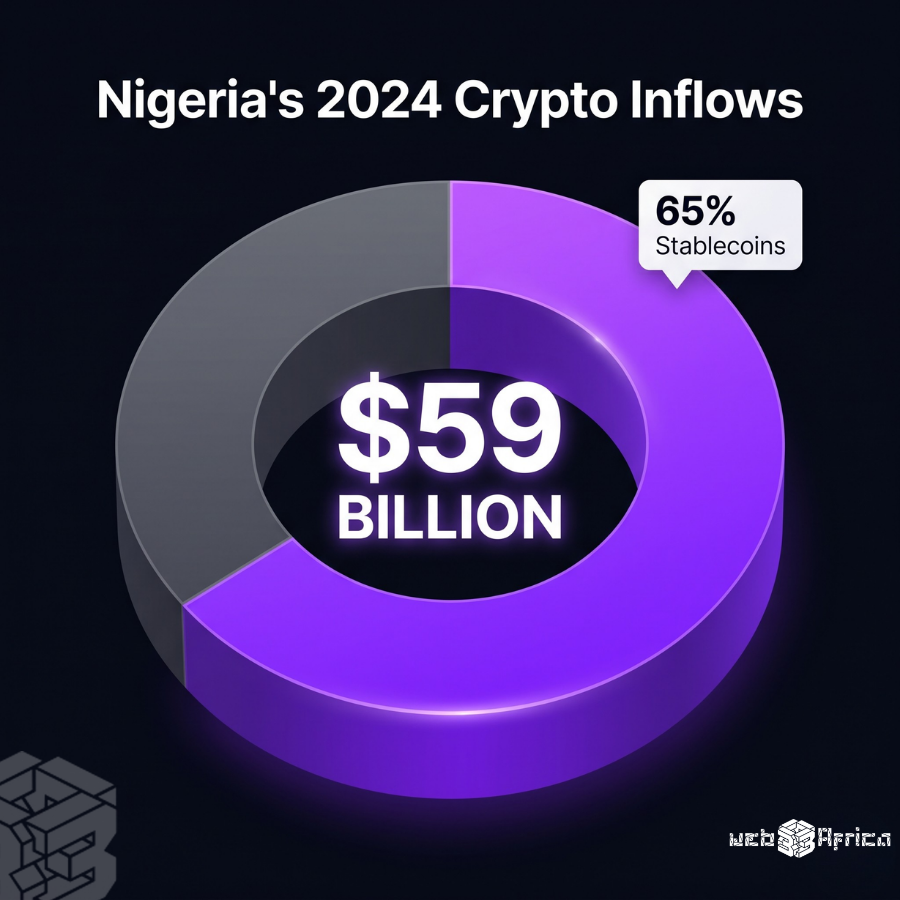
- $59 Billion: Total crypto-asset inflows into Nigeria between July 2023 and June 2024.
- 65% Dominance: The percentage of those inflows denominated strictly in stablecoins (primarily USDT and USDC).
- $22 Billion: The total value of stablecoin transactions in Nigeria within that same 12-month window.
- 60% Regional Share: Nigeria’s total share of all stablecoin inflows into Sub-Saharan Africa since 2019.
As the IMF report notes:
“The rise in stablecoins’ attractiveness can be traced to elevated inflation and naira volatility between 2023 and 2024.”
Citing World Bank data, the IMF noted that sending $200 to Sub-Saharan Africa still costs nearly 9% on average through conventional remittance channels. Remittances amount to about $21 billion annually in Nigeria.
“Stablecoins allow users with a smartphone and internet access to receive remittances or make cross-border payments in minutes, often at lower cost than traditional channels… [but] widespread use can resemble a digital form of dollarization,” warned Axel Schimmelpfennig, IMF Mission Chief for Nigeria, and Bo Zhao, IMF Economist.
How African Corporates Bypass FX Illiquidity Using Stablecoins
For local importers, stablecoins have evolved from speculative assets into operational lifelines. Consider a traditional $50,000 B2B payment from Nigeria to China:
The Traditional SWIFT Wire:
- Time: 3 to 5 business days
- Cost: $540 to $2,080 (1.1% to 4.2%)
- Friction: Intermediary bank deductions and opaque FX markups
The Stablecoin B2B Route:
- Time: Settles in minutes
- Cost: $50 to $250 (0.1% to 0.5%)
- Advantage: Immediate margin recovery for SMEs battling inflation
Surveys indicate that 41% of corporates utilizing stablecoins report cost savings of at least 10% on cross-border transactions. Think of it as a margin recovery that represents survival for African SMEs battling severe domestic inflation.
RELATED: Why Payment Velocity is the Real Driver of GDP Growth
The Central Bank of Nigeria Pivots Toward Regulated Stablecoin Integration
Five years after telling banks to stay away from crypto, the Central Bank of Nigeria has reached a different conclusion. In October 2025, CBN Governor Olayemi Cardoso announced the creation of a working group to explore how Nigeria could integrate stablecoins into its financial system during the annual IMF and World Bank meetings in Washington, D.C.
The CBN’s Payments System Vision 2028 (PSV 2028), released in June 2026, aims to deploy stablecoins, eNaira corridors, and PAPSS to bring remittance costs down to ≤5%.
Regulators in Abuja recently initiated the Virtual Asset Service Providers Regulation Bill, 2026, including compliance with the FATF Travel Rule, requiring the collection of data on senders and recipients in crypto transactions.
The IMF’s recommendation is not for a ban but for stricter rules: “bring stablecoin and other crypto-asset activities within the regulatory perimeter” through tougher licensing, reporting, and market surveillance.
RELATED: The New Battle for Control Over Stablecoin Reserves
The Death of Yield Farming and the Rise of Real-World Asset (RWA) Tokenization
The speculative DeFi of 2021, characterized by artificially inflated governance tokens subsidizing liquidity, has collapsed. In its place, Real-World Asset (RWA) tokenization has emerged as the institutional cornerstone of on-chain finance.
By mid-2026, the total value locked in tokenized real-world assets surpassed $22 billion (excluding stablecoins). BlackRock’s USD Institutional Digital Liquidity Fund (BUIDL) reached over $2.5 billion in total asset value, distributing institutional dividends natively across Ethereum, Solana, and Avalanche.
Franklin Templeton’s OnChain U.S. Government Money Fund (FOBXX) similarly managed $2.47 billion, utilizing public blockchains as the official system of record.
“A leading trend entering 2026 is the growth of tokenization… There is increased momentum in this area, especially from traditional financial institutions,” the World Economic Forum’s 2026 outlook noted.
Larry Fink and Rob Goldstein of BlackRock also shared this view:
“Tokenization can greatly expand the world of investable assets beyond the listed stocks and bonds that dominate markets today.”
African Institutional Access to Tokenized Treasuries and Private Credit
Mechanically, an African SME or corporate treasury can now utilize Real-World Asset (RWA) tokenization to:
- Convert local fiat currency into USD-pegged stablecoins.
- Allocate excess liquidity into tokenized, short-duration U.S. Treasury funds.
- Earn dollar-denominated yields (4–5% range) without exposure to algorithmic crypto volatility.
- Leverage those tokenized assets as on-chain collateral for instant working capital.
South Africa successfully recorded the continent’s first tokenized corporate bond. Private-school network Die MOS Inisiatief raised R100 million through a 10-year floating-rate bond issued on the Mesh.trade blockchain platform.
Globally, platforms like Defactor Labs tokenized $100 million in “Alpha Bonds” using the compliance-embedded ERC-3643 token standard on Polygon, allowing global investors to compliantly lend capital to emerging market SMEs.
In Nigeria, the Lagos State government initiated property-tokenization frameworks to fractionalize its highly valued residential sector (estimated at ₦173 trillion). This will allow retail investors and SMEs to gain fractional exposure to hard assets for mere hundreds of dollars.
African VASPs: Building the Compliance-First B2B Infrastructure Layer
The African DeFi ecosystem is no longer defined by grey-market P2P traders. It is being built by regulated, compliance-first virtual asset service providers constructing institutional-grade cross-border B2B rails.
Flutterwave, Africa’s most valuable fintech, achieved a $3.25 billion valuation following a Series E investment from Ripple. The company has aggressively integrated multi-chain stablecoin infrastructure.
They are now stacking Polygon, Circle, Turnkey, Tempo, and Ripple’s RLUSD into its Flutterwave for Business (F4B) platform, providing enterprise clients with predictable 24/7 USD-denominated settlement.
RELATED: Ripple and Flutterwave Just Replaced Traditional Correspondent Banking for African Trade
Ethiopia, and Esca Finance, founded by Shalom Osiadi, processes up to $120 million monthly by providing autonomous currency hedging for businesses in highly volatile corridors (Nigeria, Ethiopia, Angola).
African exporters deposit local fiat, and Esca utilizes stablecoin backend routing to sweep funds into hard currencies or hedge via forwards. This is done without the corporate client ever managing cryptographic keys.
Yellow Card raised $33 million, led by Blockchain Capital, to aggressively scale its B2B API products. By securing operational licenses across dozens of African nations, Yellow Card leverages regulatory compliance as a competitive moat. This enables international merchants to seamlessly on-ramp and off-ramp fiat to stablecoins across fragmented African jurisdictions.
The Virtual Asset Service Providers Association of Nigeria (VASPA) launched “Project Green-White-Green,” a collaborative initiative ensuring strict AML/CFT compliance and fiscal integration with the national economy.
Strategic Takeaways for African Web3 Builders and Founders
“Web3 will profoundly alter Africa’s economic, social, and political landscape, probably even more than in the West and parts of Asia,” according to Future Africa’s analysis of the continent’s Web3 trajectory.
The trajectory of the crypto market in 2026 delivers an unambiguous message to African founders. If you do not build for cross-border B2B payments, RWA integration, or deep AML/KYC compliance, you will starve yourself of institutional funding.
The capital flowing into the African DeFi ecosystem is no longer chasing retail user growth. It is compliance-oriented strategic capital seeking to replace SWIFT rails, unlock $10 trillion in frozen pre-funded liquidity, and provide dollar-denominated stability to businesses navigating severe FX volatility.
RELATED: The CapitalSage Chimoney Deal and the New Fintech Expansion Playbook
Africa’s financial explosion in 2026 is a layered transition driven by demographics, mobile access, and cross-border connectivity. Stablecoins, tokenized deposits, and RWAs are now forming an interconnected financial landscape expanding faster than global observers expected.
The Boring Revolution
By mid-2026, digital assets have completed their transformation from speculative instruments into the foundational settlement layer for global trade, corporate treasury management, and sovereign monetary systems.
Nigeria’s 60% dominance of Sub-Saharan stablecoin inflows, the CBN’s regulatory pivot toward supervised digital dollar rails, and the emergence of compliance-first African VASPs processing hundreds of millions monthly all point to the same conclusion.
The institutional DeFi trends reshaping global finance are landing first and hardest across the African continent.
Discover more from Web3Africa
Subscribe to get the latest posts sent to your email.
You must be logged in to post a comment.