











Table of Contents
Government officials now openly acknowledge that the country’s artificial intelligence ambitions depend on solving a fundamental governance problem. Agencies have fragmented public data, making it difficult to share, standardize, or utilize it at scale.
“Today, we move from policy to progress,” Kashifu Inuwa Abdullahi, Director-General of Nigeria’s National Information Technology Development Agency (NITDA), told the Nigeria AI Summit in Abuja on June 17, 2026.
“The true measure of success is not the number of policies we publish, but the impact these policies create on the lives of average Nigerians.”
However, the data integration layer has stalled that impact, and NITDA AI execution challenges now pose the next hurdle for Nigeria.
Institutional Silos Stifle Data Exchange
Nigeria’s public data infrastructure sits in institutional silos. Eight major government agencies manage critical citizen datasets, but these databases rarely talk to each other.
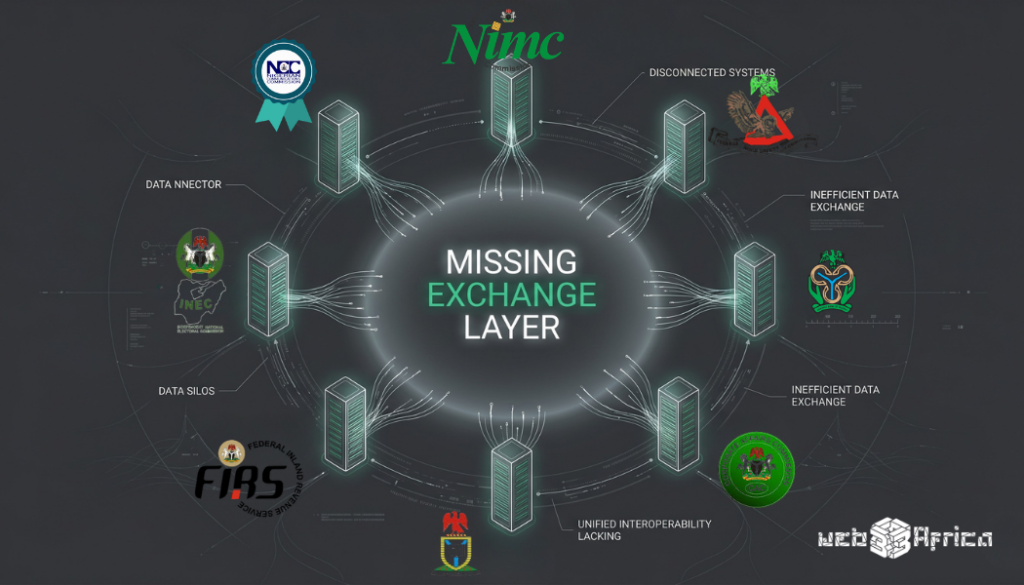
The National Identity Management Commission (NIMC) holds the National Identification Number (NIN) registry. The Central Bank oversees the Bank Verification Number (BVN). The Nigerian Communications Commission, Immigration Service, Federal Inland Revenue Service, Road Safety Corps, Corporate Affairs Commission, and Electoral Commission each maintain separate systems for telecom subscribers, passports, taxes, driver’s licenses, business registrations, and voter records.
RELATED: Inside Nigeria’s Ambitious Plan to Regulate Artificial Intelligence by 2030
Different formats, different standards. No unified exchange layer.
“We carried out a survey and realized that different government agencies classify data in different ways,” Emmanuel Edet, NITDA’s Acting Director of Regulation and Compliance, explained at the summit.
How do you harmonize these differences so that once you classify data, you know what type of data to expect and how to manage it across all agencies?
For AI systems, which depend on large, structured, cross-referenced datasets, this fragmentation is fatal.
Decades Of Policy Without Tangible Progress
Nigeria has been trying to solve this issue since 2007, when the National Identity Management Commission Act established a national identity framework meant to connect government databases. The 2020 NIN-SIM linkage mandate was the most aggressive push yet.
In September 2025, the government published its Nigeria AI strategy, the National Artificial Intelligence Strategy (NAIS), and unveiled N-Atlas, Africa’s first government-backed multilingual language model. On paper, the vision is clear.
Nigeria’s Public Data Silos
Hover over an agency to reveal its isolated dataset holding back AI integration.
However, the reality is a bit stark; data integration remains incomplete.
RELATED: Liberland Partners With Dubai AI Innovation Hub To Launch Startup Desk
A live example: NIMC’s migration to its NINAuth platform in June-July 2025 caused three weeks of SIM-service disruptions because “unforeseen integration issues” paralyzed telecom operators. The Association of Licensed Telecommunications Operators called it an “ambush.”
Data Fragmentation Paralyzes AI Deployment
Without interoperable data, AI cannot reliably verify identity, detect fraud, personalize healthcare, or streamline tax collection. Agencies classify and protect data differently and often resist sharing it.
“A lot of government agencies understand that data has value,” Edet said. “As far as they are concerned, sharing data is giving up that value. Nobody wants to be irrelevant in any system.”
Institutional rivalries now shape Nigeria’s AI readiness more than compute power or talent.
An Open Government Partnership review led by NITDA admits the root cause.
“Nigeria lacks an inclusive and independent coordination mechanism to oversee digital transformation efforts. This has led to fragmented initiatives.”
Building The Infrastructure For AI Trust
NITDA announced plans in September 2025 to roll out a Nigerian Data Exchange (NGDX) platform starting in 2026, designed to enable secure, governed sharing across agencies. National data-governance guidelines are also in development.
But as Abdullahi acknowledged at the summit,
“Artificial intelligence does not run on algorithms alone. It runs on energy, compute capacity, data, talent, infrastructure, and, most of all, trust.”
The Nigeria AI policy stack is dense. The Nigeria AI strategy is ambitious. The execution architecture, standards, APIs, governance frameworks, and institutional willingness to share are still under construction. is still under construction.
The government’s ability to break its data silos, rather than the number of published strategies, will determine the country’s AI future.
Discover more from Web3Africa
Subscribe to get the latest posts sent to your email.
You must be logged in to post a comment.