









In Brief
The CBN fintech report confirms a massive 70% growth in the number of active fintech companies in Nigeria throughout 2025.
Despite this expansion, 87.5% of operators report that high compliance costs and duplicative regulatory requirements are stifling innovation.
Nigeria’s instant payment system (NIP) reached a historic milestone of nearly 11 billion transactions, earning a “Mature” ranking from AfricaNenda.
The Central Bank has proposed a 10-point roadmap including a Single Regulatory Window to reduce licensing delays and costs.
With Nigeria steadily growing as Africa’s crypto ecosystem, its central bank recently released an assessment titled “Shaping the Future of Fintech in Nigeria: Innovation, Inclusion, and Integrity.” Its headline provides a striking narrative: the Nigeria fintech sector expanded by 70% in 2025, measured by the growth in active fintech companies from approximately 255 in January 2024 to over 430 by February 2025, according to the Nigeria Fintech Map 2025.
Yet the same report reveals a paradox. While Nigeria now commands 47% of all African fintech deals and processes nearly 11 billion instant payment transactions annually, 87.5% of operators cite regulatory compliance costs as a severe constraint on innovation. Half of all surveyed firms describe the regulatory environment as “restrictive,” and over 60% report that approval delays materially slow product launches.
This article dissects the core findings of the CBN fintech report, examining what fueled the 70% surge, the infrastructure milestones that underpin it, and the fintech regulatory challenges that threaten to cap future expansion.
What the CBN report says is powering the surge
The 70% figure specifically tracks the increase in the number of fintech companies operating in Nigeria year-over-year, not transaction value or revenue. This distinction is critical. The growth reflects a proliferation of startups, platforms, and digital financial service providers.
RELATED: Inside Nigeria’s Ambitious Plan to Regulate Artificial Intelligence by 2030
Many are enabled by agency banking models that extend services into rural and peri-urban areas previously underserved by traditional banks.
The CBN fintech report reveals:
Nigeria now hosts 430+ fintech companies, representing 28% of all African fintech firms (European Investment Bank, Nigeria Fintech Map 2025).
The country absorbed 36% of African fintech funding from 2020 to mid-2024 and 47% of all deals in 2024 alone (BCG/Elevandi, Chambers & Partners).
In 2024, Nigerian startups raised over $520 million in equity, capturing 72% of all equity capital deployed in Nigeria that year—despite a global fintech funding downturn of 20%.
CBN Governor Olayemi Cardoso attributed the resilience to improved macroeconomic stability, noting:
“Even amid global economic headwinds, Nigerian fintech firms continued to attract investment and drive change. Today, with the improved stability of our currency and domestic economy, it is clearer than ever that financial innovation can advance inclusion at scale.”
The Transaction Explosion: 11 Billion Instant Payments in 2024
Beyond company count, the CBN fintech report highlights operational scale. In 2024, the Nigeria Inter-Bank Settlement System (NIBSS) Instant Payment (NIP) platform processed nearly 11 billion transactions, a 120% increase from 5 billion in 2022. Real-time channels now facilitate over 25% of all electronic transactions in Nigeria.
This volume surge earned NIP a historic accolade. AfricaNenda’s “Mature” ranking in its 2025 State of Instant and Inclusive Payment Systems (SIIPS) report, the first and only African instant payment system to achieve this designation. The ranking assesses inclusivity, functionality, and governance, affirming that Nigeria’s payment rails are not only high-volume but also technically sophisticated.
Nigeria Records $50B in Crypto Transaction Volume and the SEC’s Call to Channel Risk Productively
Real-time payments have effectively made the “cashless economy” a reality for millions. Digital channels are no longer optional; they are the primary infrastructure for wage payments, remittances, and commerce, particularly during peak periods like the “Detty December” season when spikes in travel and transactions stress systems.
The Compliance Cost Crisis: 87.5% of Fintechs Report Innovation Is Being Stifled
Despite this momentum, the CBN fintech report exposes a critical vulnerability. The cost of fintech compliance is crippling innovation for most operators.
Survey findings from the CBN’s ecosystem assessment:
87.5% of fintech executives report that compliance costs significantly limit their ability to innovate.
62.5% say regulatory timelines materially delay product rollouts.
Over 37.5% state it takes more than 12 months to bring a new product to market due to licensing bottlenecks.
Exactly 50% view the current environment as “restrictive,” citing procedural ambiguity and slow decision-making.
Capital requirements alone create a formidable barrier:
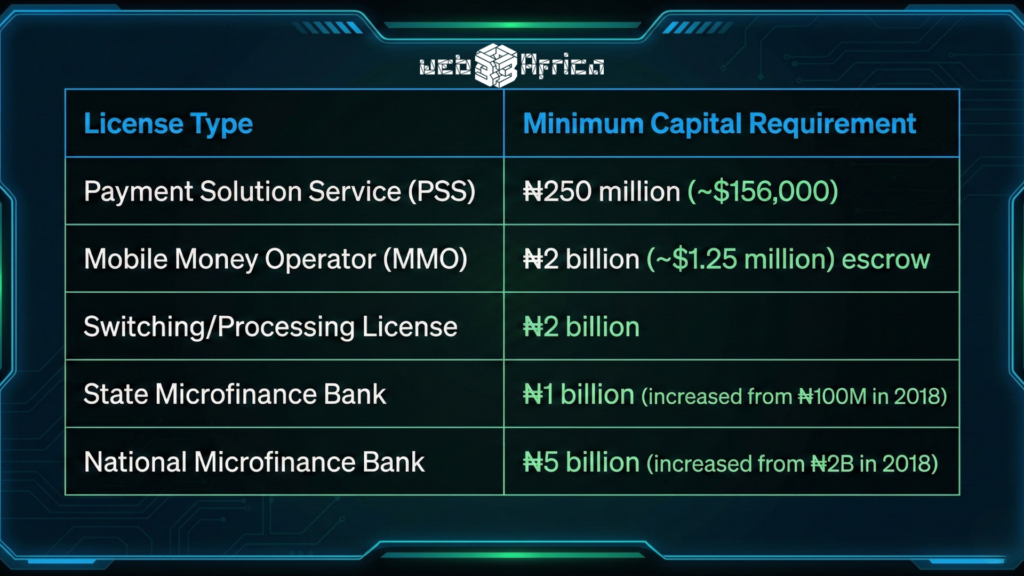
Duplicative reporting across multiple agencies (CBN, SEC, NDPC, FCCPC, NCC) compounded these costs, forcing startups to divert innovation capital to compliance overhead. In Q4 2024, banks paid over ₦15 billion in penalties for KYC and compliance failures, and total fines in H1 2024 reached ~₦1.5 billion, illustrating the high cost of non-compliance.
The report notes that 37.5% of firms cite the lack of digital identity or credit history as the primary barrier to reaching excluded populations, a problem rooted in infrastructure gaps.
The report highlights two critical infrastructure bottlenecks: the NIN Enrollment Deficit and API Fragmentation.
Two critical infrastructure bottlenecks emerged in the CBN fintech report:
Digital Identity Crisis
As of June 30, 2025, Nigeria recorded 121.4 million unique NIN (National Identification Number) enrollments, falling 59 million short of the World Bank’s 180 million target for December 2026. At the current enrollment rate of 1.08 million per month, Nigeria is on track to miss this target significantly.
The identity gap has direct financial consequences. 26% of Nigerian adults remain financially excluded, rising to 37% in rural areas. Workshop participants clarified that the problem is not the absence of identity systems but
“challenges around the cost, accessibility, and usability of identity verification infrastructure.”
System downtimes in 2025 halted SIM registrations and bank onboarding for days, while unauthorized data-selling sites like “AnyVerify” severely eroded public trust.
API and Interoperability Fragmentation
50% of surveyed firms described the ecosystem’s interoperability as weak, citing fragmented API standards and data protocols. The open banking framework is still moving toward “full operationalization,” with the industry struggling to adopt universal REST API standards and OAuth 2.0 security protocols developed by the Open Banking Nigeria initiative.
The ongoing migration from ISO 8583 to ISO 20022 messaging standards. While this change is important for providing more detailed transaction information and improving fraud detection, it has caused problems because different institutions use different standards, leading to incomplete data and failed transactions.
The CBN’s 10-Point Policy Roadmap: Can It Unlock Scale?
Acknowledging these fintech regulatory challenges, the CBN outlined a 10-point reform roadmap designed to shift the environment from “restrictive” to “collaborative.”
The CBN fintech report revealed:
Single Regulatory Window (Smart Licensing & Supervisory Gateway—SLSG):
A unified digital portal for multi-agency onboarding, eliminating redundant submissions to CBN, SEC, NDPC, and FCCPC.Compliance-as-a-Service (CaaS
Shared compliance utilities offering AML/CFT screening, sanctions checking, and transaction monitoring at scale, dramatically reducing costs for smaller fintechs.Regulatory Passporting:
Mutual license recognition with Ghana, Kenya, South Africa, Uganda, and Senegal enables pan-African expansion. This addresses the 62.5% of Nigerian fintechs planning regional expansion.Fintech Reform Delivery Secretariat:
The Fintech Reform Delivery Secretariat is a permanent body that manages the Standing Fintech Engagement Forum, ensuring a quarterly dialogue between regulators and industry leaders.National Digital ID Access:
Working with NIMC to provide affordable, high-performing NIN APIs for identity verification, reducing costs and downtime.Open Banking Acceleration:
The final guidance on data portability is being issued to compel banks to open APIs to third-party fintechs, thereby enabling embedded finance and credit scoring.
It also reveals its phased Implementation:
Phase 1 (0–3 months): Launch Engagement Forum, issue open banking framework roadmap, and begin technical scoping for SLSG.
Phase 2 (3–9 months): Operationalize Fintech Credit Guarantee Window; launch Regulatory Sandbox 2.0.
Phase 3 (9–18 months): Formalize Advisory Council; initiate regulatory passporting consultations.
What This Means for Stakeholders
For startups:
If the Single Regulatory Window and CaaS are executed effectively, time-to-market could drop from 12+ months to 3–6 months, and compliance costs could fall by 40–60%, leveling the playing field for bootstrapped firms.
For investors:
The consolidation trend is accelerating. Deals like Moniepoint’s $110 million Series C, LemFi’s $53 million Series B, and acquisitions like Flutterwave-Mono and Paystack-Brass signal the emergence of “Super Fintechs” that own payments, credit, and infrastructure. Late-stage capital will likely concentrate around these platforms.
For consumers and businesses:
The 11 billion transaction milestone and NIP’s “Mature” ranking confirm that Nigeria’s payment rails are globally competitive. If identity and API infrastructure gaps close, access to credit, insurance, and embedded finance will expand rapidly, especially in underserved regions.
Growth Under Pressure
The 70% expansion of the Nigeria fintech sector in 2025 is a testament to the resilience of digital innovation amid macroeconomic volatility, including 34.8% inflation and persistent FX fluctuations. The CBN fintech report confirms that Nigeria is not just Africa’s largest fintech market but a regulatory reference point for the Global South.
Yet the data also reveals that growth is occurring despite the regulatory environment, not because of it. The 87.5% compliance cost burden, NIN enrollment gap, and API fragmentation are structural bottlenecks that, if unresolved, will constrain the sector’s ability to scale from 430 companies to thousands and from 11 billion transactions to tens of billions.
The execution of the 10-point roadmap, particularly the Smart Licensing Gateway, Compliance-as-a-Service, and regulatory passporting, will determine whether Nigeria transitions from chaotic growth to structured dominance. If successful, Nigeria could position itself as a “rule-setter” for digital finance in Africa by exporting the model across the continent.
Related Reading:
- The Capital Squeeze Evaluating Credit Risk in Nigerian Fintech
- SARS Crypto Tax Guide Explained for South African Investors
- The Unseen Ripple Effect of London Sanctions on African Fintech Founders
Discover more from Web3Africa
Subscribe to get the latest posts sent to your email.
You must be logged in to post a comment.