











Table of Contents
Zimbabwe has officially ended nearly a decade of regulatory ambiguity regarding digital assets. Following an initial banking embargo in 2018, the rollout of a formal Zimbabwe crypto regulation mandate represents supervised tolerance rather than outright promotion.
By gazetting Statutory Instrument (SI) 99 of 2026, the government is forcing the domestic digital asset sector under strict administrative oversight. Keep in mind the nation processes an estimated $20 million in monthly peer-to-peer volume.
As Zimbabwe shifts from a crypto ban to regulation, the state is making one thing clear: operators will trade compliance for legal certainty.
Core Mandates of the New Zimbabwe Crypto Regulation
The new rules operationalize amendments made by the Finance Act No. 7 of 2025, which officially redefines VASPs as “financial institutions” under the nation’s Money Laundering and Proceeds of Crime Act.
RELATED: CBN compliance Department Introduces Proactive Measures Against Financial Crime
Under the new Zimbabwe crypto regulation guidelines, operating without mandatory FIU registration is now a criminal offense carrying severe financial penalties. Exchanges, custodians, brokers, and transfer services must now meet a substantial operational burden to secure a one-year certificate. Applicants are required to:
- Incorporate locally and maintain a physical office within the country.
- Appoint at least two resident directors.
- Hire a dedicated, locally resident compliance officer.
- Submit comprehensive cybersecurity, risk-management, and crypto AML framework policies.
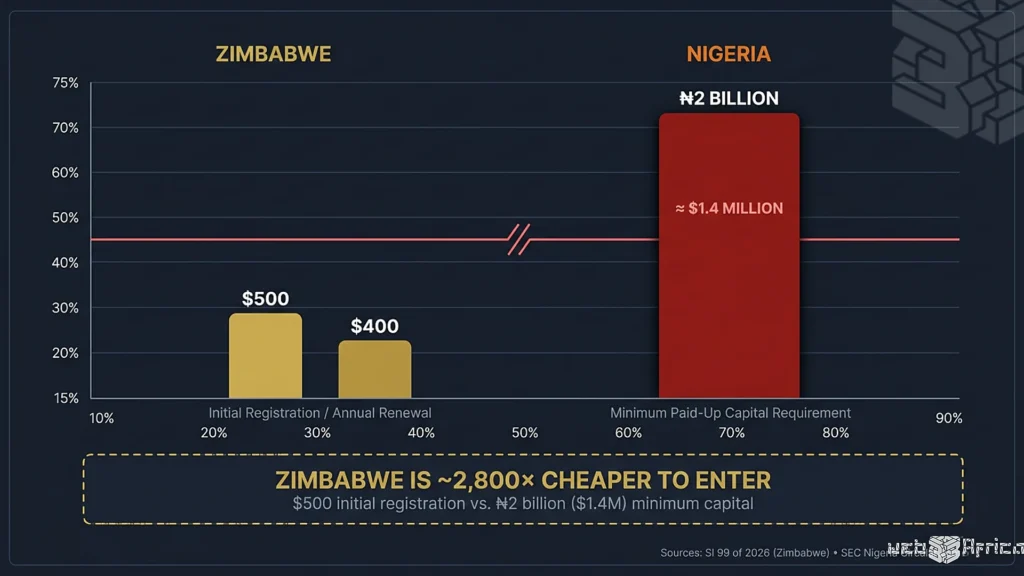
Despite the heavy operational requirements, the financial barrier to entry is relatively reasonable. Registration costs a $500 initial fee and $400 annually, a stark contrast to regional peers like Nigeria, which now demands a ₦2 billion ($1.4 million) minimum paid-up capital for major exchanges under its January 2026 regulatory update, up from previous lower thresholds.
The FATF Travel Rule and DeFi Oversight
To align with global standards, registered platforms must enforce the FATF “Travel Rule” by collecting and transmitting originator and beneficiary data during transactions. Additionally, any virtual asset transfers exceeding $1,000 sent to private or self-hosted wallets now require explicit cryptographic proof of ownership.
Notably, this crypto AML framework extends beyond centralized exchanges. The legislation is unusually broad, actively capturing entities that exercise commercial control over decentralized finance (DeFi) protocols, smart contracts, or decentralized applications (dApps).
Understanding the Dual Nature of the Current Zimbabwe Crypto Licensing Framework
Despite the legislative progress, industry operators must navigate a critical legal nuance. Securing FIU registration is necessary, but it is not sufficient on its own to conduct business.
Financial Intelligence Unit (FIU) Director-General Oliver Chiperesa explicitly clarified this limitation to the public, stating that satisfying FIU compliance requirements “does not, in itself, constitute authorization to carry on business.”
RELATED: Zimbabwe Government Launches Comprehensive Study for Digital Asset Regulation
This establishes a complex Zimbabwe crypto licensing framework. Startups may clear their AML compliance checks with the FIU but still require separate commercial approvals from the Reserve Bank of Zimbabwe (RBZ) or the Securities and Exchange Commission (SECZ).
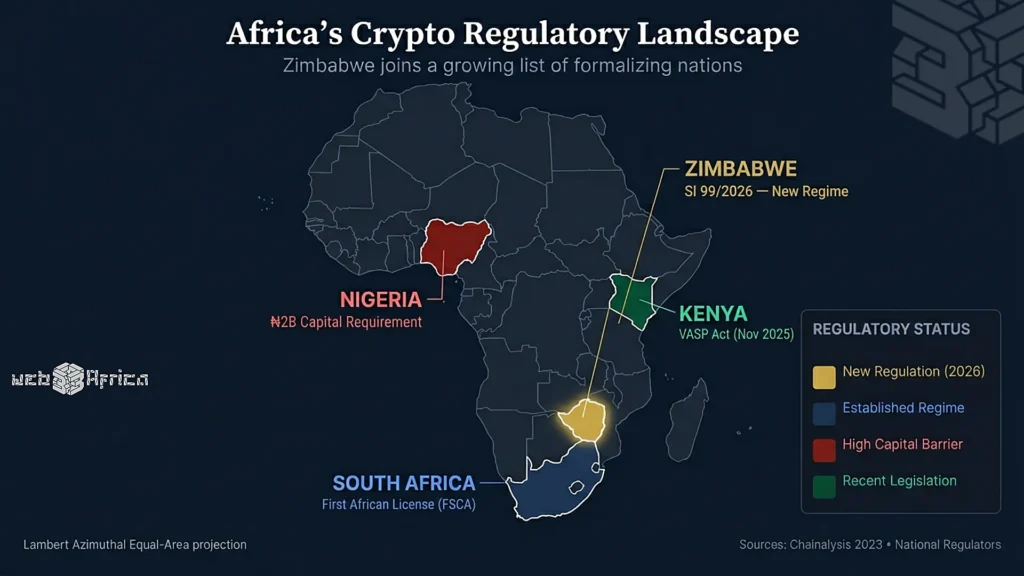
Additionally, the 2018 rule that stops commercial banks from handling crypto transactions is still active, which means that registered VASPs might still encounter challenges when trying to access local fiat banking services.
The Macroeconomic Driver Behind the Policy
Zimbabwe’s scheduled Financial Action Task Force (FATF) mutual evaluation in January 2027 heavily influences this evolution in crypto regulation. Demonstrating oversight over virtual assets is a direct response to FATF Recommendation 15.
However, the policy is also an acknowledgment of undeniable macroeconomic reality. Crypto demand in the region is deeply rooted in currency instability and cross-border remittance needs.
As local blockchain specialist Jabulani Chibaya noted regarding the shift, crypto in Zimbabwe is now treated exactly like traditional banking, demanding the same “principles of knowing your customer, reporting suspicious activity, and keeping records.”
Preparing for Institutional Compliance and Unresolved Banking Hurdles
With formal Zimbabwe crypto regulation now in place, the state has opted to formalize oversight of a market it realized it could not eliminate.
However, major questions remain. It is unclear if or when the RBZ will lift the 2018 banking ban to allow VASPs seamless access to domestic fiat liquidity. Furthermore, the cost of local incorporation and compliance may force smaller, informal OTC desks either out of business or deeper underground.
For now, as Zimbabwe shifts from crypto ban to regulation, operators are entering an era of supervision that demands institutional-grade compliance.
FAQ Section
Is cryptocurrency legal in Zimbabwe?
Yes, but it operates under strict administrative oversight. The government has transitioned from a tacit prohibition to supervised tolerance. Virtual Asset Service Providers (VASPs) are now legally recognized as financial institutions but must secure mandatory compliance certificates to operate without facing criminal penalties.
u003cstrongu003eWhat are the FIU registration requirements for crypto operators in Zimbabwe?u003c/strongu003e
Under Statutory Instrument 99 of 2026, digital asset startups must incorporate locally and maintain a physical office within the country. Additionally, operators must appoint at least two resident directors, hire a dedicated local compliance officer, and submit a comprehensive crypto AML framework.
u003cstrongu003eHow much does a Zimbabwe crypto license cost?u003c/strongu003e
The financial barrier to entry is surprisingly low compared to regional peers like Nigeria. Securing a one-year VASP certificate from the Financial Intelligence Unit (FIU) requires a $500 initial registration fee and a $400 annual renewal fee, though the operational costs of local compliance are much higher.
u003cstrongu003eCan commercial banks in Zimbabwe process cryptocurrency transactions?u003c/strongu003e
No. This is the critical bottleneck in the new regulatory framework. While the FIU now licenses crypto operators for AML compliance, the Reserve Bank of Zimbabwe’s 2018 directive prohibiting commercial banks from processing digital asset transactions remains fully active.
Discover more from Web3Africa
Subscribe to get the latest posts sent to your email.

You must be logged in to post a comment.