











Table of Contents
When Zimbabwe gazetted Statutory Instrument 99 of 2026 on June 10, Finance Minister Mthuli Ncube didn’t just create a registration process for cryptocurrency exchanges. He may have established one of Africa’s broadest definitions of who counts as a regulated crypto business. This extends oversight to anyone who “exercises control over” decentralized protocols, smart contracts, or blockchain applications.
RELATED: Zimbabwe Legalizes Digital Assets but Leaves the Commercial Banking Embargo Intact
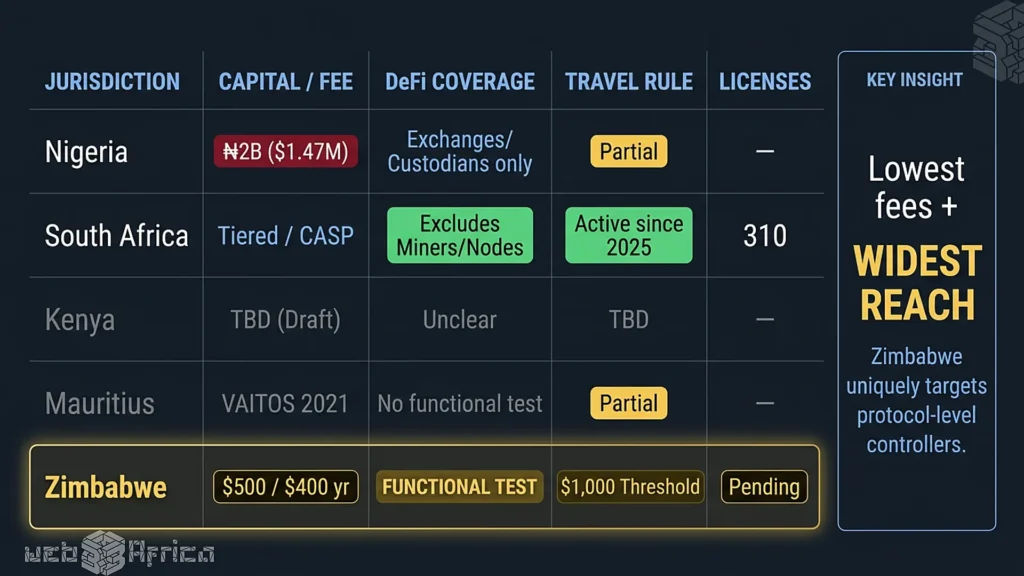
That functional scope, buried in the technical language of anti-money laundering regulations, sets Zimbabwe’s crypto framework apart from most of its continental peers. As part of the country’s broader crypto framework, while Nigeria focuses on exchanges and custodians and South Africa carves out exemptions for miners and node operators, Zimbabwe’s rules target a wider circle. Any entity that can alter code, route funds, set transaction fees, or commercially promote a protocol.
The question now is whether the country’s Financial Intelligence Unit can enforce what it has written into law.
Zimbabwe’s Definition of a Crypto Business Reaches Beyond Exchanges
Under Section 2 of the regulations, a virtual asset service provider isn’t defined merely by offering exchange or custody services. According to legal analysis by Harare-based Lucent Consultancy, a business becomes a VASP if it “exercises control over, or provides the essential means for, the operation of a software protocol, smart contract, decentralized application, or similar technological arrangement.”
Control, in turn, is assessed functionally. The framework looks at whether an operator can:
- Initiate, modify, or upgrade core protocol code
- Withdraw or reallocate assets held in smart contracts
- Set or materially alter transaction fees, staking yields, or rewards
- Influence governance decisions
- Market itself as the protocol’s operator
This approach borrows from international enforcement precedent, particularly U.S. Treasury actions against DeFi developers, rather than the European Union’s MiCA framework, which explicitly exempts fully decentralized systems where no identifiable intermediary exists. The result is a more expansive approach to smart contract regulation than most existing African regimes.
Jabulani Chibaya, an AI and blockchain specialist based in Harare, put it plainly:
“Crypto is now treated like banking. The same principles of knowing your customer, reporting suspicious activity, and keeping records now apply.”
Africa’s Crypto Rulebooks Stop Where Zimbabwe Pushes Further
To understand whether Zimbabwe’s crypto framework is unusually broad, consider the regulatory landscape across the continent’s major crypto markets:
Nigeria has the region’s most capital-intensive regime. The Securities and Exchange Commission requires ₦2 billion ($1.47 million) in paid-up capital for exchanges and custodians under its 2025 Investments and Securities Act.
RELATED: Inside ISA 2024: How Nigeria Is Legalizing Crypto and Cracking Down on Ponzi Scheme Laws
But its operative definitions focus on issuance platforms and traditional custodial services. Smart contract operators and protocol controllers aren’t explicitly targeted in published rules.
South Africa has licensed 310 crypto asset service providers under the Financial Sector Conduct Authority as of March 2026, the most in Africa. But the FSCA explicitly excludes miners and node operators from its licensing perimeter. Its DeFi market study, published in 2025, has yet to translate into formal smart contract-specific regulation.
Kenya’s Virtual Asset Service Providers Act took effect in November 2025, but implementing regulations remain in draft. The Central Bank and Capital Markets Authority have not yet clarified the treatment of decentralized protocols.
Mauritius, often considered the region’s most mature fintech jurisdiction, regulates broker-dealers, custodians, and wallet providers under its 2021 VAITOS Act. But it does not apply a functional control test to decentralized systems.
By comparison, Zimbabwe’s $500 registration fee, with a $400 annual renewal, is the lowest cost of entry in Africa. But its definitional reach may be the widest, reinforcing its growing influence on African crypto regulation.
Registration Is Only the First Regulatory Hurdle
One critical nuance often missed in initial coverage: FIU registration does not grant operational authorization.
The FIU’s public notice, issued June 16 by Director General Oliver Chiperesa, was explicit:
“Registration with the FIU for AML/CFT purposes does not, in itself, constitute authorization to carry on business in Zimbabwe.”
Crypto firms must satisfy two separate authorities:
- FIU registration for anti-money laundering compliance (what SI 99 governs)
- Operational licensing from either the Reserve Bank of Zimbabwe or the Securities and Exchange Commission of Zimbabwe
The second layer remains undefined. Neither the Reserve Bank of Zimbabwe (RBZ) nor the Securities and Exchange Commission of Zimbabwe (SECZ) has published any licensing criteria, capital requirements, or approval timelines for cryptocurrency businesses. That regulatory gap leaves firms navigating Zimbabwe’s crypto licensing requirements in partial darkness.
It also raises the specter of Zimbabwe’s 2018 experience, when the RBZ ordered banks to cease serving crypto exchanges. Golix, the country’s leading platform at the time, won a court challenge but lost its bank accounts anyway, effectively ending operations.
RELATED: The Massive Surge of Stablecoin Adoption as a Remittance Lifeline for Sub Saharan Africa
Whether registered VASPs will gain reliable banking access under the new framework remains uncertain.
Broad Powers Create Difficult Questions for Enforcement
The framework’s breadth creates practical enforcement challenges.
For traditional exchanges operating from Harare offices with known directors, compliance is straightforward. Incorporate locally, appoint two resident directors and a compliance officer, submit anti-money laundering policies, pay the fee, and display your certificate.
But how does the FIU enforce smart contract regulation against a protocol deployed by pseudonymous developers operating across multiple jurisdictions? How does it determine whether a DAO token holder “exercises control” sufficient to trigger registration obligations?
The regulations prescribe penalties up to $50,000 for failures to report material changes within 48 hours and immediate suspension powers for threats to financial stability. But those tools assume identifiable legal entities within Zimbabwe’s borders.
The control test works cleanly for centralized protocols with upgrade keys and identifiable founding teams. It struggles with genuinely immutable contracts, where no entity retains the power to alter the code, reallocate funds, or set fees.
Lucent Consultancy’s analysis acknowledged the tension: the framework offers “clear, modern, and legally defined rules” while creating “high compliance costs for local fintech startups” and risking that informal peer-to-peer trading is “pushed underground.”
FATF Compliance Sits at the Center of Zimbabwe’s Strategy
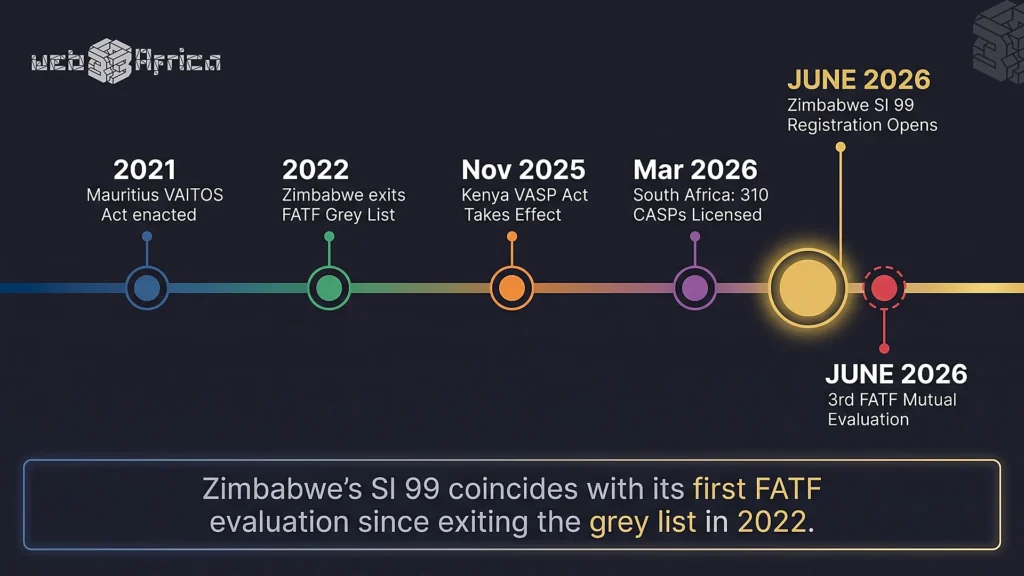
Zimbabwe faces its third Financial Action Task Force mutual evaluation in June 2026, the same month SI 99 took effect. After exiting the FATF gray list in 2022, authorities are acutely aware that backsliding on anti-money laundering controls could trigger relisting.
The framework adopts FATF’s Travel Rule, requiring VASPs to transmit sender and beneficiary information for all transfers. For transactions above $1,000 involving self-hosted wallets, platforms must verify ownership through cryptographic proof before processing.
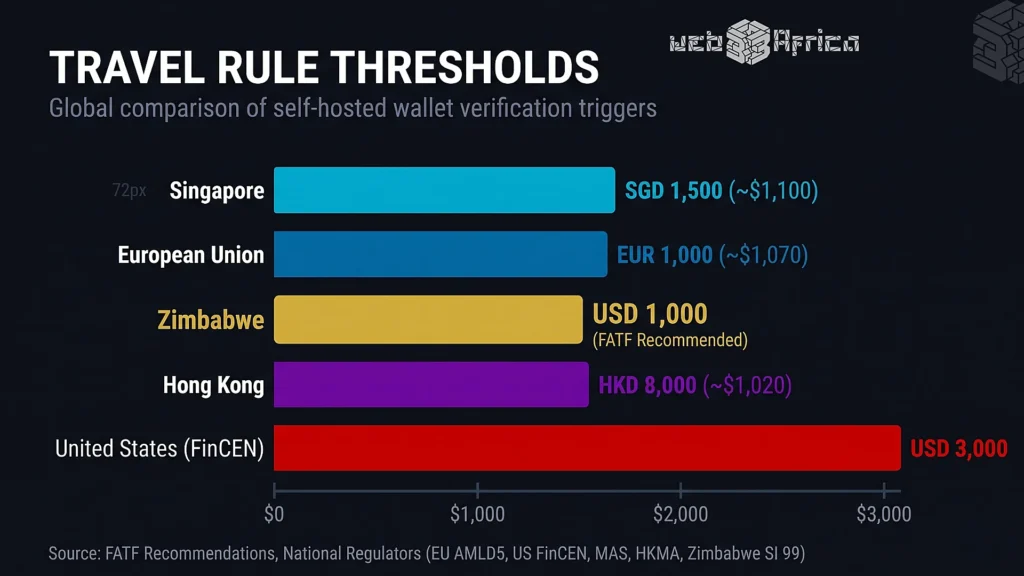
That standard exceeds enforcement expectations in many established markets. This sets Zimbabwe alongside South Africa, which operationalized Travel Rule compliance in 2025, as one of only two African jurisdictions actively implementing the FATF recommendation.
Zimbabwe’s Crypto Experiment Now Moves Into the Real World
Zimbabwe has built regulatory architecture that is simultaneously more accessible and more expansive than most African crypto regulation frameworks. Its low-cost registration invites participation. Its broad definitions extend oversight further than any peer jurisdiction on the continent.
RELATED: Blockchain Carbon Registry Milestones in Zimbabwe’s Sustainability Push
The open question is execution.
Can the FIU enforce crypto licensing compliance against decentralized systems? Will the RBZ and SECZ publish clear operational licensing standards? Will banks serve registered VASPs, or will the 2018 access restrictions persist under new branding?
Jeffrey Mutambiranwa, a Harare-based crypto trader, told Reuters the regulations represent “a positive step” and that “traders will no longer have to operate underground.”
Whether Zimbabwe’s ambitious regulatory framework becomes a model for the continent or a cautionary tale in overreach depends on what happens in the implementation phase.
FAQ Section
What makes Zimbabwe’s crypto framework different from other African regulations?
Zimbabwe applies a functional control test that extends oversight beyond exchanges and custodians to entities that control smart contracts, decentralized applications, or blockchain protocols.u003cbru003e
u003cstrongu003eDoes FIU registration allow a crypto business to operate in Zimbabwe?u003c/strongu003e
No. The article explains that FIU registration satisfies anti-money laundering requirements only. Crypto businesses must also obtain operational authorization from the appropriate financial regulator once licensing requirements are published.
u003cstrongu003eWhat compliance obligations do crypto firms face under Zimbabwe’s framework?u003c/strongu003e
Registered firms must meet AML and CFT requirements, comply with the FATF Travel Rule, appoint compliance personnel, maintain records, and report certain changes to the Financial Intelligence Unit.
Discover more from Web3Africa
Subscribe to get the latest posts sent to your email.
You must be logged in to post a comment.