











Table of Contents
When Empery Digital announced it was selling its digital assets to fund AI infrastructure, the move was framed as the next step to tangible, revenue-generating assets.
However, for those who witnessed the crypto market’s collapse in 2025 and early 2026, the company’s trajectory conveyed a different narrative. One less about disciplined capital allocation and more about chasing the next narrative before the current one fully unravels.
Empery sold 1,400 BTC at an average price of $62,200 per coin, raising approximately $87.1 million. The problem? The company had accumulated most of its bitcoin at an average cost of roughly $117,546 per coin during the height of the 2025 bull run. Selling at nearly half that price crystallized losses that would make any CFO wince.
A $65 million investment for a 25% stake in a 150-megawatt Midwest AI data center, with expansion potential to 300 MW. Co-CEO Ryan Lane emphasized the company’s intention to “continue to allocate capital to similar hyperscaler-anchored opportunities.”
Empery’s story is less an isolated corporate maneuver and more a microcosm of a broader behavioral pattern.
It asks if the AI hype cycle is simply 2025’s crypto frenzy wearing a new suit.
The Anatomy of Sequential Manias
Empery Digital’s corporate evolution compresses a decade of Silicon Valley trend-chasing into 24 months. The company began as Volcon, an electric vehicle maker. In July 2025, as bitcoin approached its all-time high of $126,210, Volcon rebranded as Empery Digital and adopted a bitcoin treasury strategy. By August 2025, it held 4,026.71 BTC, roughly $473 million worth at cost.
Six months later, bitcoin had fallen 43% from its October 2025 peak. The total crypto market capitalization collapsed from $4.4 trillion to $2.4 trillion by the end of March 2026. That’s a drawdown exceeding 40%. Empery’s share price, like those of its SPAC peers pursuing similar strategies, fell more than 90% from 2025 highs.
Now, with 1,514 BTC remaining and no plans to accumulate more, the company has rotated into AI infrastructure at precisely the moment that sector’s valuations have reached levels that make central bankers nervous.
When Capital Chases Narratives Instead of Returns
The structural parallels between the 2025 crypto boom and the 2026 AI infrastructure surge are difficult to ignore. Both sectors attracted massive institutional capital inflows based on transformative narratives. Both saw companies pivoting aggressively to capture investor attention. Both generated valuations that far outpaced near-term cash-flow realities.
The difference is that AI infrastructure represents tangible assets, data centers, power substations, cooling systems, and GPUs. While crypto holdings were merely speculative digital tokens. But tangibility does not preclude overvaluation. Real estate, after all, is tangible, yet the 2008 housing crisis demonstrated how quickly “real assets” can become overpriced and overleveraged.
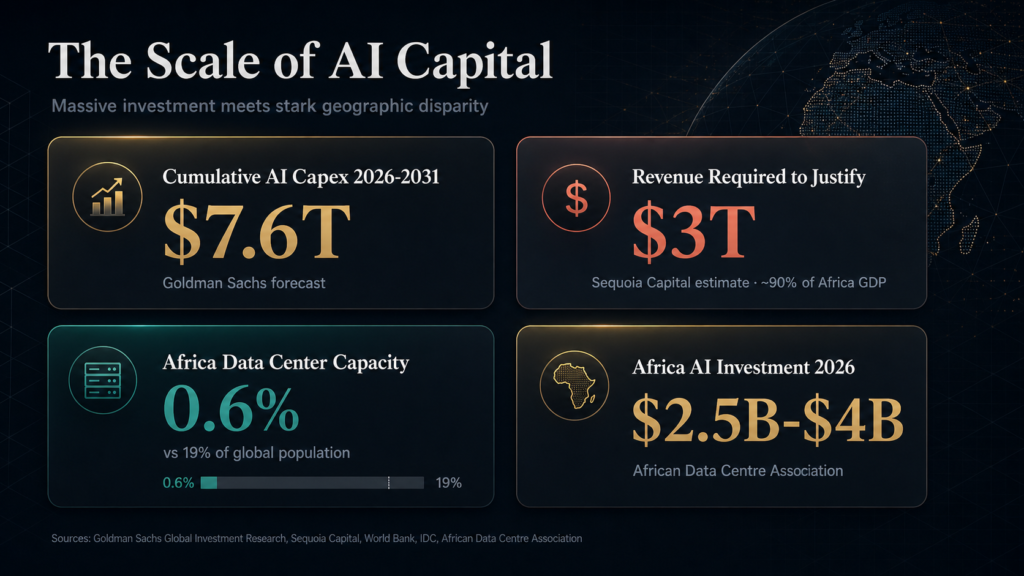
Combined hyperscaler capital expenditure for 2026 is projected between $660 billion and $725 billion, with Goldman Sachs forecasting $7.6 trillion in cumulative AI capex from 2026 to 2031. Google’s 2026 capex guidance of $185 billion exceeds its entire 2025 operating cash flow. Microsoft, Amazon, and Meta have collectively committed hundreds of billions more.
To justify returns on that scale of investment, Sequoia Capital partner David Cahn calculates that the AI industry will need to generate roughly $3 trillion in revenue just to cover hardware, data center operating expenses, and operator profits. Using IMF data, that $3 trillion figure represents approximately 90% of Africa’s projected $3.32 trillion combined GDP in 2026 (or roughly 83%, depending on which IMF estimate is used).
The Psychology of Market Rotation
The company’s SEC filings reveal that proceeds from bitcoin sales were used to repay $10 million in debt, cover elevated legal and operating costs, and fund the AI data center acquisition. This strategy is liquidity management dressed up as forward-thinking allocation.
The Federal Reserve’s May 2026 Financial Stability Report noted that survey respondents identified AI valuation concerns as a potential trigger for broader risk-asset corrections. The European Central Bank’s Financial Stability Review described technology and AI sector valuations as “particularly high.” The Bank of England explicitly warned that AI overvaluation poses a risk of global market correction, emphasizing the possible unsustainability of elevated infrastructure costs.
RELATED: Nigeria’s AI Debate Has Moved Into Enforcement
Yet capital continues to pour in. The same institutional investors who rotated out of crypto through late 2025 and early 2026 are now rotating into AI infrastructure with similar conviction levels.
Gartner’s 2025 Hype Cycle report placed generative AI in the “Trough of Disillusionment,” while AI agents sit at the “Peak of Inflated Expectations.” Simultaneously, at least 90% of firms report no measurable AI productivity impact, even as executives project significant future gains.
AI has demonstrable enterprise applications across healthcare, logistics, finance, and research. Data centers represent physical infrastructure with intrinsic value, unlike purely speculative token holdings. Corporate AI adoption is real and growing.
But utility does not preclude speculation. The internet was transformative. The dot-com bubble still destroyed $5 trillion in market value when it collapsed between 2000 and 2002. Railroads revolutionized commerce, but railroad stock manias still produced devastating losses for early investors. The technology can be revolutionary, and the AI hype cycle can still culminate in a painful correction—both things can be true simultaneously.

While the U.S. AI capital expenditure represents a massive share of its own GDP, Africa’s total AI-related data center investment in 2026, according to the African Data Centre Association (ADCA), falls within a committed range of $2.5 billion to $4 billion from hyperscalers and independent operators.
This investment represents a mere fraction of the continent’s projected $3.32 trillion combined GDP (IMF, April 2026), highlighting that Africa currently holds only 0.6% of global data-center capacity despite representing 19% of the world’s population.
This stark contrast highlights that while the U.S. is spending trillions to build foundational AI capacity, Africa’s current infrastructure spend remains in the early stages of development, driven by targeted hyperscaler projects in hubs like South Africa, Nigeria, and Kenya rather than continent-wide capital saturation.
What Comes Next
The lesson here is less about avoiding AI entirely and more about recognizing the difference between sustainable technology adoption and speculative excess.
The AI infrastructure build-out will reshape digital economies globally. Our markets stand to benefit from increased compute availability, reduced latency, and expanded cloud services. But the current valuation environment creates risks that extend beyond individual corporate balance sheets.
Empery Digital’s journey from electric vehicles to bitcoin treasury to AI infrastructure in under two years is cautionary because reactive capital allocation driven by narrative momentum rarely produces sustainable returns.
RELATED: Nigeria Is Turning AI Governance Into an Investment Advantage
The company now holds 15 employees, generated less than $1 million in revenue in fiscal 2025, reported a $150 million net loss, and is pivoting into a capital-intensive sector where construction costs have risen from $7.7 million per megawatt in 2020 to a forecasted $11.3 million in 2026.
The pattern, at this point, is repetitive. The current situation includes a transformative narrative, explosive capital inflows, valuation multiples that are disconnected from near-term fundamentals, institutional rotation from the last overhyped sector to the current one, and warnings from central banks and market historians that are politely acknowledged but ultimately ignored.
It remains uncertain whether the AI hype cycle will end in a correction as severe as crypto’s 70% drawdown or dot-com’s 80% collapse. What is certain is that when companies with negligible revenue and massive losses raise tens of millions by shifting from one speculative narrative to another, the market stops pricing in one speculative narrative after another; it is no longer pricing in fundamentals. The market is currently pricing in hope, which, historically, has proven a poor foundation for $7 trillion in capital expenditures.
Discover more from Web3Africa
Subscribe to get the latest posts sent to your email.

You must be logged in to post a comment.