









In brief
The AI dataset known as WAXAL provides 11,000+ hours of speech data to help developers overcome the linguistic “data desert” across Sub-Saharan Africa.
WAXAL focuses on spontaneous speech patterns and code-switching to ensure modern voice models can understand how Africans actually speak in real-world contexts.
Partner institutions like Makerere University and Digital Umuganda retain ownership of the corpora, setting a new standard for ethical data governance.
African startups like Lelapa AI and Lesan AI are already utilizing high-quality speech infrastructure to build local-language APIs for clinics and businesses.
Google Research Africa’s WAXAL is a rare, large-scale attempt to fix the bottleneck that has quietly held back voice AI across the continent. High-quality, locally collected speech data. On a continent with 2,000+ languages, many spoken far more than they’re written, voice isn’t a “nice to have.” It’s the interface.
As Abdoulaye Diack, a program manager at Google Research, put it when describing the project’s name: WAXAL means “speaking,” rooted in Wolof. The point is to make African languages “buildable” for modern speech systems, without relying on imported datasets that underrepresent African accents, code-switching, and everyday speech.
What WAXAL AI dataset is and why it’s different from past “low-resource” efforts
WAXAL is hosted on Hugging Face (google/WaxalNLP) and was built over “more than three years” of work. Its headline scale is big, 11,000+ hours of recorded speech and roughly 2 million rows/records, totaling about 775GB, but its design choices matter more than the raw volume.
Instead of scraping noisy web audio, WAXAL leaned on community-led collection with African university partners. For the transcribed speech needed for training recognizers, WAXAL used an image-prompt method; participants described images in their native language. That pushes speakers toward natural phrasing, real intonation, and the kinds of spontaneous patterns (including code-switching) that many speech models fail on in the real world.
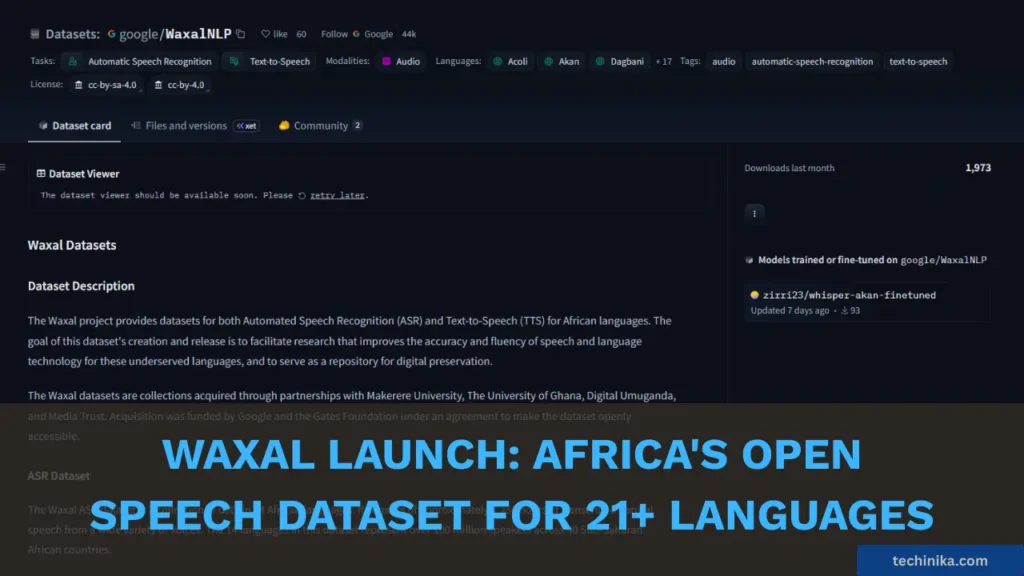
Google and the accompanying arXiv paper describe WAXAL as a dataset for 21 African languages, but the Hugging Face distribution shows more language varieties/configurations. The publication-safe way to be precise is by task: Automatic Speech Recognition (ASR) Corpus ASR spans 19 languages, and Text-to-Speech (TTS) Corpus spans 16 languages, with additional dialect/locale variants.
What WAXAL enables: ASR, TTS, and Africa-first speech products
WAXAL’s true value comes clearest when you map it to what developers can build:
1) Speech recognition for African languages (ASR)
WAXAL includes about 1,250 hours of high-quality transcribed natural speech, plus an unlabeled split that can be used for semi-supervised training. On Hugging Face, the ASR subset is structured with train/validation/test splits and fields like speaker_id, gender, transcription, language, and 16 kHz audio.
This unlocks:
- Call-center transcription that doesn’t collapse when a user code-switches
- Voice search and note-taking that can handle regional accents
- Speech interfaces for markets, minibuses, and clinics—places where “perfect studio speech” isn’t the norm
2) Text-to-speech (TTS) voices that sound local—not imported
WAXAL’s TTS corpus includes 180+ hours of studio-quality recordings with 72 voice actors (36 male, 36 female). This data enables the creation of natural-sounding voice agents that are culturally competent—a critical requirement for voice-first interfaces in regions with variable literacy rates.
This provides:
- IVR and voice agents that can respond naturally in local languages
- Accessibility tools (reading, navigation, health prompts) for users with variable literacy
- More realistic speech-to-speech AI translation flows where output quality matters as much as input
3) A Platform for Sovereignty, Not Dependence
Aisha Walcott‑Bryant, Head of Google Research Africa, says,
“The partnership framework ensures our partners retain ownership of the data they collected.”
The partner institutions named include Makerere University, the University of Ghana, Digital Umuganda, and Media Trust.
This matters because it supports an Africa-first alternative to the older “parachute science” pattern: data extracted locally, value captured elsewhere.
Governance and licensing: openness, with real trade-offs developers must check
WAXAL is openly accessible, but licensing is not one-size-fits-all. Hugging Face lists CC BY‑4.0 and CC BY‑SA‑4.0 at the dataset level, with a warning that licenses can vary by provider/language group, so downstream users must verify the subset they are using.
is the world’s leading open-source platform for artificial intelligence, often described as the “GitHub of Machine Learning”. [Photo: huggingface]
Four African startups already using AI to change industries (and why WAXAL makes voice a viable interface)
The release of high-quality speech-to-speech AI translation infrastructure is catalyzing a new generation of African startups building voice and language solutions:
1. Lelapa AI (South Africa)
Lelapa’s flagship product, Vulavula API, offers speech recognition for African languages that handles code-switching and local accents in isiZulu, Sesotho, and Afrikaans. The company uses human linguists for quality control and has developed InkubaLM, a large language model for under-resourced languages. “Our language model is not just a technological achievement; it is a step towards greater linguistic equality and cultural preservation,” said Atnafu Tonja, Lelapa’s fundamental research lead.
RELATED: Artificial Intelligence Joins The EACC Arsenal Against Financial Crime
2. Lesan AI (Ethiopia)
Lesan provides a paid translation API for Amharic, Tigrinya, Oromo, Somali, and English, languages where commercial alternatives simply did not exist. The service is used in humanitarian contexts and enables local-language content flows for policy, research, and public services where English-only interfaces exclude users.
3. Awarri (Nigeria)
Awarri’s LangEasy platform operationalizes dataset creation by enabling users to translate sentences and record audio in Yoruba, Hausa, Igbo, Pidgin, and Ibibio. The platform is building Nigeria’s multilingual AI model by creating the very linguistic “raw material” that projects like WAXAL also tackle.
4. EthiopicAI (Ethiopia)
A conversational AI platform supporting voice and text experiences in Ethiopian languages (Amharic, Afaan Oromo, Tigrinya, and Somali), EthiopicAI provides ASR, TTS, and natural language understanding for call centers, IVR systems, and enterprise support bots—making “voice the interface” in a multilingual market.
RETINA-AI CEO’s Bold Plan: Spend $1 Billion Annually on Nigeria’s AI Future
African Governments Deploying AI at Scale
African governments are no longer passive recipients of technology. By 2026, states are actively using AI to enhance revenue collection, healthcare delivery, food security, and citizen services:
1. South Africa – Algorithmic Tax Enforcement: The South African Revenue Service (SARS) has deployed Modernisation 3.0, integrating a “data lake” that pulls real-time information from banks, vehicle registries, and property records. Advanced machine learning algorithms analyze this data to construct 360-degree financial profiles, automatically flagging discrepancies and initiating audits. The system has recovered billions of rand in evaded revenue.
2. Kenya – Space-Enabled AI for Food Security: Kenya’s Ministry of Agriculture, in partnership with NASA Harvest and Microsoft, launched the CroME (Crop Map of Kenya) initiative in February 2026. Using satellite AI, the system automates crop identification, yield forecasting, and drought monitoring. To support this, Kenya announced a 3,000 GPU sovereign cloud cluster in partnership with Cassava Technologies and NVIDIA, ensuring sensitive national data is processed within its borders.
3. Rwanda – Generative AI Healthcare Pilots: Rwanda’s Ministry of Health launched the Horizon 1000 Initiative, a $50 million project to deploy generative AI tools in 1,000 primary healthcare clinics by 2028. The tools act as “co-pilots” for community health workers, assisting with triage, clinical note-taking, and adherence monitoring. “The AI technology is meant to strengthen rather than replace clinical judgment,” said Andrew Muhire, a Rwanda Ministry of Health official.
4. Nigeria – AI Business Registration Portal: Nigeria’s Corporate Affairs Commission (CAC) deployed an AI-powered business registration portal that processes up to 10,000 applications daily. The system includes an “AI Lawyer” for compliance checks and automated name verification, reducing registration timelines from weeks to minutes and formalizing the informal sector at scale.
Liberland Partners With Dubai AI Innovation Hub To Launch Startup Desk
What this means for developers, researchers, and startups building on WAXAL
If you’re evaluating WAXAL as a builder, the opportunity is real—but so are the constraints. A practical checklist:
- Confirm licensing per language subset before training or shipping anything commercial.
- Start with ASR fine-tuning on the 1,250 transcribed hours; use the unlabeled split for semi-supervised gains if you have the pipeline.
- Use the TTS corpus for high-quality voice output—then test for misuse risks (voice cloning, impersonation) and consider watermarking/responsible-release patterns.
- Budget for infrastructure: training and deployment still require compute, bandwidth, and maintenance—WAXAL reduces data friction, not operational friction.
- Evaluate dialect coverage early. WAXAL’s language configurations are a strength, but no dataset fully represents every regional variant.
WAXAL is infrastructure, not hype.
WAXAL is best understood as a foundational public good: a Google speech dataset shaped by African institutions, designed to make voice AI workable in real African speech contexts, and distributed openly enough that local researchers and startups can build without defaulting to imported speech data.
“The ultimate impact of WAXAL is the empowerment of people in Africa,” said Walcott-Bryant. The dataset provides the linguistic keys to the digital kingdom.
If the next wave of African digital services is going to be voice-first, WAXAL is one of the few efforts at a scale that can plausibly support it—provided the community gets governance, licensing clarity, and responsible deployment right.
FAQ
What is the WAXAL AI dataset?
The WAXAL AI dataset is a massive, open-source speech collection featuring over 11,000 hours of audio across 21 African languages. Launched in February 2026 by Google Research Africa and partner universities, it provides the “linguistic raw material” needed to build voice recognition and synthesis tools for languages like Yoruba, Wolof, and Luganda that were previously digitally underrepresented.
How can developers use the WAXAL AI dataset?
Developers can access the dataset via Hugging Face to train and fine-tune machine learning models. The Automatic Speech Recognition (ASR) corpus is designed for transcribing spoken audio into text, while the Text-to-Speech (TTS) corpus enables the creation of natural-sounding synthetic voices for applications in healthcare, agriculture, and public services.
Why is voice-first AI important for the African continent?
With over 2,000 languages across Africa, many of which are primarily spoken rather than written, voice-first AI acts as a digital equalizer. It allows individuals with varying literacy levels to interact with modern technology, access critical health information, or manage farming tasks using their native tongue.
Who owns the data in the WAXAL AI dataset?
Unlike traditional “parachute science” models where data is extracted by foreign firms, WAXAL ensures that local partner institutions—such as Makerere University and the University of Ghana—retain full ownership of the data they collected. This framework promotes digital sovereignty and ensures that African researchers can build local solutions independently.
Discover more from Web3Africa
Subscribe to get the latest posts sent to your email.
You must be logged in to post a comment.