







In Brief
- The Hedera Africa Hackathon has officially transitioned from a standard developer competition into a $2 million regulated venture pipeline, anchored by a landmark equity pledge from Hashgraph Ventures and UGFS North Africa.
- To solve the regional “connectivity tax,” the program utilized physical “Hacking Stations” in over 20 cities, including Lagos, Nairobi, and Tunis, supported by Orange Digital Centers.
- The project focuses on four high-impact tracks, Real-World Assets (RWA), DLT Operations, AI/DePIN, and Immersive Gaming—directly addressing infrastructure gaps in African markets.
Hashgraph Ventures Manager Ltd. has pledged US$1 million in follow-on equity investment for standout teams emerging from the Hedera Africa Hackathon, with winners announced after the event’s late‑2025 close.
Unlike most competitions, the pledge is structured as investable capital, not just prize money. This means winning projects will move from their prototype phase to a venture-scale execution in Africa.
For the 11,000+ developers who participated in Africa’s largest single-protocol Web3 event, the announcement signals that building Hedera-powered dApps for Africa can now lead to institutional backing.
The Investment Structure: Equity, Not Just Prizes
The $1 million investment is formally from Hashgraph Ventures Manager Ltd. (Abu Dhabi), a regulated VC licensed by the Financial Services Regulatory Authority (FSRA) of Abu Dhabi Global Market (ADGM). However, its reputation and agenda soon brought about additional co-investors.
Other participants included the United Gulf Financial Services (UGFS) North Africa (licensed under Tunisia’s Capital Market Authorities (CMF)), The Hashgraph Association (THA), and the Exponential Science Foundation (ESF).
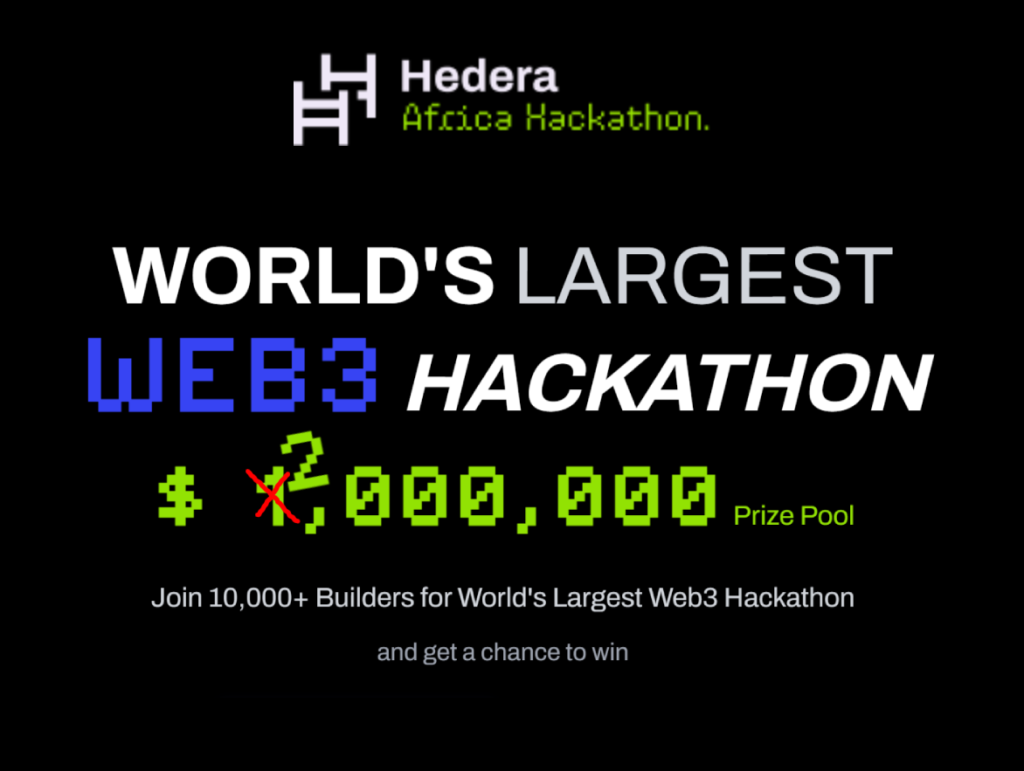
Thus, its funding architecture operates in distinct layers, each serving a different stage of venture maturation:
How the funding stack works (and why this isn’t “just a prize”)
Layer 1: Grants (non-dilutive)—$1M (THA and ESF)
Immediate awards to help teams incorporate, secure basic IP hygiene, and build MVPs.Layer 2: Equity—$1M (Hashgraph Ventures)
Reserved for case-by-case follow-on investments into the most commercially viable teams.Layer 3: Equity—$1M (UGFS North Africa)
A parallel equity pool that can be particularly relevant for teams needing regional market access and tighter compliance support.
Hashgraph Ventures Senior Executive Officer Dara Campbell framed the intent as going “beyond capital” by bringing “the full weight of our global network and strategic partnerships to help founders scale.” That signals “smart capital,” but it also implies more scrutiny. Regulated money typically comes with governance, reporting expectations, and tougher viability filters.
RELATED: Tunisian VC Doubles Hedera Hackathon Prize Pool to $2M
What happened during the Hedera Africa hackathon (timeline and operating model)?
The Hedera Africa Hackathon ran from August 2025 through October 2025, culminating in 803 project submissions from over 11,000 participants.
The event was structured around four problem-focused tracks:
On-Chain Finance & Real-World Assets (RWA): Tokenizing physical assets (land, agricultural commodities, invoices) to unlock credit in capital-starved markets.
DLT for Operations: Using Hedera Guardian to create immutable supply-chain records, critical for African exporters navigating EU sustainability regulations.
AI & Decentralized Physical Infrastructure (DePIN): Incentivizing community-owned infrastructure like solar microgrids or rural connectivity nodes.
Immersive Experiences: Play-to-earn and NFT-based gaming tailored to Africa’s youth demographic.
To address connectivity challenges, organizers deployed physical “Hacking Stations” in over 20 cities, from Lagos and Nairobi to Tunis and Addis Ababa. These were supported by Orange Digital Centers and managed by Dar Blockchain.
The Hashgraph Association engaged over 11,000 developers through its pan-African outreach. Of these registrants, approximately 4,000 developers successfully earned formal certifications, verifying their technical competency in Hedera’s tech stack, including Solidity for EVM compatibility and the Hedera Consensus Service (HCS).
Kamal Youssefi, president of The Hashgraph Association, stated,
“This event became the largest Web3 hackathon globally…. Africa’s developer ecosystem holds immense potential to shape the future of decentralized finance, AI-driven innovation, and digital inclusion.”
The Hashgraph Ventures Africa portfolio criteria involve a few non-negotiables that VC investors often require, such as
demonstrable technical execution (security, reliability, production readiness)
a credible route to distribution (enterprise partners, telcos, aggregators, or clear go-to-market)
compliance posture (especially where payments, data, or tokenized assets are involved)
realistic unit economics (fees, settlement costs, customer acquisition constraints)
Examples of the kind of projects this funding is designed to pull forward
Winners were still being finalized in late November 2025, but organizers highlighted emerging frontrunners that illustrate “deployability”:
Hedgehog
Hedgehog converts physical assets such as real estate, invoices, and commodities into digital tokens on the Hedera network, allowing users to leverage them as collateral for loans. This Real-World Asset (RWA) tokenization approach provides liquidity to African SMEs and individuals whom traditional banking systems typically underserve, effectively addressing the region’s credit gap.
Why Lisk is Betting on JavaScript, Farmers, and Local Heroes
NBX
NBX streamlines cross-border remittances across Africa through a liquidity protocol that leverages Hedera’s high-speed, low-cost infrastructure. The platform bypasses traditional correspondent banking friction—characterized by high fees and lengthy processing times—and enables near-instant settlement for both businesses and individuals engaged in intra-African trade and personal transfers.
Pay-AI
Pay-AI provides specialized infrastructure for AI-agent micro-payments that enables autonomous transactions without human intervention. The platform uses Hedera’s secure consensus service to facilitate instant, sub-cent payments for AI tasks such as data processing, API calls, and content generation, allowing African developers to monetize autonomous agents and create marketplaces where AI services can be exchanged between bots.
NSEChainBridge
NSEChainBridge bridges traditional capital markets with the digital economy through institutional financial infrastructure that integrates with established bodies like national stock exchanges. The platform facilitates the issuance and trading of regulated digital securities while maintaining strict compliance with local financial regulations, enabling institutional investors to participate in the Web3 ecosystem through a secure connection between legacy systems and the Hedera ledger.
Ecosphere Prime
Ecosphere Prime generates verifiable carbon credits and hyperlocal climate intelligence through IoT sensors and blockchain-based verification that tracks environmental data in real-time. The platform provides an immutable audit trail for carbon sequestration efforts, ensuring that carbon credits generated in Africa remain credible, transparent, and attractive to global buyers seeking high-integrity environmental offsets.
RELATED: Blockchain by Committee: NSE’s Role in Hedera’s Global Network
Risks and trade-offs (what could limit impact)
A pledge is not the same as money wired into every winner’s bank account. Key uncertainties include:
The “deployment gap”: going from hackathon code to enterprise-grade software is notoriously difficult. Only a small subset (often single digits) typically reaches fundable traction.
Interoperability and liquidity: While Hedera is EVM-compatible, connecting tokenized assets to deeper liquidity elsewhere can introduce complexity and security risk.
Currency volatility and on/off ramps: business models can break if stablecoin access or fiat rails tighten in key markets.
What this means for builders and teams
If you’re building and want a real shot at the equity pool, treat this like a pre-seed investment process—not a demo contest.
How to use this information:
Use prize grants to reach an MVP with measurable pilots (users, transactions, signed LOIs).
Prepare for regulated diligence: cap table clarity, KYC/AML approach (if relevant), and basic financial controls.
Document technical decisions (threat model, key management, audit plans).
For developers considering how to apply for Hedera Africa Hackathon 2026 funding (should the program continue), several actionable steps emerge:
Obtain Hedera certification through The Hashgraph Association’s training programs. This often aids in building Hedera-powered dApps for Africa.
Focus on compliance-first design: Understand the regulatory requirements in target markets (KYC/AML for fintech, sustainability audits for supply chain).
Build partnerships early: Engage with Orange Digital Centers, Adanian Labs, or other ecosystem partners to demonstrate traction.
Articulate clear unit economics: Show how Hedera’s fixed fee structure ($0.0001 per transaction) enables a sustainable business model.
RELATED: Your Guide to Securing a Cheque from the Lisk Empower Fund
What the pledge changes—and what it doesn’t
The Hashgraph Ventures pledge to the Hedera Africa Hackathon represents more than capital—it is a validation of regulated, infrastructure-focused Web3 innovation in Africa. It increases the odds that a handful of teams can move from prototype to scalable companies—while also raising the bar on governance, compliance, and execution.
The real proof will be visible after the winners’ announcements: which projects secure follow-on equity, how quickly they can pilot in-market, and whether regulated capital helps them ship production systems rather than remain hackathon showcases.
Frequently Asked Questions (FAQ)
What are the primary investment criteria for the Hashgraph Ventures equity pool?
Hashgraph Ventures and UGFS prioritize venture-scale readiness: demonstrable technical execution (security, production-readiness), credible market distribution routes via enterprise or telco partners, clear regulatory compliance posture, and realistic unit economics leveraging Hedera’s low transaction costs.
How do teams apply for the follow-on equity funding?
The $1 million grant pool is awarded to winners announced in January 2026. The $2 million equity pool operates via case-by-case evaluation. Frontrunner teams are invited to formal due diligence requiring pitch materials, growth metrics, and compliance documentation.
Is the $2 million pool a prize or venture investment?
It is structured as regulated equity investment, not non-dilutive grants. Selected teams receive institutional backing and strategic governance but face rigorous scrutiny on financial controls and long-term viability.
Is Hedera certification required for equity eligibility?
Not mandatory, but it’s a significant trust signal. Approximately 4,000 developers were certified during the hackathon’s training phase, and verified competencies help reduce technical risk for investors evaluating Hashgraph Ventures Africa portfolio candidates.
Discover more from Web3Africa
Subscribe to get the latest posts sent to your email.
You must be logged in to post a comment.