










In Brief,
-
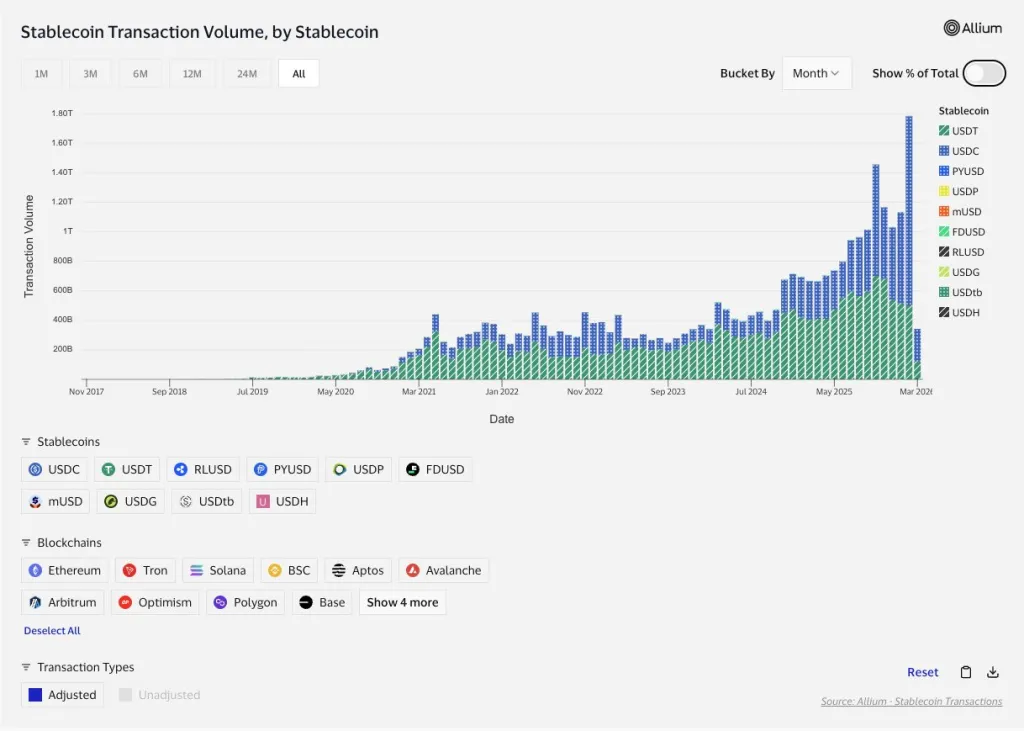
Global Stablecoin transaction volume reached a record $1.8 trillion in February 2026, with USDC settling an unprecedented $1.26 trillion to definitively overtake Tether (USDT) in real-world utility.
-
While USDT maintains a massive lead in market capitalization and retail adoption in informal corridors, USDC is rapidly becoming the backbone for institutional-grade, high-velocity digital payments.
-
Circle’s introduction of NanoPayments and partnerships with African fintech leaders like Yellow Card and Onafriq have firmly positioned USDC as the compliant, regulated digital dollar of choice across the continent
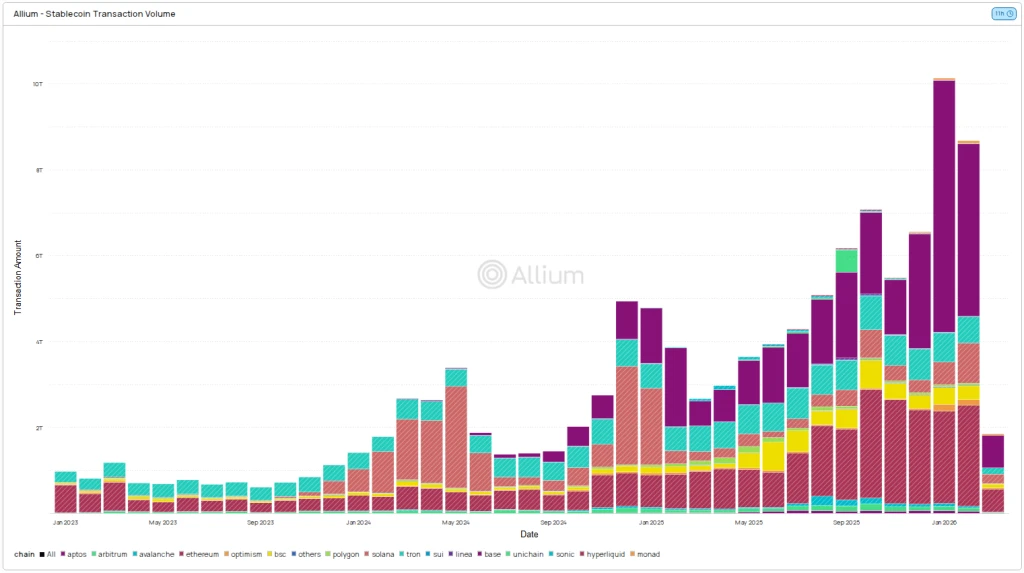
In February 2026, stablecoin transaction volume achieved an unprecedented milestone: $1.8 trillion in adjusted transfer volume globally, according to Allium data analyzed across multiple sources. Yet beyond this aggregate figure lies a more significant structural shift: USDC processed approximately $1.26 trillion, eclipsing Tether (USDT)’s $514 billion by more than a factor of two.
This marked the first sustained period where USDC surpassed USDT in transfer volume, with Simon Dedic, founder of Moonrock Capital, noting that USDC had “consistently flipped” Tether over several preceding months.
USDC Overtakes Tether as Stablecoin Transaction Volume Hits Record $1.26 Trillion
While Tether still commands roughly $184 billion in market capitalization, USDC’s $74.5 billion to $77.4 billion provides an eye-opener for most. An asset with less than half the circulating supply is settling more than double the economic value. This decoupling reveals that USDC is rapidly evolving into high-velocity, institutional-grade payment infrastructure, while USDT maintains its role as a store of value and medium of exchange in informal, retail-heavy corridors.
This bifurcation is particularly evident across the African continent, where stablecoins have gained widespread adoption. This is especially true after it accounted for 43% of all digital asset transaction volume in Sub-Saharan Africa. Today it’s an everyday financial infrastructure powering cross-border commerce, remittances, payroll, and USD-denominated savings in inflation-ravaged economies.
Why the Data Matters: Adjusted Volume vs. Raw Blockchain Noise
The $1.8 trillion figure represents “adjusted” or “organic” transfer volume, not raw blockchain throughput. Analytics providers like Allium, partnering with Visa, utilize advanced filtering heuristics to strip out automated market maker (AMM) churn, decentralized finance (DeFi) flash loans, maximal extractable value (MEV) bots, and wash trading.
As Visa’s public Onchain Analytics dashboard emphasizes, the goal is “separating signal from noise” and adjusting for bots and inflationary practices.
While USDT functions largely as digital cash held in dormant wallets, USDC circulates programmatically across commercial APIs. Citi research models indicate global stablecoin velocity accelerated from 60x in 2023 to over 113x in 2024, with institutional payments pushing this even higher into 2026.
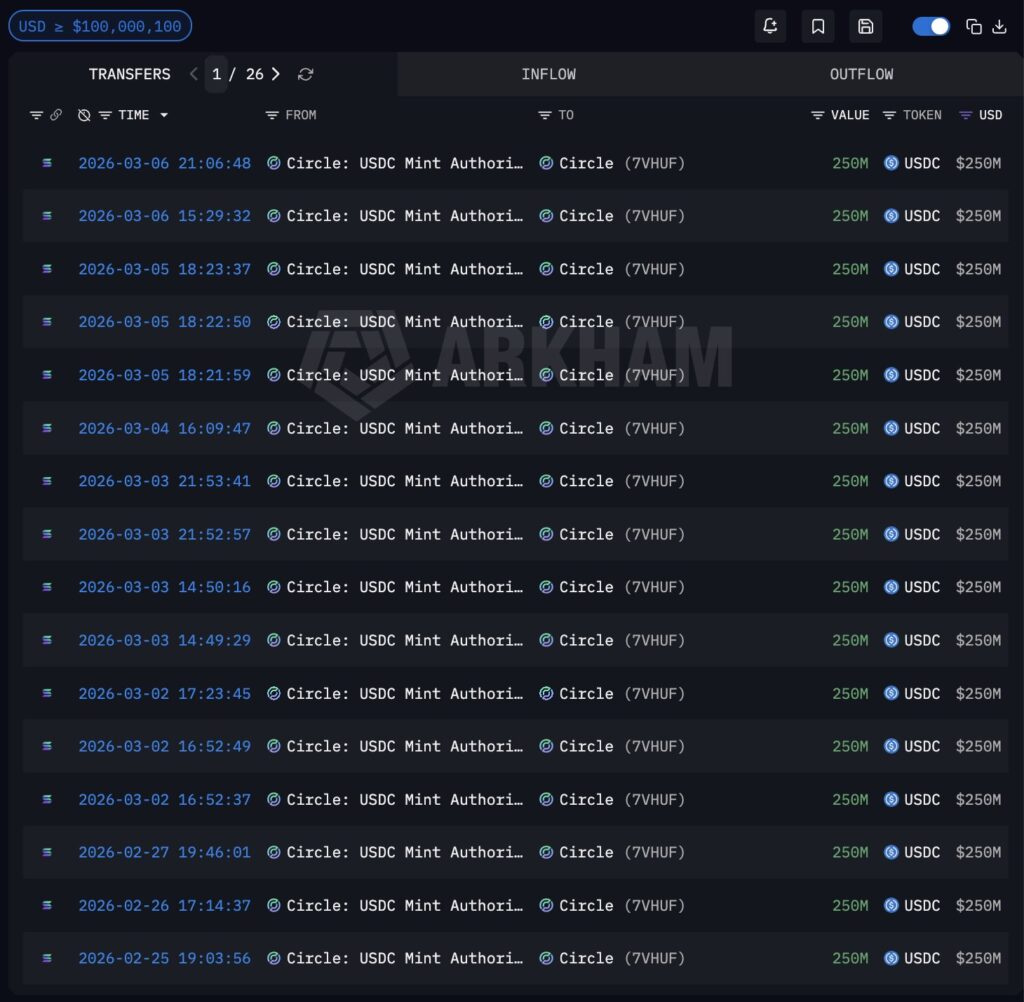
In the first week of March 2026 alone, Circle minted over $3 billion in new USDC supply, which aggressively expanded USDC’s market cap, resulting in a 72% year-over-year growth by Q4 2025.
The Big Question: Why Institutions Choose USDC
USDC’s ascendance in stablecoin transaction volume is directly tied to three structural advantages:
Stronger compliance posture and reserve transparency.
Circle aligns with emerging “regulated stablecoin” frameworks globally, including the EU’s Markets in Crypto-Assets (MiCA) regulation and the U.S. GENIUS Act. USDC reserves emphasize cash and short-duration government securities with regular reporting via BlackRock and BNY Mellon.
RELATED: Turning Prepaid Airtime Into USDC: What Fonbnk Built on Avalanche
This satisfies rigorous due diligence requirements for compliance teams executing transaction monitoring, ensuring that all transactions involving USDC are transparent and adhere to the standards set by regulatory frameworks. As Dr. Elena Rodriguez, senior blockchain economist at the Cambridge Digital Assets Program, observed:
“The dramatic shift toward USDC reflects deeper market maturation. Institutional participants increasingly prioritize regulatory compliance and transparency.”
Deeper integration with regulated payment rails.
In December 2025, Visa launched USDC settlement in the United States, allowing partners to move funds 24/7 with enhanced operational resilience. USDC maintains a stable value. Nikhil Chandhok, Circle’s Chief Product and Technology Officer, characterized this as “internet native money moving.”
In June 2025, Visa partnered with Yellow Card, merging traditional card-network liquidity with African stablecoin infrastructure across 20 nations. Corporate payment processor Corpay integrated USDC into global FX (foreign exchange) and commercial card rails in August 2025, channeling more B2B (business-to-business) treasury settlement through USDC rather than USDT.
Africa’s Fintech Trifecta: Circle, Flutterwave & Yellow Card Join Forces
Product-layer innovation enabling micropayments.
Circle’s introduction of NanoPayments enables gasless USDC transfers via bundled, batched settlement, facilitating payments as small as $0.000001. Built on the open x402 payment protocol, NanoPayments abstracts blockchain consensus from end-users.
Blessing Adesiji, Circle’s Development Relations Manager (EMEA), explained the necessity:
“Charging $0.01 for an API call [using traditional models] has been difficult to implement on blockchains because transaction fees can quickly outweigh the value of the payment itself.”
USDC nanopayments use cases unlock the “agentic economy,” allowing autonomous AI agents to transact at high frequencies. Thus, micro-purchases for compute power, bandwidth, or granular data access can be executed without human intervention.
Africa: The Primary Proving Ground for Real-World Stablecoin Utility
Now, we’ve all heard the facts: Africa has achieved over $205 billion in on-chain value, experienced a 52% year-over-year growth, and over 8% of all value transferred consisted of retail-sized transactions under $10,000.
In a nutshell, stablecoins are a safe haven for many traders, retail workers, and institutions. When compared to other continents, Sub-Saharan Africa has one of the most expensive border remittances, with traditional platforms charging average fees exceeding 7.9% to 8.46%.
The African Export-Import Bank estimates over 80% of intra-African transactions are processed via correspondent banks outside the continent, incurring $5 billion annually in fees. Foreign exchange illiquidity and chronic local currency devaluations have catalyzed massive flight to dollar-denominated digital assets, as individuals and businesses seek stability and protection against inflation in their local economies.
Where USDC Still Wins in Africa
Nigeria remains Africa’s undisputed cryptocurrency epicenter, still reigning supreme with its $92.1 billion on-chain value, accounting for 45% of Sub-Saharan Africa’s total between mid-2024 and mid-2025.
Chainalysis explicitly ties Nigerian stablecoin demand to Naira devaluation, inflation, and restricted USD access. According to Artemis data, while USDT remains primary continent-wide, USDC has gained notable traction in Nigeria. This demand is mainly through regulated platforms like Busha and Quidax, both licensed under the Nigerian SEC’s Investment and Securities Act (ISA) 2025.
South Africa occupies the continent’s most institutionally mature position, recording approximately $35 billion in transaction volume. The Financial Sector Conduct Authority (FSCA) licensed 75 Crypto Asset Service Providers (CASPs) by April 2025, enforcing stringent AML/CFT protocols under FICA. Artemis data shows USDC, a type of stablecoin pegged to the US dollar, has gained notable traction in South Africa, where professional-sized transactions dominate, unlike the retail-heavy profile of West and East Africa.
Kenya ranks fifth globally for transactional use of stablecoins, leveraging its mobile-money dominance through M-Pesa’s 34 million users. The Virtual Asset Service Providers (VASP) Bill, passed in late 2025, established a dual-regulatory structure to solidify its growing crypto economy. Artemis data indicates Ethereum sees more use in Kenya compared to Tron’s dominance in North/West Africa, consistent with more structured fintech rails. In Kenya and Nigeria, users often acquire USDT (Tether) or USDC (USD Coin) via regulated fintechs and peer-to-peer (P2P) platforms, then cash out through bank and mobile money rails.
North Africa (Egypt) exhibits substantial adoption despite official bans, with Morocco ranking 20th globally and Egypt 24th globally for crypto adoption. Artemis confirms Tron leads in North and West African markets, with USDT remaining primary in informal P2P corridors driven by capital-control evasion and inflation hedging.
However, Circle and Onafriq’s pilot to reduce cross-border costs using USDC across a network spanning 40+ countries represents the structured, compliant alternative gaining ground, as it aims to provide a more stable and regulated means of conducting transactions compared to the informal P2P corridors dominated by USDT.
Circle Gateway Arrives on Mainnet with Blockradar as Day 1 Partner
Mapping USDC’s African Expansion: 2024–2026
Circle’s deliberate push into Africa proceeded through strategic partnerships:
- April 2025: Circle launched the Circle Payments Network (CPN), a structured FI-to-FI cross-border settlement channel.
- April 2025: Circle partnered with Onafriq to pilot USDC settlement across 40+ African countries, embedding digital dollar rails into local payment ecosystems.
- May 2025: CPN connected Circle directly with Flutterwave, Yellow Card, and Onafriq via off-chain APIs and smart contracts, drastically reducing institutional reliance on correspondent banks.
- June 2025: Visa partnered with Yellow Card, facilitating smoother fiat on/off ramps across 20 African nations.
- December 2025: Stable partnered with Chipper Cash, implementing StableChain infrastructure across Chipper’s 7 million users in nine countries, driving low-cost, near-instant remittance architecture.
The Bifurcation: Where USDC Wins vs. Where USDT Wins
USDT dominates informal retail and P2P-heavy corridors. Its entrenchment is driven by historical liquidity, ubiquitous exchange pairs, and low Tron network fees. In markets bypassing capital controls or hedging hyperinflation, users prioritize accessibility over regulatory transparency. Anthony Yim, Co-founder of Artemis, noted:
“USDT is mainly used for everyday transactions, business operations, or as a store of value.”
USDC captures structured fintech and compliant corridors. For licensed entities like Yellow Card or Flutterwave operating across dozens of African jurisdictions, compliance is foundational. When global payment giants like Visa or Mastercard partner with African platforms, the underlying rail is increasingly USDC. Annual DeFi data for 2025 shows USDC transferred $17.3 trillion in value versus USDT’s $12.9 trillion, reflecting USDC’s dominance in automated lending and trading.
The Bigger Signal Behind February’s Stablecoin Transaction Volume
The stablecoin liquidity trends reflect genuine demand for functional payment infrastructure. Jeremy Allaire, Circle’s CEO, described the vision as “moving money like sending an email.” Lasbery Chioma Oludimu, VP Global Operations and MD of Yellow Card Nigeria, framed stablecoins as “crucial for financial inclusion and economic empowerment.”
As regulatory clarity expands, through Nigeria’s ISA 2025, Kenya’s VASP Bill, South Africa’s FSCA licensing, and Ghana’s 2026 framework, USDC is becoming the preferred settlement layer for compliant, high-frequency, low-cost transactions.
Discover more from Web3Africa
Subscribe to get the latest posts sent to your email.
You must be logged in to post a comment.